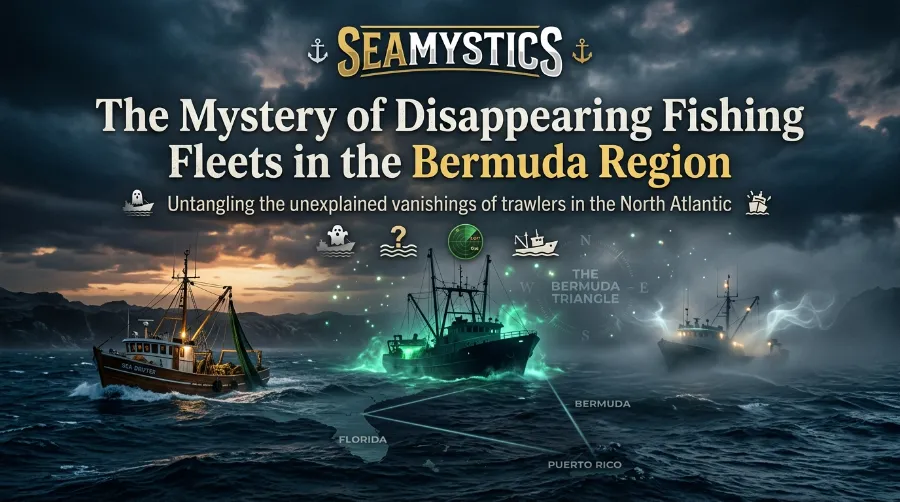

Fishermen off Bermuda have a saying. The sea gives, and sometimes it just keeps. Every year, a handful of boats leave harbor under clear skies. They never radio back in. For decades, people blamed sea monsters or magnetic anomalies. The truth behind disappearing fishing fleets is stranger in a different way. It involves satellites, missing radio signals, and an industry that watches less of the ocean than most people assume.
Underwater Volcano Eruptions The Eruptions Happening Right Now Beneath the Waves
This is not a ghost story, though it borrows that eerie tone. It looks at what actually happens when boats vanish near Bermuda. It covers what the global data says about vessels that go dark on purpose. And it explains why so much of the world’s fishing activity stays invisible, even to the agencies meant to track it.
TL;DR: Fishing boats near Bermuda do disappear. Most cases trace back to sudden storms, engine failure, or vessels that switch off their tracking systems on purpose, not to anything paranormal. A 2024 Global Fishing Watch study in Nature found that roughly 75 percent of the world’s industrial fishing vessels stay invisible to public tracking. That gap explains why so many losses near Bermuda still read as unsolved. Satellite radar and AI detection are finally closing it.
Key Takeaways
| Topic | What the Research Shows |
|---|---|
| Bermuda Triangle disappearances | Over 50 ships and 20 aircraft reported missing since record-keeping began; most have ordinary explanations |
| Untracked global fishing vessels | About 75 percent of industrial fishing vessels stay off public tracking systems (Global Fishing Watch, Nature, 2024) |
| Global fleet size in 2024 | Roughly 4.7 million vessels worldwide, down from a 2012 peak of 5.2 million |
| Ghost nets | An estimated 640,000 tonnes of fishing gear get lost or abandoned in the ocean each year |
| Pandemic-era fishing drop | Global fishing activity fell about 12 percent in 2020 and had not fully recovered by 2021 |
| Detection technology | Sentinel-1 radar plus AI reached over 97 percent accuracy in spotting untracked vessels |
What People Mean by Disappearing Fishing Fleets
People searching for disappearing fishing fleets usually mean one of two things. The first question is folkloric. Why do boats vanish near Bermuda without a trace? The second question is practical. Why do entire fleets seem to shrink or go quiet in certain regions over time? Both questions have real answers, and they connect more closely than most articles admit.
The Folklore Side
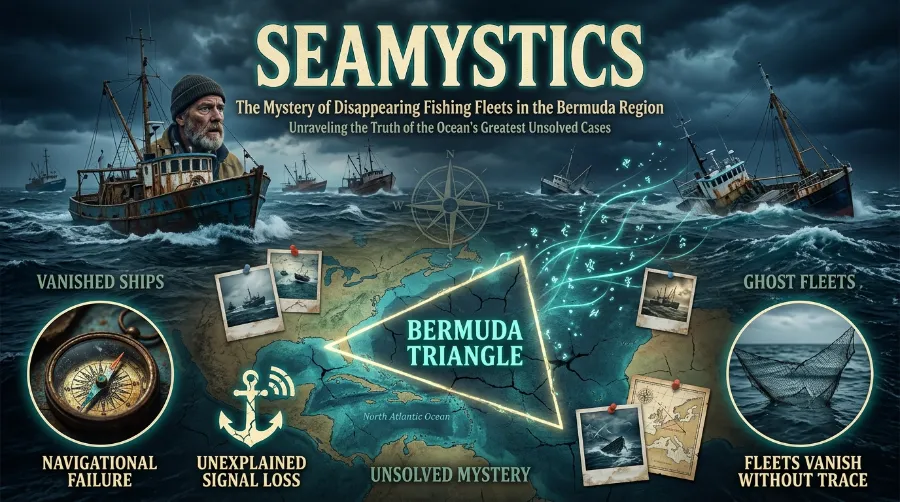
The Bermuda Triangle has a documented reputation. Since record-keeping began, people have reported more than 50 ships and 20 aircraft missing. This happened across the roughly 500,000 square mile stretch of Atlantic bounded by Miami, Bermuda, and Puerto Rico. The most famous case remains the USS Cyclops. This 542-foot Navy cargo ship vanished in March 1918 with 306 crew aboard. Nobody ever found wreckage. No distress call ever came through.
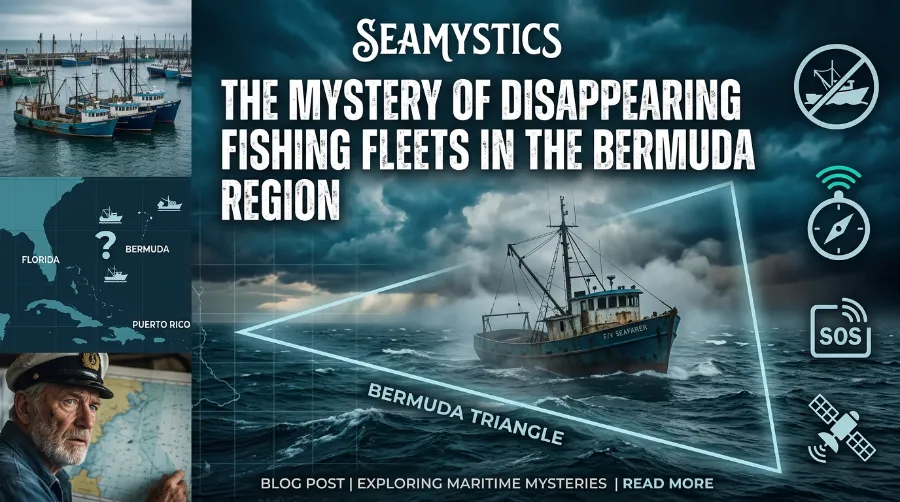
The Mystery of Disappearing Fishing Fleets in the Bermuda Region
The Practical Side
Fishing fleets really are shrinking or going dark in measurable ways worldwide. Bermuda’s waters sit inside that larger pattern. The world’s fishing fleet stood at about 4.7 million vessels in 2024. That is down from a documented peak of 5.2 million in 2012, according to the UN Food and Agriculture Organization. The decline itself is not mysterious on paper. Yet the reasons behind individual boat losses often stay unresolved for years.
The Bermuda Fishing Mystery: Separating Legend From Data
People have retold the Bermuda fishing mystery so many times that fact and fiction now blur together. Reporters in the 1950s ran stories about strange plane and boat losses off Florida and the Bahamas. Writer Vincent Gaddis coined the phrase Bermuda Triangle in a 1964 magazine article. From there, the legend grew faster than the evidence supporting it.
Here is what tends to actually happen when a small fishing vessel vanishes near Bermuda.
- Sudden squalls form quickly and can capsize small craft before a crew can radio for help.
- Engine or hull failure leaves a boat drifting silently, often outside radio range.
- Strong currents, including parts of the Gulf Stream, carry wreckage hundreds of miles from its last known position.
- In rare but documented cases, a crew deliberately switches off tracking equipment, a practice investigators call going dark.
Take the July 2015 case of two Florida teenagers, Austin Stephanos and Perry Cohen. They set out on a 19-foot boat for a fishing trip and never returned. Searchers found their capsized boat eight months later, roughly 100 miles off the Bermuda coast. The Coast Guard search covered over 15,000 square nautical miles, one of the largest in US history. No monster took that boat. Weather and distance did.
Not every case gets solved this cleanly. Investigators and marine researchers increasingly point to a less romantic but far more consequential explanation for lost fishing vessels worldwide. A huge share of the global fleet simply goes unwatched in the first place.
Missing Boats in Ocean Waters: What the Global Data Shows
This is the part most Bermuda Triangle articles skip. It is also where the real story gets interesting. In 2024, Global Fishing Watch published a landmark study in the journal Nature. Researchers combined satellite radar imagery from the European Space Agency’s Sentinel-1 constellation with AI models. The finding was blunt. Roughly 75 percent of the world’s industrial fishing vessels do not appear on any public monitoring system.
That is not a rounding error. For every boat visible on a public map, about three more operate somewhere at sea, unseen by anyone outside the vessel itself. Researchers call this the dark fleet.
The Numbers Behind the Dark Fleet
A few figures put this into perspective.
- Global fishing activity dropped by about 12 percent at the start of the COVID-19 pandemic in 2020. It still had not fully recovered by 2021.
- Between 21 and 30 percent of transport and energy vessel activity also stays missing from public tracking systems, so this is not a fishing-only problem.
- Researchers processed roughly two petabytes of satellite imagery. They reached over 97 percent accuracy in detecting vessels, with about 90 percent accuracy in telling fishing boats apart from other ship types.
So when a fishing boat off Bermuda, or off Argentina, or off West Africa stops appearing, a cosmic anomaly rarely explains it. More likely, that boat never broadcast its position in a way anyone could see. Oceana’s research into vessels vanishing along Argentina’s waters documented hundreds of foreign fishing boats that switched off tracking signals near the edge of Argentina’s exclusive economic zone. Crews use that tactic to fish undetected in protected or restricted waters. Investigators suspect similar behavior in parts of the North Atlantic, including waters near Bermuda’s fishing grounds.
A Short History of Fleet Disappearance Off Bermuda
The fleet disappearance history around Bermuda actually predates modern shipping by centuries. Christopher Columbus’s crew reported strange lights and compass irregularities passing through the region as early as the 1490s. Nobody called it a triangle back then. But the pattern most people associate with fishing losses is more recent.
- 1918: The USS Cyclops disappears with 306 people aboard, still the largest loss of life in US Navy history unrelated to combat.
- 1945: Flight 19, five Navy torpedo bombers, vanishes during a routine training flight and feeds decades of speculation.
- 1950s: Newspapers, including the Miami Herald, begin running regular stories on boat and plane losses near Florida and the Bahamas.
- 2003: A couple, Frank and Romina Leone, disappear on a new 16-foot boat off Boynton Beach. The Coast Guard searches more than 35,000 square miles.
- 2015: Two teenagers vanish on a fishing trip. Searchers later find their capsized boat near Bermuda, as noted earlier.
- 2020: A cargo vessel and its 20-person crew disappear in the wider Triangle region. Nobody recovers any wreckage.
Skeptics, including Britannica’s own assessment, note something important here. The disappearance rate in the Bermuda Triangle is not statistically higher than in other heavily trafficked ocean corridors, once insurance data and shipping volume enter the picture. The area simply sees more traffic, more storms, and more small recreational and fishing vessels than most comparable stretches of ocean. That alone produces more incidents.
Ghost Nets: The Silent Killers Drifting Through the Deep Ocean
Not every disappearance involves a boat at all. Some of the ocean’s most persistent hazards are the fishing gear that fleets leave behind and never retrieve. People call this gear ghost nets, and it forms one of the quieter threads connecting Bermuda’s fishing mystery to a much bigger global problem.
Roughly 640,000 tonnes of fishing gear, including nets, lines, traps, and cages, get lost or abandoned in the ocean every year. Once adrift, a single net can keep catching fish, turtles, and even seabirds for years. Scientists grimly call this process ghost fishing. Some of these nets eventually snag on reefs near Bermuda. There, they keep killing marine life long after the crew that lost them has gone home.
This topic deserves its own deep dive, so we cover the science of drifting gear and its ecological toll in our piece on ghost fishing nets. It pairs well with this article, because both come back to the same root cause: fleets and gear that operate with almost no oversight once they leave port.
Why Fleets Go Dark: The Real Drivers Behind the Mystery
Rarely does one single reason explain why a fishing fleet disappears from view. Researchers and maritime investigators generally point to a mix of factors.
Human Choices
- Deliberate AIS disabling. Crews sometimes switch off their Automatic Identification System to fish illegally in protected waters or dodge quota enforcement. Global Fishing Watch documents this tactic in its annual reporting.
- Economic pressure. As fish stocks decline in traditional grounds, some operators push into riskier, less monitored waters. This raises both danger and the odds of going undetected.
- Regulatory gaps. Many countries still rely on vessel monitoring systems that stay proprietary and unshared. That gap kept the dark fleet hidden for years.
Natural Forces
- Weather. Sudden Atlantic storms remain the most common cause of small-boat losses near Bermuda specifically.
- Mechanical failure. Aging engines and worn hulls fail without warning, often far from help.
- Ocean physics. Deep-sea pressure changes, sudden temperature gradients, and strong subsurface currents all affect how debris travels after an incident. This is part of why so few Bermuda cases produce recoverable evidence.
We cover this physical side of the ocean in more depth in our guide to deep sea pressure. It offers useful background on why wreckage from a lost boat can end up hundreds of miles from where it actually went down.
Global Fishing Fleet Trend, 1996 to 2024
The chart below shows the estimated size of the world fishing fleet over time, based on FAO fishery statistics. Notice the 2012 peak, the sharp COVID-era drop, and the gradual decline that continues today.
The fleet grew for years, then peaked in 2012. A steady decline followed, and COVID accelerated it. That downward trend forms the backdrop against which people now read every individual Bermuda disappearance, fairly or not, as part of a bigger mystery.
What Trackers and Regulators Are Doing About It
The good news: the technology gap behind so many missing-boat cases is finally closing. A few efforts stand out.
- Global Fishing Watch now publishes free, public maps that combine AIS, satellite radar, and AI vessel classification. Researchers and journalists can spot dark fleet activity in near real time.
- Costa Rica used this data in 2024 to document a marked drop in illegal fishing around Cocos Island National Park after ramping up monitoring.
- Papua New Guinea’s fishery authorities used the same tools to identify 22 suspected AIS disabling events on a single vessel. They later confirmed violations.
- Oceana continues publishing region-specific reports, including its investigation into vessels vanishing along Argentina’s waters. That pattern mirrors what investigators now watch for near Bermuda.
None of this fully explains every historic Bermuda case. Some, like the USS Cyclops, occurred long before satellites existed and will likely stay unsolved forever. But for the modern wave of lost fishing vessels, the tools to find answers finally exist. Political will and funding to use them consistently still lag behind.
Frequently Asked Questions
Is the Bermuda Triangle really more dangerous for fishing boats than other waters?
Not statistically, once traffic volume enters the picture. The region hosts a high concentration of small recreational and fishing vessels combined with unpredictable Atlantic weather. That combination produces more incidents in absolute numbers, not a higher rate per boat.
What percentage of fishing vessels worldwide are untracked?
About 75 percent of the world’s industrial fishing vessels do not appear on public tracking systems. This comes from the 2024 Global Fishing Watch study published in Nature.
Do ghost nets contribute to boats being reported missing?
Indirectly, yes. Drifting nets can foul propellers or rudders on smaller boats. Gear left behind by a lost vessel sometimes becomes part of the same ghost fishing problem affecting reefs near Bermuda.
Can satellite technology actually find these missing fleets?
Increasingly, yes. Sentinel-1 radar combined with AI detection reached over 97 percent accuracy in spotting vessels at sea, even ones that broadcast no public signal.
Why did the Bermuda Triangle stop making headlines?
Interest faded for two reasons. Skeptical research through the 1970s and 1980s showed disappearance rates were not unusual for the traffic volume. And modern satellite phones, GPS, and emergency beacons have made true unexplained losses far rarer than before.
Conclusion
The mystery of disappearing fishing fleets near Bermuda turns out to be two stories folded into one. There is the old legend, built on real losses like the USS Cyclops and Flight 19, that made this stretch of ocean famous for the wrong reasons. And there is a newer, quieter story. A global fishing industry lets three out of every four boats operate outside anyone’s view, a fact that had nothing to do with folklore until researchers proved it with satellites in 2024. Bermuda’s waters did not become less mysterious once that data arrived. If anything, they became a clearer example of a problem playing out across every ocean on the planet, one where the real ghosts are the vessels we simply never learned to see.
If you want to go deeper on the myths that shaped this region’s reputation long before satellites existed, our piece on the Kraken myth’s origins traces how sailors explained the unexplainable for centuries. Our breakdown of the Charybdis whirlpool legend covers a similar case from ancient Greek waters. For the bigger picture on how ocean mysteries connect across regions, start at our deep sea pressure pillar guide.
References
- Global Fishing Watch, Annual Report 2024, globalfishingwatch.org
- FAO, World Fishing Fleet Statistics, openknowledge.fao.org
- Paolo et al., “Satellite mapping reveals extensive industrial activity at sea,” Nature, 2024
- Smithsonian Magazine, Satellite Maps Reveal Rampant Fishing by Untracked Vessels
- Oceana, Vessels Vanishing Along Argentina’s Waters
- Regeneration.org, Global Fishing Fleets
- Go To Bermuda, The Legends and Lore of the Bermuda Triangle
- LoveToKnow, Disappearances That Give the Bermuda Triangle Its Notorious Rep