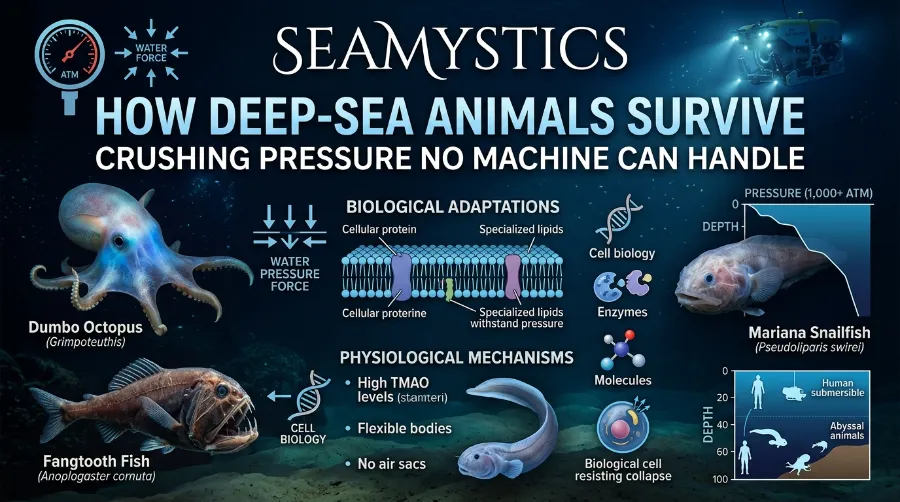

Eleven kilometers down, in the blackest trench on Earth, the water pushes on every square inch of a small pink fish. The force is strong enough to flatten a steel submarine hull like a soda can. Yet the fish barely reacts. It swims. It hunts. It goes about its day. This is the everyday reality of deep sea pressure, and it is one of the strangest survival stories in biology.
Megamouth Shark Sightings The Rare Giant Almost No One Has Seen
I’ve spent two decades studying marine life, and one question comes up more than any other: how is this even possible? So let’s actually answer it.
TL;DR: Deep-sea animals survive crushing pressure because they simply don’t fight it. Their bodies skip the air-filled spaces that make pressure dangerous in the first place, and their cells rely on special molecules that keep proteins stable under extreme load. A rigid, air-filled submarine buckles under that pressure. A soft, fluid-filled animal lets it pass right through. That one design difference explains almost everything below.
Key Takeaways
| Fact | What It Means |
|---|---|
| Pressure rises roughly 1 atmosphere every 10 meters | By 1,000 meters, animals face about 100 times surface pressure |
| The Mariana Trench floor sits near 1,100 times surface pressure | Comparable to eight tons pressing on every square inch |
| Deep-sea animals lack rigid, gas-filled spaces | Water pressure has nothing left to crush |
| A molecule called TMAO stabilizes proteins under pressure | Identified by University of Leeds researchers in deep ocean pressure science |
| Cuvier’s beaked whales dive past 2,992 meters | Their lungs collapse on purpose, as a feature, not a failure |
| Over 1,100 new marine species were logged in a single recent year | Most came from depths humans still can’t reach unaided |
What Deep Sea Pressure Actually Feels Like
At sea level, you carry about 15 pounds per square inch of atmospheric pressure without ever noticing it. That’s because your body evolved for exactly that load. Step into the ocean, though, and everything changes fast. Every 33 feet, or roughly 10 meters, adds another full atmosphere on top of what you’re already carrying. As Scuba Diving magazine points out, most recreational divers never go past 100 feet, so this math rarely feels real to them.
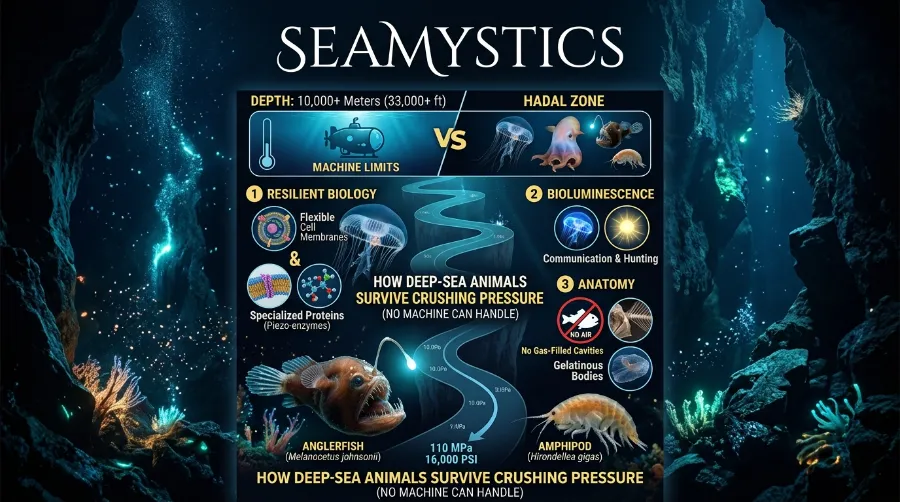
Now stretch it further. At 1,000 meters, you’re under roughly 100 atmospheres. At the bottom of the Mariana Trench, nearly 11,000 meters down, researchers at the University of Leeds calculated the pressure at 1.1 kbar. In practical terms, that’s about eight tons bearing down on every square inch. That’s over a thousand times what you feel standing on a beach.
Underwater Waterfalls The Illusion That Fools Cameras Every Time
Here’s the part that surprises most people. This pressure doesn’t squeeze from one direction, the way a hydraulic press squeezes a block of wood. Instead, it comes from every angle at once, evenly, on all sides. Biologist Mackenzie Gerringer, who studies hadal fish, makes an important point here: deep-sea organisms don’t need armor like a submarine hull, because the danger of pressure isn’t really about strength. It’s about what’s inside the body that pressure can actually act on.
Underwater Volcano Eruptions The Eruptions Happening Right Now Beneath the Waves
Pressure Adaptation Animals: The Biology That Makes the Impossible Ordinary
Pressure adaptation animals aren’t just tougher versions of shallow-water species. In fact, they’re built on a completely different blueprint, one that removes the problem instead of fighting it. Three mechanisms do most of the work.
Ghost Nets The Silent Killers Drifting Through the Deep Ocean
The Air Problem
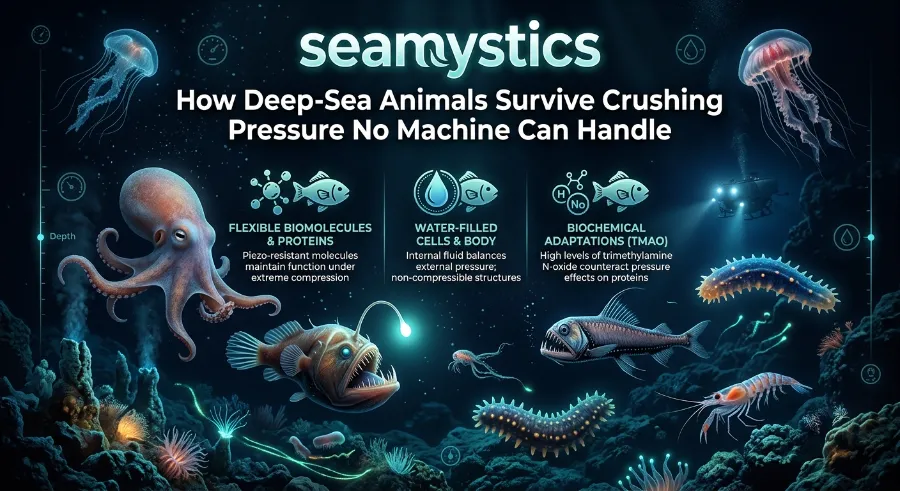
Gas compresses under pressure, but liquid essentially doesn’t. So a fish with a gas-filled swim bladder at 3,000 meters would find that bladder crushed almost flat. That’s exactly why most deep-sea fish skip the swim bladder entirely. Instead, as the American Museum of Natural History’s deep-sea vents research explains, many species control buoyancy with fatty, oil-rich livers or low-density, cartilage-heavy skeletons. Neither one relies on trapped air.
The Protein Problem
Every cell in every living thing depends on proteins folding into precise shapes to work correctly. High pressure distorts the structure of water itself, and that distortion can force proteins to unfold and stop functioning. However, University of Leeds researchers led by Dr. Laurent identified a compound called TMAO, or trimethylamine N-oxide, that acts almost like scaffolding inside deep-sea cells. It holds water structure together, so proteins stay folded even at extreme depth. The team even built an osmolyte protection ratio, a formula that predicts how much TMAO a species needs at a given depth. It’s one of the clearest wins in modern deep ocean pressure science.
The Mystery of Disappearing Fishing Fleets in the Bermuda Region
The Membrane Problem
Cell membranes need a certain fluidity to function properly, and pressure stiffens them much the way cold does. To compensate, deep-sea organisms pack their membranes with different fatty acids. As a result, those membranes stay flexible under conditions that would turn a shallow-water membrane rigid.
Kraken Myth Origins What Sea Monster Legends Got Right
A few concrete numbers help this land. The Pseudoliparis snailfish has been recorded living below 8,000 meters, deeper than almost any other vertebrate on record. Meanwhile, deep-sea hydrothermal vent crustaceans, first discovered by humans in 1977, show thermal and pressure resistance roughly 2.8 times higher than closely related coastal species. Even bacteria join in: a single strain called Shewanella eurypsychrophilus YLB-09 completely rewires its energy metabolism under pressure, switching its main respiration pathway to survive conditions that would stop most microbes cold.
The Charybdis Whirlpool Legend and the Real Whirlpools of the Strait of Messina
How Deep Sea Survives: Real Animals, Real Depths
Textbooks can make this feel abstract, so let’s ground it in specific creatures instead.
- Cuvier’s beaked whales dive as deep as 2,992 meters and have been tracked holding their breath for over two hours. Their lungs deliberately collapse under pressure. As a result, air moves out of the lungs and into the bloodstream and muscle tissue, where extra myoglobin and hemoglobin store the oxygen they need.
- Sperm whales, tracked with sonar and time-depth recorders, routinely dive between 1,500 and 3,000 feet. Some have even been measured at 6,000 feet, more than a mile down, while hunting squid.
- Elephant seals can hold their breath underwater for roughly two hours, a close rival to the beaked whale’s record.
- Hadal snailfish take a simpler approach: they exhale nearly 90 percent of the air in their lungs before diving, keeping only about 10 percent in reserve. That way, pressure has almost nothing left to act on.
Some deep divers also slow their own metabolism dramatically. Heart rates in a few species drop to around four beats per minute during a dive. Movement, too, shrinks to the bare minimum needed to hunt or hide. In short, it’s less about fighting the pressure and more about getting out of its way.
Why No Machine Can Match a Deep-Sea Body
A steel submarine hull is rigid and full of air. Unfortunately, that’s exactly the combination pressure punishes hardest. Engineers spend enormous budgets building hulls thick enough to resist collapse, and even then, most teams trust the deepest dives to uncrewed vehicles rather than crewed ones, simply because the margin for error is so small.
Ocean Whirlpools Explained The Truth Behind Maelstrom Legends
Living tissue solves the same problem for free, through evolution rather than engineering. A soft-bodied, fluid-filled animal has almost nothing rigid for pressure to crush, and no trapped air for pressure to compress. That’s the entire secret, stripped of jargon: remove the vulnerable parts instead of trying to armor them.
This is also why deep-sea exploration increasingly leans on remotely operated vehicles for routine work. Organizations like OceanX run ROV-based expeditions specifically because uncrewed systems handle depths and durations that would be riskier, and far more expensive, for a human crew. Even so, these machines are engineering marvels built to survive conditions that deep-sea animals shrug off using nothing more than fat, cartilage, and a molecule called TMAO.
New Discoveries Keep Rewriting the Rules
Fresh Finds From Recent Expeditions
Deep ocean pressure science isn’t a settled field. It’s moving fast. In a single recent year, the Ocean Census initiative documented over 1,100 new marine species. Most came from depths that remain functionally unreachable by humans without heavy equipment. Meanwhile, a 2026 expedition off the Argentine coast found such dense biodiversity around one cold seep that the expedition’s chief scientist admitted the team was caught off guard by how much life was packed into the region.
What These Discoveries Reveal
Elsewhere, researchers working the Clarion-Clipperton Zone in the Pacific described 24 new species of amphipods in early 2026, including an entirely new superfamily. That’s a genuinely rare classification event in modern taxonomy. Around the same period, Pacific ridge expeditions turned up spiky squat lobsters, translucent glass squids, and walking fish, all thriving at depths and pressures that would be lethal to an unprotected human within moments. Every one of these finds adds another data point to the same underlying story: pressure adaptation animals are far more varied, and far more common, than the historical record suggested. Clearly, we’re still mapping the edges of what deep sea life can tolerate.
A Quick Look at the Numbers
| Depth | Approx. Pressure (atmospheres) | What Lives There |
|---|---|---|
| 30 m (100 ft) | ~4 | Recreational diving limit |
| 1,000 m | ~100 | Sperm whales, giant squid |
| 3,000 m | ~300 | Beaked whales, deep-sea corals |
| 8,000 m | ~800 | Hadal snailfish |
| 10,900 m (Challenger Deep) | ~1,100 | Amphipods, microbial mats |
Frequently Asked Questions
Does deep sea pressure actually hurt the animals that live there?
No, not the animals that evolved for it. Pressure only becomes dangerous when it acts on rigid structures or trapped gas, and pressure-adapted animals simply don’t have either.
Could a human survive at those depths with the right equipment?
Not unprotected, and not for long. Human lungs, sinuses, and joints all contain gas pockets that would be catastrophically compressed. That’s why even trained divers rarely descend past a few hundred feet without a pressurized vehicle.
Why do submarines need such thick hulls if animals don’t?
Because submarines are rigid and hollow, filled with breathable air at roughly surface pressure. That combination creates exactly the pressure differential that crushes things. Animals avoid it entirely by staying flexible and largely gas-free.
What is the deepest a fish has ever been recorded?
Just over 8,000 meters, held by a hadal snailfish. That makes it one of the deepest-living vertebrates ever documented.
Is deep ocean pressure science still discovering new adaptations?
Yes, absolutely. Researchers keep uncovering new details in TMAO chemistry, membrane composition, and protein compressibility. On top of that, new expeditions keep adding species and mechanisms scientists hadn’t previously catalogued.
Conclusion
Deep sea pressure is one of the most punishing forces on the planet. It can fold steel and stop human physiology within seconds. Yet an entire ecosystem, from whales down to bacteria, has quietly built solutions that make that same force irrelevant. There’s no trapped air to compress, no rigid structure to crack, and cellular chemistry engineered to keep proteins working exactly where they’d otherwise fail. The deeper marine science digs, the clearer it becomes that we’ve only mapped a fraction of how life handles the deep. For more on the animals behind these adaptations, our pressure adaptation animals guide and hadal zone deep dive go further into specific species. Meanwhile, our ROV exploration overview covers how researchers document these creatures without ever leaving the surface.
References
- Scuba Diving Magazine, “How Deep-Sea Creatures Survive Extreme Pressure”
- OceanX, Deep Ocean Research Focus Area
- American Museum of Natural History, “Pressure in the Deep Seas”
- University of Leeds, “How fish survive extreme pressures of ocean life”
- Scientific American, “How do deep-diving sea creatures withstand huge pressure changes?”
- Ocean Census, “Over 1,100 New Marine Species Discovered”