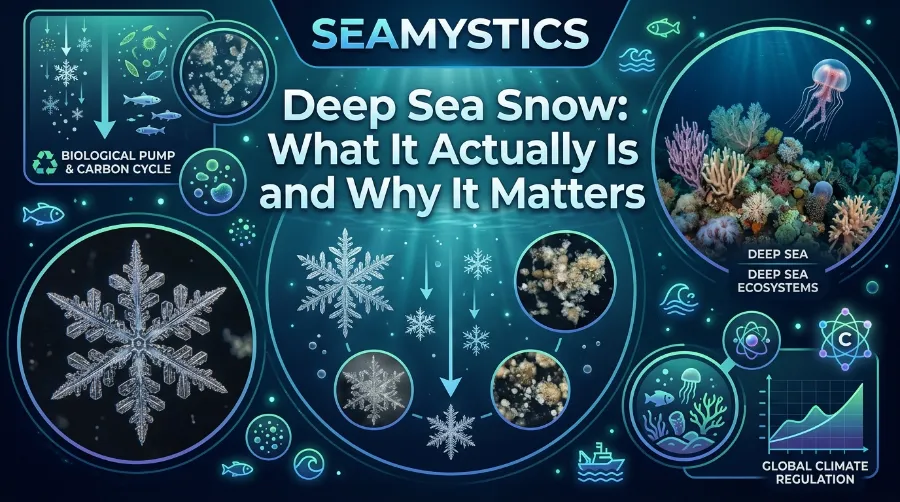

Picture snow falling in complete darkness, a kilometer beneath the waves. There’s no wind. No winter. That is the marine snow phenomenon, and it never stops. It has been drifting downward since before the first fish had a spine. It is still the main reason anything survives in the deep ocean today.
Underwater Volcano Eruptions The Eruptions Happening Right Now Beneath the Waves
Most people never hear about marine snow in school. Yet this steady rain of organic debris moves more material through the ocean each year than almost any other natural process on Earth. It feeds ecosystems that sunlight will never touch. And it locks away carbon that would otherwise stay in our atmosphere.
Key Takeaways
| Fact | Detail |
|---|---|
| What it is | Organic debris (dead plankton, fecal pellets, mucus, dust) sinking from the surface to the seafloor |
| Speed | Individual flakes fall slowly, but the journey to the bottom can take several weeks |
| Size | Ranges from a few micrometers to several centimeters across |
| Carbon impact | Around 815 million tons of carbon reach the ocean floor every year |
| Seafloor coverage | Roughly 75% of the deep ocean floor is covered in this settled organic ooze |
| Newest finding (2026) | Bacteria riding on marine snow can dissolve its mineral ballast and slow its descent |
TL;DR: Marine snow is the constant, gentle fall of dead plankton, waste, and organic debris from the sunlit surface down to the deep ocean floor. It feeds nearly every creature below the sunlight zone. Along the way, it buries hundreds of millions of tons of carbon a year, making it one of the planet’s quiet climate regulators.
What Is the Marine Snow Phenomenon, Exactly?
The marine snow phenomenon describes the continuous shower of organic particles that falls from the upper, sunlit layer of the ocean toward the seafloor. NOAA describes it plainly: it is a shower of organic material falling from upper waters to the deep ocean. The flakes really do resemble snowflakes drifting past a diver’s light. That resemblance is where the name comes from, and once you see footage of it, the comparison makes sense.
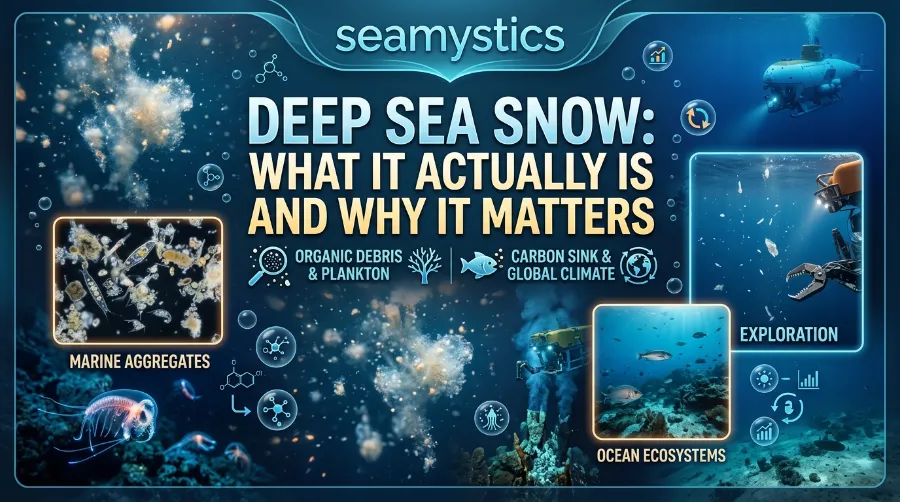
This is not one single substance. It is a mix of dead phytoplankton, zooplankton fecal pellets, mucus, sand, soot, and the remains of larger animals. All of it clumps together into loose, fragile flakes. As these ocean snow particles sink, they collide with more debris and grow larger. That growth actually speeds up their descent instead of slowing it down.
The Mystery of Disappearing Fishing Fleets in the Bermuda Region
Scientists first noticed this drifting material through submersible windows decades ago. It looked so much like a blizzard that the name simply stuck. It has been used in scientific literature ever since, and it remains one of the most visually accurate names in ocean science.
Marine Snow Explained: How It Actually Forms
Understanding how marine snow forms means starting at the surface, not the seafloor. Sunlight drives photosynthesis in phytoplankton near the top of the water column. This single process is the starting point for almost all marine snow on the planet.
Here is the basic sequence:
- Phytoplankton grow and multiply in sunlit surface water, powered by photosynthesis.
- Zooplankton graze on that phytoplankton and release fecal pellets, one of the biggest contributors to marine snow.
- Dead cells, mucus, and other debris begin clumping together into loose aggregates.
- These aggregates sink, picking up more material and growing as they fall.
- Some flakes reach several centimeters across before they ever touch the seafloor.
The clumping stage matters more than most people realize. A 2025 study from Brown University and the University of North Carolina at Chapel Hill looked closely at this. Published in the Proceedings of the National Academy of Sciences, it found that sinking speed depends on more than drag from the surrounding water. It also depends on how fast a particle can absorb salt relative to its volume. That single detail changes how scientists model the whole journey downward. The physics of a snowflake in your backyard and a flake of marine snow are genuinely different.
Deep Sea Snow Facts That Rarely Make the News
A few deep sea snow facts tend to surprise people who assume the deep ocean is empty and lifeless.
- The trip from surface to seafloor can take several weeks, even as individual flakes keep growing and accelerating along the way.
- Marine snow can glow faintly, thanks to bioluminescent organisms living inside the aggregates themselves.
- Roughly 75% of the deep ocean floor is blanketed in a soft, muddy ooze built almost entirely from settled marine snow.
- That seafloor layer thickens by only about six meters every million years, showing how slow and patient this process really is.
None of this happens in isolation. It connects directly to currents, seasonal plankton blooms, and even storms on the surface hundreds of meters above.
Ocean Snow Particles and the Deep Sea Carbon Pump
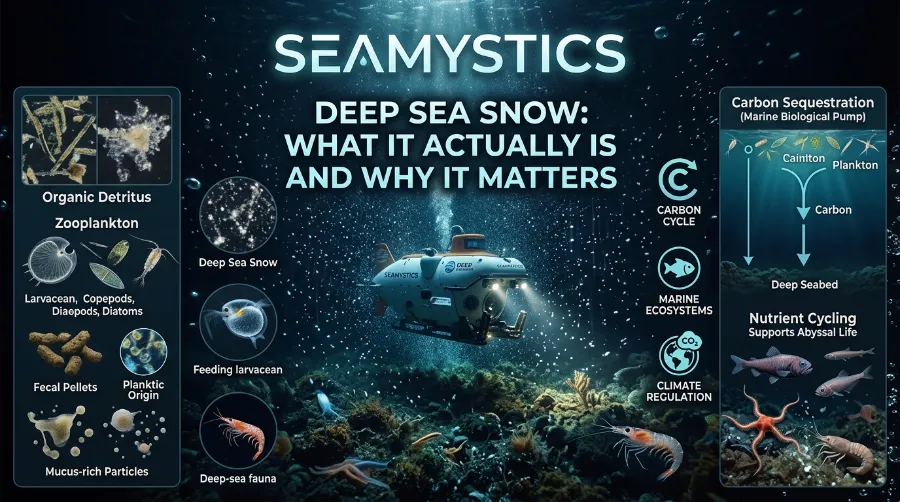
The ocean snow particles that make up marine snow drive what scientists call the biological carbon pump. Phytoplankton absorb carbon dioxide near the surface. When they later sink as marine snow, some of that carbon gets carried down and buried for centuries, sometimes far longer.
The Smithsonian’s Ocean Portal reports a striking figure here. Sediment traps on the ocean floor show around 815 million tons of carbon reaching the seafloor every year through this process. That number puts marine snow in the same conversation as forests and soil as a major carbon sink, even though it rarely gets the same attention.
The 2025 EXPORTS Study: Tracking Individual Particles
Recent field research has added real nuance to that picture. In a 2025 EXPORTS field campaign, researchers worked across the North Atlantic and North Pacific. The team came from MBARI, the University of Rhode Island, the University of Maine, and UC Santa Barbara. They sorted through 800 individual marine snow particles collected by sediment traps at depths between 100 and 500 meters.
Instead of studying bulk biomass like earlier studies did, they analyzed genetic material from individual flakes. They found that the abundance of certain phytoplankton groups, particularly diatoms, can predict how much carbon gets exported to the deep sea. That detail helps climate scientists build better satellite-based carbon models going forward.
Storms and Carbon Export: The December 2025 Findings
Weather even reaches down here. A December 2025 study led by David Siegel of UC Santa Barbara tracked marine snow through a series of North Atlantic storms. Published in Global Biogeochemical Cycles, it found that storms fragment the flakes, slowing their descent. Carbon reaching the deep ocean dropped temporarily as a result.
Once conditions calmed, the particles reaggregated, and export picked back up again. The same research turned up another surprise. Zooplankton, not microbes as long assumed, are the primary consumers of sinking marine snow at depth. That quietly overturns a fairly old assumption in ocean science.
The Mucus “Comet Tail” Discovery
Then there is the mucus. A 2025 Science paper came from Stanford, Woods Hole Oceanographic Institution, and Rutgers researchers, including Rutgers professor Kay Bidle. Using an in-situ microscope and a hydrodynamic treadmill, they discovered something new. Marine snow trails a “comet tail” of mucus that had gone undetected before.
That tail changes the drag on each particle. It appears to slow carbon sequestration more than earlier models accounted for.
Bacteria and Ballast: The March 2026 WHOI Study
The newest twist arrived in March 2026. Woods Hole Oceanographic Institution scientists published findings in the Proceedings of the National Academy of Sciences. Bacteria hitching a ride on marine snow can dissolve the calcium carbonate ballast holding the flakes together.
Less ballast means slower sinking. Slower sinking means less carbon reaching depths where it can be stored for the long haul. It is a small biological detail with a genuinely large climate footprint.
Marine Snow Food Chain: Who Actually Eats It
The marine snow food chain supports an enormous share of life below the sunlit zone. Sunlight never reaches the deep ocean, but marine snow does. That single fact makes it the primary energy source for countless species.
Some of the more surprising diners include:
- Vampire squid, which trail long filaments through the water and wrap captured marine snow in balls of mucus before eating it. Scientists only pinned down this feeding strategy in recent decades.
- Larvaceans, tiny tadpole-shaped animals that build elaborate mucus “houses” to filter marine snow directly from passing water, according to researchers at the Monterey Bay Aquarium Research Institute.
- Deep-sea corals and sponges, which rely almost entirely on falling particles since they cannot move to chase food.
- Bottom-dwelling scavengers, which pick through settled ooze on the seafloor itself once the flakes finally land.
Most organic material never even makes it to the bottom. It gets consumed by microbes, zooplankton, and filter feeders within the first 1,000 meters of the journey, according to NOAA. In that sense, marine snow behaves less like leftovers and more like a moving buffet. Different animals tap into it at different depths, not unlike how creatures cope with the crushing conditions described in our deep sea pressure guide.
A Real-World Snapshot: Why This Data Matters Right Now
Here is a comparison of recent findings that show how fast this field is moving.
| Year | Institution | Key Finding |
|---|---|---|
| 2025 | MBARI, URI, U. Maine, UC Santa Barbara | Genetic analysis of 800 particles links phytoplankton type to carbon export volume |
| 2025 | Stanford, WHOI, Rutgers | Marine snow carries a mucus “comet tail” that slows carbon sequestration |
| 2025 | Brown, UNC Chapel Hill | Salt absorption, not just drag, controls how fast particles sink |
| Dec 2025 | UC Santa Barbara | Storms fragment marine snow but export rebounds once flakes reaggregate |
| Mar 2026 | Woods Hole Oceanographic Institution | Bacteria dissolve mineral ballast, slowing descent and carbon burial |
Taken together, these five studies from the past two years tell a consistent story. Marine snow is not a static, slow-moving curiosity. It responds to storms, microbes, and even the internal chemistry of individual particles. That responsiveness has direct consequences for how much carbon the ocean can lock away as the planet keeps warming.
Threats Facing the Marine Snow Phenomenon
Marine snow is resilient, but it is not untouchable. Two growing pressures stand out in current research.
Microplastics are the more immediate concern. Tiny plastic fragments can make marine snow more buoyant. That slows its descent and keeps carbon closer to the surface instead of burying it in the deep ocean, according to Oceana’s recent reporting. Ocean acidification adds a second layer of risk. It weakens the calcium carbonate structures some marine snow particles depend on for ballast, echoing the same mineral vulnerability WHOI researchers documented in 2026.
Human debris compounds the problem in less obvious ways too. Discarded fishing gear, like the equipment discussed in our piece on ghost fishing nets, settles into the same deep-sea zones where marine snow accumulates. That disrupts the feeding patterns of animals such as the megamouth shark, which passes through these nutrient-rich layers on its own feeding migrations.
Why the Deep Sea Snow Phenomenon Matters to Everyone
It is easy to assume something happening a kilometer underwater has nothing to do with daily life on land. That assumption does not hold up. Marine snow is one of the ocean’s primary tools for regulating atmospheric carbon dioxide. The ocean’s capacity to keep doing that job affects global climate trends that touch every coastline and every farm.
It also sustains fisheries indirectly. Deep-sea food webs built on marine snow support species that migrate vertically each night. That connects deep and shallow ecosystems, and eventually, the fish that end up on dinner plates around the world. Losing efficiency in this system does not just affect obscure deep-sea creatures. It ripples upward through the entire ocean food web.
For more on how extreme depth itself shapes life down there, our deep sea pressure guide breaks down the physical conditions marine snow has to survive on its way to the bottom.
Frequently Asked Questions
Is marine snow the same as regular sediment?
Not exactly. Marine snow is organic, biologically produced debris. Sediment often includes inorganic material like sand and dust that washes in from land. Over time, settled marine snow does become part of the seafloor’s sediment layer.
How deep does marine snow travel?
It falls from the sunlit surface zone down through the entire water column, often past 1,000 meters, with some reaching the deepest trenches on the planet.
Do all marine snow flakes reach the seafloor?
No. Most organic material gets consumed by microbes, zooplankton, and filter feeders within the first 1,000 meters. Only a fraction of the original material ever settles on the bottom.
Can marine snow be seen without special equipment?
Yes. Submersibles and remotely operated vehicles routinely capture it on camera, and it looks remarkably like a snowstorm caught in a spotlight.
Why do scientists study marine snow so intensely right now?
Because it is one of the ocean’s main carbon storage mechanisms. Understanding exactly how fast, how far, and how efficiently it sinks is essential for building accurate climate models.
Conclusion
Marine snow does not ask for attention, and that is exactly why so few people know it exists. It falls quietly, feeds an entire hidden ecosystem, and buries hundreds of millions of tons of carbon every year without a single headline. Research from MBARI, Woods Hole, Stanford, and UC Santa Barbara over just the past two years shows how much is still being discovered about something that has been falling since long before humans ever looked at the ocean. The next time you picture the deep sea as empty and still, remember that somewhere down there, it is snowing right now. It has never stopped.
References
- NOAA Ocean Exploration, “What is marine snow?” oceanexplorer.noaa.gov
- Smithsonian Ocean Portal, “Marine Snow: A Staple of the Deep” ocean.si.edu
- Oceana, “Marine Snow: The Ocean’s Endless Snowfall Explained” oceana.org
- US Ocean Carbon and Biogeochemistry Program, marine snowfall research us-ocb.org
- MBARI, “Marine snow provides new clues about the export of carbon to the deep sea” (2025) mbari.org
- Woods Hole Oceanographic Institution, “Bacteria hitching a ride on marine snow may slow the ocean’s carbon sink” (2026) whoi.edu
- Rutgers Climate and Energy Institute, “Recent Study Reveals How Marine Snow Impacts Carbon Sequestration” (2025) rcei.rutgers.edu