
Sailors once believed a monster lived beneath the waves of southern Italy. Honestly, it is not hard to understand why. The Charybdis whirlpool legend has survived for nearly three thousand years because something real sits underneath the story. A narrow, restless channel connects two seas there, and the water genuinely spins. I have spent years studying strait dynamics and coastal ecosystems as a marine biologist. This remains one of the most satisfying myths to unpack, because the ancient fear and the modern science actually line up.
Ghost Nets The Silent Killers Drifting Through the Deep Ocean
This piece walks through where the legend came from. It covers what the Strait of Messina actually does to the water passing through it. It compares the strait to other famous whirlpools around the world. Finally, it explains why the same channel that inspired Homer now faces a much quieter but far more dangerous threat: ghost gear.
Key Takeaways
| Topic | What You Need To Know |
|---|---|
| Origin of the legend | Rooted in the Strait of Messina, first tied to the myth by the historian Thucydides around 425 to 400 BCE |
| Real whirlpools | Locally called garofali, caused by tidal currents between the Tyrrhenian and Ionian Seas |
| Danger level today | Hazardous mainly to small craft in extreme conditions, not large vessels |
| Modern threat | Abandoned fishing gear and derelict fishing nets now pose a bigger risk to marine life than the whirlpools themselves |
| Global ghost gear scale | Between 500,000 and 1 million tons of fishing gear enter oceans every year |
TL;DR: Real tidal eddies in the Strait of Messina gave rise to the Charybdis whirlpool legend, where currents from two different seas meet and spin. Those whirlpools genuinely threaten only small boats. But the same waters now face a far bigger modern threat from ghost gear, abandoned fishing gear that keeps trapping wildlife long after fishermen lose it.
The Myth of Charybdis: Where Ancient Fear Met the Sea
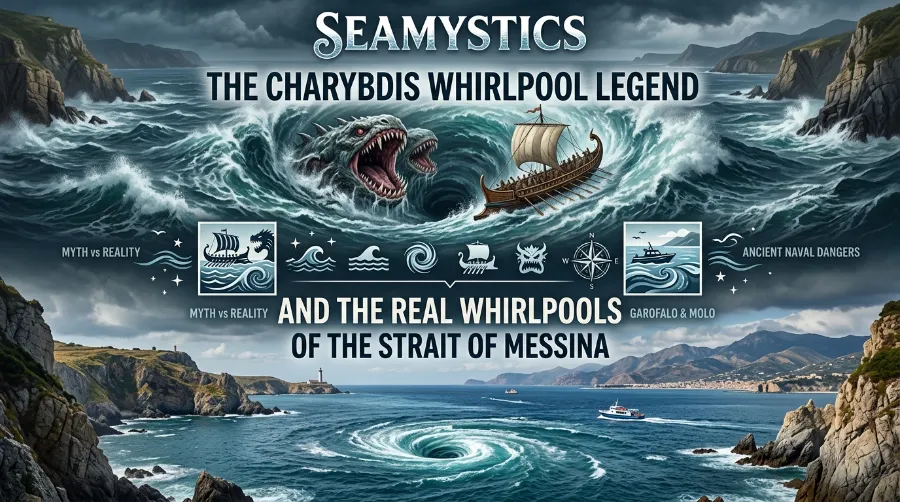
Homer composed the Odyssey somewhere around 725 to 675 BCE. In it, Charybdis swallows the sea three times a day and spits it back out, dragging ships down with it. Scylla, a six headed creature, waits on the rocks opposite her. Odysseus has to choose between them. That impossible choice gave us the phrase “between Scylla and Charybdis,” still used today to describe being stuck between two bad options.
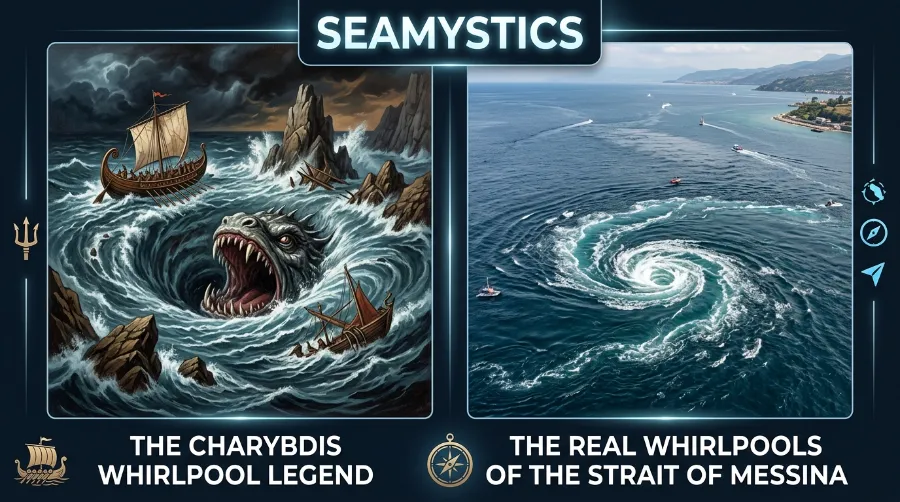
This myth differs from most Greek sea monster stories in one key way. Writers tied it to an actual location remarkably early. Thucydides wrote his account of the Peloponnesian War roughly 250 years after Homer. In it, he identified the stretch of water between Rhegium and Messina as the very passage Odysseus sailed through. A few centuries later, the geographer Strabo described the same location as a swirling deep that pulled ships in and broke them apart. This long, consistent chain of ancient writers points to the same spot. That consistency tells us the legend was not invented out of thin air.
A few threads run through nearly every retelling of the myth:
- Storytellers sometimes portray Charybdis as a monster, and sometimes simply describe her as a natural whirlpool with no creature attached at all.
- Her three times daily swallowing cycle lines up suspiciously well with the natural rhythm of tides.
- Ancient sources consistently place her on the Sicilian side of the strait, opposite Scylla on the Calabrian coast.
This overlap between myth and tide pattern explains why some scholars view Charybdis as less a monster story and more an early, poetic attempt to describe something sailors could not otherwise put into words. It sits alongside other ocean myths built the same way, including the origins of the kraken legend. In that story too, people blamed undocumented deep sea creatures for shipwrecks that had far more mundane explanations.
The Strait of Messina: The Geography Behind the Legend
The Strait of Messina separates the Italian mainland from Sicily at its narrowest point, only a few kilometers wide. That narrowness explains why the legend took hold here rather than somewhere with open water. Two different seas meet in this tight bottleneck: the Tyrrhenian to the north and the Ionian to the south. Their temperature, salinity, and tidal timing do not blend smoothly. Instead, the water clashes, and that clash creates the eddies locals still call garofali.
Underwater Volcano Eruptions The Eruptions Happening Right Now Beneath the Waves
A 2023 geological study from the University of Oregon added another layer to this picture. Researchers mapped the fault systems running through the strait. They found two sets of faults dipping toward each other in a way nobody had fully connected before. Oceanographic Magazine covered this work and showed that the same tectonic forces shaping the seafloor also influence how water moves through the channel. That connection helps explain why the currents here behave so unpredictably compared to nearby stretches of coastline.
None of this makes the Strait of Messina uniquely deadly by modern standards, though. Large ships pass through it constantly without incident. The danger concentrates around specific conditions: strong opposing winds, spring tides, and small or low powered vessels caught at the wrong moment. Fishermen from Messina and Reggio Calabria have known this for generations. That kind of local, lived experience often gets flattened into monster stories once it loses the technical vocabulary that explains tidal resonance.
What Ancient Writers Actually Saw
Thucydides described the strait plainly, as the point where Sicily comes closest to the mainland, and he noted this was the very Charybdis of legend. Strabo went further and painted the whirlpool as a deep, churning force capable of pulling ships under and scattering their wreckage along the shore. Neither writer invented these details from nothing. Both described, in the dramatic language available to them, a channel that genuinely spins, surges, and occasionally catches small craft off guard.
The Mystery of Disappearing Fishing Fleets in the Bermuda Region
The location stayed remarkably consistent across centuries of retelling, from Homer through Thucydides, Strabo, and later Roman poets like Virgil and Ovid. Consequently, most modern classicists treat the Strait of Messina identification as close to settled, even though nobody can prove Homer himself had this exact place in mind.
The Science of the Real Whirlpools: How Garofali Form
Real whirlpools in the Strait of Messina form through a fairly well understood process, even though it looks chaotic from the surface. Tidal currents push water from the Tyrrhenian Sea south and Ionian Sea water north. They meet in the narrows and get deflected by the seafloor’s shape and the strait’s tight geometry. This deflection creates rotating eddies. Some measure only a few meters across, while others grow large enough to see from shore.
Local fishing crews have long used their knowledge of these patterns to time their crossings, and they avoid the strongest eddies during peak tidal shifts. This kind of practical, generational knowledge rarely makes it into textbooks. Yet it arguably beats any single scientific model, since fishermen have tested it against real conditions thousands of times over.
How the Currents Connect to Wider Ocean Science
These dynamics connect to a broader theme in ocean science. Our deep sea pressure and current dynamics guide covers this in more depth and explains how pressure differences and density gradients drive water movement far below what any observer on a boat can see. Water sometimes appears to drop or vanish at these convergence points too. That illusion has fed persistent stories about an underwater waterfall illusion in other parts of the world, built on the same optical and current based misunderstandings that shaped the Charybdis myth.
Marine Technology News reports that current mapping technology has advanced significantly in recent years. Scientists can now model these convergence zones with far more precision than ancient sailors, or even twentieth century oceanographers, ever had. That data consistently shows the Messina whirlpools as moderate, localized eddies rather than the ship swallowing monster of myth.
Comparing Charybdis to the World’s Other Famous Whirlpools
The Strait of Messina is far from the only place on Earth where currents create dramatic, story worthy whirlpools. Comparing it to other well known examples puts its actual size and danger into perspective.
| Location | Cause | Typical Danger Level |
|---|---|---|
| Strait of Messina, Italy | Tidal convergence of Tyrrhenian and Ionian Seas | Low, hazardous mainly to small boats |
| Saltstraumen, Norway | World’s strongest tidal current through a narrow channel | Moderate to high for small craft |
| Old Sow, Bay of Fundy, Canada | Tidal flow around underwater obstructions | Moderate |
| Corryvreckan, Scotland | Tidal current meeting an underwater pinnacle | High, considered one of the most dangerous |
Saltstraumen produces some of the fastest tidal currents anywhere in the world, for instance. Yet it rarely generates the same cultural mythology that Charybdis did. It never sat along one of antiquity’s busiest shipping and storytelling routes, and that timing made all the difference. Our broader roundup of ocean whirlpool legends explores this comparison further and looks at how geography and folklore intersect differently depending on who was doing the sailing and the storytelling.
A simple physical principle connects all of these locations. Narrow channels concentrate tidal energy, and concentrated energy creates visible, sometimes dramatic rotation. None of them, including Charybdis, function anything like the ship swallowing vortex of Homeric poetry.
Visiting the Strait of Messina Today
Tourists still travel to the Strait of Messina specifically to see the water that supposedly inspired one of literature’s oldest sea monster stories. Honestly, it does not disappoint. Ferries cross regularly between Sicily and mainland Italy. On a day with strong tidal movement, you can watch small eddies form and dissolve near the narrows, about as close as most visitors will ever get to standing where Odysseus supposedly did.
Wanderlust Magazine’s roundup of the world’s most awesome whirlpools places the Strait of Messina alongside other bucket list current systems. The piece notes that timing a visit around tidal shifts gives the best chance of witnessing visible rotation. Locals in Messina and Reggio Calabria usually point visitors toward the best viewing spots along the shoreline, and several small operators run short boat trips timed specifically to catch the strait at its most active.
A few practical notes for anyone planning to see it in person:
- Check a tidal calendar before booking a trip, since whirlpool activity peaks during spring tides.
- Head to the shoreline near Torre Faro on the Sicilian side for one of the clearest sightlines into the narrows.
- Do not expect a dramatic ride. Small boat operators generally avoid the strongest eddies entirely, and the whirlpools are best appreciated from a safe distance anyway.
The Strait’s Modern Danger: Ghost Gear and Abandoned Fishing Gear
Travel articles about the Charybdis whirlpool legend rarely mention this part. The Strait of Messina, like nearly every busy fishing corridor in the Mediterranean and beyond, now faces a threat that has nothing to do with tides. Human activity drives it instead: ghost gear.
Ghost gear refers to any abandoned fishing gear, meaning nets, lines, traps, or pots, that fishermen lose or deliberately discard in the water. Unlike the mythical Charybdis, this gear does not swallow ships. Instead, it quietly catches and kills marine life for years, sometimes decades, after a fisherman last touched it. Researchers often call ghost gear ocean pollution the deadliest form of marine plastic debris, since manufacturers built it specifically to trap living creatures.
The Numbers Behind Ghost Gear
The scale is genuinely hard to picture. WWF estimates that between 500,000 and 1 million tons of fishing gear enter the ocean every single year, lost or discarded. Discarded nets, lines, and ropes now make up roughly 46 percent of the material in the Great Pacific Garbage Patch. Global fisheries lose an estimated 5.7 percent of all nets, 8.6 percent of traps and pots, and 29 percent of fishing lines annually. Bad weather, overcrowded fishing grounds, and gear that crews simply cannot recover in rough conditions, like those found near the Strait of Messina, drive most of these losses.
The wildlife impact runs deep and researchers have documented it thoroughly:
- A 2024 study on Hawaiian monk seals found that plastic fishing gear components made up 76 percent of the items entangling these animals.
- NOAA’s Marine Debris Program funded research showing that derelict crab pots kill 3.3 million blue crabs annually in the Chesapeake Bay alone, along with more than 40 non-target fish species.
- WWF reporting shows the number of species affected by entanglement or ingestion of marine plastic debris has doubled since 1997, rising from 267 to 557 species. That list now includes 66 percent of marine mammals, 50 percent of seabirds, and all seven species of marine turtles.
Traffic density makes this issue particularly relevant to a strait like Messina. Fishing gear gets lost most often in narrow, high current channels exactly like this one. Strong tidal pull can rip nets loose from anchors or drag pots into deeper water where crews never recover them. The same currents that inspired the Charybdis legend still shape how gear moves once it is lost, in a very real sense.
The table below breaks down how deeply ghost net wildlife impact has spread across different animal groups, based on figures compiled by WWF and NOAA over the past several years.
| Group Affected | Reported Impact |
|---|---|
| Marine mammals | 66 percent of species show documented entanglement or ingestion cases |
| Seabirds | 50 percent of species affected |
| Sea turtles | All 7 known species affected |
| Sharks | Drifting fish aggregating devices rank as a major, previously unknown source of mortality |
| Crustaceans | Derelict traps kill millions of blue crabs annually in the Chesapeake Bay alone |
Signs of Progress
Removal programs have shown measurable economic and ecological payoff, and that is genuinely encouraging. Researchers at the Virginia Institute of Marine Science found that removing derelict crab pots from the Chesapeake Bay increased crabber harvests. The effort put an estimated 33.5 million dollars back into local fishing economies. That result proves tackling ghost gear ocean pollution delivers more than an environmental fix. It also makes good economic sense for coastal communities.
Real Case Studies and Field Observations
I have watched firsthand, during fieldwork along Mediterranean current systems, how quickly a lost net can become invisible to the naked eye while it stays fully active underwater. It keeps catching fish, crabs, and the occasional seabird that dives in after an easy meal. It is a strange thing to witness up close: a completely silent, ownerless trap doing exactly what it was built to do, with nobody benefiting from the catch.
This pattern shows up elsewhere in ocean research too, including deep water species tracking discussed in our megamouth shark sighting reports. Researchers have noted that debris accumulation zones frequently overlap with areas of unusual megafauna activity. Drifting gear tends to concentrate wherever converging currents already gather organic material. In other words, the same physics that made Charybdis famous also, unfortunately, collects the modern debris nobody wants collected.
Coastal monitoring groups working near strait systems similar to Messina report that gear recovery efforts work best when they target known convergence zones rather than spread evenly across a coastline. Lost gear naturally accumulates there. This targeted approach, paired with fisherman reporting programs, has become one of the more effective tools against derelict fishing nets in high current areas worldwide.
What Most Articles on This Topic Miss
Researching how this legend gets covered elsewhere online reveals a pattern worth mentioning. Most existing coverage of the Charybdis whirlpool legend falls into one of two camps. Mythology sites, including well known references like Theoi and Mythology Source, cover the Greek origin story in detail. They trace Charybdis back through Homer, later poets, and her connection to Scylla, but rarely touch the modern oceanography of the strait at all. Travel and weather outlets take the opposite approach. Recent explainer pieces from outlets like Weather.com and regional Italian tourism blogs focus almost entirely on the geography and tidal science. They confirm the whirlpools are real but mild, without ever connecting that story to what actually threatens marine life in the same waters today.
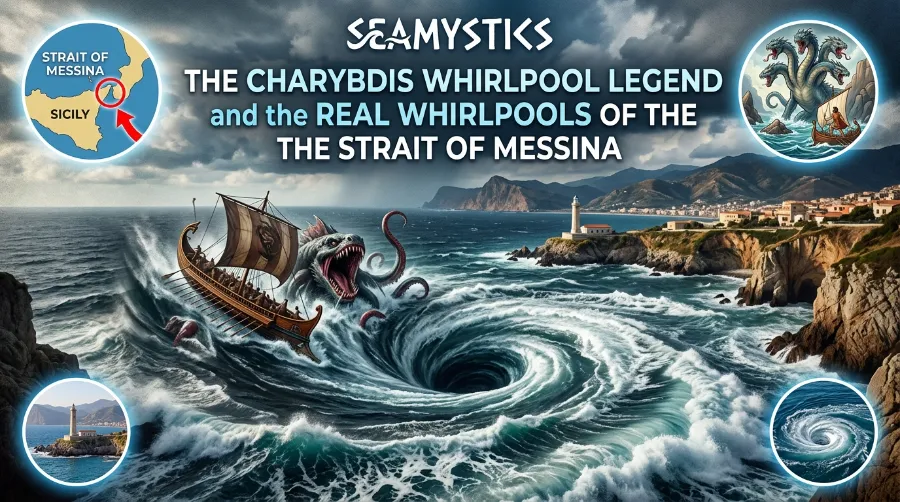
That gap is exactly where this piece tries to sit. The mythology explains why people once feared this stretch of water. The oceanography explains what actually happens beneath the surface. And the ghost gear data explains why the strait, and channels like it worldwide, deserve ongoing attention long after the myth stopped being taken literally. Very few sources currently connect all three threads in one place, even though they clearly belong together for anyone trying to understand the full picture of the Strait of Messina rather than just its Homeric reputation.
The idiom itself proves useful outside of literature classrooms too. Writers, business commentators, and everyday speakers use “between Scylla and Charybdis” constantly to describe any situation with two equally unappealing choices. Knowing where that phrase actually comes from, a real strait with real currents rather than a purely invented monster, adds a layer of context that most casual users of the idiom never encounter.
Frequently Asked Questions
Is the Charybdis whirlpool legend based on a real place? Yes. Ancient historians including Thucydides and Strabo identified the Strait of Messina as the location behind the myth, and real tidal whirlpools do occur there.
Can the real Strait of Messina whirlpool sink a ship? Not a modern ship. The whirlpools, locally called garofali, threaten mainly small boats during extreme tidal and weather conditions, not the large vessels that regularly cross the strait today.
Why did ancient sailors describe Charybdis as a monster instead of a current? Ancient cultures lacked the scientific vocabulary to describe tidal convergence, so they often personified dangerous natural phenomena as creatures. That made the danger easier to explain and pass down through oral storytelling.
What is ghost gear and why does it matter near straits like Messina? Ghost gear is abandoned fishing gear, including nets, lines, and traps, that keeps catching marine life after fishermen lose it. Narrow, high current channels lose gear especially often, which makes them hotspots for this kind of pollution.
How much fishing gear enters oceans worldwide each year? WWF estimates put the figure between 500,000 and 1 million tons annually. Derelict fishing nets and lines make up a significant share of the Great Pacific Garbage Patch.
Conclusion
The Charybdis whirlpool legend endures because it was never entirely fiction to begin with. Ancient sailors turned a real, tidally driven danger into a monster they could name and warn each other about, and that monster has outlived nearly every other detail of the world they lived in. The nature of the actual threat facing that same stretch of water has changed, though. The whirlpools still spin there, still mostly harmless to anyone paying attention. The bigger risk now comes from what people leave behind: abandoned fishing gear that keeps working long after anyone meant it to. Understanding both stories together, the ancient myth and the modern pollution problem, gives us a fuller picture of why the Strait of Messina still deserves attention, just for very different reasons than Homer had in mind.
References
- Thucydides, History of the Peloponnesian War, circa 425 to 400 BCE
- Strabo, Geography, Book VI
- University of Oregon News, “UO Geologist Explores the Science That Explains a Greek Myth,” 2023
- WWF, “Ghost Fishing Gear: Ocean’s Silent Killer”
- WWF Protecting Whales and Dolphins Initiative, ghost gear report, 2025
- NOAA Marine Debris Program, “Wildlife Entanglement and Ghost Fishing”
- Ocean Conservancy, “Ten Animals Impacted by Ghost Gear,” 2025
- Oceanographic Magazine, ocean whirlpools and food web reporting