
A dead ray washes up on a Florida beach in the middle of summer. A fisheries boat off Peru hauls up something nobody in the crew can name. A research vessel drifting over an Australian seamount films a flat, wing shaped shadow gliding through total darkness. None of these moments looked like a scientific breakthrough at the time. Yet each one led scientists to the same conclusion: there is a new ray species hiding in plain sight, and it was not supposed to be there.
Museum Specimens Reclassified Old Samples That Turned Out to Be New Species
That is the strange part of this story. Rays are not small animals. Some stretch nearly twenty feet across. Yet for decades, entire species swam past divers, fishing boats, and coastal towns without a name. Understanding how that happens, and why it keeps happening off coastlines nobody expected, is the whole point of this guide.
Key Takeaways
| Point | What It Means |
|---|---|
| Third manta ray species confirmed | Researchers formally described Mobula yarae, the Atlantic manta ray, in 2025 after 15 years of research |
| Discoveries are not always deep sea | Scientists found several new rays and skates in shallow coastal water, including one off Pompano Beach, Florida |
| DNA plus body shape wins | Modern ray species identification blends genetics, skin patterns, teeth counts, and clasper shape |
| New skates keep surfacing | Teams confirmed or newly recorded species from Madagascar, Peru, Alaska, and Australia within the last six years |
| Conservation depends on naming | A species cannot receive legal protection until it has a confirmed scientific name |
TL;DR
Scientists confirmed the Atlantic manta ray, Mobula yarae, as a distinct species in 2025, closing a 15 year mystery that started with a stranded animal in Florida. Around the same period, researchers described new skate species off Madagascar and Peru, and recorded rays and skates never before documented off Alaska and Australia. Most of these undiscovered ray species were not found in some far off trench. They were sitting closer to shore than anyone assumed, waiting on better tools and closer looks to be told apart from their relatives.
Why New Ray Species Keep Turning Up Where We Least Expect Them
Rays belong to a group called elasmobranchs, the same family that includes sharks and skates. For a long time, taxonomists sorted them mostly by eye: body shape, color, and size. That approach worked until it did not. Many rays that look nearly identical on the surface turned out to be genetically distinct once researchers checked their DNA.
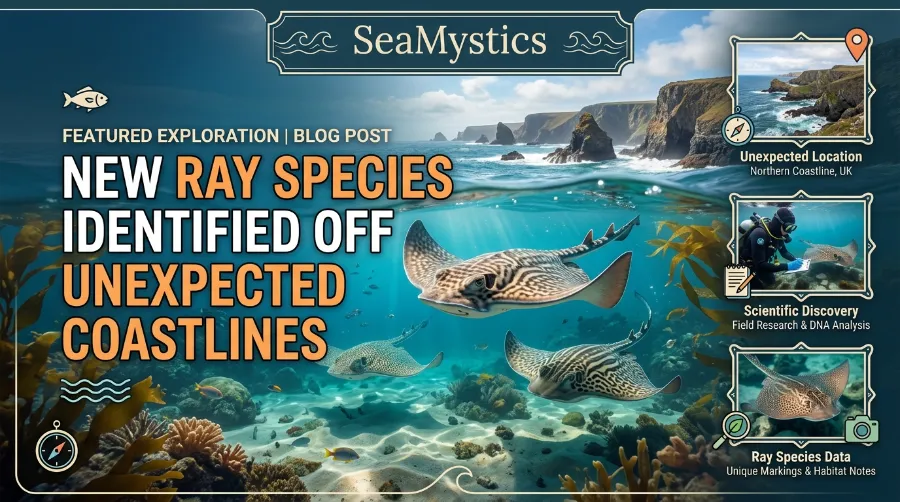
This pattern has a name in biology: cryptic speciation. Two animals appear almost the same to a diver or a fisherman, yet their genetic code tells a completely different story. It explains why a stingray discovery ocean researchers are excited about today might involve an animal people have been swimming past for a hundred years.
Coastal development adds another layer. Citizen science apps, drone surveys, and university expeditions now reach waters that used to draw little attention. Teams photograph, tag, or collect more specimens as a result. A 2025 report from the Ocean Census initiative, a partnership involving the Nippon Foundation and Nekton, documented more than 866 new marine species in under two years. That total included a guitar shark off the coasts of Mozambique and Tanzania that shares traits of both sharks and rays. That single figure says a lot about how much of the ocean remains unlabeled.
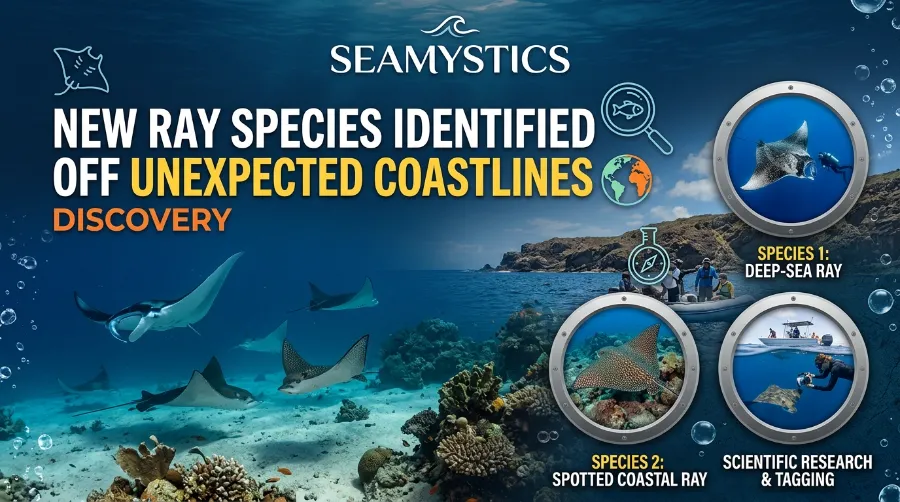
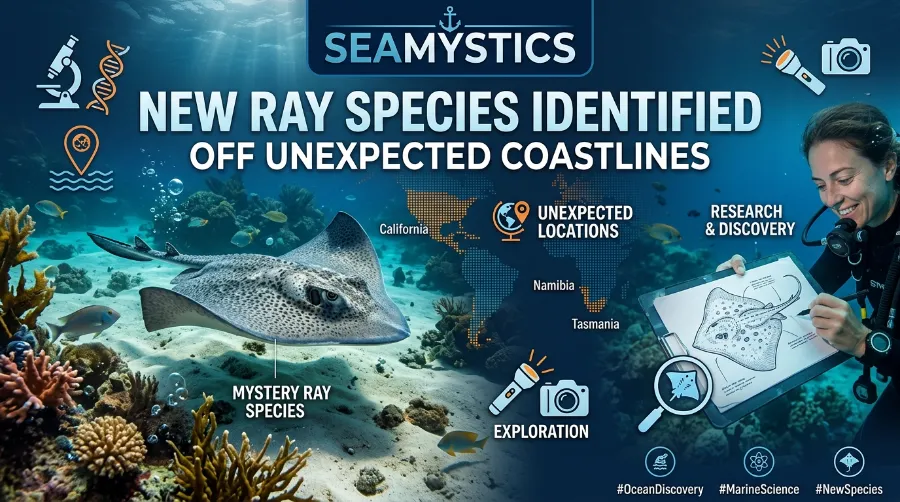
New Ray Species Identified Off Unexpected Coastlines
If you want to see how this same pattern plays out across the wider category of ocean animals, our pillar guide to new abyssal species breaks down several 2025 finds beyond rays and skates.
The Atlantic Manta Ray: A Stingray Discovery Ocean Scientists Waited 15 Years For
The clearest case study in ray species identification right now is Mobula yarae, the Atlantic manta ray. For more than a decade, researchers suspected that manta rays living in the western Atlantic were not quite the same as the giant oceanic manta or the reef manta. Confirming it took patience, a stroke of bad luck, and a lot of careful comparison work.
The Florida Holotype That Changed Everything
In July 2017, a dead manta washed ashore near Pompano Beach, Florida. Biologist Jessica Pate, who leads the Florida Manta Project, made sure the carcass stayed intact rather than decomposing, which almost never happens with mantas since they sink and their cartilage breaks down fast. The Smithsonian’s National Museum of Natural History later cataloged that specimen under the number USNM 443866, and it became the reference point, or holotype, for the entire species description.
Undersea Volcano Discoveries New Species Found Near Hydrothermal Vents
A team led by Nayara Bucair at the University of São Paulo, working alongside veteran manta researcher Andrea Marshall of the Marine Megafauna Foundation, spent years comparing color patterns, teeth counts, skin texture, and genetic markers. They pulled specimens from the United States, Mexico, the Caribbean, and Brazil. In 2025, the group formally confirmed the Atlantic manta ray as the third recognized manta species, joining the giant manta (Mobula birostris) and the reef manta (Mobula alfredi).
Field Identification Cues and Numbers
A few numbers make this discovery easier to picture:
- The Atlantic manta ray reaches an estimated 16 to 20 feet across, roughly the length of a small motorboat.
- Researchers currently confirm the species only in the western Atlantic Ocean.
- Around 10 percent of the juveniles the Florida Manta Project studied have shown boat strike injuries.
Field identification also comes down to small visual cues. Bucair’s team noted that the Atlantic manta’s white shoulder patches form a “V” shape on its back, compared with the “T” shape on a giant manta and the “Y” shape on a reef manta. A casual diver would never think to check that detail, which is exactly why the species stayed unnamed for so long. You can read the full species profile from the Manta Trust and the original research summary from the Marine Megafauna Foundation if you want the technical side of the story.
Why the Confirmation Matters
Naming a species is not just paperwork. It gives conservationists a legal hook to track boat strikes, bycatch, and habitat loss species by species instead of lumping every manta together. Lumping them together had been hiding real differences in how each population is faring.
Beyond Mantas: New Skate Species Surfacing From Madagascar to Peru
Manta rays get the headlines, but new skate species have been quietly stacking up too. Skates are close cousins of rays, generally smaller. They reproduce by laying leathery egg cases that beachcombers sometimes call mermaid’s purses.
Madagascar and Peru: New Skates From the Deep
In 2024, a team led by Simon Weigmann at the Leibniz Institute for the Analysis of Biodiversity Change described Leucoraja longirostris, the brown longnose skate. They based it on eight specimens collected from the Madagascar Ridge in the southwestern Indian Ocean at depths between 750 and 1,050 meters. It is the fourth species of Leucoraja known from that region, and researchers define it mostly by an unusually long, sharply angled snout, a feature the team confirmed using 3D modeling of the skate’s internal cartilage.
A similar story played out off South America. Researchers described Bathyraja chapmani, a new softnose skate, from two female specimens caught at 1,714 meters deep off Lima, Peru, in a fishery targeting Patagonian toothfish. Subtle differences in spot pattern and skin texture separate it from close relatives, the kind of detail that only shows up under close lab comparison.
Alaska to Australia: Skates and Rays in Unexpected Latitudes
North America has its own recent example. In Alaska and British Columbia, NOAA Fisheries researchers confirmed range extensions for two rare skates: the fine-spined skate, the deepest dwelling skate species known anywhere, and the Pacific white skate. No one had previously recorded either species that far north, and researchers housed the specimens at the Burke Museum in Seattle.
Then in 2025, an Australian expedition aboard the CSIRO research vessel Investigator explored the Kenn Plateau at depths from roughly 650 to nearly 10,000 feet. The team documented more than 100 new species in one 35 day trip, including a previously unrecorded ray with adaptations for near total darkness, a new skate with a long snout, and a chimera, sometimes called a ghost shark. If deep water exploration like this interests you, our deep sea expedition roundup covers several similar missions in more detail.
How Ray Species Identification Actually Works
Telling one ray or skate apart from a close relative is rarely as simple as looking at a photo. Modern ray species identification tends to follow a fairly consistent process, whether the animal in question is a manta the size of a car or a skate that fits on a dinner plate.
- Collect physical measurements. Researchers record disc width, snout shape, tooth counts, and the arrangement of thorns or denticles on the skin.
- Compare coloration and pattern. Shoulder markings, spot placement, and shading differences, sometimes only visible in good light, can separate look alike species.
- Run genetic analysis. DNA sequencing checks whether a specimen forms its own distinct branch on the family tree rather than sitting inside an existing species.
- Cross reference historical specimens. Museum collections, sometimes decades old, get pulled out and re-examined against new finds, which is how Leucoraja longirostris was confirmed using specimens first collected in the 1970s.
- Publish a formal description. A new species is not official until it appears in a peer reviewed journal with a designated holotype specimen.
This is slow, unglamorous work, and it usually takes years rather than weeks. That is part of why so many undiscovered ray species stay unnamed even after someone has already photographed or caught one.
Undiscovered Ray Species: Where Scientists Are Looking Next
Researchers generally agree that Western science has formally documented fewer than 20 percent of the planet’s species, and rays sit squarely inside that knowledge gap. A few patterns show scientists where to look next.
- Guitarfish and guitar sharks. These animals blend shark and ray features and ranked among the standout finds from the Ocean Census survey off Mozambique and Tanzania, an area researchers had not surveyed closely before.
- Seamounts and ridges. Isolated underwater terrain, like the Madagascar Ridge or Australia’s Kenn Plateau, tends to host species found nowhere else, since isolation cuts these populations off from relatives for long stretches of time.
- Nearshore juvenile habitat. Ironically, some of the biggest gaps sit close to shore. Juvenile rays often use shallow bays and estuaries, and those spots receive less scientific attention than the open ocean.
- Museum backlogs. Collections sitting in storage for decades sometimes hold specimens that someone misidentified long ago and that are now waiting for a second look with modern genetic tools.
For readers who want to see how naming conventions and discovery methods compare across other groups, our guides on octopus species naming, new nudibranch species, and new anglerfish species walk through similar detective work outside the ray family.
Recently Confirmed Ray and Skate Species: A Quick Reference Table
| Species | Common Name | Location | Year Confirmed | Notable Detail |
|---|---|---|---|---|
| Mobula yarae | Atlantic manta ray | Western Atlantic (Florida holotype) | 2025 | Third recognized manta species, up to 20 feet wide |
| Leucoraja longirostris | Brown longnose skate | Madagascar Ridge | 2024 | Found at 750 to 1,050 meters deep |
| Bathyraja chapmani | Softnose skate | Off Lima, Peru | 2022 | Collected at 1,714 meters deep |
| Bathyraja microtrachys | Fine-spined skate | Alaska and British Columbia | 2019 (new record) | Deepest-dwelling skate species known |
| Unnamed Kenn Plateau ray | Deepwater ray | Off Australia | 2025 | Adapted for near total darkness habitat |
| Guitar shark, Rhinobatos sp. | Guitarfish | Mozambique and Tanzania coast | 2025 | Shares shark and ray body features |
Why This Matters: Conservation Stakes of New Ray Species
A species without a name has no legal standing. That sounds bureaucratic, but it has real consequences. Regulators almost always write fishing quotas, bycatch protections, and habitat safeguards species by species, so an unnamed ray or skate can slip through every regulatory gap even if its population is shrinking fast.
Rays and skates also grow slowly and produce few offspring compared with many bony fish, which makes them especially vulnerable to overfishing once it starts. The IUCN Shark Specialist Group and groups like the Manta and Ray Alliance have pushed for faster species descriptions partly for this reason, since conservation funding and legal protection tend to follow a confirmed scientific name rather than a suspected one.
There is also a simple honesty to this work that draws people to marine biology in the first place. Every one of these discoveries started with someone refusing to assume they already knew what they were looking at, whether that was a stranded animal on a beach or an old specimen sitting in a drawer. If you enjoy this side of ocean science, our piece on bioluminescent species discoveries and our coverage of hydrothermal vent species follow a similar thread of patient, unglamorous fieldwork paying off years later.
Frequently Asked Questions
What is the most recently confirmed new ray species? Researchers formally confirmed the Atlantic manta ray, Mobula yarae, in 2025 after 15 years of comparative research, making it the most recent major ray species description as of this writing.
How do scientists tell a new ray species apart from a known one? They combine physical measurements, skin pattern comparison, tooth and clasper structure, and DNA sequencing, then cross check the results against museum specimens before publishing a formal description.
Are new ray species usually found in deep water? Not always. Researchers found several recent skates at depths past 1,000 meters, but they confirmed the Atlantic manta ray using a specimen that washed up on a Florida beach in shallow coastal water.
Why does naming a species matter for conservation? Regulators typically assign legal protections, fishing regulations, and conservation funding to a specific named species, so an unnamed animal can slip past notice even while its numbers decline.
How many new marine species are discovered each year? Recent survey efforts, including the Ocean Census initiative, documented more than 866 new marine species in under two years, though only a portion of those are rays, skates, or other elasmobranchs.
Conclusion
The coastlines in this story, Florida, Madagascar, Peru, Alaska, and Australia, have almost nothing in common except one thing. Each hid a ray or skate species that nobody had gotten around to naming yet. The gap between when people first spot an animal and when science formally names it is bigger than most people assume, even for creatures as large as a car. As genetic tools get cheaper and expeditions reach more remote seafloor, expect that gap to keep closing, one stranded specimen or deepwater trawl at a time. Anyone who keeps an eye on the water should remember that the next undiscovered ray species might not hide in some far off trench. It could sit closer to shore than anyone thought to look.
References
- Bucair, N., Marshall, A., et al. (2025). Description of the Atlantic manta ray, Mobula yarae. Referenced via Manta Trust and Marine Megafauna Foundation.
- Weigmann, S., et al. (2024). Description of Leucoraja longirostris from the Southwestern Indian Ocean, published in Biology.
- Pacific Shark Research Center and ProDelphinus (2022). Description of Bathyraja chapmani from the Southeast Pacific.
- NOAA Fisheries (2019). Rare deep-dwelling skates discovered in Alaska and British Columbia.
- Ocean Census / Nippon Foundation and Nekton (2025). More than 866 new marine species documented, including guitar shark finds off Mozambique and Tanzania.
- Manta and Ray Alliance, species reference pages: maralliance.org