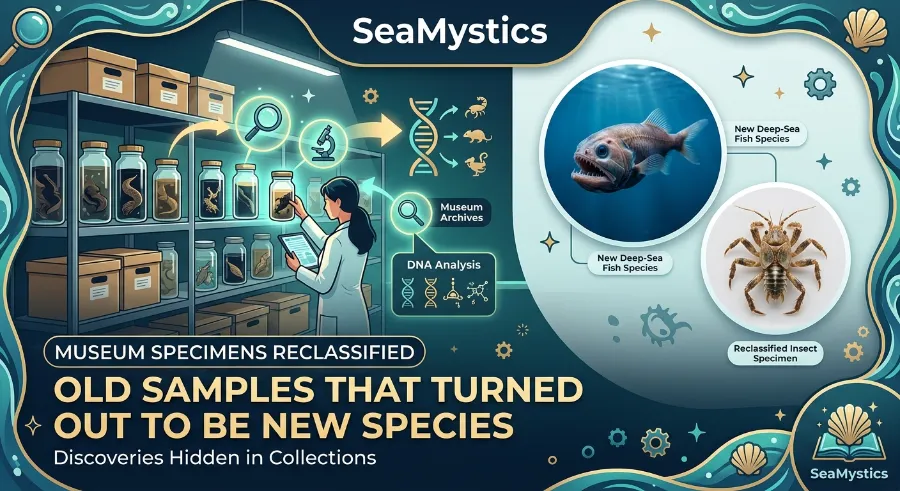

A jar has been sitting on a shelf since before most of us were born. The label has faded. The ethanol has turned slightly amber. Nobody has opened the lid in decades. Then one afternoon, a researcher lifts it down, runs a scan, and realizes the animal inside matches nothing in the record books. That moment, a reclassified museum specimen turning into a brand new species, happens more often than most people outside marine biology would guess. It is reshaping how we count life in the ocean.
New Ray Species Identified Off Unexpected Coastlines
I have spent two decades working alongside collections staff. I still find this pattern remarkable. A museum specimen discovery rarely starts with a headline. It starts with a drawer, a barcode, and a scientist willing to look twice at something everyone else assumed was already settled.
Key Takeaways
| Point | Detail |
|---|---|
| Scale of the trend | AMNH described 70+ new species in 2025; several came directly from decades-old collections |
| Marine focus | The Natural History Museum in London named 262 new species in 2025, including deep-sea corals and worms pulled from existing archives |
| Why it works now | DNA barcoding and micro-CT scanning let scientists re-examine old samples without destroying them |
| Ocean scale | Roughly two million marine species may exist; scientists have formally described only a fraction |
| Practical driver | Backlogs, not shortages, cause the bottleneck. Specimens already exist. Trained taxonomists do not |
TL;DR: A reclassified museum specimen is an old sample, sometimes over a century old, that a researcher pulls from storage and formally names as a new species once modern tools like DNA barcoding or micro-CT scanning reveal it matches nothing known. This happens often. Museums like AMNH and the Natural History Museum in London have named hundreds of species this way in the past year alone. The ocean, where sampling has always lagged behind land-based fieldwork, produces an outsized share of these overlooked species specimen stories.
Why Old Samples Keep Turning Into New Species
Natural history collections were never meant to be static. Curators have always known that a jar labeled “unidentified” was a placeholder, not a final answer. The available toolkit has changed, and that changes everything.
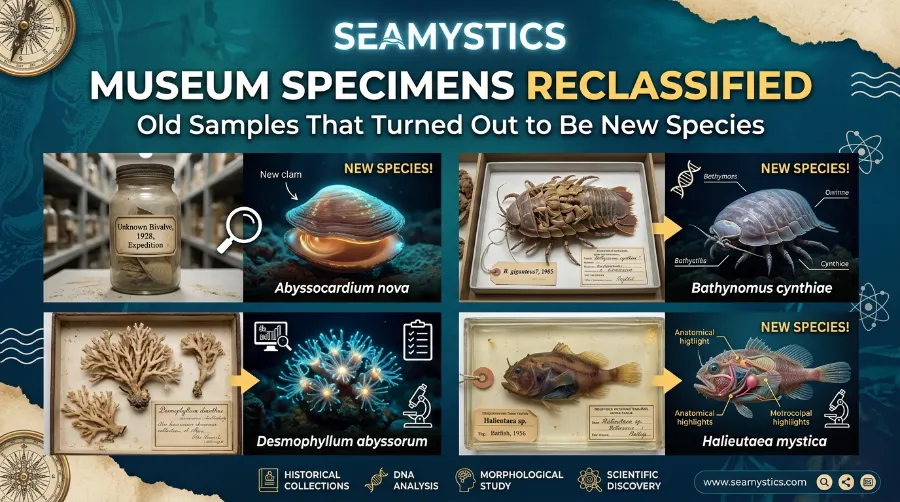
Twenty years ago, confirming a new species usually meant fresh fieldwork. Researchers needed a boat, a net, a permit, and months at sea. Today, a scientist can pull a specimen collected in 1930, extract a sliver of tissue, and run DNA barcoding in an afternoon. This shift explains why so much taxonomy reclassification ocean work now happens in basement archives instead of on research vessels.
Consider the scale. The American Museum of Natural History described more than 70 species new to science in 2025. Museum leadership noted that some came directly from specimens that had sat in the collection for decades, waiting for new technology. That is not a fluke year. It reflects a real shift in how taxonomy gets done.
The Tools Making This Possible
A handful of technologies now do most of the heavy lifting behind this wave of museum specimen discovery:
- DNA barcoding compares a short, standardized gene sequence against global reference libraries and flags mismatches with known species
- Micro-CT scanning builds a 3D internal map of a specimen without dissecting it, so the sample survives for future study
- Digitization programs let museums photograph and catalog specimens at scale, so outside researchers can study them remotely
- Archival DNA extraction works on degraded tissue preserved in old formalin or ethanol, a task that used to be nearly impossible
Each tool lowers the cost of re-examining what already sits in storage. That is exactly why old sample new species stories keep multiplying instead of slowing down.
Real Cases: When the Shelf Became the Discovery
Numbers convince, but specific cases make the pattern concrete. A few recent examples show how varied this process can be.
The squid with no family. Researchers examined a single preserved specimen taken from Antarctic waters. It did not fit any known squid family. The animal was distinctive enough that scientists established not just a new species but an entirely new family, Mobydickidae, according to the World Register of Marine Species. It had sat unnoticed inside a museum collection for years before anyone recognized what they held.
Fruit flies from the Philippines, a century later. AMNH scientists studied specimens collected nearly 100 years ago. They identified two new fruit fly species, Psilodorha mandibula and Psilodorha forceps, both marked by unusual jaw-like mouth structures that researchers believe help males grip females during mating. The specimens had sat correctly stored the whole time. Nobody had studied them closely against modern comparative data.
Undersea Volcano Discoveries New Species Found Near Hydrothermal Vents
A fish based on a decade-old sample. Researchers formally described the new species Labeo niariensis, an African carp relative, using specimens originally collected between 2010 and 2013. “Old” in taxonomy can mean a few years, not just a century, whenever a backlog forms between collection and formal study.
262 species in a single year. The Natural History Museum in London reported describing 262 new species in 2025 alone. The list spans deep-sea coral found 5,000 metres beneath the Pacific to polychaete worms recovered from sediment around polymetallic nodules. Museum staff admitted that some specimens represent the only known record that a species ever existed at all.
These are not edge cases. They have become the normal route to a museum specimen discovery, especially in ocean science, where fieldwork has always cost more and moved slower than work on land.
Why the Ocean Produces So Many Overlooked Species
Land-based collecting has a two-century head start on ocean sampling. Researchers have walked, netted, and cataloged most coastal and shallow-water regions repeatedly since the 1800s. The deep ocean never got that luxury.
Sampling below a few hundred metres demands specialized vessels, remotely operated vehicles, and funding that most 19th and 20th century expeditions simply did not have. So when ships did manage to dredge something up from real depth, crews preserved the specimen, jotted a brief note, and shelved it. Often, nobody available at the time specialized in that particular group.
That backlog still causes problems today. Researchers working in the Clarion-Clipperton Zone, a Pacific seabed region under review for deep-sea mining, estimate that roughly 90 percent of local species remain unnamed and poorly understood. Museums worldwide already hold many of these specimens. Taxonomic expertise, not specimen access, is now the real bottleneck. One amphipod group gets described at a rate of about 25 species a year; at that pace, researchers estimate cataloging what they have already collected could take a full decade.
This is where an overlooked species specimen becomes more than an academic curiosity. Naming a species often marks the first legal and scientific step toward protecting its habitat. That step matters enormously as mining and other industrial interest in the deep sea keeps growing.
How Researchers Actually Confirm a Reclassification
Here is roughly how a taxonomy reclassification ocean case moves from suspicion to formal publication.
- A specimen gets flagged. This can happen during routine digitization, a graduate student’s thesis research, or a targeted review of a group nobody has revisited in years.
- Morphology gets rechecked. Researchers compare physical traits, body proportions, shell ridges, mouth structures, against the original description and against related species.
- DNA extraction follows where possible. Archival DNA techniques pull usable genetic material even from decades-old, formalin-preserved tissue, though the process is technically difficult and does not always succeed.
- Results get checked against reference databases. Barcoding data gets compared to libraries like the World Register of Marine Species to see whether the sequence matches anything already named.
- A formal description gets published. Only after peer review, usually in a taxonomic journal, does the animal receive an official scientific name and enter the permanent record.
None of these steps move fast. That is part of why so many specimens sit unresolved for years, even after someone first suspects something looks off.
What This Means Beyond the Lab
It would be easy to treat this as a purely academic story, but the stakes reach further. A named species can undergo extinction risk assessment. Conservation planners can include it in habitat protections. Environmental reviewers can factor it into decisions about deep-sea mining or bottom trawling. An unnamed species, formally speaking, does not exist yet, no matter how real the animal is.
That gap matters right now. Industrial interest in seabed mining keeps accelerating, and faster taxonomy has become an environmental policy tool, not just a scientific exercise. Every reclassified museum specimen that receives a name becomes one fewer species that could vanish before anyone even knew it existed. If you want to see how this plays out with entirely new-to-science animals rather than reclassified ones, check our deep-sea expedition coverage, which walks through how modern surveys add to the record in real time.
Museums themselves keep leaning into this shift. Harvard’s Museum of Comparative Zoology maintains an enormous searchable specimen archive so outside researchers can query holdings without traveling. The Smithsonian’s National Museum of Natural History collections database serves a similar function for one of the largest natural history holdings in the world.
A Pattern Across Many Groups
This trend touches nearly every branch of marine life, from octopuses to nudibranchs to sea spiders. Our piece on how new octopus species get formally named covers the same core process, just triggered by an old jar instead of a new net haul. Our coverage of newly described nudibranch species and new sea spider discoveries shows how often “new” really means “newly recognized.”
Deep-sea groups dominate these stories for a simple reason: undersampling hit them hardest. Our reporting on new anglerfish species, bioluminescent species, and animals found around hydrothermal vents all trace back to the same shortage of trained eyes relative to the volume of specimens sitting in storage. Ray taxonomy has not escaped this either, as recent work on new ray species shows, built partly on archival material.
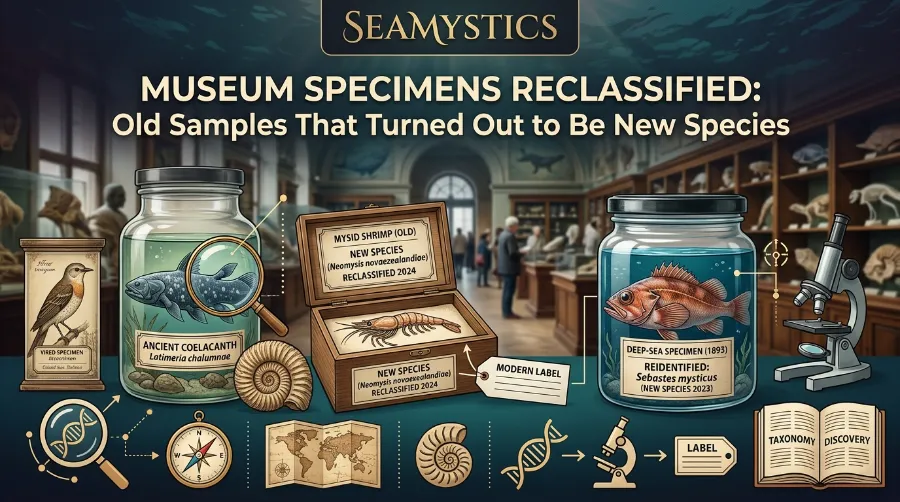
Want the full scope of how modern discovery methods, not just reclassification, keep expanding the species count? Start with our pillar guide to new abyssal species, and pair it with genetic reference tools like the American Museum of Natural History’s comparative genomics search platform.
Frequently Asked Questions
What does it mean when a museum specimen is “reclassified”?
Researchers determine that a preserved sample, originally filed under one species name or left unidentified, actually belongs to a different, previously unnamed species. They base this call on updated morphological or genetic evidence.
How old are the specimens typically involved?
Ages vary widely. Some cases involve specimens collected within the last 10 to 15 years that simply never got formal study. Others, like the Philippine fruit flies, involve material close to a century old.
Why don’t museums just check every specimen when it arrives?
Taxonomic expertise stays scarce relative to the volume of material collected, especially for deep-sea groups. Backlogs form because few specialists can confidently identify a given family or genus.
Does reclassification affect conservation status?
Yes. A formally named species can undergo extinction risk evaluation. An unnamed one generally cannot receive that same formal consideration.
Is this trend increasing or slowing down?
It appears to be increasing. DNA barcoding and micro-CT scanning have made non-destructive re-examination of old material far more practical than it was even a decade ago.
Conclusion
The next major marine species discovery may not come from a submersible at all. It might already sit in a drawer, correctly preserved and quietly mislabeled, waiting for someone with the right tools and enough curiosity to look again. That is the quiet promise behind every reclassified museum specimen: the ocean’s undiscovered life is not always somewhere new. Sometimes it has sat on the shelf the whole time.
References
- American Museum of Natural History, 2025 New Species Report, phys.org coverage
- World Register of Marine Species, “Ten Remarkable New Marine Species from 2025,” marinespecies.org
- Natural History Museum London, “262 New Species Described in 2025,” nhm.ac.uk
- Natural History Museum London, “Dozens of Deep-Sea Species Discovered as New Crustaceans Named,” nhm.ac.uk
- Harvard Museum of Comparative Zoology Specimen Database, mgmh.fas.harvard.edu
- Smithsonian National Museum of Natural History Collections Search, collections.nmnh.si.edu