
Somewhere off the coast of Western Australia, a research vessel called the RV Investigator hauled up a shark that nobody had a name for. It lived at roughly 2,000 feet down, in total darkness. Parts of its skin glowed on their own. Researchers with Australia’s CSIRO eventually named it the West Australian lanternshark, Etmopterus westraliensis. It became one of several new bioluminescent species confirmed this year alone.
Stories like this show up in headlines every few months. They always raise the same question: how do scientists actually prove an animal glows on its own, rather than just reflecting someone else’s light?
| Key Takeaway | Detail |
|---|---|
| What’s new | Several new bioluminescent species were confirmed in 2025 to 2026, including a lanternshark, a coral, a sea worm, and a nudibranch |
| Why it matters | Bioluminescence has evolved independently more than 100 times across the tree of life, and it’s still being found in new lineages |
| How it’s confirmed | Field footage, specimen collection, DNA barcoding, and spectral light testing, followed by peer review |
| Where discoveries happen most | Deep sea zones below 500 meters, where an estimated 90 percent of animals produce their own light |
| What’s still unclear | Why bioluminescence evolved separately so many times, and how widespread it really is among smaller, harder-to-sample species |
TL;DR: New bioluminescent species are turning up faster than ever, thanks to deep-sea ROVs and genetic testing. Scientists don’t just snap a glowing photo and call it done. They collect the specimen, sequence its DNA, test its light chemically, and send the description through peer review before a new glowing animal earns an official name.
Why New Bioluminescent Species Keep Turning Up
For most of history, nobody could see far enough into the ocean to find these animals. That changed once remotely operated vehicles, or ROVs, started carrying cameras thousands of feet down and beaming footage back to a control room in real time. Teams like the Monterey Bay Aquarium Research Institute (MBARI) now spot organisms that older submersibles or trawl nets would have missed entirely, or destroyed before anyone got a good look.
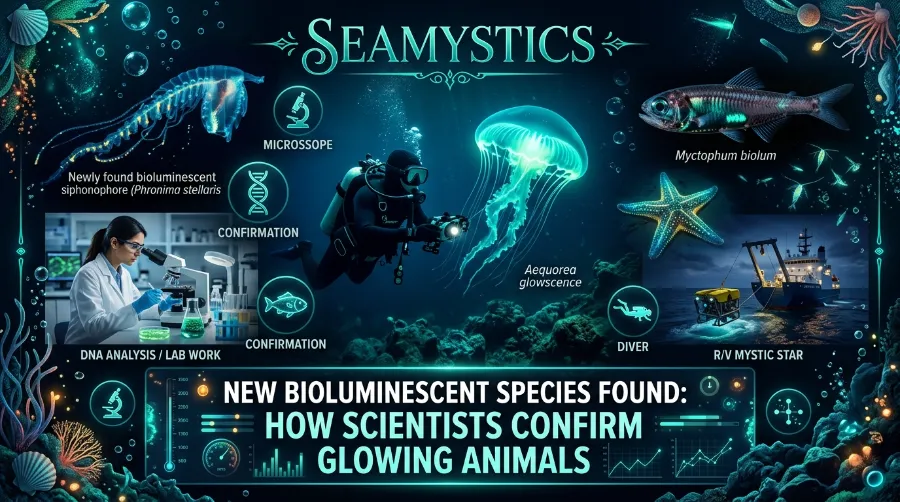
That shift matters because bioluminescence isn’t rare in the deep sea. It’s closer to the default setting. The Smithsonian’s Ocean Portal estimates that bioluminescence exists in roughly 90 percent of animals living below 500 meters in the open ocean. The National Wildlife Federation and Natural Habitat Adventures both note that self-generated light evolved independently in dozens of separate lineages, from fireflies to fungi to fish, rather than spreading from one common glowing ancestor. Given how common the trait is, the real story isn’t that new glowing animals exist. It’s that we’re only now building the tools to properly document them.
Confirmed Discoveries from the Last Two Years
Here’s a snapshot of confirmed discoveries from the last two years:
| Species | Group | Location | Year Confirmed | Research Team |
|---|---|---|---|---|
| Etmopterus westraliensis (West Australian lanternshark) | Shark | Off Western Australia, ~2,000 ft depth | 2026 | CSIRO, RV Investigator |
| Bathydevius caudactylus | Deep-sea nudibranch | Eastern North Pacific, midwater zone | First described 2021, widely reported since | MBARI |
| Undescribed Corallizoanthus species | Zoantharian coral | Minamidaito Island, southern Japan | Published November 2025 | JAMSTEC D-ARK project |
| Bioluminescent Aricidea polychaete worm | Marine worm | Minamidaito Island, Japan | Published 2025 | JAMSTEC D-ARK project |
| Four Phuphania land snail species | Terrestrial mollusk | Thailand | 2023 | Chulalongkorn University, Chubu University |
Each case followed a similar arc. Something odd shows up on camera or in a sample. Then a slow, methodical process kicks in before anyone can call it a confirmed new glowing animal.
Undersea Volcano Discoveries New Species Found Near Hydrothermal Vents
How Scientists Actually Confirm a New Glowing Animal
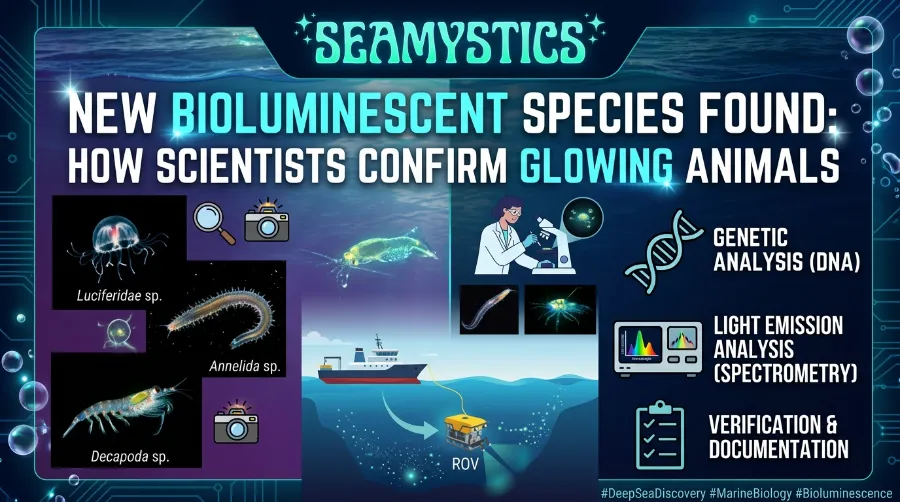
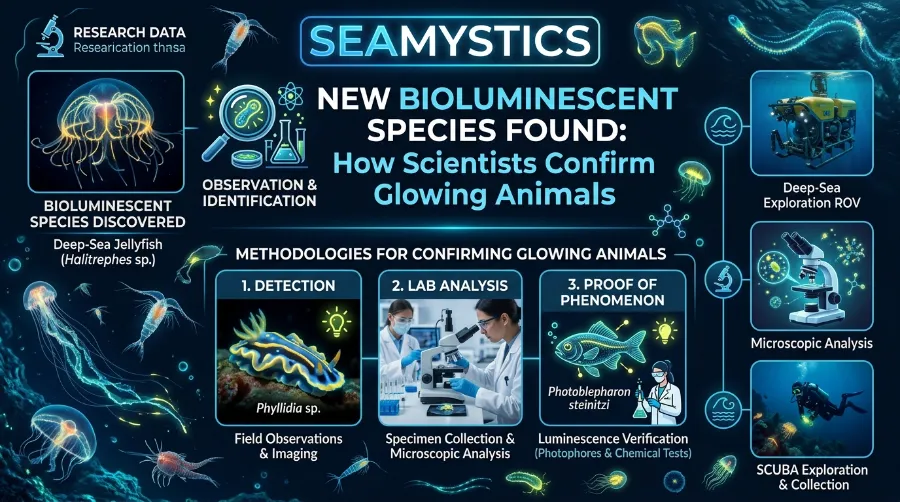
A glowing photo from a submersible is a lead, not proof. Researchers follow an actual sequence of steps before they name a species. It often takes years to move from “we saw something weird” to “we named a new species.” Here’s why.
The Five-Step Confirmation Process
- Field observation and collection. An ROV or diver documents the animal glowing in its natural setting. Where possible, the team brings back a physical specimen or tissue sample.
- Morphological examination. Scientists compare the animal’s physical structure against known relatives. They want to see whether it truly looks distinct, not just differently lit or photographed.
- DNA barcoding. Researchers extract DNA and sequence a short, standardized gene region, most often the COI gene. They then check it against reference databases built from previously confirmed species.
- Spectral and chemical light testing. Bioluminescence comes from a genuine chemical reaction. Teams test the light’s wavelength and confirm the presence of luciferin and luciferase, the compound and enzyme responsible for the glow.
- Peer review and formal publication. The team submits the full case, including the description, DNA data, and light chemistry, to a journal. Outside experts review it. Only then does it get published with an official scientific name.
Ocean researchers rarely field questions about this part of the process in interviews. Yet it’s the part that actually separates a confirmed new bioluminescent species from an interesting photo.
Why DNA Barcoding Changed Everything
DNA barcoding has sped things up enormously. Geneticist Paul Hebert’s early work through the University of Guelph showed that a short DNA sequence can flag a specimen as genetically distinct. That once took years of manual comparison. A 2024 review of deep-sea decapod shrimp bioluminescence found known or suspected light production in 157 species across 12 families. That’s a 65 percent jump over earlier records, largely because genetic and spectral testing caught things visual inspection alone had missed.
Newly Described Sea Spider Species and Why They’re Larger Than Expected
If you want a deeper look at what these confirmations look like in practice, our deep-sea expedition coverage walks through an actual research cruise from departure to published description.
What Counts as Solid Evidence for a New Bioluminescent Species
Not every glowing sighting survives scrutiny. Reviewers and editors at journals like Royal Society Open Science generally want to see several forms of evidence line up together before they’ll accept a claim of a new glowing species:
- Confirmed light emission recorded on camera or with a photometer, ideally more than once
- A distinct DNA barcode that doesn’t match any species already on record
- Physical or morphological features that hold up under a microscope, not just under low light
- Consistency between field behavior and lab-based light testing
- Independent review from taxonomists outside the discovery team
That last point matters more than people assume. Naming rights and press attention have occasionally pushed teams to announce a new glowing animal too early. Later genetic work has sometimes folded that “new” animal back into an existing species. The peer review step exists specifically to catch that before it becomes permanent in the scientific record.
Recent Cases Worth a Closer Look
The West Australian lanternshark shows just how fast this field moves. The shark lives at around 2,000 feet in total darkness. CSIRO identified it through ongoing survey work aboard the RV Investigator, and its confirmation followed the same DNA-plus-morphology path outlined above, rather than skipping straight from photo to headline.
New Anglerfish Species Discovered in the Pacific Abyss
Bathydevius caudactylus, the deep-sea nudibranch MBARI researchers described, offers a different kind of proof. It represents the third separate origin of bioluminescence within sea slugs. That means light production evolved in this lineage independently from other bioluminescent slugs already known to science. MBARI senior scientist Steven Haddock’s team also watched the animal detach a still-glowing, finger-like projection from its tail, apparently as a decoy to distract predators. Researchers had to document that behavior on camera and cross-check it against the animal’s anatomy before it went into the published description.
New Ray Species Identified Off Unexpected Coastlines
Meanwhile, the JAMSTEC-led D-ARK project made two discoveries near Minamidaito Island: a new Corallizoanthus coral and a light-emitting Aricidea worm. Both came out of the same 2024 ROV survey, and researchers published them within weeks of each other in late 2025. That pairing shows how a single well-equipped expedition can surface more than one new bioluminescent species at once, once genetic and spectral testing catches up with the field footage.
Museum Specimens Reclassified Old Samples That Turned Out to Be New Species
For readers who want the octopus side of this story, our octopus species naming piece covers how researchers handle naming disputes. Our new nudibranch species article covers a separate glowing sea slug case in more depth.
Why This Keeps Happening in the Deep Sea Specifically
The deep sea remains the least-sampled habitat on the planet. That’s exactly why it keeps producing new bioluminescent species faster than shallow-water environments do. Sunlight disappears within the first 200 meters. Any animal that wants to see, hunt, hide, or attract a mate down there faces strong evolutionary pressure to make its own light instead. National Geographic’s reporting on bioluminescence’s evolutionary history backs this up: the trait likely first appeared in coral species, long before it showed up independently in fish, jellyfish, and beyond.
Improved ROV access is only part of the story, though. Genetic sequencing has also gotten cheaper and faster. That combination, better cameras plus cheaper DNA testing, explains why confirmed discoveries have picked up noticeably over the last five years rather than staying flat. Our new anglerfish species coverage and new sea spider piece both walk through similar cases, where cheaper sequencing, not just better cameras, tipped a sighting into a confirmed discovery.
Frequently Asked Questions
How long does it typically take to confirm a new bioluminescent species? It varies widely, but most confirmed cases take between one and three years from first sighting to published description. The DNA sequencing and peer review steps account for most of that time.
Can an animal glow without being bioluminescent? Yes. Some animals are biofluorescent instead. They absorb light and re-emit it in a different color, rather than producing their own light through a chemical reaction. Casual reporting frequently confuses the two.
Why does the deep sea have so many glowing species? Sunlight vanishes below roughly 200 meters. Self-generated light became a major evolutionary advantage for hunting, hiding, and communication down there, which is why bioluminescence shows up independently across so many unrelated deep-sea lineages.
Is DNA barcoding always necessary to confirm a new glowing animal? For a formal, peer-reviewed species description, yes, almost always. Researchers treat photos and field observation alone as a starting lead rather than proof.
Do amateur divers or citizen scientists ever find new bioluminescent species? Occasionally, yes, particularly in shallower coastal waters. Even so, the formal confirmation process still requires the same DNA and morphological testing before anything becomes official.
Conclusion
New bioluminescent species aren’t showing up because the ocean suddenly started making more of them. They’re showing up because researchers finally have the cameras and genetic tools to catch what was always down there. The last two years alone have added several confirmed glowing animals to the record: the West Australian lanternshark, MBARI’s decoy-dropping nudibranch, and the coral and worm species from Japan’s D-ARK survey. Researchers verified each one through the same slow combination of field footage, DNA barcoding, and peer review. That process lacks the glamour of the headline photo, but it’s the only reason we can trust that a new glowing animal is actually new, and actually glowing on its own.
If a full ocean tour of these discoveries interests you, our new abyssal species hub pulls together the broader pattern behind why the deep sea keeps surprising researchers.
References
- CSIRO, RV Investigator survey reporting via Bow Seat Creative Action for Conservation (2026)
- Kise, H. et al., “Glow in the D-ARK: a new bioluminescent species of Corallizoanthus,” Royal Society Open Science (2025)
- Sci.News, “New Species of Bioluminescent Sea Slug Discovered,” reporting on MBARI’s Bathydevius caudactylus description
- Smithsonian Ocean Portal, “Encounters with Bioluminescent Creatures” and “Bioluminescent Animals Photo Gallery”
- National Geographic: When did bioluminescence evolve?
- Nautilus: Bioluminescence Is Nature’s Love Light
- Natural Habitat Adventures: Bioluminescent Animals and Where to Find Them
- National Wildlife Federation: Beyond Fireflies
- Yale E360, “DNA Technology: Discovering New Species”