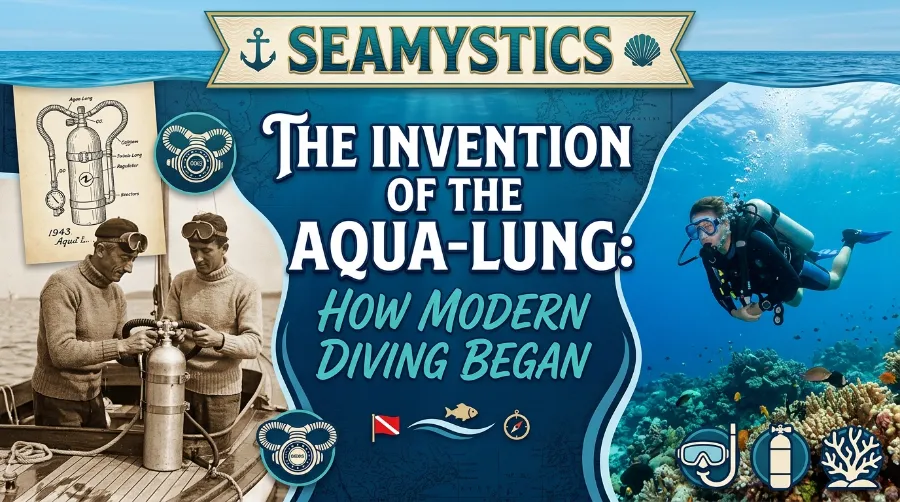

Picture a rocky cove on the French Riviera in the winter of 1942. Fuel is scarce, the war has emptied the coastline of tourists, and a young naval officer named Jacques Cousteau is testing a clunky metal box strapped to his chest, hoping it will let him breathe underwater without drowning himself in the process. That box became the Aqua-Lung, and the Aqua-Lung invention history that followed is really the story of how humans finally learned to move through the ocean instead of just looking at it from above.
The History of Shipwreck Salvage and Treasure Hunting
I have spent two decades studying reef systems and training divers, and I still tell new students this story on their first open-water dive, because every breath they take from a regulator traces back to that cove. This piece walks through how the device came together, who built it, and why it still shapes every scuba regulator on the market today.
Key Takeaways
| Fact | Detail |
|---|---|
| Inventors | Jacques-Yves Cousteau and Émile Gagnan |
| Year invented | 1943, in Paris and tested off the French Riviera |
| Original purpose of the core part | Gagnan’s demand valve was first built to regulate gas in car engines |
| First production model | The CG45, released commercially in 1946 |
| Depth of first test dive | Around 210 feet (64 metres) in the Mediterranean |
| Lasting impact | Direct ancestor of nearly every modern scuba regulator |
TL;DR: The Aqua-Lung was invented in 1943 by Jacques Cousteau and engineer Émile Gagnan, who adapted a car-engine gas regulator into a demand valve that fed air to divers only when they inhaled. It became the first safe, self-contained scuba system and the direct ancestor of first scuba regulator designs used worldwide today.
Why the Ocean Needed a New Kind of Breathing Apparatus
Before the 1940s, going underwater meant either holding your breath or hauling around heavy, surface-fed helmet suits. Neither option let a diver move freely or stay down for long. Inventors had been chasing a solution for centuries, and Aristotle himself is said to have written about breathing tubes back in the third century B.C.
Underwater Archaeology Methods Explained How Sunken History Gets Recovered
By the early twentieth century, progress had sped up. Captain Yves Le Prieur built a continuous-flow compressed-air system in 1925, and American physiologist Christian Lambertsen designed a military breathing rig in 1939 for what he called SCUBA, short for Self-Contained Underwater Breathing Apparatus. However, these early systems wasted air constantly or carried a real risk of oxygen toxicity, so divers were still working on borrowed time.
Deep Sea Submersibles A Complete History From Bathysphere to Today
What the field lacked was a way to deliver air only when a diver actually needed it. That single gap is what Cousteau and Gagnan closed.
Aqua-Lung Cousteau Gagnan: An Unlikely Partnership
Jacques Cousteau was not an engineer. He was a French naval officer who had nearly lost the use of both arms in a car crash and turned to the sea as a form of rehabilitation. Once he could swim comfortably in goggles, he became obsessed with finding a way to stay under longer, and by 1942 he was actively testing prototypes with a small circle of diving partners in the Mediterranean.
The Beagle Voyage Darwin Took How Five Years at Sea Rewrote Ocean Science
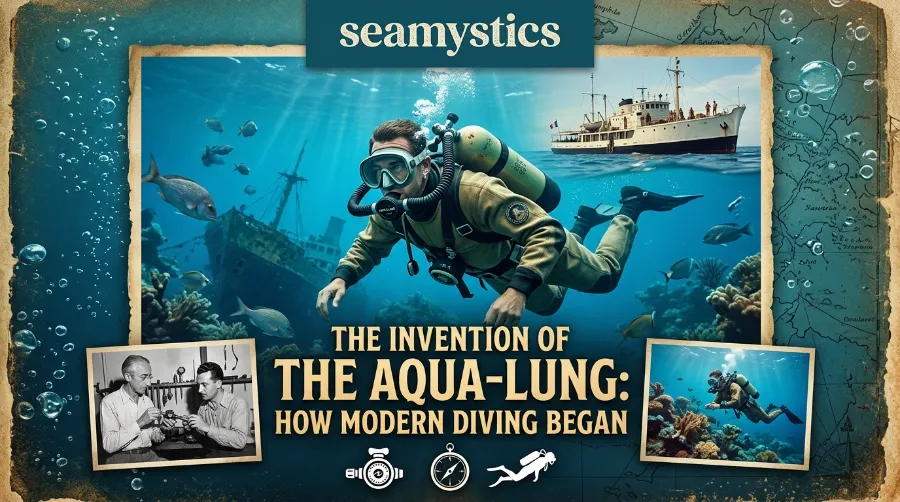
Émile Gagnan, meanwhile, was an engineer at the industrial gas company Air Liquide. His job had nothing to do with diving. He had built a demand valve that regulated gas flow into car engines running on cooking gas, a common wartime fuel substitute. When Cousteau’s father-in-law, who also worked at Air Liquide, introduced the two men, Gagnan realised his valve could be reworked to control airflow to a human diver instead of an engine.
The Invention of the Aqua-Lung How Modern Diving Began
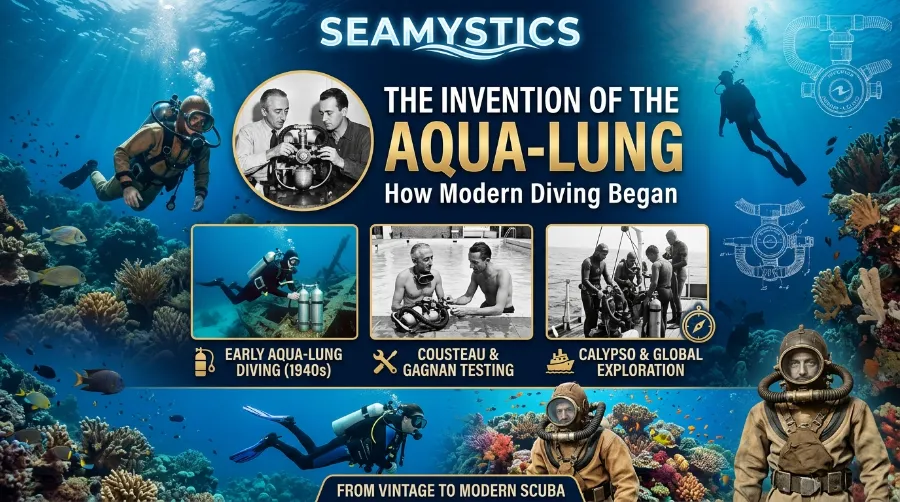
Within weeks the pair had a working prototype. Cousteau tested it himself in the winter of 1942 to 1943 near Bandol on the French coast, and by the summer of 1943 he was diving to roughly 210 feet with two colleagues, Frédéric Dumas and Philippe Tailliez, at depths that would have been unthinkable with earlier gear. That test season is widely treated as the true birth of recreational and scientific scuba diving.
The History of Underwater Photography and Filmmaking
First Scuba Regulator: How the Demand Valve Actually Worked
The genius of the design was simplicity. A twin-hose regulator sat behind the diver’s neck, connected to compressed-air tanks on the back, and released air only on inhalation, then vented the exhaled breath straight into the water. That single change meant divers stopped wasting air on a continuous flow and could stay down for far longer than any earlier system allowed.
Cold War Oceanography The Secret Race to Map the Ocean Floor
A few things made the first scuba regulator design so effective:
- It matched air delivery to the diver’s own breathing rhythm instead of a fixed flow rate.
- It worked automatically at different depths, adjusting to the surrounding water pressure.
- It was light enough that one person could carry and wear it without help.
- It used parts that were already being manufactured, which made it realistic to produce at scale once the war ended.
Cousteau and Gagnan patented the system in France in 1943. According to the historical account published by The Cousteau Society, the two men built on Le Prieur’s earlier open-circuit ideas but solved the wasted-air problem that had limited every system before it.
How Sonar Was Invented and Changed Ocean Exploration
From Prototype to Product: The Scuba Invention History Timeline
The device did not reach ordinary divers overnight. Wartime shortages and military secrecy slowed everything down, and Cousteau actually used early versions to support French resistance efforts before the technology became public.
Here is a simplified timeline of how the scuba invention history unfolded:
- 1942–1943: Cousteau and Gagnan design and test the demand-valve regulator near the French Riviera.
- 1943: The system is patented in France under both their names.
- 1943, summer: Cousteau, Dumas, and Tailliez complete deep test dives in the Mediterranean.
- 1946: The first commercial model, called the CG45, using Cousteau’s and Gagnan’s initials plus the patent year, goes on sale in France.
- 1950s: U.S. Divers begins importing and later manufacturing the equipment for the American market, and recreational diving starts spreading beyond France.
For readers who want a deeper regional angle on this rollout, Buzios Divers has put together a Portuguese-language account of how the Aqua-Lung reached diving communities outside France, and the brand’s own history page from Aqualung / Mil Pro walks through the company’s growth from that first CG45 model into the modern gear brand divers use today.
How Diving Bells Paved the Way for Modern Submarines
Modern Diving History: What Changed After the Aqua-Lung
Once ordinary people could buy a self-contained breathing system, diving stopped being a purely military or scientific activity. Cousteau’s own films, especially the 1956 documentary The Silent World, brought footage of coral reefs and shipwrecks into cinemas and pulled the wider public toward the sport. Dive clubs opened across Europe and the United States through the 1950s and 1960s, and training organisations eventually formalised the safety standards that recreational divers rely on now.
Lighthouse Navigation History: How Beacons Guided Sailors for 2,300 Years
In my own training sessions, I still see the DNA of that 1943 design in every single-hose and twin-hose regulator I hand a student. The materials have changed, and safety redundancies have improved enormously, but the core idea, air on demand, remains identical. That continuity is part of why modern diving history treats the Aqua-Lung as the true starting point of the sport rather than just one invention among many.
If you are curious about how underwater exploration tools evolved after this point, our pillar guide on the history of underwater photography covers the cameras that Cousteau and his contemporaries built to document what the Aqua-Lung let them finally reach.
Why This History Still Matters to Working Divers
I bring students to shallow wrecks every season, and I always ask them to hold their breath for thirty seconds before we suit up. It is a small exercise, but it reminds them what diving was like before 1943. The Aqua-Lung did not just create a piece of gear, it created a completely new relationship between people and the ocean, one where curiosity was no longer capped by a single lungful of air.
For a technical breakdown of the regulator mechanics themselves, the write-up from Scuba Diver Greece on the Aqua-Lung’s invention is a solid companion resource if you want the engineering side in more depth. And if this kind of ocean-exploration history interests you, you might also enjoy our related piece on the pioneers who took diving even further after Cousteau, on /related-guide.
Frequently Asked Questions
Who actually invented the Aqua-Lung? Jacques-Yves Cousteau and Émile Gagnan co-invented it in 1943. Cousteau supplied the diving expertise and testing, while Gagnan engineered the demand-valve regulator that made the system work.
What was the Aqua-Lung originally built from? Its core component, the demand valve, was adapted from a regulator Gagnan had designed to control gas flow in car engines running on cooking gas during wartime fuel shortages.
When did the Aqua-Lung become commercially available? The first production model, the CG45, went on sale in France in 1946, three years after the original patent.
Is the Aqua-Lung the same as modern scuba gear? Not identical, but directly related. Modern regulators use the same demand-valve principle, refined with better materials, redundant air sources, and improved depth performance.
How deep did the first Aqua-Lung dives go? Cousteau and his diving partners reached roughly 210 feet (about 64 metres) during test dives in the summer of 1943, a remarkable depth for the time.
Conclusion
The Aqua-Lung was not the product of a single genius working alone. It came from a naval officer’s stubborn curiosity meeting an engineer’s spare-parts solution, tested in cold water with almost no safety net. That partnership between Cousteau and Gagnan gave the world its first reliable scuba regulator, and everything divers do today, from reef surveys to wreck exploration, still runs on the same simple idea they proved in 1943: give a person air only when they need it, and the ocean opens up.
References
- The Cousteau Society, The Aqua-Lung: The Invention That Revolutionized SCUBA Diving
- Buzios Divers, O que foi o Aqualung
- Aqualung / Mil Pro, The Aqualung Story
- Scuba Diver Greece, Aqualung Invention History