
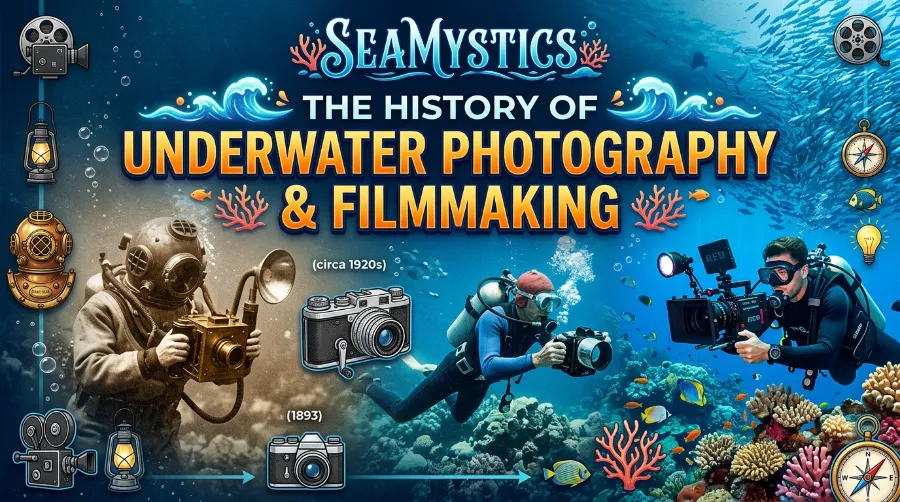

Picture a man in a heavy brass diving helmet. He stands on the seabed off the coast of France in 1893. He waits thirty minutes for a single photograph to expose. That man was Louis Boutan, and his patience gave the world its first true look beneath the waves. The story of underwater photography history is not a straight line of neat inventions. It is a messy, stubborn chain of people who refused to accept that the ocean was off limits to the camera. From glass plates that photographers sealed in wooden boxes, to the 4K housings divers carry today, this journey shaped how we see, study, and fall in love with the sea.
The Beagle Voyage Darwin Took How Five Years at Sea Rewrote Ocean Science
TL;DR: Underwater photography began in 1893, when French zoologist Louis Boutan captured the first true underwater image near Banyuls-sur-Mer, France. Jacques Cousteau’s Aqua-Lung and Calypso-Phot camera later turned diving and filming into something ordinary people could do. The GoPro launch in 2004 finally put an underwater camera in everyone’s pocket, and each leap forward has pushed marine science and ocean storytelling further than the last.
Key Takeaways at a Glance
| Milestone | Year | What Happened |
|---|---|---|
| First underwater photo attempt | 1856 | William Thompson tried a wet collodion camera off Dorset, UK |
| First true underwater photograph | 1893 | Louis Boutan photographed the seabed at Banyuls-sur-Mer, France |
| First underwater portrait | 1899 | Boutan photographed diver Emil Racovitza using a magnesium flash |
| Aqua-Lung invented | 1942 to 1943 | Jacques Cousteau and Émile Gagnan built the first practical scuba gear |
| First underwater film to win major awards | 1956 | Cousteau’s The Silent World won the Palme d’Or and an Academy Award |
| Calypso-Phot camera released | 1960 | Jean de Wouters and Cousteau built the first mass-market underwater camera |
| Nikonos series launched | 1963 | Nikon bought the Calypso-Phot design and rebranded it |
| First GoPro Hero | 2004 | Nick Woodman released a waterproof, wrist-mounted 35mm camera |
The First Underwater Photo: How the Ocean Was Finally Captured on Film
Before Boutan, there was a rougher, less successful attempt. In 1856, a British photographer named William Thompson lowered a wet collodion glass plate camera into the sea off Dorset, England. He pulled up an image that showed barely anything at all. Still, it counted as a beginning, and it proved that a camera could survive a dip beneath the surface.
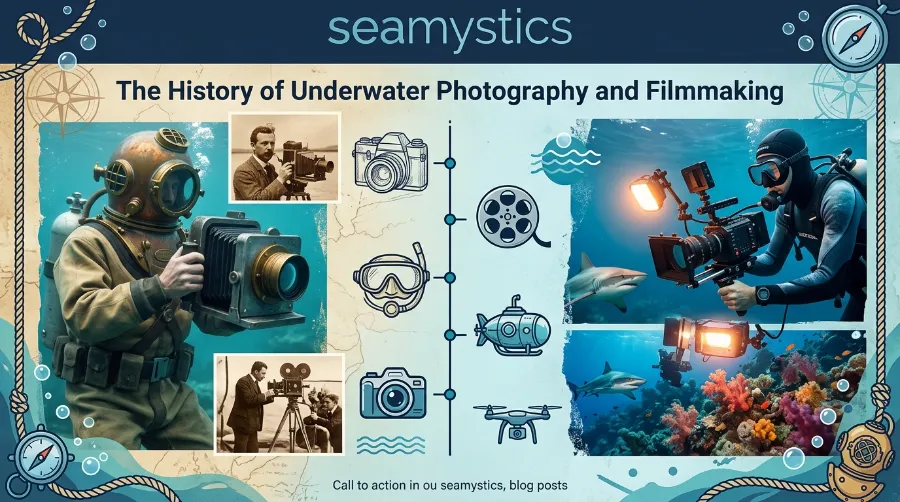
The real breakthrough came decades later. Louis Boutan, a French marine zoologist working at the Arago Laboratory in Banyuls-sur-Mer, wanted to photograph the mollusks he studied in their natural habitat rather than in a jar. Between 1893 and the years that followed, he built a zero-pressure underwater camera with a five by seven inch frame. His exposure times stretched up to thirty minutes. By 1898, he had added a magnesium powder flash to capture the first image with both camera and photographer beneath the surface at once. Historians widely credit him with the first underwater photo that actually holds up as a real photograph, not just a murky test.
The History of Shipwreck Salvage and Treasure Hunting
His method was far from elegant. He worked with his engineer brother Auguste and lab technician Joseph David to build underwater cameras into a diving helmet. Together they exposed Lumiere Brothers photographic plates and produced what many historians consider the earliest underwater photographs. The equipment weighed so much that it sometimes took three men on land just to lift it before it went into the water.
The History of Underwater Photography and Filmmaking
The First Underwater Selfie and Portrait
Boutan’s most famous image did not arrive until 1899. He exposed the first true underwater portrait that year, six years after he invented his first underwater camera setup, once he finally perfected a working underwater flash. The subject was his colleague, Romanian oceanographer Emil Racovitza. That photograph became one of the earliest visual records of a diver at work.
Deep Sea Submersibles A Complete History From Bathysphere to Today
Boutan later wrote up his findings in a 1900 book on underwater photography. Organizers displayed his images at the 1900 Exposition Universelle in Paris, introducing this new underwater visual world to a global audience for the first time. If you enjoy tracking down historical firsts like this, our team has put together a deeper guide to first photos of new species and the expert techniques behind them, which picks up right where Boutan’s story leaves off.
How Diving Bells Paved the Way for Modern Submarines
Ocean Photography Pioneers Before Scuba Gear Existed
For the next several decades, underwater photography stayed a slow, cumbersome science experiment rather than a hobby. Divers wore heavy metal helmets connected to air hoses on the surface. Every photograph demanded enormous patience.
A few key figures kept pushing the field forward during this period:
- Hans Hass, an Austrian biologist, began filming sharks and reef life in the 1940s. He used some of the earliest underwater cine cameras, well before scuba gear became common.
- William Longley and Charles Martin worked with National Geographic in the 1920s. They produced some of the first color underwater photographs using a raft-mounted flash system above the water’s surface.
- Léon Vèche, a French mechanical engineer, designed a depth-pressure-proof camera case. It made early underwater filmmaking history possible for a generation of French divers.
These pioneers worked without any of the conveniences modern photographers take for granted. There was no autofocus, no digital preview, and no waterproof housing you could buy off a shelf.
Lighthouse Navigation History: How Beacons Guided Sailors for 2,300 Years
Jacques Cousteau and the Birth of Modern Underwater Filmmaking History
If one person turned underwater photography from a scientific curiosity into a mainstream obsession, it was Jacques Cousteau. France sat under German occupation during the winter of 1942 to 1943. Even so, Cousteau worked with engineer Émile Gagnan to invent the Aqua-Lung, the first self-contained underwater breathing apparatus to achieve worldwide popularity, a device we now call scuba gear. Divers could suddenly move freely underwater instead of trailing a hose back to the surface. You can read more background on this invention on Wikipedia’s Aqua-Lung page.
That freedom changed everything for filmmaking. In 1943, Cousteau and his diving partners Philippe Tailliez and Frédéric Dumas released the film Épaves. They shot it using two of the very first Aqua-Lung prototypes anyone had built. Cousteau could not even find blank movie reels wide enough for the project. So he spliced together dozens of small still-camera film reels just to keep filming underwater.
Underwater Archaeology Methods Explained How Sunken History Gets Recovered
By 1950, Cousteau finally had a proper platform for his work. He leased the research vessel Calypso, a converted British minesweeper, from Sir Loel Guinness for one franc a year. He then turned it into a floating research and filmmaking studio. Six years later, that investment paid off in a huge way. Cousteau turned the footage his crew gathered aboard Calypso into The Silent World, released in 1956. The film won both the Palme d’Or at Cannes and an Academy Award. Mainstream audiences on land finally got to see coral reefs, wrecks, and sea creatures the way divers actually experienced them. The Cousteau Society still documents this legacy in detail on their official Calypso page.
Cold War Oceanography The Secret Race to Map the Ocean Floor
The Calypso-Phot Camera and the Nikonos Legacy
Cousteau’s contribution to underwater camera invention did not stop at diving gear. In 1960, he worked with Belgian designer Jean de Wouters to build a self-contained 35mm underwater camera. It could operate down to 60 meters. They named it the Calypso, and later marketed it as the Calypso-Phot. It quickly became the camera that serious underwater photographers wanted.
The Invention of the Aqua-Lung How Modern Diving Began
Then came the deal that changed the industry. Nikon took over production of the Calypso-Phot in 1963. The company released it as the Nikonos, and the line went on to become a long-running, celebrated series of underwater cameras. Photographers relied on it well into the 1990s. For roughly three decades, if you were a serious ocean photographer, there was a strong chance a Nikonos hung around your neck.
How Sonar Was Invented and Changed Ocean Exploration
The Digital Revolution: Underwater Camera Invention Enters a New Era
Film cameras like the Nikonos ruled the underwater world for a long time, but they had real limits. Divers had to guess their exposure settings and count their remaining frames. Then they had to wait until they got home to see whether a shot actually worked.
Digital sensors changed the math entirely. Photographers could now check their results instantly, underwater, and adjust before the moment passed them by. This shift mattered enormously for marine science too. Researchers could suddenly document reef health, fish behavior, and coral bleaching events with far greater volume and speed than film ever allowed.
A few practical improvements defined this era:
- Waterproof housings became lighter and cheaper, and manufacturers made them available for consumer cameras rather than only professional rigs.
- LED video lights replaced bulky strobe setups, making underwater filmmaking history accessible to hobbyists.
- Memory cards replaced film rolls, letting divers shoot hundreds of images per dive instead of thirty six.
The GoPro Era and the Democratization of Ocean Photography
No single product did more to put a camera in the hands of everyday divers and swimmers than GoPro. The idea started small. During a 2002 surfing trip to Australia, ruined equipment and missed shots frustrated Nick Woodman. He began sketching a wrist strap that could secure a simple camera while leaving a surfer’s hands free.
The first version was almost primitive by today’s standards. In 2004, Woodman released the original GoPro Hero, a lightweight camera that used 35mm film and required no batteries to operate. It was not fully digital yet, and it was not even waterproof at first. That changed fast. By 2006, GoPro launched the Digital Hero. It kept the same compact size, but it could now record footage and function underwater as well.
The impact on ocean storytelling was massive. Anyone with a few hundred dollars could suddenly film a shark encounter, a reef dive, or a whale breach. That kind of footage once required a National Geographic budget. It is a fitting bookend to Boutan’s story. What began with a thirty minute exposure, and three men lifting equipment, ended up fitting in a diver’s palm.
Modern Ocean Photography Pioneers Carrying the Torch
People are still writing today’s underwater photography history, pushing the same boundaries Boutan first crossed in 1893. David Doubilet, born in 1946, has worked as a contributing photographer for National Geographic since 1971. He has published more than seventy feature articles built around his underwater images. He started out at age twelve with a Brownie Hawkeye camera, which he sealed inside a rubber anesthesiologist’s bag to keep the water out. His split-level shots, half above water and half below, remain some of the most copied techniques in the field. You can see his full body of work on his Wikipedia profile.
Modern photographers now blend science and storytelling in ways earlier pioneers could only dream of. Marine biologists frequently double as photographers themselves. They document new species discoveries as part of their own fieldwork rather than hiring a separate crew. If that side of the story interests you, we cover it in our piece on what it actually looks like when scientists discover a new octopus species.
| Camera | Year | Max Depth | Why It Mattered |
|---|---|---|---|
| Boutan’s helmet rig | 1893 | ~50m | First working underwater camera setup |
| Calypso-Phot | 1960 | 60m | First mass-market 35mm underwater camera |
| Nikonos | 1963 | 60m | Standard camera for pros and amateurs for 30 years |
| GoPro Hero (original) | 2004 | 5m, no housing | First affordable action camera |
| Modern GoPro (with housing) | 2020s | 60m | Digital 4K, waterproof out of the box |
Depth capability did not climb in a straight line, either. It actually dipped when GoPro launched in 2004, since Woodman built that first Hero for surfers riding waves, not divers descending reefs. It took a few more product cycles before action cameras caught back up to what a 1960s Nikonos could already handle.
Why This History Still Matters for Marine Conservation Today
None of this is just trivia for camera collectors. Every leap in underwater photography history has directly expanded what marine science can document. It has expanded what the public can understand about ocean health, too. Researchers and citizen divers now track coral bleaching events, plastic pollution, and shifting migration patterns visually and in real time, using tools Boutan could never have imagined.
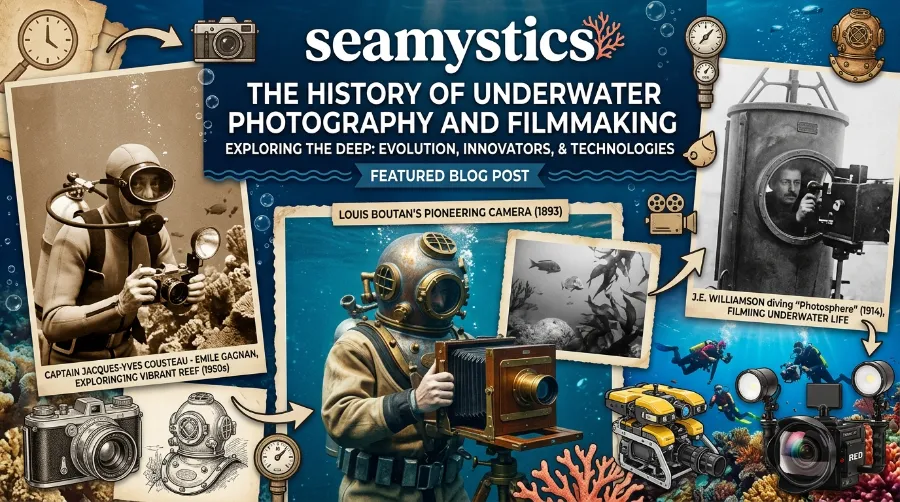
For readers who want the full technical evolution of this equipment, our detailed guide covers housing design, strobe technology, and lens choices across the decades. Find it at our underwater photography gear guide.
A few respected voices in the diving and photography community have also written excellent field accounts of this shift. Henley Spiers documents this evolution frequently on his own photography blog. The Nomadic Photographer’s underwater stories section collects strong first-hand field accounts as well. For a more equipment-focused walk through this same timeline, check out Housing Camera’s history of underwater photography.
Frequently Asked Questions
Who took the first underwater photo?
Historians credit Louis Boutan, a French marine zoologist, with the first true underwater photograph. He captured it in 1893 near Banyuls-sur-Mer, France, while studying mollusks.
When was the underwater camera invented?
Boutan built the first working underwater camera setup around 1893. The underwater camera invention most people recognize today traces back to the 1960 Calypso-Phot, which Jacques Cousteau and Jean de Wouters developed.
What was the first underwater film?
Jacques Cousteau, Philippe Tailliez, and Frédéric Dumas released Épaves in 1943. Many historians regard it as one of the earliest underwater films, and the team made it using some of the first Aqua-Lung prototypes.
How did GoPro change underwater filmmaking?
GoPro’s 2004 Hero camera, and its 2006 waterproof Digital Hero follow-up, made underwater filming affordable for the first time. Everyday divers and swimmers could finally shoot footage that once required trained professionals.
Who are today’s leading ocean photography pioneers?
David Doubilet remains one of the most influential names. He has worked as a National Geographic contributing photographer since 1971, alongside a growing community of marine biologists who photograph their own fieldwork.
Conclusion
Underwater photography history stretches from a thirty minute exposure on the seafloor in 1893 to a 4K clip shot on a wrist-mounted camera today. It has always moved at the pace of human stubbornness rather than convenience. Louis Boutan refused to accept that mollusks could only be studied out of water. Jacques Cousteau refused to accept that filmmakers needed a surface air hose. Nick Woodman refused to accept that a decent camera had to stay reserved for professionals. Each of them pushed the ocean a little closer to the rest of us, and that work continues today, one dive and one frame at a time.
References
- GeoGarage Blog, The First Underwater Photo, geogarage.com
- Guinness World Records, First Underwater Photo Portrait, guinnessworldrecords.com
- Wikipedia, Aqua-Lung, en.wikipedia.org
- Wikipedia, Calypso (camera), en.wikipedia.org
- Wikipedia, David Doubilet, en.wikipedia.org
- The Cousteau Society, Calypso, cousteau.org
- Housing Camera, Diving Into History: The Evolution of Underwater Photography, housingcamera.com