

Picture a ship’s captain in 1750. He stands on deck in total darkness. He has no radar, no radio, and no satellite overhead. The only thing between his crew and the rocks below is a flicker of flame on a distant tower.
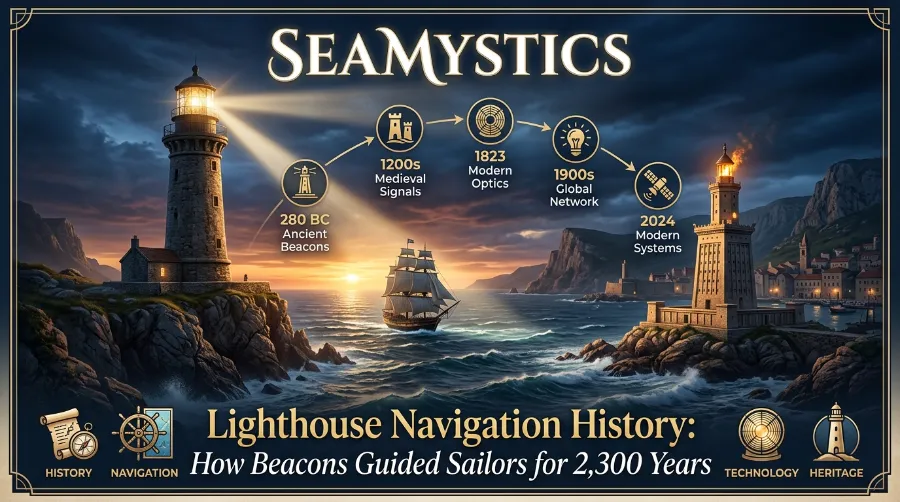
That flicker sums up lighthouse navigation history in one image. A small, stubborn light told sailors where safe water ended and danger began. For more than two thousand years, this simple idea shaped trade routes, saved fleets, and quietly built the maritime world we live in today. This piece traces that story from ancient Egypt to the age of GPS. It draws on the oldest lighthouse history, the big leaps in lighthouse technology history, and the famous lighthouses history buffs still visit today.
TL;DR: Lighthouses began as bonfires on hilltops. They evolved into engineered towers, starting with the Pharos of Alexandria around 280 BC. Better lenses, oil lamps, and electricity turned scattered signal fires into a coordinated global system. GPS now supplements that system rather than replacing it, because lighthouses still work when electronics fail.
Key Takeaways
| Era | What Changed | Why It Mattered |
|---|---|---|
| 280 BC | Pharos of Alexandria built | First engineered lighthouse tower, over 330 feet tall |
| 1st-2nd century AD | Tower of Hercules built in Spain | Still operating today, the oldest working lighthouse on Earth |
| 1698 | Eddystone Lighthouse first lit | First offshore rock lighthouse in open ocean |
| 1716 | Boston Light established | First lighthouse in what became the United States |
| 1789 | US Lighthouse Act signed | Federal government took over America’s coastal lights |
| 1822 | Fresnel lens invented | Beam range jumped from a few miles to over 20 miles |
| 1973-1995 | GPS developed and opened to civilians | Satellites became the primary tool, lighthouses became backup |
From Bonfires to Beacons: Where It All Began
Long before anyone built a tower on purpose, sailors relied on ordinary fires. Coastal communities lit bonfires on hilltops and headlands. These fires simply marked where the land ended. Mariners learned to read those glowing points like a street sign. Someone eventually realized that a higher fire could be seen from farther out. That small insight launched the entire concept of a lighthouse.
Historians often point to Sigeion in the Troad as the first true, purpose-built lighthouse. The Greek poet Lesches mentioned it around 660 BC. But one building actually defines ancient lighthouse navigation history: the Pharos of Alexandria.
The Pharos of Alexandria: The Original Lighthouse
Construction began under Ptolemy I Soter. His son, Ptolemy II, finished the project around 280 to 247 BC. The Ptolemaic Kingdom of Ancient Egypt built the tower on the island of Pharos, at the entrance to Alexandria’s harbor. Estimates of its height vary, since so little of it survives. Most sources place it between 330 and 390 feet. That made it one of the tallest structures on Earth for centuries, second only to the Great Pyramid of Giza.
The Beagle Voyage Darwin Took How Five Years at Sea Rewrote Ocean Science
Here’s a detail that tends to surprise people. The Pharos didn’t collapse in one dramatic event. It stood for roughly 1,500 to 1,600 years. A series of earthquakes across the tenth through fourteenth centuries gradually weakened it. It finally fell. By 1477, workers reused the ruined stones to build a coastal fort, a fairly ordinary end for a genuine wonder-of-the-world structure.
How Diving Bells Paved the Way for Modern Submarines
The Pharos matters most to lighthouse technology history because of its name. The Greek word for the island, Pharos, became the root word for lighthouse in French (phare), Italian (faro), Spanish (faro), and Romanian (far). Every time an engineer in Marseille or Lisbon names the building they maintain, they unknowingly quote a 2,300 year old harbor marker.
If you enjoy this kind of long technological arc, our related piece on sonar invention history traces a similarly quiet revolution. That one hides underwater instead of glowing from a tower.
The Oldest Lighthouse Still Working Today
The Pharos gets most of the attention, but it isn’t actually the oldest lighthouse still doing its job. That title belongs to the Tower of Hercules in A Coruña, Spain. Builders raised this Roman tower during the reign of Emperor Trajan, in the late first or early second century AD. It has guided ships for roughly 1,900 years straight.
Why the Tower of Hercules Still Stands
The Romans originally called it the Farum Brigantium. It marked a key stretch of the sea route linking the Mediterranean to northwest Europe, along the rugged Galician coast. Workers restored it in the eighteenth century. UNESCO named it a World Heritage Site in 2009.
This single fact reframes the oldest lighthouse history conversation. The Pharos was the most famous lighthouse, but it’s gone. The Tower of Hercules is the one still shining. It has survived Roman legions, Visigothic kingdoms, Spanish empires, and two world wars, and it still does exactly what it was built to do.
Building in the Open Sea: The Eddystone Story
Most early lighthouses sat on solid ground near a harbor mouth. Building one on an isolated, wave-battered rock in the open ocean posed a very different problem. Nowhere illustrates that struggle better than the Eddystone Rocks off Plymouth, England.
Two Failed Towers
Engineer Henry Winstanley designed the first attempt, an ornate wooden tower built between 1696 and 1699. A storm destroyed it in 1703. That same storm killed Winstanley, who happened to be on site making repairs. John Rudyerd designed a second wooden tower, which lasted until 1755. Then it burned down. The fire was so intense that a 94 year old keeper died after swallowing molten lead that dripped from the melting roof.
Smeaton’s Breakthrough Design
The third attempt changed everything. Engineer John Smeaton studied the shape of an oak tree for inspiration. He designed a granite tower using interlocking stone blocks and dovetail joints. Workers built it between 1756 and 1759. On October 9, 1759, Smeaton’s lighthouse blazed to life for the first time. The achievement had seemed impossible, given how the two previous towers had failed.
This design became the template for offshore lighthouses worldwide. It directly shaped modern civil engineering. In fact, people still call Smeaton the father of the profession.
Meanwhile, France built its own offshore masterpiece across the Bay of Biscay. Workers began the Cordouan Lighthouse in 1584 and finished it in 1611, seven kilometers out in the Gironde estuary. Locals nicknamed it the king of lighthouses. It remains the oldest French lighthouse still in operation, and the only sea lighthouse in the country still open to visitors. In 1823, Cordouan became the testing ground for a technology that changed lighthouse engineering forever.
The Lens That Saved a Million Ships
Before 1822, lighthouses relied on open flames, mirrors, and parabolic reflectors. Honestly, they weren’t very good at their job. A lamp radiates light in every direction. Most of that light simply wasted away into empty air instead of pointing out to sea.
Fresnel’s Elegant Solution
French physicist Augustin-Jean Fresnel solved the problem. The French government recruited him as commissioner of lighthouses in 1819. In 1822, he developed a multipart lens that captured up to 80 percent of a lamp’s light. It projected that light up to 20 miles out to sea. Instead of one weak beam bleeding outward in every direction, the Fresnel lens concentrated the light into a narrow, powerful ray.
Cordouan became the first lighthouse in the world fitted with this technology, in 1823. The results spoke for themselves. Within decades, the Fresnel lens became the global standard. By the 1860s, every lighthouse in the United States carried one. Some engineers of the era claimed the lens saved a million ships. That number leans more toward legend than statistic, but the sentiment still holds up. This was the single biggest leap in maritime navigation history between the ancient world and the age of radio.
A few quick numbers worth remembering:
- Pre-Fresnel lighthouses: visible for roughly 5 to 8 miles on a clear night
- Post-Fresnel first-order lenses: visible for up to 20 to 25 nautical miles
- Adoption speed: from invention in 1822 to full US coverage by the 1860s, roughly 40 years
If you’re curious how similarly quiet inventions changed what humans could see underwater, our guide to the invention history of the aqua lung covers a comparable leap. That one arrived a century later, pointed downward instead of outward.
America Builds Its Own System
Across the Atlantic, the American colonies built their own answer to the same problem. Boston Light became the first lighthouse in what would become the United States. Workers first lit it on September 14, 1716, on Little Brewster Island. Local merchants had petitioned the Massachusetts legislature for a lighthouse back in 1713. They chose Little Brewster as the site, and a tonnage tax on ships entering the harbor funded the project.
A Rocky History for Boston Light
Boston Light did not have a peaceful history. British troops destroyed it in 1776, during the Revolutionary War. Massachusetts rebuilt it in 1783, and that same structure still stands today. Its story also captures a wonderfully human detail. After serving faithfully for 215 years, Boston Light became the last lighthouse in the country to get automated, in 1998. Congress kept it staffed under a special act until keeper Sally Snowman retired in 2023.
The 1789 Law That Changed Everything
The bigger institutional turning point came just a few years after independence. On August 7, 1789, Congress passed an act placing the nation’s lighthouses, beacons, buoys, and public piers under federal care. It was only the ninth law the new Congress ever enacted. By that point, 12 lighthouses stood along the American coastline, all suddenly under one coordinated system instead of a patchwork of state and colonial control.
That single law matters just as much to lighthouse navigation history as any piece of hardware. It turned lighthouses from a local convenience into national infrastructure. Today, estimates vary depending on how strictly you define the term. But the United States maintains somewhere between 400 and 800 lighthouse structures, alongside roughly 50,000 total aids to navigation of every kind.
For readers interested in how governments handled dangerous or valuable material recovered from the sea during this same period, our piece on shipwreck salvage history sits right next to this topic.
Comparing the Giants: Height and Reach
Numbers help put these towers in perspective. A lighthouse’s job always came down to two things: how high it stands, and how far its light can reach. The chart above compares five famous towers by height, from the Pharos of Alexandria at roughly 350 feet down to Boston Light at 89 feet.
Height was never just about vanity. A taller tower pushes its beam farther over the curve of the earth. That’s exactly why the Pharos, built to rival the Great Pyramid, could reportedly be seen up to 35 miles out to sea using mirrors and firelight alone.
The Electric Age and the Slow Fade of the Keeper
By the late nineteenth and early twentieth centuries, oil lamps gave way to electric bulbs. The physical work of keeping a lighthouse running started to shrink. Fog signals, radio beacons, and eventually radar filled in the gaps that light alone couldn’t cover, especially in poor visibility.
Automation crept in gradually rather than all at once. According to Coast Guard records, nearly every US lighthouse had been automated by 1990, except one. Congress specifically kept Boston Light staffed as a tribute to the tradition it represented. That single exception says a lot about how attached people remained to the human side of this story, even as the technology moved on without them.
Satellites Take Over: The GPS Era
The next disruption didn’t come from a better lens or a brighter bulb. It came from space. The GPS program formally began on September 17, 1973. The US Department of Defense merged several competing military navigation projects into one system, originally called NAVSTAR. Engineer Bradford Parkinson led the team. They designed the 24 satellite architecture over a single weekend at the Pentagon.
Civilian Access Changes the Game
The system became fully operational by 1995. In 1996, President Bill Clinton announced that GPS would open to civilian users. This launched a new era for automotive navigation, aviation, and maritime navigation history alike. Suddenly, a fishing boat or a container ship could know its exact position anywhere on Earth. It never needed to look for a light on the horizon again.
People often describe this moment as the end of the lighthouse era, and there’s truth in that. Lighthouse preservation experts estimate that only 60 to 70 percent of America’s roughly 800 remaining lighthouses still work as active navigational aids today. Communities preserve the rest as historic landmarks rather than working equipment.
But that’s not the whole story.
Why Lighthouses Still Matter in a GPS World
Ask any experienced mariner why lighthouses haven’t disappeared entirely. The answer usually comes down to one word: redundancy. Electronics fail. Solar activity or deliberate interference can jam or knock out satellites. A granite tower with a working lens can’t be hacked, and it doesn’t need a software update.
Four Reasons Lighthouses Persist
- Backup during electronic failure, since solar storms or interference can disrupt GPS signals
- Visual confirmation for pilots and small craft operators who want a physical landmark to double check their instruments
- Cultural and tourism value, since many coastal communities depend on lighthouse tourism for local economic activity
- Historical preservation, with more than 200 lighthouses now listed on the National Register of Historic Places
One longtime lighthouse historian summed it up well in an interview about his state’s lighthouses. Most boats today carry GPS and VHF radio. But that equipment can fail. It doesn’t hurt to have physical, tangible things like lighthouses and buoys to confirm a vessel’s position. That practical, unglamorous logic explains why these towers have outlived every prediction of their extinction.
Readers who enjoy this tension between old and new maritime technology may also like our piece on Cold War era oceanography, which covers a similarly dramatic technological pivot point at sea.
A Working Timeline of Lighthouse Navigation History
| Year | Event |
|---|---|
| c. 660 BC | Earliest recorded lighthouse mentioned at Sigeion |
| 280-247 BC | Pharos of Alexandria built |
| 1st-2nd century AD | Tower of Hercules built in Spain, still operating today |
| 1611 | Cordouan Lighthouse completed in France |
| 1698-1759 | Three Eddystone Lighthouses built and destroyed in England |
| 1716 | Boston Light established, first US lighthouse |
| 1789 | US Lighthouse Act signed, federal system created |
| 1822-1823 | Fresnel lens invented and first installed at Cordouan |
| 1860s | All US lighthouses fitted with Fresnel lenses |
| 1973 | GPS program formally begins |
| 1995-1996 | GPS made fully operational and opened to civilians |
| 1998-2023 | Boston Light automated, last keeper retires in 2023 |
Frequently Asked Questions
What is the oldest lighthouse in the world?
The Tower of Hercules in A Coruña, Spain holds this title. It’s the oldest lighthouse still operating, dating back to the first or second century AD. The Pharos of Alexandria came earlier, but it no longer exists.
Who invented the modern lighthouse lens?
French physicist Augustin-Jean Fresnel invented the Fresnel lens in 1822. Engineers first tested it at Cordouan Lighthouse in France in 1823. It remains the design basis for most lighthouse optics used today.
When did lighthouses become automated?
US lighthouse automation happened gradually through the twentieth century. Nearly all towers were automated by 1990. The final staffed exception, Boston Light, was fully automated by 1998, though it kept a ceremonial keeper until 2023.
Did GPS make lighthouses obsolete?
Not entirely. GPS became the primary navigation tool once it opened to civilians in 1996. But lighthouses remain active as backup aids to navigation, because satellite systems can fail or get disrupted.
How many lighthouses are still active in the United States?
Estimates vary. Roughly 400 to 800 lighthouse structures remain in the US. Lighthouse historians estimate that around 60 to 70 percent of them still function as active aids to navigation.
Conclusion
Lighthouse navigation history is really a story about persistence. A fire on a hilltop became a stone tower. A stone tower became a precision optical instrument. Eventually, that optical instrument started sharing its job with a satellite orbiting hundreds of miles overhead. One thing hasn’t changed: the desire to give a sailor something solid to look for in the dark. Even now, with GPS in every pocket, that flicker of light on the horizon still means exactly what it meant to a Ptolemaic sailor sighting the Pharos two thousand years ago. Land is close, and the way home is marked.
For readers who want to keep exploring how humans have learned to work with, and survive, the ocean, our archive on deep-sea submersibles picks up a related thread of maritime engineering history.
References
- National Park Service, History of Lighthouses in the United States: https://home.nps.gov/articles/000/history-of-lighthouses.htm
- Smithsonian National Museum of American History, Fresnel Lighthouse Lens: https://www.si.edu/object/fresnel-lighthouse-lens:nmah_844143
- Wikipedia, History of Lighthouses: https://en.wikipedia.org/wiki/History_of_lighthouses
- Wikipedia, Eddystone Lighthouse: https://en.wikipedia.org/wiki/Eddystone_Lighthouse
- Wikipedia, Cordouan Lighthouse: https://en.wikipedia.org/wiki/Cordouan_Lighthouse