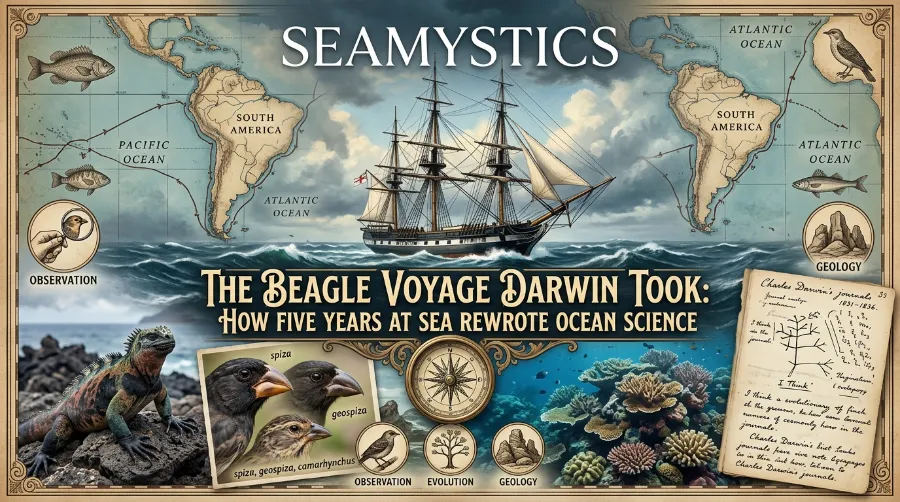

A 22-year-old with a beetle collection boarded a cramped ten-gun brig in December 1831. He had a bad case of seasickness too. The Beagle voyage Darwin took across the Atlantic and Pacific lasted almost five years. It produced far more than a famous book about finches. It gave marine science its first serious look at coral reefs, ocean currents, and deep-time geology. This happened long before anyone had a name for oceanography.
How Diving Bells Paved the Way for Modern Submarines
TL;DR: The Beagle voyage Darwin joined in 1831 circled the globe over nearly five years. It turned a young naturalist into the founder of modern evolutionary and ocean science. Along the way, Darwin mapped coral reef formation and collected thousands of marine specimens. Below, we walk through the HMS Beagle history, the expedition route, and the ocean discoveries that still shape marine biology today.
Key Takeaways
| Topic | What Happened | Why It Matters Today |
|---|---|---|
| Voyage dates | December 27, 1831 to October 2, 1836 | Nearly five years of continuous field observation, rare even now |
| Ship | HMS Beagle, a converted 10-gun brig launched May 11, 1820 | Shows how modest equipment produced major discoveries |
| Route | South America, Galapagos, Tahiti, Australia, Indian Ocean, South Africa | Set the template for later global research expeditions |
| Coral reef theory | Published 1842 in The Structure and Distribution of Coral Reefs | Still the basic framework used to explain atoll formation |
| Barnacle research | Eight years of study, Royal Medal awarded 1853 | Cemented Darwin’s authority before he published on evolution |
| Galapagos arrival | September 15, 1835, sailing from Callao, Peru | Produced the finch and tortoise evidence behind natural selection |
Why the Beagle Voyage Darwin Took Still Matters Today
It is easy to reduce this story to finches and beak shapes. But the Darwin Beagle voyage was really an ocean science expedition first. FitzRoy’s orders were to survey coastlines, chart currents, and take longitude readings. He was not hunting for evolutionary evidence. Darwin was brought along as a gentleman naturalist and dinner companion. FitzRoy feared the isolation of command.
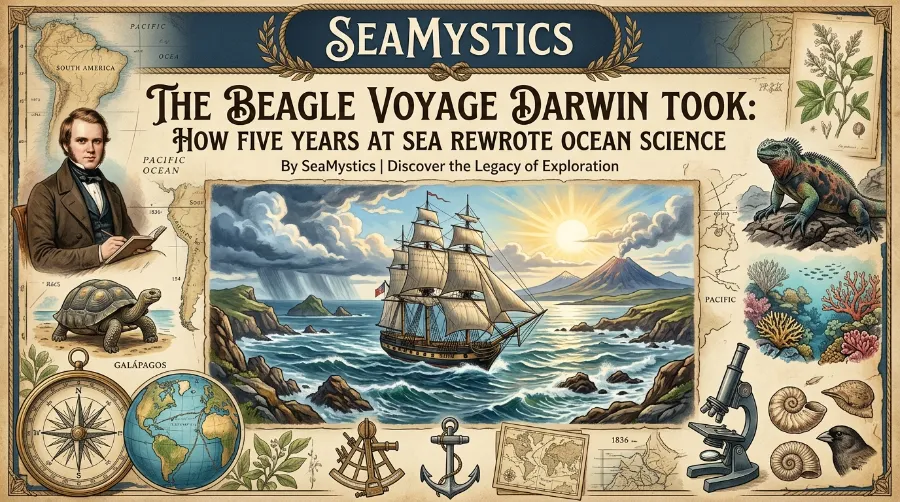
Because of that surveying mission, Darwin spent enormous amounts of time near open water and tide pools. He worked reef systems too. He was, in effect, one of the first working marine biologists. The term did not even exist yet. That accidental framing matters. It explains why so many of his ocean observations still hold up more than 180 years later.
Lighthouse Navigation History: How Beacons Guided Sailors for 2,300 Years
HMS Beagle History: The Ship, the Crew, and the Mission
A Warship Built for Survey Work
HMS Beagle was launched on May 11, 1820, at the Woolwich dockyards on the River Thames. She started life as a flush-decked brig meant for scouting duty, not scientific glory, HMS Beagle was launched on May 11, 1820, at Woolwich, the site of the Royal Navy’s dockyards on the River Thames near London, and the ship was designed as a flush-decked, 10-gun brig intended for scouting, courier duty, and other light assignments. By 1825 she had been converted to a bark rig. Further upgrades then prepared her for the long second survey voyage that would carry Darwin around the world.
The ship carried a genuinely crowded roster for such a small vessel. Officers, midshipmen, seamen, marines, and supernumeraries pushed the total well past sixty people. Darwin himself had to sling his hammock above the chart table. There was nowhere else to put him, a total of 10 officers, 4 midshipmen and volunteers, 38 seamen and boys, 8 marines, and 8 supernumeraries, including Darwin, started the voyage, and the ship was so crowded that Darwin had to sleep in a hammock slung above the drafting table in the poop cabin. That single detail tells you how little space existed for the fossils and specimens Darwin was about to collect.
The Crew Behind the Circumnavigation
Robert FitzRoy commanded the Beagle. He wanted a trained observer on board who could study geology during the long stretches at sea. Darwin was fresh out of Cambridge and only 22 years old. His only prior credential was an amateur beetle collection, yet he fit the role well.
The mission itself was funded privately rather than by the navy. Darwin’s father initially refused to pay. It was his uncle, Josiah Wedgwood II, who quietly financed the trip. Readers researching HMS Beagle history often overlook this financial detail. Yet it shaped everything that followed, since Darwin sailed as an unpaid civilian rather than a navy employee.
Beagle Expedition Route: Charting Five Years at Sea
The Beagle expedition route was ambitious by any standard. This explains why Darwin’s ocean observations cover such a wide range of ecosystems. FitzRoy needed a complete circle of longitude measurements. That task required 22 chronometers. It was ultimately completed within just 33 seconds of error, an extraordinary feat of navigation for 1831, a goal of the voyage was to obtain a complete circle of measurements of longitude, a feat requiring the use of 22 chronometers and accomplished within only 33 seconds of error.
| Leg | Approximate Dates | Key Stops | Scientific Focus |
|---|---|---|---|
| Departure and South Atlantic | Dec 1831 to 1832 | Plymouth, Cape Verde, Brazil | Tropical rainforest specimens, early geology |
| South American coast | 1832 to 1834 | Argentina, Tierra del Fuego, Chile | Fossil mammals, earthquake and volcano observations |
| Pacific crossing | 1835 | Galapagos Islands, Callao, Peru | Finches, tortoises, marine iguanas |
| Wider Pacific and Indian Ocean | 1835 to 1836 | Tahiti, Australia, Keeling Islands | Coral reef structure and formation |
| Return voyage | 1836 | South Africa, St Helena, England | Final specimen cataloguing |
Darwin actually spent roughly three of the nearly five years on land. This gave him time to explore inland geology while the crew handled coastal surveying. That balance of land and ocean work explains why his eventual writings blended geology, biology, and what we would now call oceanography so seamlessly.
Darwin Ocean Observations That Changed Marine Science
Coral Reefs and the Birth of Atoll Theory
Darwin sketched out a theory of coral atolls before he ever saw a living reef. His idea had to explain how they form in open ocean water far deeper than coral can survive. When the Beagle finally reached a reef near Mauritius on the homeward leg, Darwin wrote that such formations rank among the most wonderful objects in the world. Remarkably, he came up with the foundation of this theory before he ever saw a coral reef with his own eyes.
His idea was elegant. Reefs grow upward as the seafloor slowly subsides. The living coral keeps pace with the sinking land beneath it. Eventually this leaves a ring-shaped atoll where an island once stood. He tested this against real island chains, drawing on volcanic activity and reef development he had personally surveyed.
Darwin published the full theory in 1842 as The Structure and Distribution of Coral Reefs. For that work, plus eight years of barnacle research, he received the Royal Society’s Royal Medal in 1853, and for this and his work on barnacles, Darwin received the Royal Society’s royal medal in 1853. Modern marine geologists still use a version of Darwin’s subsidence model. It explains atoll formation in the Pacific, which is rare to say about a 19th century theory built without sonar or satellite data.
Barnacles, Plankton, and the Patience of Fieldwork
Darwin’s collecting habits during the voyage were relentless rather than glamorous. He gathered specimens ranging from microscopic plankton to Megatherium fossils. His forecastle became a makeshift storage room for crates of samples destined for London specialists.
His later, less famous barnacle work grew directly out of specimens gathered near South America. That eight year project on barnacle taxonomy might sound tedious. Yet it built the detailed observational discipline he needed before tackling a theory as controversial as natural selection. A few numbers illustrate the scale of his effort:
- Nearly five years at sea, from December 1831 to October 1836
- 22 chronometers used for longitude work, accurate to within 33 seconds
- Eight years spent studying barnacle taxonomy after returning home
- 23 years between the voyage’s end and the 1859 publication of On the Origin of Species
Galapagos and the Seeds of Evolution
The Beagle arrived in the Galapagos on September 15, 1835. It sailed in from the Peruvian port of Callao. Darwin treated the islands as something close to a dream assignment, since the HMS Beagle arrived in the Galápagos on September 15, 1835, having sailed from the port of Callao in Perú, and Darwin surveyed the islands extensively before bringing aboard a colossal amount of cargo, including notes, rocks, bones, feathers, and skins. He noticed that tortoise shell shapes varied from island to island. Mockingbird features shifted too. Those small differences eventually became core evidence for evolution by natural selection.
It is worth remembering FitzRoy’s actual survey priorities were economic, not biological. He was mainly assessing whaling potential. Darwin’s now-famous observations were, in a sense, a side project. That side project outlived the mission’s original purpose by more than a century and a half.
From Sailing Ship to Sonar: How Ocean Exploration Evolved After Darwin
Darwin worked with nothing more advanced than a hand lens, a notebook, and patience. Yet his instinct for systematic observation set a template. Ocean scientists still follow that template today.
Navigation Tools After the Beagle
Anyone curious about how navigation developed after Darwin’s era should look at our guide to lighthouse navigation history. It picks up the story of how sailors solved positioning problems. FitzRoy had only chronometers and dead reckoning to work with.
From Hand-Drawn Charts to Sound
Later oceanographers eventually replaced hand-drawn charts with acoustic technology. We cover that shift in our piece on sonar invention history. That leap from visual surveying to sound-based mapping is arguably the biggest change in seafloor study since Darwin’s day.
Modern Tools Darwin Never Had
Modern expeditions have gained tools Darwin could never have imagined. Our feature on deep-sea submersibles describes several of them. Where Darwin had to wait for a reef to surface, today’s researchers can descend directly to depths of several thousand meters.
A few lessons from Darwin’s fieldwork still shape marine research practice:
- Record observations immediately and in detail, since memory fades fast.
- Collect specimens systematically rather than selectively, since patterns often only appear later.
- Compare findings across locations, the way Darwin compared islands in the Galapagos.
- Stay open to revising a theory as new evidence arrives, which Darwin did with his coral reef model.
If you want a broader view of how ocean exploration became a documented science, our pillar guide on underwater photography history traces the visual record. That record eventually replaced hand sketches like the ones Conrad Martens produced aboard the Beagle.
For primary sources rather than summaries, the Darwin Correspondence Project’s account of the Beagle voyage and the five-year journey breakdown from Kronecker Wallis both go deeper into the expedition. A more visual route map is available through this interactive Beagle voyage resource if you prefer to trace the journey stop by stop.
Frequently Asked Questions
How long did the Beagle voyage Darwin took actually last?
It ran from December 27, 1831 to October 2, 1836. That is just under five years, though the trip was originally planned for only two.
Was Darwin the ship’s official naturalist?
Not officially. He sailed as a supernumerary and gentleman companion to Captain FitzRoy. The formal naturalist label only stuck after the voyage’s scientific impact became clear.
What was Darwin’s first major scientific theory from the trip?
His coral reef and atoll formation theory came first, published in 1842. It earned him the Royal Society’s Royal Medal in 1853, well before his evolutionary work appeared.
Did Darwin discover evolution during the voyage itself?
No. He gathered the raw observations, especially from the Galapagos. He did not publish On the Origin of Species until 1859, 23 years after returning to England.
What ocean-related discoveries came out of the Beagle voyage besides evolution?
Coral reef and atoll formation theory came from it. So did extensive marine specimen collection and detailed coastal geology of South America.
Conclusion
The Beagle voyage Darwin took started as a coastal survey mission. It ended up reshaping how humans understand life in the ocean. From atoll formation theory to the finches that later illustrated natural selection, nearly every major discovery traces back to patient, repeated observation. That approach still defines good marine science today. Watch closely, record everything, and let the evidence accumulate, whether the tool in hand is a hand lens or a deep-sea submersible.
References
- Britannica, “Beagle: Darwin’s Voyage, HMS Beagle and Ship’s History”
- The History Blog, “Read and See What Darwin Read and Saw on the HMS Beagle”
- Wikipedia, “The Voyage of the Beagle” and “Second Voyage of HMS Beagle”
- Darwin Correspondence Project, “Voyage of HMS Beagle” and “Darwin and Coral Reefs”
- Smithsonian Ocean, “Charles Darwin’s Ocean Upwelling”
- Natural History Museum, “Charles Darwin’s Coral Conundrum”
- AbeBooks, publication history of “The Structure and Distribution of Coral Reefs”