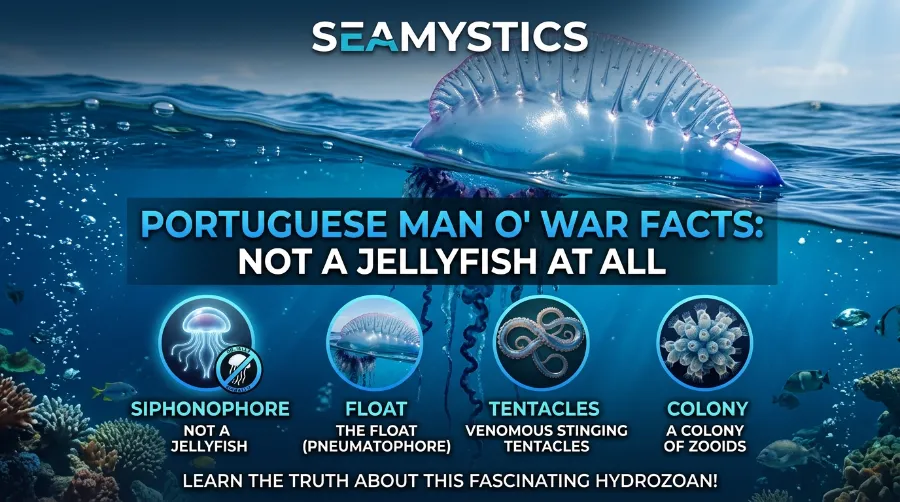

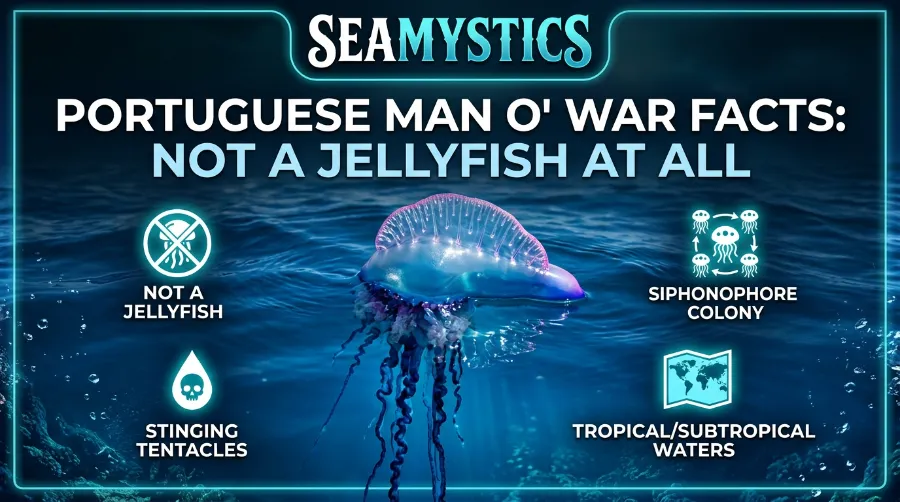
If you have ever spotted a bright blue balloon floating just off the shoreline and assumed it was a jellyfish, you are not alone. The Portuguese man o’ war fools almost everyone at first glance, and honestly, it fooled marine science too for a long time. This creature drifts on the open sea like a tiny pirate ship, dragging tentacles that can stretch further than a school bus is long, yet it is not one animal at all. It is a floating colony, and once you understand what that actually means, the ocean starts to feel a little stranger and a lot more fascinating.
In this guide, we will walk through what the Portuguese man o’ war really is, where it lives, why its sting hurts so much, and how it compares to true jellyfish. We will also look at real incidents from recent years, so you can see why lifeguards from Florida to France still take this creature seriously.
TL;DR
The Portuguese man o’ war is a siphonophore, not a jellyfish, and it is actually a colony of specialized organisms working as one. It drifts across warm oceans worldwide, delivers a sting that can cause intense pain and, rarely, serious allergic reactions, and the current science-backed first aid is vinegar, not urine or ice. Because it cannot swim on its own, wind and current patterns decide where it ends up, which is exactly why beach closures from the Gulf Coast to the French Atlantic keep making headlines.
Key Takeaways
| Fact | Detail |
|---|---|
| Scientific name | Physalia physalis |
| Classification | Siphonophore (colonial hydrozoan), not a true jellyfish |
| Float length | Roughly 9 to 30 cm (about 3.5 to 12 inches) |
| Tentacle length | Usually around 10 meters, occasionally up to 50 meters (165 feet) |
| Habitat | Warm surface waters of the Atlantic, Indian, and Pacific Oceans |
| Sting risk | Painful, occasionally severe; rarely fatal in healthy adults |
| Best first aid | Rinse with vinegar, remove tentacles carefully, seek help if breathing is affected |
What Is a Portuguese Man o’ War, Really?
Here is the twist that surprises most beachgoers. A single Portuguese man o’ war is not one animal but a colony made up of many smaller, genetically identical organisms called zooids. Each zooid specializes in one job, such as floating, stinging, digesting, or reproducing, and together they behave as a single creature would. This body plan places the man o’ war inside a group called siphonophores, a strange branch of the animal kingdom that even trained biologists find a little mind-bending.
Fire Coral Facts: Why It Burns and How to Treat It
According to the Encyclopedia of Life summary on siphonophores, these zooids develop by budding from a single fertilized egg rather than growing separately, which is why they share identical DNA despite looking so different from each other. The topmost structure, called the pneumatophore, is a gas-filled float that can rise several inches above the waterline. It even tilts at an angle, catching wind like a small sail, which is exactly how the “man o’ war” name came about, since sailors thought it resembled an 18th century Portuguese warship in full sail.
Sea Wasp Facts: Australia’s Most Feared Ocean Animal
Portuguese Man of War vs Jellyfish: What Actually Separates Them
People often search for man of war vs jellyfish comparisons because the two look so similar at a glance, but the differences run deeper than appearance. True jellyfish belong to the class Scyphozoa and are single, self-contained animals that can pulse and swim, even if only weakly. The Portuguese man o’ war belongs to the class Hydrozoa and cannot propel itself at all, so it depends entirely on wind and currents for movement.
- Body structure: A jellyfish is one organism; a man o’ war is a colony of specialized zooids.
- Movement: Jellyfish can pulse their bell; the man o’ war only drifts with wind and current.
- Sting mechanism: Both use nematocysts, but man o’ war venom tends to cause more intense, longer-lasting pain.
- Classification: Jellyfish sit in Scyphozoa, while the man o’ war sits in Hydrozoa, according to marine taxonomists cited by the American Museum of Natural History.
If you want a deeper look at how a true jellyfish sting compares in intensity and treatment, our guide to box jellyfish facts breaks down one of the most dangerous stingers in the ocean and how its venom differs from the man o’ war’s.
Siphonophore Facts Ocean Lovers Should Know
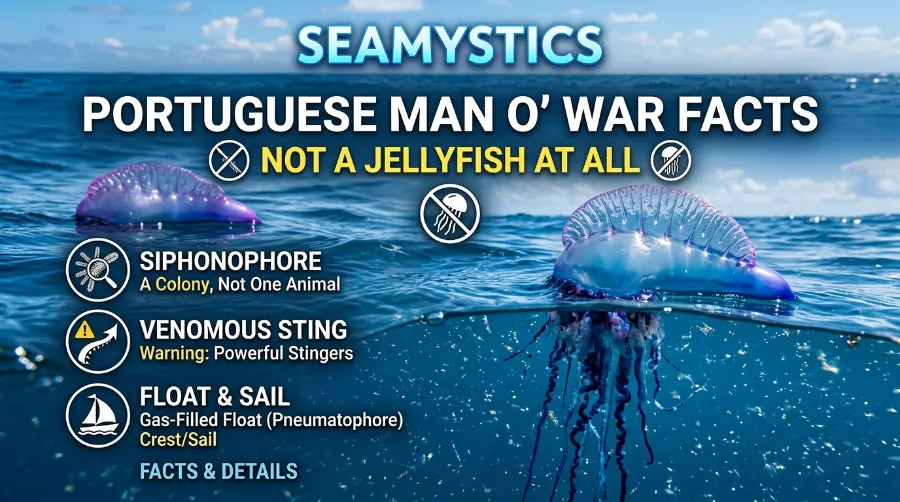
Siphonophores are one of the ocean’s more underrated groups, and the man o’ war happens to be the most famous member simply because it washes ashore where people can see it. Most siphonophores actually live in deep water and are almost never spotted by anyone outside a research submersible. That makes the man o’ war a rare, visible window into a lifestyle that otherwise stays hidden.
| Zooid type | Job in the colony |
|---|---|
| Pneumatophore | Gas-filled float that keeps the colony at the surface and catches wind |
| Tentacles (dactylozooids) | Capture and paralyze prey using stinging nematocysts |
| Gastrozooids | Digest captured prey and distribute nutrients |
| Gonozooids | Handle reproduction for the colony |
Because these zooids cannot survive independently, the whole colony behaves like a single super organism. This is exactly the kind of evolutionary cooperation biologists get excited about, since it blurs the line between what counts as “one animal” and what counts as “many.”
Textile Cone Snail vs Geography Cone: Comparing the Deadliest Shells
Portuguese Man o’ War Habitat: Where It Drifts and Why
The Portuguese man o’ war habitat spans warm and temperate surface waters in the Atlantic, Indian, and Pacific Oceans, including the Gulf Stream, the Caribbean, and even the Mediterranean during warmer months. Because it has no way to swim against the current, its location on any given day depends almost entirely on wind direction and ocean surface patterns, which is why sightings can shift dramatically within a single season.
This unpredictability is not just theoretical. In August 2025, several beaches along the French Atlantic coast, including Biarritz, Anglet, Bidart, and Seignosse, were temporarily closed after a wave of man o’ war sightings, with officials warning the closures could return depending on wind patterns. In September 2026, a tourist in Phuket, Thailand was hospitalized after a sting, prompting local hospitals to publicly repeat first aid guidance about never rubbing the affected area. Guam’s National Park Service has issued similar public warnings for Asan Beach multiple times over the past decade, showing this is a recurring, not one-off, seasonal event.
- 2019: A Portuguese man o’ war washed ashore at Sullivan’s Island, South Carolina, the first confirmed sighting there that season.
- 2020: Malaysia’s Department of Fisheries warned swimmers after sightings along Terengganu’s coast during monsoon season.
- 2025: Multiple beach closures across France’s Atlantic coast due to mass strandings.
- 2026: A hospitalization in Phuket renewed public safety warnings across Southeast Asia.
For a broader look at how ocean creatures and human activity intersect along these same coastlines, our piece on the fishing bycatch problem shows how surface-dwelling species like the man o’ war often share space with commercial fishing routes.
Portuguese Man of War Sting: What Actually Happens to Your Skin
A Portuguese man of war sting comes from thousands of microscopic stinging capsules called nematocysts, packed along the length of each tentacle. Even a tentacle that has broken off and washed up on sand can still fire these capsules, so touching a stranded man o’ war is never a good idea, dead or alive.
Stingray Sting Facts: What Actually Happens During a Sting
Most healthy adults experience intense, burning pain along with red, whip-like welts that can last for a few hours to a few days. In rare cases, especially with large stings or in children and older adults, symptoms can escalate to nausea, breathing difficulty, or a drop in blood pressure that requires emergency care. Research from Dr. Angel Yanagihara’s lab at the University of Hawai’i, published in the journal Toxins, reshaped how first responders treat these stings, replacing older advice that sometimes made symptoms worse.
First Aid Steps Backed by Current Research
- Get out of the water calmly. Panicking or swimming hard can spread venom faster and increase drowning risk.
- Rinse with vinegar, not fresh water. Vinegar deactivates nematocysts that have not yet fired; fresh water can trigger them.
- Remove tentacles with a gloved hand or a flat object. Never use bare skin, since even detached tentacles sting.
- Avoid rubbing the area. Friction can activate leftover stinging cells still stuck to the skin.
- Seek medical help immediately if there is difficulty breathing, facial swelling, chest pain, or spreading hives.
This protocol lines up with guidance published by the University of Florida IFAS Extension, which also notes that ice packs applied directly to skin are discouraged since cold alone does not deactivate venom the way vinegar does. If you want to compare this to another notoriously venomous ocean animal, our blue ringed octopus guide covers a very different, and far more lethal, venom delivery system entirely.
Why This Small Colony Matters for Ocean Health
It is easy to think of the Portuguese man o’ war as just a beach nuisance, but its presence actually tells us something about ocean surface conditions, wind patterns, and even climate variability. Researchers at Oceana point out that mass stranding events often correlate with shifting wind systems, which scientists increasingly track as one small signal within larger ocean health monitoring.
There is also a quieter connection worth mentioning. Just like the man o’ war, countless surface-dwelling species get caught in human-made hazards drifting through the same currents, including abandoned fishing gear known as ghost nets. If ocean conservation and sustainable practices interest you, our sustainable seafood guide is a good next stop, since it explains how everyday seafood choices ripple outward into these same fragile surface ecosystems.
Weever Fish Facts: The Hidden Danger Buried in Sand
Man o’ War vs Other Ocean Stingers
The ocean has no shortage of creatures that can ruin a beach day, and comparing them side by side helps put the man o’ war’s risk into perspective.
| Creature | Type of animal | Sting severity |
|---|---|---|
| Portuguese man o’ war | Siphonophore colony | Very painful, rarely severe |
| Box jellyfish | True jellyfish (Cubozoa) | Potentially life-threatening |
| Sea wasp | Box jellyfish species | Among the most venomous in the world |
| Blue-ringed octopus | Cephalopod | Can be fatal without treatment |
| Cone snail | Marine gastropod | Venom can be lethal in rare cases |
Curious how a sea wasp’s venom compares in real numbers? Our sea wasp facts guide lays out exactly why this particular jellyfish earns its fearsome reputation, and our cone snail venom breakdown looks at one of the slowest-moving yet most dangerous predators in shallow reef waters.
Tentacle Length Comparison (Typical Reach in Meters)
Man o’ war (~10m avg)Box jellyfish (~3m)Sea wasp (~1-2m)Blue-ringed octopus arm (~0.2m)0mFigures rounded for typical adult specimens; individual sizes vary with age and region.
Frequently Asked Questions
Is a Portuguese man o’ war actually a jellyfish?
No. It is a siphonophore, a colony of specialized zooids, while true jellyfish are single organisms in the class Scyphozoa.
Can a Portuguese man o’ war sting kill you?
Death is extremely rare in healthy adults, though severe allergic reactions or drowning caused by panic during a sting are the real dangers to watch for.
Does urine help a man o’ war sting?
No, and this is one of the most persistent beach myths around. Vinegar is the treatment supported by current research, not urine.
Where are Portuguese man o’ war most commonly found?
They drift through warm surface waters of the Atlantic, Indian, and Pacific Oceans, and strong onshore winds can push them onto beaches far from their usual range.
Is it safe to touch a dead man o’ war on the beach?
No. Detached tentacles and even dead specimens can still fire venom, so it is best to avoid contact entirely and alert a lifeguard.
Quick Quiz: Test What You Just Learned
1. What group of animals does the Portuguese man o’ war actually belong to?
A) True jellyfish B) Siphonophore C) Sea anemone
Answer: B, siphonophore.
2. What is the recommended first-aid rinse for a man o’ war sting?
A) Fresh water B) Ice directly on skin C) Vinegar
Answer: C, vinegar.
3. What class do true jellyfish belong to, unlike the man o’ war?
A) Scyphozoa B) Hydrozoa C) Cephalopoda
Answer: A, Scyphozoa.
4. Roughly how long can a man o’ war’s tentacles stretch?
A) 1 meter B) Up to 50 meters C) 500 meters
Answer: B, up to about 50 meters in rare cases.
5. Which country closed several Atlantic beaches in August 2025 due to man o’ war sightings?
A) France B) Portugal C) Ireland
Answer: A, France.
Conclusion
The Portuguese man o’ war is proof that the ocean rarely fits neatly into the categories we expect. It looks like a jellyfish, drifts like a lost balloon, and still manages to be neither a single animal nor harmless in any sense. Once you understand it as a colony of cooperating zooids, its sting, its habitat, and its strange sailing behavior all start to make a lot more sense. The next time a beach flag goes up warning of man o’ war sightings, you will know exactly why lifeguards are not taking any chances, and exactly what to do if you or someone nearby gets stung.
References
- University of Florida IFAS Extension, “What Is It: Portuguese Man o’ War”
- Oceana, “Portuguese Man o’ War”
- American Museum of Natural History, “Portuguese Man of War”
- NOAA Ocean Service, “What is a Portuguese man o’ war?”
- Euronews, “Several beaches in France close after sightings of venomous Portuguese man o’war” (August 2025)
- Toxins journal, University of Hawai’i SOEST research on nematocyst first aid