
There is a creature drifting through warm, glassy water off the coast of Queensland right now that most swimmers will never see coming. It has no brain, no bones, and barely any color, yet it can stop a grown man’s heart in under five minutes. That creature is the sea wasp, and understanding sea wasp facts could genuinely save a life this summer.
Also called the Australian box jellyfish, this animal has earned its reputation the hard way. Locals in Cairns, Townsville, and the Whitsundays plan entire beach days around it. Before we go further, here is what you actually need to remember.
Key Takeaways
| Fact | Detail |
|---|---|
| Scientific name | Chironex fleckeri |
| Nickname | Sea wasp |
| Venom strength | Among the most potent in the animal kingdom |
| Tentacle length | Up to 3 metres (10 feet) |
| Known Australian deaths | At least 64 since 1883 |
| Time to fatal reaction | As little as 2 to 5 minutes in severe cases |
| Stinger season | October to May, tropical northern Australia |
| First aid | Vinegar first, never alcohol or fresh water |
TL;DR: The sea wasp, or Chironex fleckeri, is widely regarded as the world’s most venomous marine animal, and it has caused at least 64 confirmed deaths in Australia since record-keeping began. Its sting delivers venom fast enough to trigger cardiac arrest within minutes, so prevention (stinger suits, vinegar, patrolled beaches) matters more than treatment after the fact. Most encounters are survivable when people act quickly and correctly.
What Exactly Is a Sea Wasp?
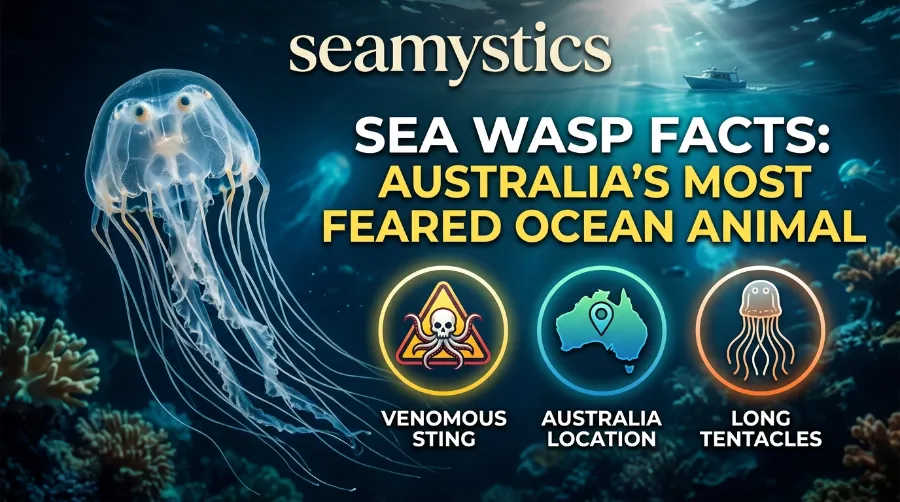
The sea wasp is not actually a wasp at all. It is a species of box jellyfish, named for the cube-shaped bell that sits at the top of its body. Marine biologists classify it under Chironex fleckeri, a name that honors Dr. Hugo Flecker, the North Queensland toxicologist who first linked the species to human deaths in the 1950s.
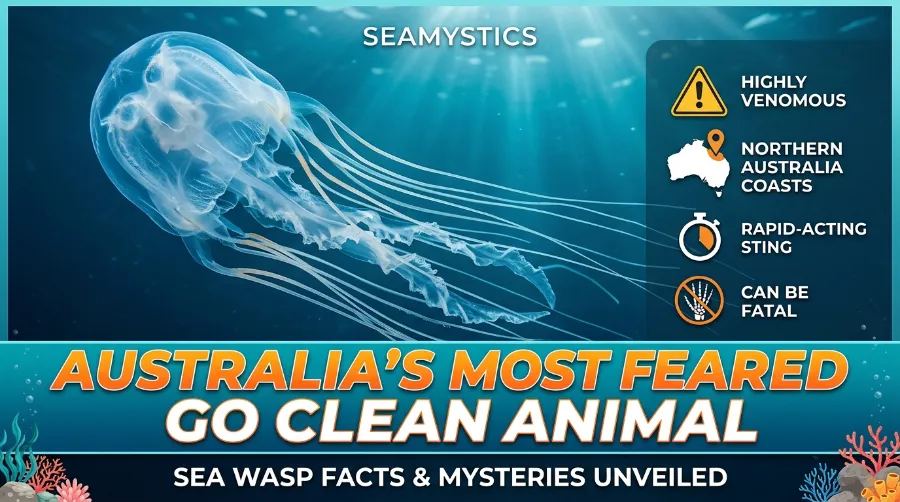
Unlike the round, drifting jellyfish most people picture, the sea wasp is an active hunter. It has clusters of eyes, some capable of basic image formation, and it can swim at speeds of up to two metres per second. That mobility, combined with near-total transparency in shallow water, is exactly why it catches so many swimmers off guard.
Fire Coral Facts: Why It Burns and How to Treat It
How Big Does a Sea Wasp Get?
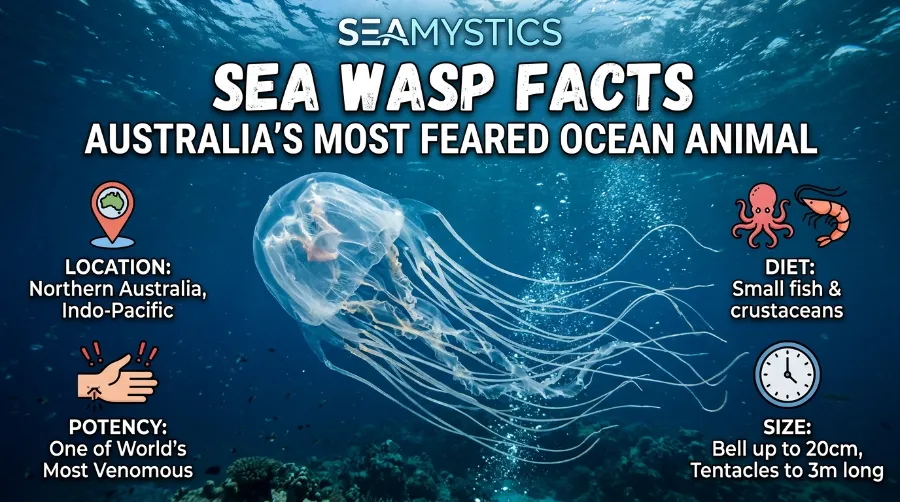
A fully grown sea wasp can reach the size of a basketball, with a bell roughly 30 centimetres across. From each corner of that bell trail up to 15 tentacles, and each tentacle can stretch to 3 metres long. Every one of those tentacles is lined with millions of microscopic stinging cells called nematocysts, so contact with even a short strand of tentacle can deliver a serious dose of venom.
Sea Wasp Venom Facts You Need to Know
This is where sea wasp facts move from interesting to genuinely urgent. The venom produced by Chironex fleckeri attacks the heart, nervous system, and skin cells simultaneously, which is unusual even among venomous marine species. Researchers have found that the venom load in a single adult sea wasp is theoretically strong enough to kill around 60 adult humans, based on laboratory dosage studies referenced by the Britannica encyclopedia of marine animals.
Here is what actually happens biologically after a sting, broken down step by step:
- Nematocysts fire microscopic barbed threads into the skin on contact, often within milliseconds.
- Venom proteins enter the bloodstream and begin breaking down red blood cell membranes.
- Potassium leaks from damaged cells into the bloodstream, a condition called hyperkalemia.
- Elevated potassium disrupts the heart’s electrical rhythm, which can lead to cardiac arrest.
- In severe, untreated cases, this entire sequence can unfold in two to five minutes.
That speed is what separates sea wasp venom facts from almost every other marine sting. Compare it to a stingray or a lionfish, both of which cause intense pain but rarely threaten life within minutes. The sea wasp’s venom is built for fast, large prey like fish, and a human body simply reacts to that same chemistry.
Sea Wasp Jellyfish Sting: What It Actually Feels Like
Survivors consistently describe the sea wasp jellyfish sting as instantly and overwhelmingly painful, often compared to being branded with a hot iron. Whip-like red or purple welts appear almost immediately, tracing the exact path the tentacle touched. In moderate cases, the pain alone can cause a swimmer to panic in the water, which brings its own drowning risk even before venom effects fully set in.
A widely cited Australian study of 225 stings recorded in the Top End between 1991 and 2004 found that only 8 percent required hospital admission and just one fatality occurred in that entire sample, a three-year-old child. That statistic matters because it shows most sea wasp encounters, while agonizing, are survivable with prompt care. Severity depends heavily on tentacle contact area, the victim’s body size, and how quickly first aid begins.
Portuguese Man O’ War Facts: Not a Jellyfish at All
Sea Wasp First Aid: What Actually Works
Misinformation about jellyfish first aid is everywhere, and some of it can make a sting worse. Here is the protocol recommended by Australian lifesaving and toxicology experts:
- Pour vinegar generously over the sting area for at least 30 seconds to deactivate any unfired nematocysts.
- Never rub the area, apply fresh water, or use alcohol, as this can trigger remaining stingers to fire.
- Call emergency services immediately for any sting covering a large area or affecting a child.
- Begin CPR without delay if the person becomes unresponsive or stops breathing.
- Remove any visible tentacle fragments carefully using tweezers or a gloved hand, never bare skin.
Australia’s Dangerous Jellyfish: How the Sea Wasp Compares
Australia is genuinely unusual in how many dangerous jellyfish species share its coastline. When people search for Australia dangerous jellyfish information, they are usually trying to tell these species apart, since the danger level and treatment differ significantly.
| Species | Size | Danger Level | Typical Symptoms |
|---|---|---|---|
| Sea wasp (Chironex fleckeri) | Up to 30 cm bell, 3 m tentacles | Extreme, fastest-acting | Cardiac symptoms, severe welts |
| Irukandji jellyfish | Roughly 1 cm bell | High, delayed onset | Irukandji syndrome, severe cramping, hours later |
| Blue bottle (Portuguese man o’ war) | Small floating sac | Moderate | Painful welts, rarely fatal |
| Southern moon jellyfish | Medium | Low | Mild irritation |
If you want a deeper breakdown of a closely related species, our guide to box jellyfish facts covers the wider Cubozoa family in more detail. Interestingly, Chironex fleckeri is technically one species within that broader box jellyfish group, which is why the two names are often used interchangeably in casual conversation.
Deadliest Jellyfish Species: Where Does the Sea Wasp Rank?
Among discussions of the deadliest jellyfish species worldwide, the sea wasp consistently sits at or near the top. According to Wikipedia’s compiled records on Chironex fleckeri, the species has caused at least 64 confirmed deaths in Australia since the first documented case in 1883. Most recent fatalities have involved children, whose smaller body mass makes a given venom dose proportionally more dangerous.
For comparison, the Irukandji jellyfish causes far more hospitalizations but fewer confirmed deaths, largely because its venom triggers a slower, more treatable syndrome rather than immediate cardiac collapse. This distinction is genuinely important for anyone planning a trip to northern Australia, because the two require different levels of urgency.
Stingray Sting Facts: What Actually Happens During a Sting
Other marine animals sometimes mentioned in the same breath as Australia’s deadliest creatures include the blue-ringed octopus and various cone snail species, both of which deliver venom through entirely different mechanisms. You can read more about the octopus in our blue-ringed octopus guide, and the snail’s unusual harpoon-based venom delivery is covered in our piece on cone snail venom.
Where and When Sea Wasps Are Most Active
Stinger season in tropical Australia typically runs from October through May, though marine biologist Dr. Lisa-ann Gershwin has noted publicly that there is genuinely no fully “safe” month in far north Queensland waters, only lower and higher risk periods. Warmer water above roughly 20°C triggers the sea wasp’s breeding cycle, pushing large numbers toward shallow coastal areas where swimmers gather.
In early 2025, lifesavers at Eimeo Beach near Mackay reported catching eight box jellyfish in a single net drag, an unusually early start to the season driven by a combination of heat, rain, and still winds. A year earlier, disrupted breeding patterns following Tropical Cyclone Jasper led to an unusual spike of 21 recorded stings in Queensland within just a few months. These real, dated incidents show how weather and ocean conditions directly shift sea wasp risk from year to year, rather than following a fixed calendar.
Textile Cone Snail vs Geography Cone: Comparing the Deadliest Shells
Stinger Nets and Beach Safety
Most patrolled beaches across Cairns, Townsville, and the Whitsundays install physical stinger nets each season to keep the largest jellyfish out of swimming areas. These nets are a completely different tool from the fishing nets responsible for marine bycatch, though both raise interesting questions about how humans manage ocean barriers, a topic we explore further in our piece on the fishing bycatch problem.
Even with nets in place, smaller juvenile sea wasps can sometimes slip through the mesh, which is why lifesavers still recommend wearing a full-body stinger suit during peak season. Combining a stinger net, a suit, and vinegar on hand at the lifeguard tower remains the most effective layered defense available today.
Weever Fish Facts: The Hidden Danger Buried in Sand
Real Case Study: The Cardwell Incident
One of the earliest and most consequential sea wasp deaths occurred on 20 January 1955, when a five-year-old boy died after being stung in shallow water at Cardwell, North Queensland. That single tragedy prompted Dr. Hugo Flecker to formally investigate the species, eventually leading to its scientific naming and, decades later, to today’s stinger net programs and vinegar-based first aid protocols. It is a sobering reminder that much of what protects swimmers now exists because of hard lessons learned generations ago.
What Marine Biologists Still Don’t Fully Understand
Even after decades of research, some sea wasp facts remain genuinely unresolved. Scientists have proposed a zinc-based compound as a potential antidote, but nothing has reached widespread clinical use yet. Researchers also continue to study why Chironex fleckeri appears to actively hunt small fish using image-forming eyes, a level of sensory complexity rarely seen in jellyfish. From firsthand conversations with reef guides in Cairns, one pattern comes up again and again: locals trust the stinger nets and seasonal warnings far more than any single first aid trick, because prevention consistently outperforms treatment once a serious sting has occurred.
Frequently Asked Questions
Is the sea wasp the most dangerous jellyfish in the world?
Most marine toxicologists consider it the most venomous, based on how quickly its sting can cause cardiac symptoms, though the Irukandji causes more overall hospital visits in Australia each year.
Can you die from a sea wasp sting in under 5 minutes?
Yes, in severe cases where a large amount of tentacle contacts the skin, cardiac arrest can occur within two to five minutes, which is why immediate vinegar treatment and emergency calls matter so much.
Does vinegar really help with a sea wasp sting?
Yes, vinegar deactivates nematocysts that have not yet fired, preventing further venom release, while fresh water or rubbing can actually trigger more stingers to activate.
Where in Australia are sea wasps found?
They live in coastal tropical waters from northern Western Australia across the Northern Territory and Queensland, generally north of Gladstone, with the highest concentrations around Cairns and the Whitsundays.
Are sea wasps found anywhere outside Australia?
Yes, related populations exist in coastal waters of Papua New Guinea, Indonesia, the Philippines, and Vietnam, though Australian cases are the most extensively documented.
Test Your Sea Wasp Knowledge
1. What is the scientific name of the sea wasp?
A) Physalia physalis
B) Chironex fleckeri
C) Carukia barnesi
Answer: B, Chironex fleckeri
2. How long can a sea wasp’s tentacles grow?
A) Up to 1 metre
B) Up to 3 metres
C) Up to 10 metres
Answer: B, up to 3 metres
3. What should you use for first aid on a sea wasp sting?
A) Fresh water
B) Rubbing alcohol
C) Vinegar
Answer: C, vinegar
4. When does Australian stinger season typically run?
October through May.
5. What condition can sea wasp venom trigger in the heart within minutes?
Cardiac arrest, caused by potassium leakage from damaged cells (hyperkalemia).
Conclusion
The sea wasp earns its fearsome reputation honestly, and understanding these sea wasp facts is far more useful than simply fearing the ocean. Its venom is fast, its habitat is well documented, and its risks drop dramatically once swimmers respect stinger season, wear protective suits, and know that vinegar comes before anything else. Australia’s tropical coastline remains extraordinary to visit, and a little preparation goes a long way toward keeping it that way. For more on the wider marine world worth respecting and protecting, our sustainable seafood guide is a good place to continue exploring.
References
- Britannica, Sea Wasp: https://www.britannica.com/animal/sea-wasp
- Indiana Public Media, A Moment of Science: https://www.ipm.org/show/amomentofscience/2019-09-12/sea-wasps-deadliest-creature
- Vineyard Gazette, Sea Wasp: https://vineyardgazette.com/news/2024/12/27/sea-wasp
- ABC News Australia, Box Jellyfish Risk North Queensland (2025)
- Wikipedia, Chironex fleckeri and Jellyfish stings in Australia