
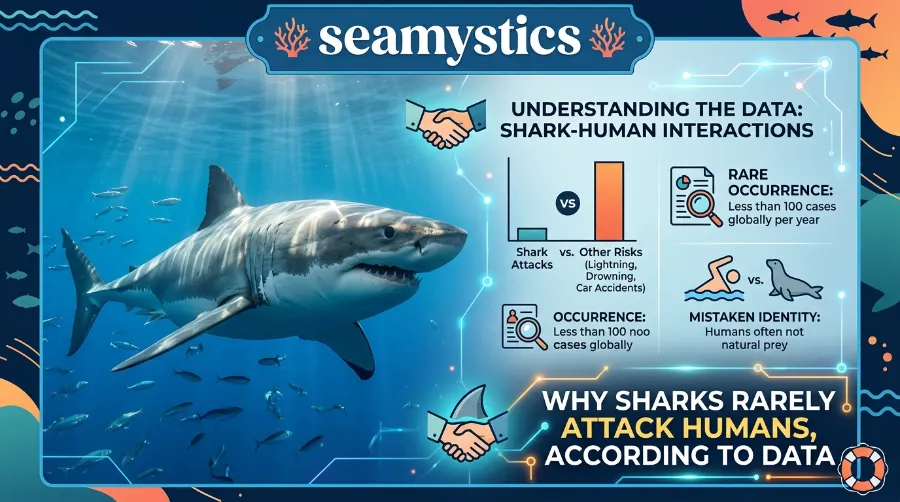

The moment a fin breaks the surface, most people’s brains skip straight to worst case scenarios. Yet the actual shark attack statistics tell a far calmer story than the headlines do. According to the International Shark Attack File (ISAF) at the Florida Museum of Natural History, there were 65 confirmed unprovoked shark bites worldwide in 2025, out of billions of ocean visits that year. That is not a typo. Billions of swims, surfs, and dives, and only a few dozen unprovoked incidents. This piece walks through the real numbers, why the fear so rarely matches the data, and what actually raises or lowers your odds in the water.
Key Takeaways
| Fact | Data Point |
|---|---|
| Unprovoked shark bites worldwide (2025) | 65 confirmed cases |
| Total human-shark interactions investigated (2025) | 105, including provoked bites |
| Fatalities from unprovoked bites (2025) | 9, roughly matching the 5-year average of 8 |
| U.S. share of global unprovoked bites | About 38% |
| Florida’s share of U.S. bites | 11 of 25 cases, the highest of any state |
| Lifetime odds of dying from a shark attack (U.S.) | Roughly 1 in 4 million |
| Lifetime odds of dying from heart disease | About 1 in 5 |
TL;DR: Shark attacks stayed close to the historical average in 2025, with 65 unprovoked bites and 9 fatalities worldwide, according to ISAF. Your statistical odds of ever being killed by a shark sit somewhere around 1 in 4 million, far behind risks like drowning, lightning, or car accidents. Most bites happen because a shark misidentifies a swimmer for prey in low visibility, not because it is hunting people.
Can the Ocean Run Out of Fish? The Data Explained
Shark Attack Statistics: What The Latest Data Actually Shows
Numbers change every year, so it helps to look at more than one season before drawing conclusions. In 2024, ISAF logged an unusually quiet year, just 47 unprovoked bites worldwide and only 4 fatalities, well below the ten year average of roughly 70 incidents. Then 2025 crept back toward the norm. The Florida Museum’s yearly summary confirmed 65 unprovoked bites and 9 unprovoked fatalities, a total close to the five year average of about 61 incidents annually, according to the Florida Museum’s shark attack file.
How Deep Sea Mapping Sonar Actually Works Today
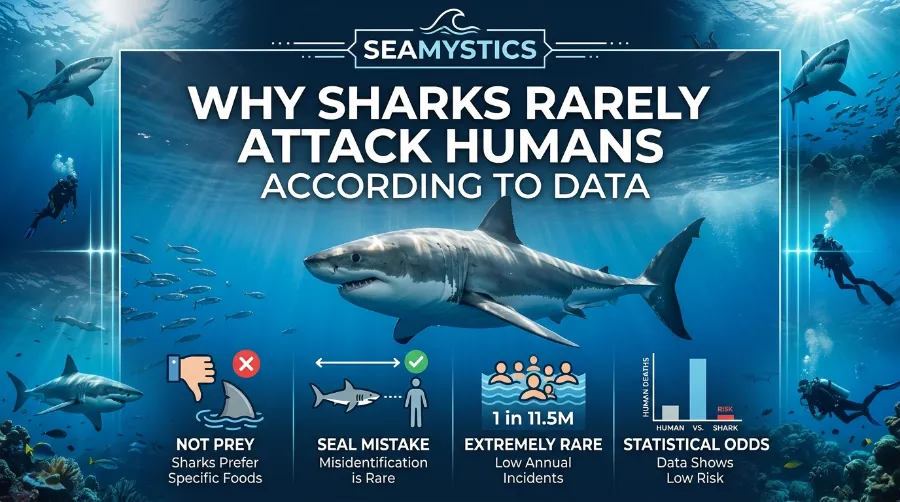
That kind of swing from one year to the next is exactly why marine biologists caution against reading a single season as a trend. Gavin Naylor, who directs the Florida Program for Shark Research, said as much when the 2025 numbers came in, noting it was still too early to call the uptick a shift rather than normal year to year noise. If you have followed shark attack odds long enough, you already know this rhythm: a calm year, a busier year, then back to average.
Where Most Bites Actually Happen
Geography matters more than most people assume when reading shark attack data facts. The United States accounted for about 38% of all unprovoked bites globally in 2025, and within the U.S., Florida led with 11 cases, more than double any other state. Volusia County, on Florida’s central east coast, has topped that state list for years because of warm, shallow, wave filled water where surfers and baitfish share the same narrow strip of ocean.
Outside the U.S., Australia recorded a heavier than usual share of the year’s incidents, several of them fatal, spread across Western Australia, South Australia, Queensland, and New South Wales. For anyone tracking incidents in near real time, Tracking Sharks maintains an ongoing 2025 shark attack map that logs each case as it is reported, which is a useful supplement to ISAF’s annual roundup.
How Rare Shark Attacks Really Are
This is the part that tends to surprise people the most. Once researchers convert raw bite counts into lifetime odds, sharks fall near the bottom of almost every list of things that can kill you. The Florida Museum’s own risk comparison puts the lifetime odds of a fatal shark attack in the United States at roughly 1 in 4 million, depending on the dataset used.
For context, here is how that stacks up against other everyday risks:
- Heart disease: about 1 in 5
- Cancer: about 1 in 7
- Car accident: about 1 in 84
- Lightning strike: about 1 in 80,000
- Fatal shark attack: roughly 1 in 4 million
Put another way, you are meaningfully more likely to be struck and killed by lightning on your way to the beach than to be killed by a shark once you’re in the water. Coastal data backs this up directly. Florida recorded 459 lightning deaths between 1959 and 2010, compared with 9 fatal shark bites over that same stretch, according to long term NOAA and ISAF tracking. That gap has not closed since.
How Deep Can Humans Actually Dive Without Equipment?
Shark Attack Myths That Refuse To Die
A handful of shark attack myths keep resurfacing in movies, news segments, and beach gossip, and they shape how people behave in the water far more than the actual data does.
- “Sharks hunt humans.” Most researchers agree sharks do not recognize humans as prey. The leading explanation for the majority of bites is mistaken identity, a shark investigating an unfamiliar shape in murky water, often letting go once it realizes the “prey” is not what it expected.
- “A shark attack usually kills you.” Survival rates are high. Most unprovoked bites in the ISAF database are non fatal, and many require nothing more than stitches once a person is out of the water.
- “Every shark species is dangerous.” Of the roughly 500 known shark species, only about a dozen have ever been linked to unprovoked bites on humans, with great whites, tiger sharks, and bull sharks responsible for most serious incidents.
- “Calm water means no sharks.” Sharks patrol calm, clear water just as often as rough surf. Visibility and time of day influence risk far more than how the water looks on the surface.
If you want a deeper breakdown of ocean misconceptions like these, our pillar guide on ocean myths covers a wider set of them, from megalodon rumors to misconceptions about shark senses.
Why Sharks Rarely Attack Humans, According to Behavior Science
Data explains the “how often.” Behavior explains the “why.” Sharks are ambush predators built to detect movement, electrical signals, and silhouettes from below, which is exactly the vantage point of a shark looking up at a surfer paddling on a board. From underneath, a person on a surfboard can resemble a seal, particularly in low light or murky coastal water.
Is the Ocean Actually Getting Saltier Over Time?
Once a shark closes in and bites, it typically releases quickly because a human body does not deliver the fat content it needs. That single detail, confirmed repeatedly in bite pattern studies, explains why so many unprovoked encounters end in one bite and a retreat rather than a sustained attack. It is a costly mistake for the shark too, since a wasted bite burns energy the animal cannot easily replace.
Fishing behavior also shapes the numbers. Provoked incidents, cases where a diver grabs a shark, a fisherman removes one from a net, or a spearfisher is bitten while holding a catch, made up 29 of the 105 total interactions ISAF investigated in 2025. Provoked bites tend to be more severe, precisely because the shark is defending itself rather than investigating.
The Future of Ocean Exploration: What’s Next After 2026
A Closer Look: The 2025 Numbers By Category
| Category | 2025 Total |
|---|---|
| Unprovoked bites | 65 |
| Provoked bites | 29 |
| Boat bites | 4 |
| Scavenge incidents | 2 |
| Public aquaria incidents | 1 |
| Total interactions investigated | 105 |
Florida’s own state breakdown tells a similar story of concentration rather than randomness:
| U.S. State | Unprovoked Bites (2025) | Fatal |
|---|---|---|
| Florida | 11 | 0 |
| California | 5 | 1 |
| Hawaii | 4 | 0 |
| South Carolina | 2 | 0 |
| New York | 1 | 0 |
| North Carolina | 1 | 0 |
| Texas | 1 | 0 |
One case from 2025 illustrates the human side of these statistics. Triathlete Erica Fox, 55, disappeared during a group open water training swim near Santa Cruz, California, in December, and her death was later attributed to a shark encounter. It was the only U.S. fatality that year, and it happened during exactly the kind of activity, an early morning group swim in a known white shark corridor, that safety researchers flag as slightly higher risk.
For readers who spend time in the water without gear, our guide on human free diving covers how breath hold divers assess and reduce that kind of exposure.
What Actually Lowers Your Risk
Statistics aside, a few practical habits meaningfully shift the odds in your favor, and organizations that track bites closely tend to repeat the same short list.
- Swim, surf, or dive with a group rather than alone, since isolated individuals account for a disproportionate share of incidents.
- Avoid dawn, dusk, and night sessions in known shark habitat, when many species feed most actively.
- Stay out of the water near fishing activity, baitfish schools, or visible seabird feeding, since these all signal prey concentration.
- Skip high contrast swimwear or jewelry that can catch light the way fish scales do.
- Check regional advisories before entering unfamiliar water, particularly after storms that stir up visibility.
South Africa’s Shark Spotters program, which has monitored Cape Town beaches for two decades, publishes some of the most detailed shark bite safety statistics and advice available anywhere, built from direct beach level observation rather than aggregated global data. It is worth a look if you spend serious time in South African waters specifically.
Do Fish Feel Pain? What Fish Pain Science Actually Shows
Are Shark Attacks Increasing?
Not in any way that current data supports. Bite totals oscillate year to year based on water temperature, storm patterns, prey migration, and simple beach attendance, not because sharks are becoming more aggressive toward people. In fact, global shark populations have fallen sharply over recent decades due to fishing pressure, which makes the relatively stable bite count even more notable. Fewer sharks, roughly similar bite numbers, suggests that reporting accuracy and coastal population growth explain more of the yearly variation than shark behavior does. Our piece on ocean salinity trends touches on some of the broader environmental shifts influencing where marine species, sharks included, are turning up in recent years.
Ocean Myths Debunked: What Marine Science Actually Confirms
Frequently Asked Questions
How many shark attacks happened worldwide in 2025?
ISAF confirmed 65 unprovoked shark bites and 9 related fatalities worldwide in 2025, out of 105 total human-shark interactions investigated.
What are the odds of dying from a shark attack?
Roughly 1 in 4 million over a lifetime in the United States, according to Florida Museum risk comparisons, making it far less likely than dying from a car accident, drowning, or lightning.
Which state has the most shark attacks?
Florida, consistently, with 11 unprovoked bites recorded in 2025 alone, more than double any other U.S. state.
Do sharks actually hunt humans?
No credible evidence supports that. Most bites are attributed to mistaken identity in low visibility conditions, not predatory targeting of people.
Is shark attack frequency rising?
Not according to multi year ISAF data. Totals move up and down year to year but stay close to long term averages once you look past any single season.
Quick Quiz: Test What You Just Learned
1. How many unprovoked shark bites did ISAF confirm worldwide in 2025?
A) 25
B) 65
C) 150
Answer: B, 65 unprovoked bites
2. What are the approximate lifetime odds of dying from a shark attack in the U.S.?
A) 1 in 4,000
B) 1 in 400,000
C) 1 in 4 million
Answer: C, roughly 1 in 4 million
3. Which U.S. state records the most shark bites almost every year?
A) Florida
B) Texas
C) New York
Answer: A, Florida
4. What is the leading explanation behind most unprovoked shark bites?
Mistaken identity, where a shark misreads a swimmer or surfer as natural prey in low visibility water.
5. True or False: Global shark bite numbers have been steadily climbing for decades.
False. Totals fluctuate year to year but remain close to long term averages once several seasons are compared together.
Conclusion
Once you set fear aside and look at the actual shark attack statistics, the picture is far less alarming than most headlines suggest. Sixty-five unprovoked bites against billions of ocean visits in 2025 is not evidence of a predator hunting people, it is evidence of an animal that rarely interacts with humans at all, and usually by accident when it does. Understanding the real shark attack odds, the myths worth retiring, and the small habits that lower risk further lets you enjoy the water with a far more accurate sense of what is actually out there.
References
- Florida Museum of Natural History, International Shark Attack File, Yearly Worldwide Summary
- Tracking Sharks, 2025 Shark Attack Map
- Shark Spotters, Shark Bite Safety Statistics
- Florida Museum of Natural History, Risk Comparison Data, Odds of Shark Attack vs. Other Fatalities
- National Oceanic and Atmospheric Administration, Lightning Fatality Records, 1959 to 2010