

Picture a stone arch. Pull out the top stone and the whole thing falls. The ocean works the same way, and a few animals sit in that top spot. Scientists call them keystone marine species, and they matter far more than their numbers suggest.
I have spent two decades watching reefs and kelp forests change, and the pattern repeats every time. Lose one key animal and the whole community shifts. This guide explains how that works, which animals do the job, and what you can do about it.
Key Takeaways
| Question | Short answer |
|---|---|
| What is a keystone species? | An animal whose impact on its habitat is much bigger than its size or number |
| Best-known ocean example | The sea otter, which protects kelp forests by eating urchins |
| Classic experiment | Robert Paine removed purple sea stars in 1966 and mussels took over |
| Biggest modern threats | Disease, overfishing, warming water, and lost fishing gear |
| Why it matters to you | Healthy keystone species protect fisheries, coastlines, and climate storage |
TL;DR: Keystone marine species are animals like sea otters, sea stars, and sharks that keep their habitats balanced. When they disappear, one species often takes over and the ecosystem loses variety. Protecting them is one of the fastest ways to protect the ocean.
What Makes a Species “Keystone” in the Ocean?
A keystone species is one that shapes its whole community through what it does, not through how many of them exist. A single sea star can control a rocky shore. A few hundred otters can decide whether a kelp forest lives or dies.
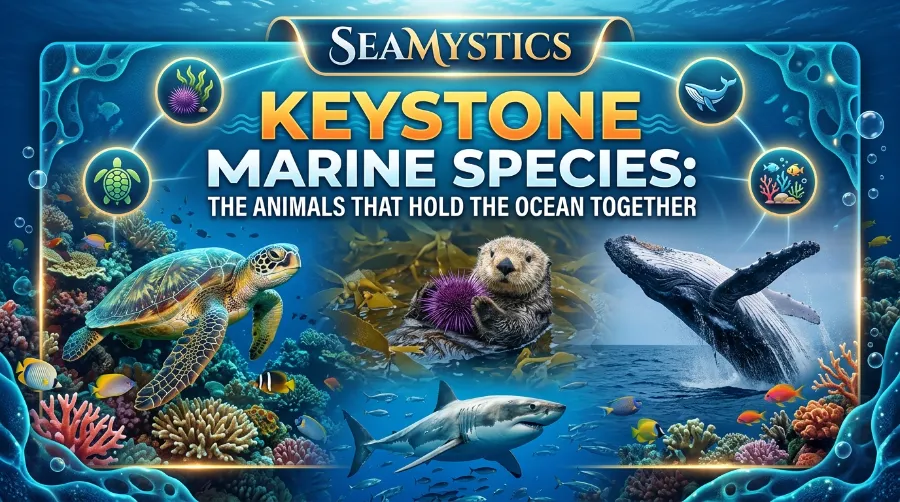
Ecologists often group these animals by their job. Some are predators. Others are grazers, builders, or engineers. Each job keeps one group from growing too large.
Many people confuse keystone species with apex predators or foundation species. They overlap, but they are not the same.
- Apex predators sit at the top of the food chain. Not all of them are keystone species.
- Foundation species, such as corals and kelp, build the habitat itself.
- Keystone species control the balance, often at a middle level of the food web.
If you want the bigger picture of who eats whom, read our guide to the ocean food chain. It shows where each keystone animal fits.
The idea has a clear history. The Center for Marine Conservation explains how the term started and why scientists still use it. The Ecological Society of America also keeps a helpful archive of research on the subject.
The Experiment That Started It All
In 1966, ecologist Robert Paine worked on a rocky shore in Washington State. He removed purple sea stars from one stretch of coast and left another stretch alone. Then he waited.
Within a year, mussels spread across the cleared area. They crowded out barnacles, limpets, and algae. Species count dropped from about 15 to about 8. The untouched section stayed rich and varied.
That result changed marine science. It showed that one predator could protect variety by holding back the strongest competitor. Paine later called the sea star a “keystone” and the name stuck.
I still use this example when I teach new students. It is simple, clean, and impossible to forget. [Dr. Rabica: add a short note from your own intertidal survey work here.
Fish Nursery Habitat: Why Baby Fish Need Specific Ecosystems to Survive
Sea Otter Keystone Story: How Small Predators Save Kelp Forests
The sea otter keystone story is the one I tell most often because the numbers are so clear.
Sea otters eat sea urchins. Urchins eat kelp. When otters are present, urchins stay few and kelp grows tall. When otters disappear, urchins multiply and chew through the kelp until the seafloor looks like a gray desert. Scientists call these places urchin barrens.
Marine Trophic Cascade: What Happens When One Ocean Species Vanishes
What happened when otters vanished
Fur traders hunted sea otters almost to extinction. By 1911, when an international treaty finally protected them, only about 1,000 to 2,000 animals remained worldwide. Kelp forests along parts of the Pacific coast collapsed during that time.
Later, otters returned to some areas. Researchers saw kelp rebound and fish numbers rise with it.
The Aleutian Islands case study
In the Aleutian Islands, biologist James Estes and his team tracked otters for decades. Where otters thrived, kelp forests thrived. In the late 1990s, otter numbers dropped sharply across the chain, and scientists linked the loss to more killer whales hunting them. Urchins boomed and kelp declined.
This case also shows how far the chain reaches. A change in killer whale diet ended up reshaping the seafloor.
Otters and carbon
Healthy kelp pulls carbon from the water and stores it. A 2012 study estimated that otters protect large amounts of stored carbon along the North Pacific coast by keeping kelp in place. Their value goes beyond fish and fun.
In California, otters have also helped seagrass in Elkhorn Slough. They eat crabs that would otherwise graze on the small animals that keep seagrass clean. The seagrass recovers, and the whole estuary benefits.
California’s population now sits at roughly 3,000 animals. That is better than a century ago, yet it is still small and the species stays listed as threatened.
Ocean Keystone Examples You Should Know
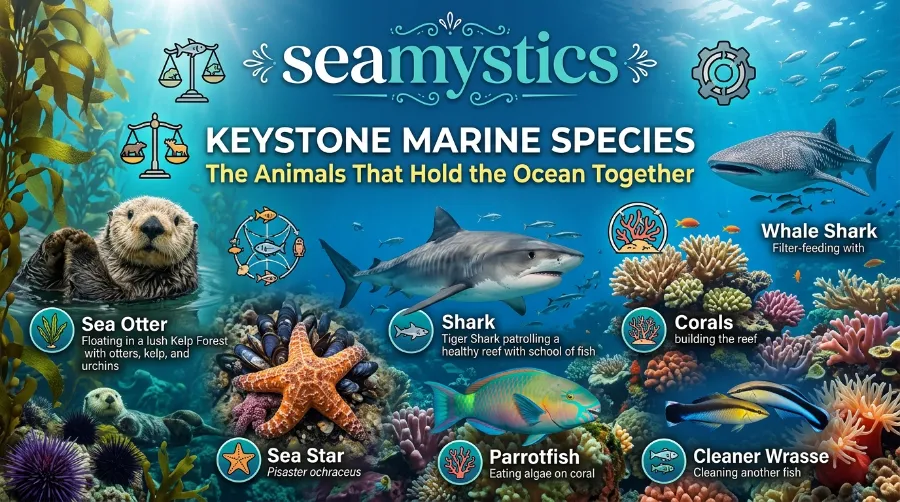
Ocean keystone examples go well beyond otters. Here are the main ones, with the job each animal does.
Sea stars on rocky shores
Purple sea stars and the large sunflower sea star both control prey that would otherwise take over. The sunflower star eats urchins, so it protects kelp too.
Then came disease. Starting in 2013, sea star wasting syndrome swept the Pacific coast from Mexico to Alaska. Researchers estimate that sunflower stars lost roughly 90 percent of their numbers across much of their range. The IUCN now lists the species as critically endangered.
The effect followed the pattern we expected. In parts of Northern California, urchin numbers exploded and bull kelp forests fell by around 90 percent after 2014. Warm water also played a role, which shows that threats often stack on each other.
Phytoplankton Blooms Explained: The Engine Behind Ocean Life
Sharks on reefs and open water
Sharks keep prey animals moving and healthy. They remove weak fish and stop grazers from staying too long in one place.
Scientists have debated how much each shark species matters. That honest debate is useful. Reef sharks clearly shape fish behavior, while the effect of some large oceanic sharks is harder to measure. What we can say is that fewer sharks usually mean a less stable reef.
Parrotfish and the Caribbean reefs
Parrotfish graze algae off coral. In 1983 and 1984, a disease wiped out about 97 percent of the long-spined sea urchin across the Caribbean. Urchins had been doing much of the grazing. After they died, algae smothered many reefs.
Where parrotfish remained abundant, reefs recovered faster. Places that had overfished parrotfish stayed overgrown for decades. That is a hard lesson about leaving only one animal to do an important job.
Parrotfish also make sand. Their droppings are crushed coral, and a single large fish can produce hundreds of kilograms of it each year. Many tropical beaches exist partly because of them.
Invasive Marine Species: How One Animal Can Wreck an Ocean Ecosystem
Whales and nutrient cycling
Large whales feed deep and release waste near the surface. That waste carries iron and nitrogen, which feed plankton. Plankton feeds the base of the food web and also pulls carbon from the air.
When whales die, their bodies sink and create “whale falls.” These feed deep-sea communities for years. [Dr. Rabica: add a note about a whale fall or ROV footage you have worked with, if any.]
Quick comparison
| Species | Main job | Habitat | Main threat |
|---|---|---|---|
| Sea otter | Eats urchins | Kelp forests | Oil spills, entanglement, past hunting |
| Sunflower sea star | Eats urchins and snails | Rocky shores and kelp | Wasting disease, warming |
| Purple sea star | Controls mussels | Rocky intertidal | Disease, heat waves |
| Parrotfish | Grazes algae | Coral reefs | Overfishing |
| Reef shark | Shapes fish behavior | Coral reefs | Overfishing, finning |
| Whales | Move nutrients | Open ocean | Ship strikes, gear |
Why Marine Ecosystem Balance Depends on a Few Animals
Marine ecosystem balance sounds abstract, so here is the simple version. Every habitat has a few species that could take over if nothing stopped them. Keystone animals are the check on that.
When the check disappears, ecologists see three things happen.
- One species grows too fast.
- Variety drops because the winner crowds out others.
- The habitat loses its ability to recover from storms, heat, or disease.
The last point matters most. A varied reef bounces back from a bleaching event more often than a simple one. Balance is not just pretty. It is insurance.
Scientists call this a trophic cascade. A change at one level of the food web spreads up or down the chain. The otter, urchin, and kelp story is the textbook case.
The MPA Collaborative has a good local example from Van Damme State Beach in California. It shows how a protected area helps keystone animals do their job.
Ocean Zonation Layers: How Marine Life Is Layered by Depth
What a Keystone Species Means for People
It is easy to treat this as a topic for biologists. It is not. Keystone animals protect things people use every day.
- Fisheries: Healthy kelp forests shelter young fish, crab, and abalone.
- Coastlines: Reefs and kelp slow waves and reduce storm damage.
- Climate: Kelp, seagrass, and plankton store carbon.
- Income: Dive tourism around healthy reefs and wildlife brings money to coastal towns in the US, UK, and across Europe.
When keystone animals vanish, communities pay. Northern California’s red abalone fishery closed in 2018 after kelp loss and urchin growth starved the abalone. That closure hurt local businesses and cultural traditions. The ecological chain ended in a human one.
Threats Facing Keystone Marine Species Today
Four main threats keep showing up in my work.
Warming water and heat waves
The 2014 to 2016 marine heat wave in the Northeast Pacific, often called “the Blob,” stressed kelp and helped the wasting disease spread. Warm water also pushes species into new areas, which can upset local balance.
Overfishing
Taking too many sharks or parrotfish removes the animals that keep reefs in order. Poor rules and weak enforcement make it worse.
Disease
Disease can hit a species that has no defense. The sea star and urchin die-offs both showed how fast a single illness can alter an entire coast.
Lost fishing gear
Lost nets and lines keep killing long after the boat goes home. Otters, sea turtles, sharks, and whales get caught, and many do not survive. Read more in our guide to ghost nets and how they drift through the deep. It explains why this threat is so hard to stop.
Marine Nutrient Cycling Explained Simply: How the Ocean Feeds Itself
How We Can Protect Keystone Species
I get this question after every talk: “What can one person do?” Here is my honest list.
- Support marine protected areas. They work best when they cover whole habitats, not small pieces.
- Choose seafood carefully. Look for local, well-managed fisheries and avoid products tied to shark or parrotfish catch.
- Cut plastic and gear waste. Join a beach cleanup or support gear recovery programs.
- Back restoration. Kelp planting and urchin removal projects are growing in California, Tasmania, and parts of Europe.
- Share good science. Pass on posts like this one. Informed people vote and buy differently.
My own opinion, after years of fieldwork, is that we put too much hope in single-species rescue. Saving one animal helps, but protecting its home and its prey does more. The strongest recovery stories, like otters in parts of British Columbia, came from protection plus time plus habitat that was still intact.
For more on how marine life connects, see our related guide on coral reef food webs and our explainer on kelp forest ecosystems. You can also browse the rest of Sea Mystics for new research summaries.
Marine Biodiversity Hotspots: The Richest Ecosystems in the Ocean
For official updates on protected species and ocean policy, the NOAA Ocean Service and the IUCN are the most reliable places to check.
The Biological Carbon Pump Explained: How the Ocean Moves Carbon to the Deep
Frequently Asked Questions
What is a keystone species in the ocean?
It is an animal that has a huge effect on its habitat compared with its size or number. Sea otters and sea stars are two famous examples.
Is a shark a keystone species?
Some sharks act as keystone species, especially on coral reefs. The effect varies by species and place, so scientists study each case separately.
Why are sea otters called keystone species?
They eat urchins, which would otherwise destroy kelp forests. Their presence keeps kelp healthy and the whole habitat varied.
What happens if a keystone species disappears?
One species often takes over, variety drops, and the habitat becomes weaker. Recovery can take decades.
Can keystone species come back?
Yes, sometimes. Sea otters have returned to parts of the Pacific coast, and kelp followed. It works best when the habitat is still healthy.
Conclusion
Keystone marine species prove that size does not decide importance. A small otter, a slow sea star, or a busy parrotfish can hold a whole habitat together. When people protect them, they protect fish, coastlines, and the climate too. Start with one action this week, and share what you learn.
Test What You Learned: 5 Question Quiz
1. Who ran the famous 1966 sea star experiment?
A. Jacques Cousteau
B. Robert Paine
C. James Estes
2. What do sea otters eat that protects kelp forests?
A. Mussels
B. Sea urchins
C. Parrotfish
3. Which disease began hitting Pacific sea stars in 2013?
A. Sea star wasting syndrome
B. White band disease
C. Black spot disease
4. What does a parrotfish help make on tropical beaches?
A. Salt
B. Sand
C. Seaweed
5. What is a trophic cascade?
A. A waterfall in a river
B. A change in one food web level that spreads to others
C. A type of coral
Answers: 1. B, 2. B, 3. A, 4. B, 5. B
References
- Paine, R. T. (1966). Food web complexity and species diversity. The American Naturalist, 100.
- Estes, J. A. et al. (1998). Killer whale predation on sea otters linking oceanic and nearshore ecosystems. Science, 282.
- Wilmers, C. C. et al. (2012). Do trophic cascades affect the storage and flux of atmospheric carbon? Frontiers in Ecology and the Environment, 10.
- Hughes, B. B. et al. (2013). Recovery of a top predator mediates negative eutrophic effects on seagrass. PNAS, 110.
- Hewson, I. et al. (2014). Densovirus associated with sea-star wasting disease. PNAS, 111.
- Lessios, H. A. (1988). Mass mortality of Diadema antillarum in the Caribbean. Annual Review of Ecology and Systematics, 19.
- IUCN Red List: Pycnopodia helianthoides (2022 assessment).