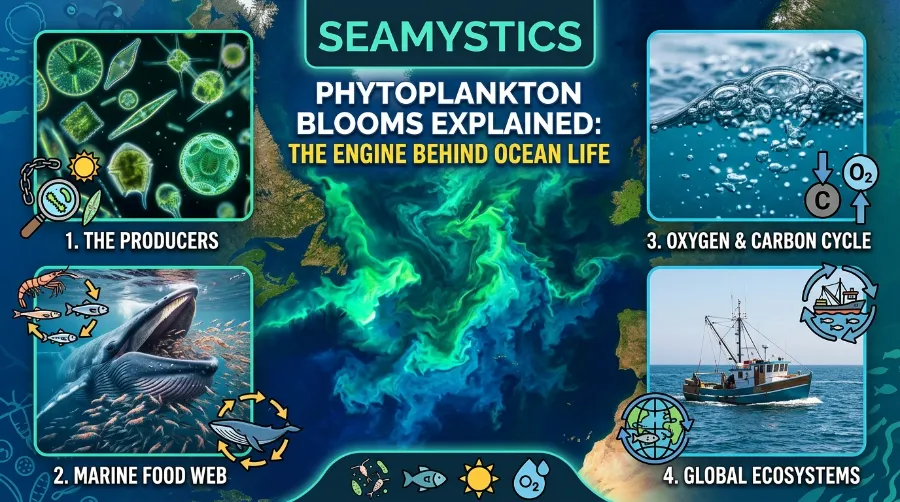

Picture a patch of sea the size of a country turning milky green, then electric turquoise, all within a few weeks. Satellites catch it, fishing boats follow it, and whales travel thousands of miles to reach it. That patch is the center of a phytoplankton bloom ecosystem, and it runs on cells too small to see without a microscope.
TL;DR
A phytoplankton bloom is a fast jump in the number of tiny ocean algae when light, nutrients, and calm water line up. These blooms feed the entire ocean food chain, make a large share of our oxygen, and pull carbon out of the air. Most blooms help the sea, but a small share turn harmful when nutrient pollution or warm water pushes them too far.
Key Takeaways
| Question | Short Answer |
|---|---|
| What is a bloom? | A rapid rise in phytoplankton numbers in the sunlit ocean |
| What triggers it? | Light, nutrients, stable water, and few grazers |
| Why does it matter? | It starts the ocean food chain and makes oxygen |
| How much oxygen? | At least half of the oxygen we breathe, per NOAA |
| Are all blooms bad? | No. Most are healthy, and a few are toxic |
| Where can I see one? | From space, using satellite ocean color images |
I have spent two decades sampling seawater, counting cells under a microscope, and reading satellite maps. In that time I learned one thing: if you want to understand the sea, start with the green water. Everything else in the ocean sits on top of it.
This guide explains how blooms start, what they feed, and when they go wrong. I will also share what I have seen in the field. By the end, you will know why this tiny life matters to every beach, fish dinner, and breath you take.
What Is a Phytoplankton Bloom? A Simple Definition
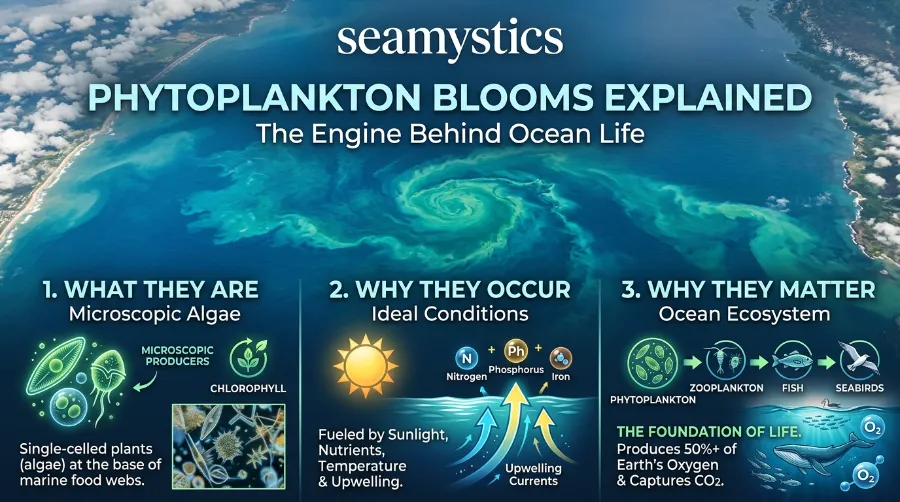
Phytoplankton are single-celled, plant-like organisms that drift in the upper ocean. They use sunlight, carbon dioxide, and nutrients to grow, just like land plants. The word comes from Greek and roughly means “drifting plants.”
A bloom happens when their numbers climb fast. In the right conditions, one cell can split into two within a day. After just ten days of good growth, a single cell can become a thousand.
Scientists often describe a bloom by how much chlorophyll it adds to the water. Chlorophyll is the green pigment that makes light turn into food. Satellites measure it from space, which lets us see blooms across whole oceans.
If you want a classroom-friendly overview, the Science Education Resource Center at Carleton College has a clear primer on phytoplankton basics. I often send students there before we discuss field data.
Phytoplankton Bloom Facts That Surprise Most People
Here are some phytoplankton bloom facts I share at public talks, because they change how people see the ocean.
- Phytoplankton make up only a tiny fraction of the living plant matter on Earth, yet they do about half of the planet’s photosynthesis.
- NOAA states that phytoplankton produce at least half of the oxygen in our atmosphere.
- A single milliliter of seawater can hold thousands of cells during a bloom.
- Blooms can grow large enough to see from space, covering hundreds of thousands of square kilometers.
- The most common photosynthetic organism on Earth is a bacterium called Prochlorococcus, with roughly three octillion cells in the ocean.
For a quick reference on these numbers, NOAA’s National Ocean Service keeps a short fact page that is easy to cite.
The Phytoplankton Bloom Ecosystem: How It Works
A bloom is not just a crowd of algae. It is a whole living system with feeders, hunters, recyclers, and drifters. Every part depends on the others.
Think of it as a pop-up city. First, the builders arrive: the phytoplankton. Next come the grazers, such as copepods and krill. After that, small fish, squid, seabirds, and whales show up to eat. Finally, bacteria break down what is left and return nutrients to the water.
This is why I call the phytoplankton bloom ecosystem the engine of ocean life. Without the engine, nothing else moves.
The Main Types of Phytoplankton
Not all phytoplankton look or act the same. Four groups matter most in bloom science.
| Group | Size | Key Feature | Role in Blooms |
|---|---|---|---|
| Diatoms | Small to medium | Glass-like silica shell | Dominate cold, nutrient-rich spring blooms |
| Dinoflagellates | Small to medium | Two whip-like tails, can swim | Cause many red tides and some toxic events |
| Coccolithophores | Very small | Chalky white plates | Turn water milky turquoise, move carbon to the seafloor |
| Cyanobacteria | Tiny | Bacteria that photosynthesize | Common in warm water and some freshwater and brackish blooms |
Diatoms are my favorite to study. Their glass shells look like tiny jewelry boxes under a microscope. They also sink fast when the bloom ends, which carries carbon to deep water.
What Triggers an Ocean Bloom? The Four Ingredients
To get an ocean bloom explained in plain words, picture a kitchen. You need four things on the counter before anything cooks.
- Light: Phytoplankton need sunlight, so they live in the top 100 meters or so of the sea.
- Nutrients: Nitrogen, phosphorus, silica, and iron act as the fertilizer.
- Stable water: The cells need to stay in the sunny layer instead of being mixed down into the dark.
- Few grazers: If predators eat the cells as fast as they grow, no bloom appears.
When all four line up, growth explodes. When even one is missing, the bloom stalls.
Why Spring Is Bloom Season
In temperate seas, such as the North Atlantic and the North Sea, blooms follow a steady yearly pattern. In winter, storms mix the water deeply. Nutrients rise to the surface, but the cells get dragged into the dark, so growth stays slow.
As spring arrives, days get longer and the surface warms. The water forms a calm, light layer on top. Now the cells sit in sunshine and nutrients at the same time, and the bloom begins.
Oceanographer Harald Sverdrup explained this idea in 1953 with his critical depth theory. Modern research has refined it, but the core story still holds. Spring blooms start when light finally beats the mixing.
NASA studied this pattern closely in its North Atlantic Aerosols and Marine Ecosystems Study, known as NAAMES, which ran field campaigns from 2015 to 2018. The team tracked blooms through every season, not just spring. That work showed that the start of a bloom can begin earlier than many textbooks say, sometimes in late winter when mixing slows.
Upwelling and Iron: The Hidden Switches
Some blooms do not follow the seasons at all. Along coasts such as Peru, California, Northwest Africa, and Namibia, winds push surface water away from shore. Cold, nutrient-rich water rises to replace it. Scientists call this upwelling, and it creates some of the most productive fishing grounds on Earth.
Iron works as another switch. In large parts of the Southern Ocean, nitrogen and phosphorus are plentiful, but iron is scarce. Cells there cannot grow well without it. Dust blown from land or iron from melting ice can start a bloom in these waters.
This idea led to real experiments. In 1999, the Southern Ocean Iron Release Experiment, known as SOIREE, added iron to a patch of sea and watched it turn green. In 2012, a private project off the coast of Haida Gwaii in Canada dumped about 100 tonnes of iron sulfate into the Pacific. It caused strong criticism from scientists and regulators. Many of us believe that kind of geoengineering needs far more study before anyone tries it again.
The Phytoplankton Food Chain: From Single Cells to Whales
The phytoplankton food chain is short at the bottom and surprisingly powerful. Here is how energy moves up, step by step.
- Phytoplankton turn sunlight and nutrients into living cells.
- Zooplankton, such as copepods and krill, graze on the cells.
- Small fish, such as sardines, anchovies, and herring, eat the zooplankton.
- Larger fish, seabirds, seals, and dolphins eat the small fish.
- Top predators, such as tuna, sharks, and orcas, sit at the top.
Some animals skip steps. Baleen whales and basking sharks filter zooplankton and small fish straight from the water. Mussels and oysters filter phytoplankton directly.
If you want the full picture beyond blooms, our guide to the ocean food chain walks through each level, from plankton to apex predators.
A Real Example: Right Whales and Their Bloom Link
The North Atlantic right whale shows how tightly the system is linked. Fewer than 400 of these whales remain. They feed mainly on a tiny copepod called Calanus finmarchicus, which in turn feeds on the spring bloom in the Gulf of Maine and nearby waters.
When bloom timing or copepod numbers shift, the whales have to travel farther to find food. Researchers have linked these shifts to warming water in the Gulf of Maine. In this way, a change that starts with microscopic cells can end up affecting one of the rarest large animals on Earth.
Why Some Species Matter More Than Others
Some animals hold the web together far more than their numbers suggest. Sea otters, sea stars, and certain sharks all fit this role. You can learn more about them in our article on keystone marine species. Phytoplankton are not keystone species in the strict sense, but they act as the base layer that every keystone species relies on.
The Biological Pump: How Blooms Cool the Planet
Blooms do more than feed the sea. They also help manage the climate.
When phytoplankton grow, they take in carbon dioxide from the water. That pulls more carbon dioxide from the air into the ocean. When the cells die or get eaten, some of that carbon sinks as dead cells, fecal pellets, and shell fragments. Scientists call this process the biological pump.
Marine phytoplankton fix roughly 50 billion tonnes of carbon each year, about half of all carbon fixed on Earth. Only a small share reaches the deep sea and stays there for centuries. Even so, without this pump, the air would hold much more carbon dioxide than it does now.
Coccolithophores add a twist. They build chalk plates from calcium carbonate. This process releases a little carbon dioxide at the surface, but the heavy plates also sink fast and carry carbon downward. The net effect depends on the species and the conditions, which is why scientists still debate it.
What I Have Seen While Sampling Blooms
On one North Atlantic research cruise in late spring, I worked the night shift on the water sampler. We lowered a rosette of bottles through a bloom that was only three days old. The surface samples looked pale green, but the cells under the microscope were packed so tightly that they crowded the whole slide.
Two days later, the water changed. The bloom had run out of silica, and the diatoms began to sink. The deck crew noticed first, because the surface water looked clearer and the seabirds moved on. That sudden handoff, from boom to bust, taught me how fast these systems shift.
My practical lesson from that work is simple. Never judge a bloom by color alone. Colour tells you where it is, but only cell counts, nutrient data, and time series tell you what it is doing.
Algae Bloom Ocean Events: Helpful vs. Harmful
People often hear “algae bloom” and think of something toxic. That reaction makes sense, because harmful events grab headlines. But the numbers tell a different story.
Most blooms are healthy and short. Only a small share of phytoplankton species make toxins, and even those usually stay at safe levels. Scientists use the term harmful algal bloom, or HAB, only when the event hurts people, wildlife, or local economies.
How to Tell the Difference
| Feature | Healthy Bloom | Harmful Bloom |
|---|---|---|
| Duration | Days to weeks | Can last months |
| Water color | Green, turquoise, or brown | Red, brown, or thick green scum |
| Smell | Fresh or slightly fishy | Strong, rotten, or chemical |
| Wildlife | Active feeding | Fish kills, sick birds or mammals |
| Oxygen | Stable | May crash when the bloom decays |
If you see dead fish, foam with a bad smell, or thick scum on the water, keep people and pets away. Then report it to your local health or environment agency.
Real Cases of Harmful Blooms
Real events show how serious these can be. Here are some of the best documented ones.
- Lake Erie, August 2014: A bloom of cyanobacteria released a toxin called microcystin into the water supply of Toledo, Ohio. Around 400,000 people were told not to drink tap water for about three days.
- West Coast, 2015: A huge bloom of the diatom Pseudo-nitzschia produced domoic acid along much of the US coast. Crab fisheries closed for months, and sea lions and seabirds fell sick.
- Southwest Florida, 2017 to 2019: A red tide caused by the dinoflagellate Karenia brevis lasted more than a year. It killed large numbers of fish, sea turtles, and manatees and hurt coastal tourism.
- Baltic Sea, every summer: Blooms of cyanobacteria cover large areas of the sea. They affect beaches in Sweden, Finland, Germany, and Poland and warn swimmers away.
Each of these events had a different cause, but a pattern repeats. Extra nutrients from farms and cities, warm water, and calm weather feed the problem. When the bloom dies, bacteria eat the dead cells and use up the oxygen. That creates what we call dead zones.
Dead Zones: When Blooms Go Too Far
A dead zone forms when decaying bloom material drains the oxygen from deep water. Fish swim away, and animals that cannot move, such as clams and crabs, die.
The Gulf of Mexico has one of the best studied dead zones in the world. Nutrients flow down the Mississippi River from farms across the middle of the United States. In 2017, NOAA measured the largest Gulf dead zone on record at about 8,776 square miles. More recent measurements show wide swings from year to year, with about 3,058 square miles in 2023 and about 6,705 square miles in 2024.
Europe faces the same problem. The Baltic Sea has some of the largest low-oxygen areas in the world. The North Sea, the Adriatic, and the Black Sea have all seen similar events.
Simple Steps That Reduce Bloom Pollution
You do not need to be a scientist to help. These actions cut nutrient pollution at the source.
- Use less lawn fertilizer, and never apply it before heavy rain.
- Pick up pet waste so it does not wash into storm drains.
- Support local buffer strips, wetlands, and rain gardens.
- Choose seafood from farms and fisheries with good nutrient management.
- Back policies that upgrade sewage treatment plants.
Seeing Blooms From Space: Fresh Data and Tools
Satellites changed bloom science. Before them, we only knew about blooms where ships happened to sail. Now we can watch the whole ocean daily.
NASA’s SeaWiFS mission began a continuous ocean color record in 1997. Later sensors, such as MODIS and VIIRS, extended it. In February 2024, NASA launched the PACE satellite, which can tell different groups of phytoplankton apart by their color. That is a big step, because it lets us spot harmful species from orbit rather than just measure total chlorophyll.
NASA Earth Observatory has a strong overview of how these maps work in its phytoplankton feature. Their images are worth a look just for the beauty.
Recent Bloom Events Worth Knowing
Journalists and scientists keep an eye on unusual blooms. A report in The Inertia on a phytoplankton bloom off the East Coast of the United States is a good example of how satellite images reach the public. These images often go viral because they look like paintings.
For a view from the research ship itself, the NOAA Teacher at Sea blog posts on phytoplankton share firsthand notes from people working on the water. I like them because they show the daily routine of sampling, filtering, and counting.
| Data Source | What It Tells You | Best For |
|---|---|---|
| SeaWiFS, MODIS, VIIRS | Chlorophyll and ocean color since 1997 | Long-term bloom trends |
| PACE (launched 2024) | Phytoplankton groups by color | Spotting harmful species |
| Ship sampling | Cell counts, toxins, nutrients | Confirming what satellites see |
| Autonomous floats | Profiles under the surface | Seeing blooms below the top layer |
Climate Change and the Future of Blooms
This part is where scientists still argue, and I think honesty matters here. Anyone who tells you that climate change has one clear effect on blooms is oversimplifying.
Here is what we know with good confidence. Warmer water forms stronger layers, which can lock nutrients away from the surface. In some regions, that could lower total phytoplankton growth. In others, warming extends the growing season or helps harmful species spread.
Here is what we still debate. Satellite records are only a few decades long, and natural cycles such as El Niño can hide long-term change. Different studies of global chlorophyll trends give different results.
Based on my own work, I would say this: the timing of blooms may matter more than their size. If a bloom arrives too early or too late, fish larvae and copepods miss the meal. Ecologists call this a mismatch. It is one of the biggest risks to fisheries I can think of.
What Should Policy Focus On?
From the evidence, three priorities stand out.
- Cut nutrient pollution, because it is the one driver we can control locally.
- Keep and expand long-term ocean monitoring, because gaps in data hurt every forecast.
- Study ocean geoengineering carefully, with strict rules, before any large-scale trials.
Frequently Asked Questions
What is a phytoplankton bloom in simple words?
It is a sudden increase in tiny ocean algae when light, nutrients, and calm water come together. The bloom can turn the water green, blue, or brown and is often visible from space.
Why are phytoplankton blooms important?
They start the ocean food chain, produce at least half of the oxygen we breathe, and help remove carbon dioxide from the air. Almost every sea animal relies on them directly or indirectly.
Are all algae blooms in the ocean harmful?
No. Most blooms are natural and helpful. Only a small number produce toxins or cause oxygen loss, and those are called harmful algal blooms.
What causes a harmful algal bloom?
Excess nutrients from farms and sewage, warm water, and calm weather are the usual causes. The exact trigger differs by species and place.
Can I swim in water with a bloom?
It is best to avoid it if the water looks scummy, smells bad, or if officials have posted a warning. Toxins can irritate skin and cause illness if swallowed.
How do scientists track blooms?
They use satellites to measure ocean color, ships to take water samples, and floats that drift and record data below the surface. Together, these tools give a full picture.
Do phytoplankton blooms affect climate?
Yes. They pull carbon dioxide from the ocean surface, and some of that carbon sinks to the deep sea. This process is known as the biological pump.
Test Your Knowledge: 5 Question Quiz
1. Which group of phytoplankton has a glass-like silica shell?
a) Dinoflagellates
b) Diatoms
c) Coccolithophores
2. What is the main reason spring blooms start in temperate seas?
a) Fish leave the area
b) Longer days and calm, layered water
c) Rivers run dry
3. What do we call the process that sends bloom carbon down to the deep ocean?
a) The biological pump
b) The tide cycle
c) The salt exchange
4. True or False: All phytoplankton blooms are toxic.
5. True or False: Satellites can measure chlorophyll to spot blooms from space.
Answers: 1) b, 2) b, 3) a, 4) False, 5) True
Conclusion
A phytoplankton bloom may look like a green smudge on a satellite map, but it is the starting point for most life in the sea. It feeds krill, fish, whales, and seabirds, makes much of our oxygen, and helps store carbon. When nutrient pollution and warming push it too far, it can also bring toxins and dead zones.
The good news is that we understand the basics well, and we can act on them. Cut nutrient runoff, support ocean monitoring, and learn how your local waters work. Start with the Sea Mystics home page to keep exploring, and the next time you see a green or turquoise sea, remember the engine running beneath it.
References
- NOAA National Ocean Service, “What are phytoplankton?”
- NASA Earth Observatory, “Phytoplankton”
- NASA, North Atlantic Aerosols and Marine Ecosystems Study (NAAMES), 2015 to 2018
- NASA, PACE mission overview, launched February 2024
- Science Education Resource Center, Carleton College, “Phytoplankton Primer”
- NOAA, Gulf of Mexico Hypoxia Forecast and Measurement reports, 2017 to 2024
- NOAA Teacher at Sea Program, phytoplankton field posts
- The Inertia, “Phytoplankton bloom off the East Coast of the United States”
- Sverdrup, H. U. (1953), “On Conditions for the Vernal Blooming of Phytoplankton,” ICES Journal of Marine Science
- Flombaum et al. (2013), “Present and future global distributions of the marine cyanobacteria Prochlorococcus and Synechococcus,” PNAS