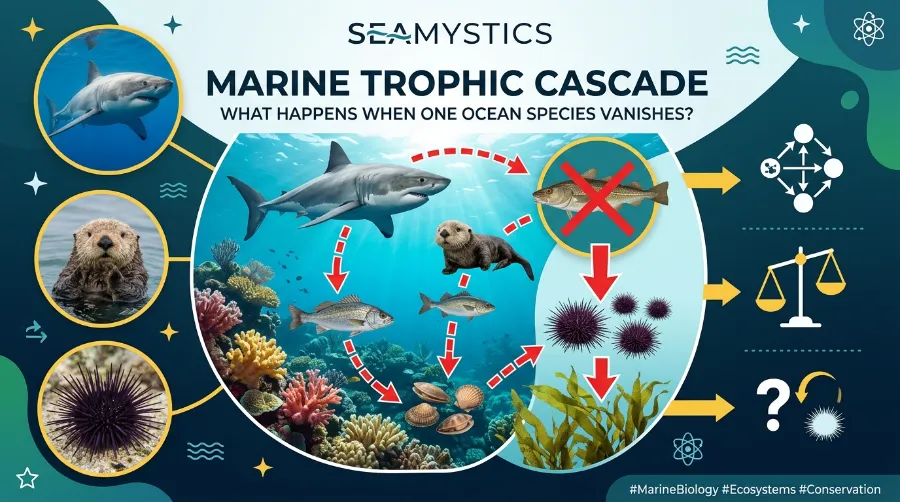

Marine Trophic Cascade: What Happens When One Ocean Species Vanishes
Picture a kelp forest in northern California in 2013. Golden fronds sway, fish dart through the light, and sea stars cling to the rocks. Five years later, most of that forest was gone, and the cause was a small group of missing predators. That is a marine trophic cascade in real life, and it shows how one lost species can reshape an entire coast.
I have spent two decades studying reefs, kelp beds, and open water. The same lesson keeps coming back. Remove one link, and the whole chain shakes.
TL;DR: A marine trophic cascade happens when a change at the top or bottom of the food web ripples through every level below or above it. When a key predator disappears, its prey often explodes in number and eats away the habitat. The fix is usually to protect or restore the missing species.
Key Takeaways
| Question | Short Answer |
|---|---|
| What is a marine trophic cascade? | A chain reaction through the food web after one species changes in number |
| What starts one? | Overfishing, disease, hunting, heatwaves, or pollution |
| Classic example | Sea otters, sea urchins, and kelp |
| Biggest warning sign | A sudden boom in one prey species |
| Can it be reversed? | Often yes, if the missing species returns |
| Why it matters | Kelp, seagrass, and fish stocks feed people and cool the planet |
What Is a Marine Trophic Cascade?
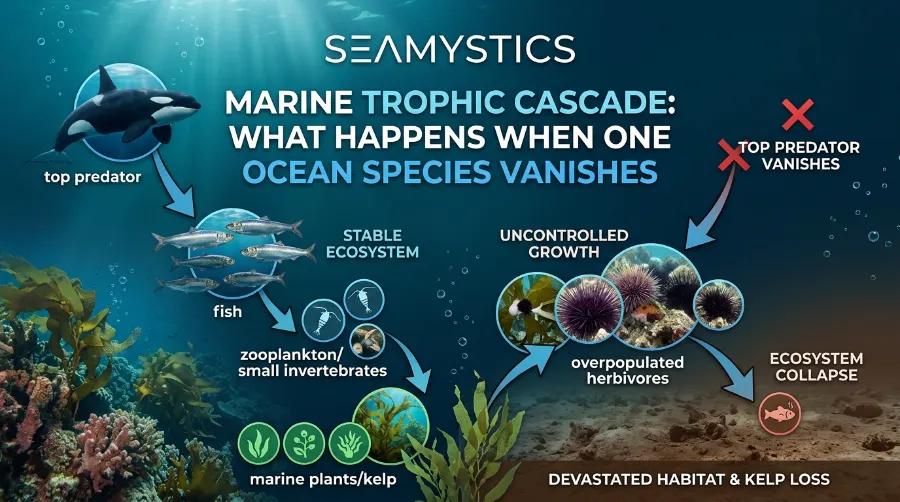
A trophic cascade is a chain of effects that moves through the food web. Think of it like a row of dominoes. Push the top one, and the rest fall.
In the sea, scientists describe two main types. A top-down cascade starts with predators. A bottom-up cascade starts with plankton or nutrients. Both matter, and you can read more about the base of the system in our guide to the phytoplankton bloom ecosystem.
Most famous stories are top-down. A predator keeps a grazer in check. The grazer keeps a plant or alga in check. When the predator leaves, the grazer eats too much, and the habitat shrinks.
If you want the full picture of who eats whom, start with our pillar guide to the ocean food chain.
Why the Trophic Cascade Ocean Effect Is So Hard to Spot
Land cascades are easier to see. Wolves return to a park, and willows grow back within years. The ocean hides its changes under water, and the signs often show up late.
Water also moves. Larvae drift for miles. Currents mix nutrients. One heatwave can hit a whole coast at once. Because of this, a cascade can look like random bad luck until you trace the chain.
For a good overview of surprising land and sea examples, see this piece on five unexpected effects of trophic cascades. It shows how far the ripples can travel.
Keystone Species: The Pieces That Hold It All Together
Some species matter far more than their numbers suggest. Ecologists call them keystone species. Remove one, and the structure of the whole community changes.
The idea came from Robert Paine in 1966. He removed sea stars from rocky shores on Tatoosh Island in Washington State. Mussels took over the rock. Within about a year, the number of species in the plot fell from around 15 to around 8.
That simple experiment changed how we think about nature. You can explore more examples in our guide to keystone marine species.
Common keystone species in the sea include:
- Sea otters, which control urchins in kelp forests
- Sea stars, which control mussels on rocky shores
- Sharks, which shape the behavior of mid-level predators and grazers
- Whales, which move nutrients between deep and surface water
Ecosystem Collapse Example 1: Sea Otters, Urchins, and Kelp
This is the textbook case. It plays out along the North Pacific coast.
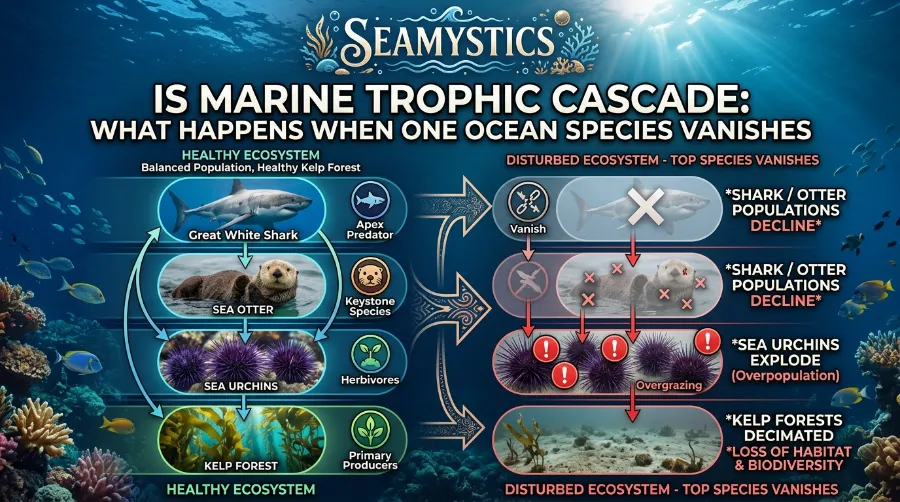
Sea otters eat sea urchins. Urchins eat kelp. When otters thrive, urchins stay small in number, and kelp forests grow thick. Fur traders hunted otters hard from the 1740s until 1911, when a treaty finally protected them. By then, only a small number survived in scattered groups.
In the 1970s, James Estes and John Palmisano compared Aleutian islands with and without otters. Islands with otters had lush kelp. Islands without otters had “urchin barrens,” bare rock grazed clean by urchins.
Later, otter numbers fell again in parts of Alaska in the 1990s. Researchers linked the drop to killer whales that shifted their diet. Urchins boomed, and kelp thinned once more. The cascade ran in reverse.
Here is the chain in simple steps:
- Otters decline.
- Urchins multiply and graze without limit.
- Kelp forests shrink into barrens.
- Fish, crabs, and birds that depend on kelp lose their homes.
Kelp forests also shelter young fish and soften storm waves. Losing them hurts local fishing towns too.
Ecosystem Collapse Example 2: The Cod Crash of 1992
Cod once ruled the Northwest Atlantic. Fishers on the Grand Banks off Newfoundland caught them for centuries. Then industrial trawlers arrived in the mid 1900s, and catches climbed to record levels.
In July 1992, Canada closed the northern cod fishery. The stock had fallen to a tiny fraction of its past size. About 30,000 people lost their jobs in one of the largest layoffs in Canadian history.
The food web did not stay still. With fewer cod, prey such as snow crab and northern shrimp grew in number. Those species later became the region’s top catches. The system flipped into a new state, and cod have been slow to come back, even after decades.
This is a clear predator removal ocean story. Taking out one big fish changed the whole community, and the new balance proved hard to undo.
Ecosystem Collapse Example 3: The Sea Star Plague and the Lost Kelp
This one is recent, and I watched parts of it unfold myself.
In 2013, sea star wasting disease swept the Pacific coast of North America. Starfish melted, lost limbs, and died within days. More than 20 species were affected. The sunflower sea star, a big and hungry urchin hunter, lost an estimated 90 percent of its range-wide population.
Then a marine heatwave, nicknamed “the Blob,” warmed the water from 2014 to 2016. Kelp weakened. Purple urchins, freed from their main predator, surged. Researchers reported that purple urchin numbers rose about 60 times in parts of northern California.
The result was stark. Bull kelp along northern California fell by roughly 95 percent between 2014 and 2019. Red abalone fisheries closed, and the loss hit local economies hard.
Field note from Dr. Rabica: When I dive an urchin barrens, the first thing I notice is the quiet. Normal kelp forests hum with movement. A barren looks like a parking lot under water. Anyone who has seen both never forgets the contrast.
Quick Comparison of Real Cascades
| Case | Species Lost or Reduced | Winner in the Food Web | Habitat Result |
|---|---|---|---|
| Aleutian Islands (1970s, 1990s) | Sea otters | Sea urchins | Kelp to barrens |
| Northwest Atlantic (1992) | Atlantic cod | Snow crab, shrimp | New fishery state |
| Northern California (2013 to 2019) | Sunflower sea stars | Purple urchins | About 95% bull kelp loss |
| Tatoosh Island (1966) | Ochre sea stars | Mussels | Species fell from about 15 to 8 |
Predator Removal Ocean Effects Beyond Kelp
Kelp gets the headlines, but cascades hit other habitats too.
In Shark Bay, Western Australia, researchers found that tiger sharks change how sea turtles and dugongs graze. When sharks are near, grazers avoid the riskiest seagrass patches. Scientists call this the “landscape of fear.” Without sharks, grazers can overeat and strip the meadow.
Global shark numbers have fallen sharply. A 2021 study in Nature found that oceanic shark and ray abundance dropped by about 71 percent between 1970 and 2018. That is a huge loss of top predators, and the effects on coastal food webs are still being measured.
One caution is worth stating. Some famous claims, like the idea that fewer sharks led to a rise in cownose rays and then to a collapse in Atlantic scallops, drew strong pushback from other scientists. Good science tests big claims, and not every cascade story holds up. I trust a case more when several research teams reach the same result.
Great Whales and the Nutrient Cascade
Whales add a different twist. They do not just eat. They move nutrients.
Whales feed deep and release waste near the surface. That waste carries iron and nitrogen, which feed phytoplankton. Phytoplankton then feed krill and fish. When whaling killed millions of animals in the 20th century, that nutrient pump weakened.
A recent article on how whales drive the marine trophic cascade explains this link in plain language. It fits well with what researchers see in whale recovery zones.
When a whale dies and sinks, it feeds a deep-sea community for decades. Scientists call this a whale fall. It is another way one species supports many others.
Food Web Disruption: How Fishing Changes the Whole Chain
Fishing does more than remove fish. It changes who sits at the top.
In 1998, Daniel Pauly and colleagues described a pattern called “fishing down the food web.” Fleets first catch big predators. When those run low, they move to smaller fish and invertebrates. The average level of the catch on the food chain drops over time.
The Sea Around Us project tracks this with its Marine Trophic Index. The index shows the average trophic level of catches by region. A falling line signals that big predators are thinning out.
This matters for dinner plates too. Tuna, cod, and grouper sit high on the chain. Anchovies and shrimp sit lower. A world that eats lower on the chain has less resilience when something goes wrong.
How to Spot an Early Warning Sign
After years in the field, I use a short checklist when I visit a reef or kelp bed. You can use it too, even as a diver, snorkeler, or coastal walker.
- Look for one grazer that seems everywhere, such as urchins or crown-of-thorns starfish.
- Check for missing top predators like large reef fish, sharks, or sea stars.
- Notice bare rock where plants used to grow.
- Ask local fishers what changed in the last 10 years.
- Compare recent photos with older ones from the same spot.
Local knowledge often beats a spreadsheet. Fishers saw the cod decline and the urchin boom long before many papers came out.
Can a Cascade Be Reversed?
Sometimes, yes. The best proof comes from places where predators came back.
In Elkhorn Slough, California, sea otters returned to the estuary in the late 1980s. A 2013 study found that otters helped eelgrass recover. They ate crabs that otherwise let algae smother the grass. The estuary looked healthier within years.
In British Columbia, otters were reintroduced in the 1970s. Kelp forests rebounded in many places, and the coast gained new fish and bird life.
Recovery has limits, though. Some systems settle into a new stable state and resist change. Urchin barrens can last for decades because urchins can survive on almost nothing. This is why early action works better than late rescue.
Practical steps that help:
- Protect keystone predators with catch limits and marine protected areas.
- Reduce bycatch so sharks, turtles, and sea stars survive.
- Cull urchins in barrens, then replant kelp, as some community groups now do.
- Cut pollution and warming, which stress kelp and corals.
- Track food web data so managers can act before a crash.
What It Means for You
You do not need a boat to help. Your choices shape demand and policy.
Choose seafood from fisheries with strong management. Back marine protected areas in your region. Support local groups that restore kelp and seagrass. Share what you learn, because few people know how closely ocean species depend on each other.
Frequently Asked Questions
What is a marine trophic cascade in simple words?
It is a chain reaction in the ocean food web. When one species rises or falls in number, the effect passes to the species above and below it.
What is the best ecosystem collapse example in the ocean?
The sea otter, urchin, and kelp story is the classic one. The 2013 to 2019 loss of bull kelp in northern California is the best recent case.
How does predator removal in the ocean harm habitats?
Prey species that predators once controlled can grow too numerous. They then overgraze plants and algae that shelter other animals.
What causes food web disruption in the sea?
Overfishing, disease, ocean heatwaves, pollution, and habitat loss are the main drivers. They often act together.
Can the ocean recover after a cascade?
It can, especially if the missing predator returns early. Some systems lock into a new state and recover slowly, or not at all.
Are trophic cascades always bad?
No. Cascades are a normal part of nature. The trouble starts when people remove key species faster than the system can adjust.
Conclusion
A marine trophic cascade shows how tightly the sea is wired. Lose one predator, and urchins, crabs, or mussels can take over. Lose kelp or seagrass, and fish, birds, and coastal towns pay the price.
The good news is that the story can run in both directions. Where otters, sea stars, and whales get protection, habitats often bounce back. Start with the ocean food chain, learn who the keystone players are, and support the places that keep them safe. Visit Sea Mystics for more guides like this one.
Quick Quiz
1. Which animal controls sea urchins in North Pacific kelp forests?
A) Sea otter B) Parrotfish C) Blue whale
2. What year did Canada close the northern cod fishery?
A) 1975 B) 1992 C) 2005
3. What did Robert Paine remove in his 1966 experiment?
A) Kelp B) Sharks C) Sea stars
4. True or False: A trophic cascade can only start with predators.
5. True or False: Urchin barrens can last for decades.
Answers: 1) A. 2) B. 3) C. 4) False, because bottom-up cascades start with nutrients or plankton. 5) True.
References
- Paine, R. T. (1966). Food web complexity and species diversity. The American Naturalist.
- Estes, J. A., and Palmisano, J. F. (1974). Sea otters: their role in structuring nearshore communities. Science.
- Estes, J. A., et al. (1998). Killer whale predation on sea otters linking oceanic and nearshore ecosystems. Science.
- Pauly, D., et al. (1998). Fishing down marine food webs. Science.
- Hughes, B. B., et al. (2013). Recovery of a top predator mediates negative eutrophic effects on seagrass. PNAS.
- Rogers-Bennett, L., and Catton, C. A. (2019). Marine heat wave and multiple stressors tip bull kelp forest to sea urchin barrens. Scientific Reports.
- Harvell, C. D., et al. (2019). Disease epidemic and a marine heat wave are associated with the continental-scale collapse of a pivotal predator. Science Advances.
- Pacifici, M., et al. (2021). Half a century of decline in oceanic sharks and rays. Nature.
- NOAA Fisheries and NOAA Ocean Service public resources on kelp forests and sea otters.