
Ocean Zonation Layers: How Marine Life Is Layered by Depth
Dive 200 meters down and the sun is nearly gone. Dive 1,000 meters and it is gone for good. Yet life keeps going all the way to the bottom of the deepest trench. The ocean zonation layers are the key to understanding why a sea turtle, a lanternfish, and a pale snailfish can all live in one ocean but never meet.
TL;DR: The ocean has five main depth zones: sunlight, twilight, midnight, abyss, and trench. Light, pressure, and temperature change with every layer, and each change decides which animals can live there. Human trash, especially lost fishing nets, now reaches every one of these layers.
Key Takeaways at a Glance
| Zone | Depth | Light | Typical life |
|---|---|---|---|
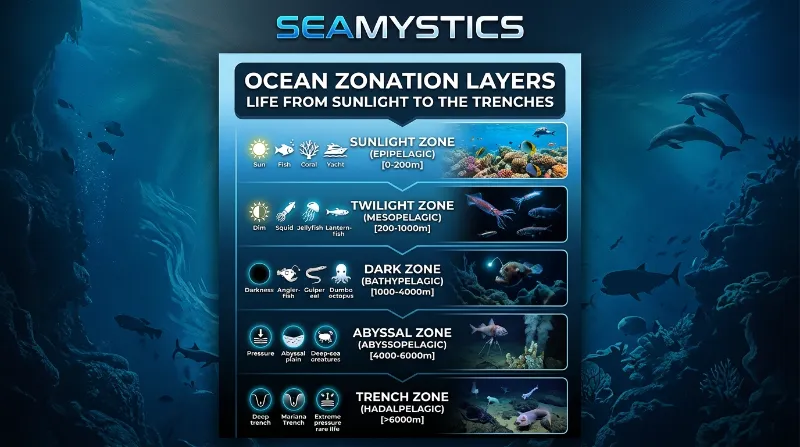
| Sunlight (epipelagic) | 0 to 200 m | Bright | Tuna, dolphins, sea turtles, plankton |
| Twilight (mesopelagic) | 200 to 1,000 m | Faint blue | Lanternfish, squid, swordfish |
| Midnight (bathypelagic) | 1,000 to 4,000 m | None | Anglerfish, vampire squid, sperm whale prey |
| Abyss (abyssopelagic) | 4,000 to 6,000 m | None | Sea cucumbers, tripod fish, giant isopods |
| Trench (hadopelagic) | 6,000 to about 11,000 m | None | Amphipods, snailfish, microbes |
The average ocean is about 3,700 meters deep, so most of the planet’s water sits in the dark layers. Pressure rises by about one atmosphere for every 10 meters. At the bottom of the Challenger Deep, it passes 1,000 atmospheres.
What Are the Ocean Depth Zones?
Scientists split the water column into layers because three things change as you go down: light, temperature, and pressure. These layers are not walls. They blend into each other, and the exact depth changes with latitude, season, and water clarity.
Still, the five-layer system works well. It gives students, divers, and researchers a shared map. The Woods Hole Oceanographic Institution offers a clear overview of how the ocean zones work, and it is worth a look after you finish this guide.
Think of the ocean like a tall apartment building. The top floors get sun and have plenty of food. The lower floors are cold, quiet, and short on food. Every tenant has adapted to its own floor.
The Ocean Zones Diagram in Simple Words
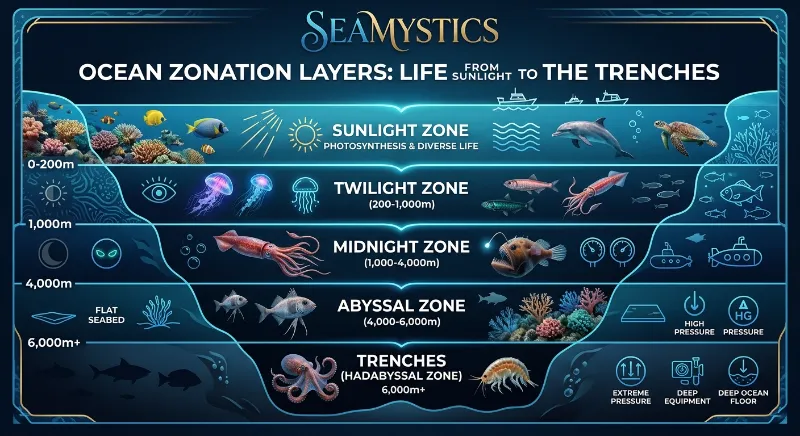
If you picture an ocean zones diagram, draw a tall rectangle. Color the top fifth bright blue. Fade the blue to navy in the middle. Make the lower part black. Then add a small, deep notch at the bottom for the trenches.
You can also build a quick model at home. Pour layers of blue-tinted liquids of different densities into a tall glass. A fun hands-on version is described in this DIY ocean layers project. Kids often remember the order of the layers after they make one.
Ocean Zonation Layers: The Five Zones From Top to Bottom
Here is the full journey. Each section covers what changes and who lives there.
The Sunlight Zone (0 to 200 Meters)
This is where most ocean life lives. Sunlight reaches this layer, so tiny algae called phytoplankton can make food with photosynthesis. They grow in huge numbers, and almost every other sea animal depends on them.
The warm top part, called the mixed layer, is churned by wind and waves. Below it, the thermocline begins. This is a zone where the temperature drops fast. Many fish use the thermocline like a ceiling or a floor when they hunt.
Reefs, kelp forests, seagrass beds, and open water all sit in this layer. Tuna, sharks, dolphins, and sea turtles feed here. If you want to see how plankton blooms power the rest of the web, read our guide to the phytoplankton bloom ecosystem.
Quick facts about this layer:
- It holds about 90% of marine life by number of species.
- Water temperature ranges from near freezing at the poles to above 30°C in the tropics.
- Pressure is low, from 1 to about 21 atmospheres.
- Most scuba diving happens in the top 40 meters.
The Twilight Zone (200 to 1,000 Meters)
Here the light fades to a dim blue glow. By 1,000 meters, there is no sunlight at all. Photosynthesis stops, so animals must find food in other ways.
Many creatures here use bioluminescence, which means they make their own light. Lanternfish have tiny glowing spots along their sides. The glow helps them blend in with faint light from above. This trick is called counter-illumination.
This zone also hosts one of the biggest migrations on Earth. Every night, billions of fish and squid swim up toward the surface to feed. At dawn, they sink back into the dark. Scientists call it diel vertical migration. A well-known 2014 study led by Xabier Irigoien and published in Nature Communications estimated that mesopelagic fish may weigh around 10 billion tonnes in total. That is far more than earlier counts, though researchers still debate the exact number.
Why does this matter to climate? These animals carry carbon down in their bodies and waste. This movement is a key part of the biological carbon pump, which helps pull carbon dioxide out of the air.
The Midnight Zone (1,000 to 4,000 Meters)
Now it is fully dark. The water is cold, often just 2 to 4°C. Pressure is more than 100 times what you feel at the beach.
Food is scarce here. Most of it arrives as marine snow, which is a slow rain of dead plankton, fecal pellets, and bits of animals from above. Many animals in this layer move slowly to save energy. Some have large mouths and stretchy stomachs, so they can swallow whatever shows up.
The anglerfish is the famous example. Females carry a glowing lure on their heads to attract prey. The vampire squid lives in the low-oxygen part of this zone and eats marine snow with sticky filaments.
Air-breathing animals visit as well. In 2014, researchers reported a Cuvier’s beaked whale that dived to about 2,992 meters, the deepest dive ever recorded for a mammal at that time. These whales can stay down for more than two hours on a single breath.
The wreck of the Titanic rests at roughly 3,800 meters, inside this layer. When Robert Ballard’s team from WHOI found it in 1985, the cold, dark water was a big reason the ship was so well preserved. This is also a good lesson about the deep sea: things decay slowly down there. Remember that point. It matters a lot for ghost nets, which we cover below.
The Abyssal Zone (4,000 to 6,000 Meters)
Most of the deep seafloor sits in this zone. It is a wide, flat plain covered in soft mud. The temperature stays close to freezing, and the water is almost perfectly still.
Animals here grow slowly and live long lives. Sea cucumbers crawl across the mud and eat settled organic matter. Tripod fish stand on long fin rays and face into the current to catch drifting food. Giant isopods, which look like huge pill bugs, clean up dead animals that sink down.
A single whale carcass can change this zone for decades. When a whale falls, it creates a feeding hotspot called a whale fall. Worms, crabs, and bacteria move in and feed for many years. Scientists often compare it to an oasis in a desert.
Nutrients matter a lot in this layer. The way matter drops and gets reused is explained in our article on marine nutrient cycling.
The Hadal Zone (6,000 to About 11,000 Meters)
This is the deepest layer. It is named after Hades, the Greek god of the underworld. The hadal zone is found mostly in deep trenches, such as the Mariana Trench in the Pacific.
The deepest point, Challenger Deep, is about 10,935 meters down. On January 23, 1960, Jacques Piccard and Don Walsh reached about 10,911 meters in the bathyscaphe Trieste. In 2012, James Cameron went solo to nearly the same depth. In 2019, Victor Vescovo made multiple dives as part of the Five Deeps expedition.
Life is surprisingly rich here. Small shrimp-like animals called amphipods swarm around baited traps. In 2022, a Japanese and Australian team filmed a snailfish at about 8,336 meters in the Izu-Ogasawara Trench. That set a new depth record for a fish, announced in 2023. Scientists think fish may not be able to live much deeper than about 8,200 to 8,400 meters because of how pressure affects their body chemistry.
Comparing the Zones: Facts and Figures
Here is a closer look at how conditions change. These are typical values, and they shift by location.
| Zone | Pressure | Typical temperature | Main food source |
|---|---|---|---|
| Sunlight | 1 to 21 atm | 5 to 30°C | Photosynthesis |
| Twilight | 21 to 101 atm | 4 to 12°C | Vertical migration, sinking matter |
| Midnight | 101 to 401 atm | 2 to 4°C | Marine snow, carcasses |
| Abyss | 401 to 601 atm | 1 to 3°C | Marine snow, carcasses |
| Trench | 601 to 1,100 atm | 1 to 4°C | Trench funneling, carcasses |
Notice how little the temperature changes below 1,000 meters. The big change in the deep is pressure and food. That is why deep animals tend to be slow, soft-bodied, and efficient.
Here is another way to look at it. Light and warmth drop fast in the top 1,000 meters. After that, the deep ocean is a steady, cold place for thousands of meters.
Why Marine Zonation Facts Matter to People
Depth zones are not just trivia. They shape fishing, climate, and conservation. Each layer links to the one above it through falling food and rising animals.
Take the food web. Everything starts with sunlight and plankton. Small fish eat plankton, bigger fish eat small fish, and the leftovers sink. Our pillar guide to the ocean food chain shows how these links connect from the surface to the seafloor.
Some species hold a layer together. If they vanish, the whole habitat can change. You can read more about this idea in our article on keystone marine species.
Zones also help us with exploration. In my experience as a deep-sea researcher, one of the best habits is to log depth, temperature, and light first, before anything else. Those three numbers tell you which zone you are in, and they tell you what to expect to see. A new student often wants to jump to species names, but the zone comes first.
How Scientists Map the Layers
Researchers use several tools to study the water column:
- CTD sensors measure conductivity, temperature, and depth as they drop through the water.
- Sonar sends sound down and listens for echoes, which reveals fish schools and the seafloor.
- Remotely operated vehicles (ROVs) carry cameras and arms to depths no diver could reach.
- Submersibles carry people into the deep for direct study.
Sonar can also produce odd results. Sometimes it shows strange shapes that confuse even experienced crews. We looked at some famous cases in our piece on sonar unidentified shapes.
For official data and expedition news, the NOAA Ocean Exploration program at oceanexplorer.noaa.gov is another solid source.
Ghost Nets: The Silent Killers Drifting Through the Deep Ocean
Now we reach the dark side of the story. Fishing gear that is lost, dumped, or abandoned keeps on catching animals. Scientists call it ghost gear, and the nets are called ghost nets. They are built to trap fish, and they do not know when to stop.
A widely cited 2009 report from the UN Environment Programme and the Food and Agriculture Organization estimated that about 640,000 tonnes of fishing gear enter the sea each year. That number is an older estimate, and researchers keep refining it. A 2022 study in Science Advances by Kelsey Richardson and colleagues estimated that about 5.7% of all fishing nets, 8.6% of traps, and 29% of lines are lost around the world each year.
One of the clearest case studies comes from the Great Pacific Garbage Patch. In 2018, a team led by Laurent Lebreton found that fishing nets made up at least 46% of the floating plastic mass in the patch. That means a big share of the trash is gear that was built to catch life.
How Ghost Nets Move Through the Ocean Layers
A ghost net does not stay in one place. It travels through the same layers we just covered.
- In the sunlight zone: Floating nets drift on currents. Turtles, seals, dolphins, and seabirds get tangled and cannot surface to breathe.
- In the twilight zone: Nets that lose their floats sink slowly. They keep snagging fish and squid on the way down.
- On seamounts and deep reefs: Nets catch on rocks and corals. They smother slow-growing animals such as cold-water corals and sponges.
- On the seafloor: Heavy nets settle and keep trapping crabs, fish, and other bottom dwellers.
Here is the part that connects to what we learned about the Titanic. Cold, dark water slows decay. Nylon and polyethylene do not break down quickly even in warm, bright water. In the deep, where there is no sunlight and very little warmth, they last even longer. A net lost today may still be fishing decades from now.
Here is a simple view of how the problem changes by depth:
| Zone | Main ghost gear problem | Who suffers most |
|---|---|---|
| Sunlight | Drifting nets, entanglement | Turtles, marine mammals, seabirds |
| Twilight | Sinking nets, mid-water trapping | Fish, squid, sharks |
| Seamounts and deep reefs | Snagging, smothering | Corals, sponges, deep fish |
| Seafloor | Long-term ghost fishing | Crabs, bottom fish, scavengers |
What Sonar and ROVs Reveal
Divers and ROV pilots now find ghost gear far deeper than most people expect. In my own review of survey video, I have noticed that nets often stand out as bright, unnatural lines against dark mud. Once you know what to look for, they are easy to spot.
Removal is hard work. Teams must cut nets free without harming the animals or the reef. In deeper water, it often needs an ROV. Some groups also use sonar to find where gear has gathered, which links back to the mapping tools mentioned earlier.
What You Can Do About Ghost Nets
You do not need to be a scientist to help. Small choices add up.
- Choose seafood from fisheries that mark their gear and report losses.
- Support groups that run net recovery programs.
- Join a local beach or harbor cleanup and report any nets you find.
- Share what you learn, since many people have never heard of ghost gear.
- Back policies that require gear marking and easy ways to report lost nets.
How to Read an Ocean Zones Diagram Like a Scientist
Next time you see a diagram, check these four things in order:
- The depth scale on the side, and whether it is drawn to scale.
- The color change, which shows how fast light fades.
- The temperature line, which usually shows the thermocline as a sharp bend.
- The animal icons, which show where each group lives most often.
Many diagrams cheat and stretch the top layer so it fits more animals. Real depth is very uneven, because 200 meters is a small slice of an ocean that is nearly 3,700 meters deep on average. That is a useful fact to keep in mind. It tells you how thin the bright world really is.
An old tip from teaching: students remember the layers best when they link each one to a feeling. Sunlight is warm and busy. Twilight is dim and quiet. Midnight is cold and empty. Abyss is still. Trench is extreme.
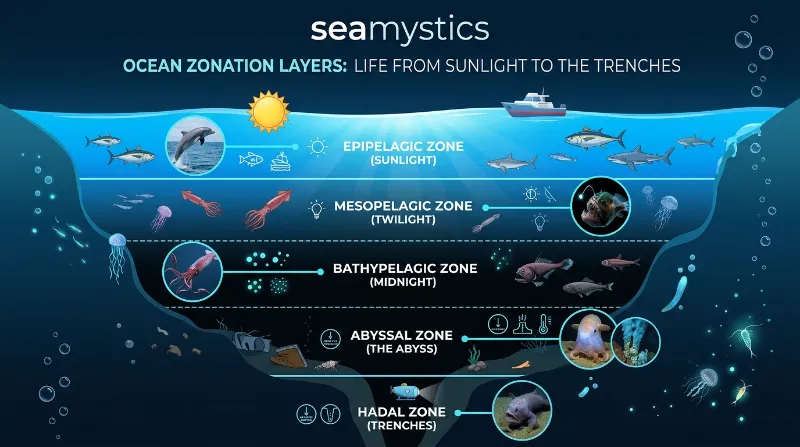
You can also compare how other writers explain the layers. A good, simple tour of all five is available at this journey through the five zones of the ocean.
Frequently Asked Questions
How many ocean zones are there?
Scientists usually list five: sunlight, twilight, midnight, abyss, and trench. Some charts also add the neritic zone near the coast and the benthic zone on the seafloor.
What is the deepest ocean zone called?
It is the hadal zone, also called the hadopelagic zone. It starts at about 6,000 meters and reaches about 11,000 meters in the deepest trenches.
Where does most sea life live?
Most marine life lives in the sunlight zone, where light allows plankton to grow. Life does exist in every layer, but it gets sparser as you go down.
Why is the deep ocean so cold?
Sunlight only warms the top layer. Cold, dense water from the poles sinks and spreads along the bottom, which keeps the deep close to freezing.
What is a ghost net?
A ghost net is fishing gear that was lost or left behind. It keeps trapping animals long after the crew has gone.
Can ghost nets reach the deep sea?
Yes. Many nets sink, and ROVs have found gear on seamounts and on the seafloor. Cold, dark water slows how fast it breaks down.
Conclusion
Ocean zonation layers explain how light, pressure, and food shape every creature in the sea. The sunlight zone is full of life and color. Below it, each layer grows darker, colder, and stranger, until you reach the trenches. Understanding these layers also shows why ocean problems like ghost nets matter, since they cross every boundary and last for years. The more you know about the layers, the better you can protect them.
Test Your Knowledge: 5-Question Quiz
1. Which zone is also called the twilight zone?
A) Epipelagic
B) Mesopelagic
C) Bathypelagic
2. About how deep is the Challenger Deep?
A) 6,000 meters
B) 8,200 meters
C) 10,935 meters
3. Why do ghost nets last so long in the deep ocean?
A) Cold, dark water slows decay
B) Fish repair them
C) Salt makes plastic stronger
4. True or false: Photosynthesis happens in the midnight zone.
5. Fill in the blank: The slow rain of dead plankton and waste that feeds deep animals is called marine ______.
Answers: 1) B. 2) C. 3) A. 4) False, since no sunlight reaches that depth. 5) Snow.
References
- Irigoien, X. et al. (2014). Large mesopelagic fishes biomass and trophic efficiency in the open ocean. Nature Communications.
- Lebreton, L. et al. (2018). Evidence that the Great Pacific Garbage Patch is rapidly accumulating plastic. Scientific Reports.
- Macfadyen, G., Huntington, T., and Cappell, R. (2009). Abandoned, lost or otherwise discarded fishing gear. UNEP and FAO.
- Richardson, K. et al. (2022). Global estimates of fishing gear lost to the ocean each year. Science Advances.
- Schorr, G. S. et al. (2014). First long-term behavioral records from Cuvier’s beaked whales. PLOS ONE.
- Woods Hole Oceanographic Institution. Ocean zones and ocean learning hub.
- NOAA Ocean Exploration. Deep-sea exploration and mapping resources.