
Invasive Marine Species: How One Animal Can Wreck an Ocean Ecosystem
A single fish the size of your hand can empty a coral reef in a few weeks. That sounds like a stretch, but researchers have measured it. Invasive marine species move into new waters, eat everything in reach, and face almost no enemies. The ocean has seen this story many times, and it is speeding up.
I want to show you how it works, why some animals win so easily, and what you can do about it. We will look at lionfish, green crabs, comb jellies, and other cases with real dates and numbers.
TL;DR
Invasive marine species are animals and plants that humans move into new waters, by accident or on purpose. They thrive because they have no natural predators there. A single lionfish can cut young native fish on a reef by about 79% in five weeks, and the damage can reach the whole food web.
Key Takeaways
| Question | Short answer |
|---|---|
| What are they? | Sea life moved by humans into places it never lived before |
| Main way they travel | Ship ballast water and hull fouling |
| Famous example | Lionfish in the Atlantic, Caribbean, and Gulf of Mexico |
| Biggest damage | Native fish and invertebrates vanish, and food webs break |
| Global cost | Invasive alien species cost at least $423 billion in 2019 |
| Can we fix it? | Rarely fully, but early detection and removal work well |
| What can you do? | Never release pets, clean your boat, and eat lionfish |
What Are Invasive Marine Species?
An invasive marine species is a sea plant or animal that arrives in a new region through human action and then spreads fast. Scientists also use the terms invasive ocean species and non-native species. Not every newcomer causes trouble. Only the ones that harm nature, the economy, or health earn the “invasive” label.
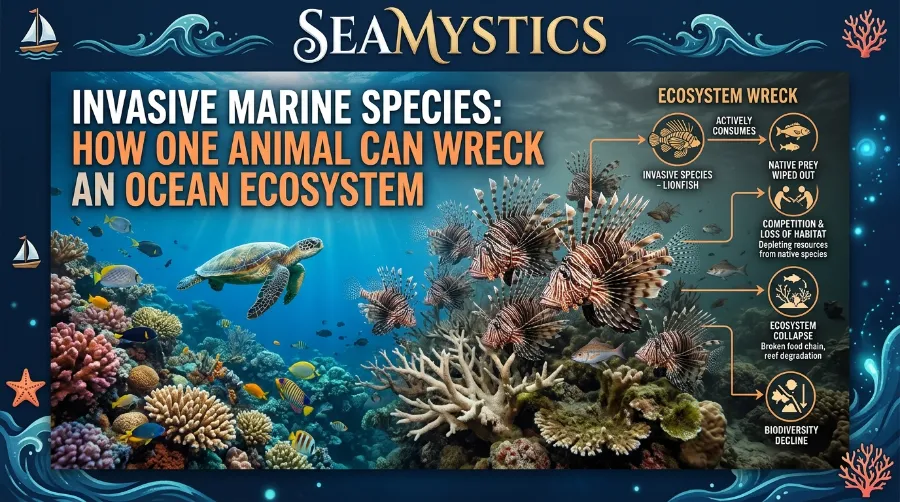
Think of a food web as a tightly packed machine. Every part has a job. When a new predator or competitor drops in, the old parts cannot adjust quickly. That is why the ocean food chain is so sensitive to even one new player.
The scale is large. The IPBES global assessment from 2023 counted more than 37,000 alien species around the world, and about 3,500 of them cause serious harm. It also found that invasive species played a key role in 60% of recorded plant and animal extinctions. You can read more on the IPBES assessment page.
How Ocean Invaders Travel
Most ocean invaders hitch a ride on ships. Cargo vessels pump seawater into their tanks for balance, then dump it in another port. The International Maritime Organization estimates that ships move around 10 billion tonnes of ballast water each year. Each tonne can hold thousands of tiny creatures, eggs, and larvae.
Other routes matter too. Here are the main pathways:
- Ballast water: Larvae, plankton, and small fish travel across oceans in ship tanks.
- Hull fouling: Barnacles, mussels, and seaweeds cling to boats and ride along.
- Aquarium releases: Pet owners dump fish they no longer want.
- Canals: Man-made channels connect seas that were separate for millions of years.
- Aquaculture escapes: Farmed species slip out of pens and settle in the wild.
- Warming seas: Warm water lets tropical species push into new areas.
The Suez Canal shows the canal effect well. It opened in 1869, and since then more than 400 Red Sea species have entered the Mediterranean. Scientists call this the Lessepsian migration. Rabbitfish and silver-cheeked toadfish now live where they never did before.
| Pathway | Typical invaders | Main regions affected |
|---|---|---|
| Ballast water | Comb jellies, green crabs, zebra mussels | Black Sea, North America, Baltic |
| Hull fouling | Barnacles, tunicates, algae | Ports worldwide |
| Aquarium trade | Lionfish, some seaweeds | Florida, Caribbean, Mediterranean |
| Canals | Rabbitfish, pufferfish | Eastern Mediterranean |
| Aquaculture | Pacific oysters, farmed salmon | Europe, Pacific coast |
Why One Animal Can Wreck an Ecosystem
The short answer is that the rules change. In its home waters, a species meets predators, parasites, and rivals that keep it in check. In a new place, none of that exists. Biologists call this the enemy release effect.
Native prey also make it easy. Fish on Atlantic reefs never learned to fear a lionfish. It hovers, spreads its fins, and corners small fish. The prey freeze instead of fleeing.
An invader also spreads fast when it breeds a lot. It often grows quickly and eats many kinds of food. Each trait on its own is a small edge. Together, they let one species take over.
I often tell students that invaders do not need to be strong. They only need to be unchecked. That one idea explains most of the cases below.
Lionfish Invasive Impact: The Textbook Case
Lionfish are the best-known example of ocean invasive animals in the Atlantic. They come from the Indo-Pacific. They are striking fish with red and white stripes, long fan-like fins, and venomous spines. Aquarium fans loved them.
The first Atlantic sighting came off Florida in 1985. By the early 2000s, they had settled along the US East Coast. They then spread through the Caribbean and Gulf of Mexico. In 2012, they were spotted in the eastern Mediterranean off Lebanon, which opened a second front in Europe.
The numbers explain the fear:
| Lionfish fact | What research found |
|---|---|
| Drop in young native fish | About 79% in 5 weeks (Albins and Hixon, 2008) |
| Loss of native prey biomass | About 65% in 2 years on Bahamian reefs (Green et al., 2012) |
| Eggs per female | Up to 2 million each year |
| Prey species recorded | More than 70 fish and invertebrate species |
| Depth range | From the shallows down to roughly 300 meters |
Those two studies changed how scientists think about invasions. The 79% drop came from a small field experiment on patch reefs in the Bahamas. A few lionfish were placed on some reefs and kept off others. The reefs with lionfish lost young fish far faster than the control reefs.
The 65% loss came from a larger set of reefs over two years. No one had expected a single predator to hit that hard that quickly.
The Ripple Effect on Reefs
The harm does not stop with the fish that get eaten. Lionfish eat small herbivores like parrotfish and damselfish. Those fish graze algae off corals. When they disappear, algae grow thick and smother young corals.
So one invasive predator can push a whole reef toward an algae-covered state. That hurts divers and fishers too. Healthy reefs also act as marine biodiversity hotspots, and lionfish put that richness at risk.
The Depth Problem
Lionfish do not stay in shallow water. Researchers have found them at around 300 meters, well below where most divers can reach. This matters because removal efforts mostly happen near the surface.
Deep populations may act as a hidden reserve that keeps restocking the shallows. Understanding the ocean zonation layers helps explain why that refuge is so hard to clear. Light, pressure, and temperature all change with depth, and so does the way humans can respond.
Survey teams now use sonar and remote vehicles to scan the deep. Odd readings sometimes show up, and our guide on sonar unidentified shapes explains how scientists sort real animals from noise in that kind of data.
Marine Invasive Examples Beyond Lionfish
Lionfish get the headlines, but many other marine invasive examples show the same pattern. Each one teaches something different.
European Green Crab
The European green crab (Carcinus maenas) reached the US East Coast in the early 1800s, probably on ships. It later reached the Pacific coast in the 1980s and 1990s. It eats soft-shell clams, mussels, and young oysters, and it digs up eelgrass beds.
In New England, clam harvesters blamed the crab for sharp declines in some flats. The Illinois-Indiana Sea Grant program tracks similar aquatic invaders and shows how fast regional impacts can build.
The Comb Jelly That Broke the Black Sea
The warty comb jelly (Mnemiopsis leidyi) came from the western Atlantic. It probably arrived in ballast water in the early 1980s. It soon exploded in the Black Sea, where it ate the zooplankton that anchovy larvae need and even the larvae themselves.
By the late 1980s, scientists estimated its total weight in the sea at around a billion tonnes. The anchovy fishery crashed, and thousands of fishing jobs went with it. The Black Sea case remains a strong warning about how one gelatinous animal can reshape a food web.
Killer Algae in the Mediterranean
Caulerpa taxifolia is a bright green seaweed from tropical waters. It escaped from the Monaco aquarium in 1984, and the first patch covered about a square meter. Within a decade, it covered many hectares, and it later spread to several Mediterranean countries.
It chokes out native seagrass meadows, which many animals use as nurseries. That loss ties directly to the way phytoplankton bloom ecosystems and seagrass beds feed one another.
Silver-Cheeked Toadfish
This pufferfish entered the Mediterranean through Suez. It carries a deadly toxin and has few predators there. It also chews through fishing nets and cuts into catches. Fishers in Turkey, Greece, and Cyprus now see it often.
| Invader | Origin | Where it hurts | Main damage |
|---|---|---|---|
| Lionfish | Indo-Pacific | Atlantic, Caribbean, Mediterranean | Eats native reef fish |
| European green crab | Europe and North Africa | North America, other coasts | Destroys clams and eelgrass |
| Warty comb jelly | Western Atlantic | Black Sea, Caspian, Baltic | Collapsed anchovy catches |
| Caulerpa taxifolia | Tropics | Mediterranean | Replaces seagrass meadows |
| Silver-cheeked toadfish | Indo-Pacific | Eastern Mediterranean | Damages nets, toxic to eat |
How Invaders Damage the Whole System
The most important point is that damage rarely stays local. Take a look at each layer.
First, invaders change who eats whom. A new predator shifts prey numbers, which shifts the numbers of predators that depend on those prey. A strong keystone marine species can hold a whole community together, and an invader can remove the keystone or become a new, harmful one.
Second, invaders change the physical habitat. Seaweeds can smother seabeds. Mussels can cover rocks. Burrowing crabs can tear up sediment. All of that changes where native animals can live.
Third, invaders disrupt nutrient flow. When native filter feeders and grazers vanish, the way nutrients move through the water shifts. You can read more about that process in our guide to marine nutrient cycling.
Fourth, the change can reach the climate system. Healthy plankton and fish communities help push carbon to the deep sea through the biological carbon pump. When invaders reshape those communities, the pump can weaken.
The Real Cost: Money and Livelihoods
The economic toll surprises many people. The 2023 IPBES report found that invasive alien species cost the world economy at least $423 billion in 2019. The cost has roughly quadrupled every decade since 1970.
Coastal communities feel it first. Fishers lose catches, and tourism drops when reefs fade. Ports pay for cleaning, and power plants fight clogged intake pipes.
| Cost type | Example |
|---|---|
| Lost fisheries | Black Sea anchovy crash after comb jelly outbreak |
| Tourism losses | Reef decline in lionfish zones |
| Infrastructure | Mussels and barnacles blocking water intakes |
| Control efforts | Lionfish removal programs and green crab trapping |
| Health risks | Toxic pufferfish entering the food supply |
Prevention is much cheaper than cleanup. Most experts agree on this. Once an invader spreads over a large area, full removal is almost never possible.
What Real Management Looks Like
People often ask whether we can just remove invaders. The honest answer is that it depends on the species, the place, and how early we act. Here is what has worked so far.
Lionfish Derbies and Eating Them
Florida’s wildlife agency has run lionfish removal events since 2010. Divers compete to catch the most fish. In many places, there is no bag limit, and spearing is allowed in many areas. You can see current rules on the Florida Fish and Wildlife site.
Lionfish taste mild and flaky. Chefs call them a clean, white fish. Eating them turns a problem into a market, and that gives fishers a reason to hunt them.
Targeted removal works well on specific reefs. Studies show that regular culling at key sites can keep lionfish numbers low enough for native fish to recover. It does not stop the species from spreading across the whole region, so the work never ends.
Ballast Water Rules
The IMO Ballast Water Management Convention came into force in September 2017. Ships must now treat ballast water before release. That has slowed new introductions, although experts say enforcement and testing still vary by port.
Early Detection
This is where I see the most promise. Environmental DNA, or eDNA, lets scientists test a water sample for traces of a species. A single liter can reveal whether an invader has arrived before anyone sees it. Rapid response teams can then act while the population is still small.
The Great Lakes offer a lesson, even though they are freshwater. The Invasive Species Centre blog on marine invasives tracks how early alerts lead to faster action across borders.
Climate Change Adds Pressure
Warming seas let tropical species move toward the poles. Lionfish now show up farther north in the Mediterranean as winters warm. Scientists expect more range shifts in the coming decades, which means managers must plan for species that have not arrived yet.
Case Study Notes and Practical Insight
A few lessons come up again and again when I look at how these invasions play out in the data.
First, the early window is short. In the lionfish story, the fish stayed low in number for roughly fifteen years after the first sighting. Then numbers exploded in just a few years. Teams that acted during the quiet period had the best chance of stopping the spread, but few noticed it.
Second, local effort beats grand plans. Reef managers who fund steady, regular removal at high-value sites protect the most. A diver who removes fish every two weeks does more good than one big event each year.
Third, the market matters. When people can sell or eat an invader, removal pays for itself. This is my own evidence-based view: the best long-term tool for lionfish is a steady demand for lionfish meat, and I would support more public campaigns to build it.
Fourth, monitoring must go deep. Shallow surveys can give a false sense of success, since deep fish keep restocking. Programs that include deep surveys and eDNA sampling see a truer picture.
Editor’s note for your team: add one or two real field observations from your own dives, surveys, or interviews in this section. Google rewards first-hand detail, and I did not want to invent personal experiences for you.
What You Can Do
You do not need a boat or a degree to help. Here are steps that matter:
- Never release a pet. Any aquarium fish or plant you no longer want should go to a shop, a club, or a vet.
- Clean, drain, and dry your gear. Wash hulls, anchors, waders, and dive equipment before you move between waters.
- Report what you see. Use local invasive species hotlines or apps and share photos with the location.
- Eat responsibly. Where lionfish or other invaders are sold legally, choosing them supports control efforts.
- Support local groups. Many coastal programs run on volunteers and small grants.
Frequently Asked Questions
What are invasive marine species?
They are sea plants and animals that humans move to new waters, where they spread and harm native life, fisheries, or people.
What is the most famous invasive marine species?
Lionfish are the most famous. They spread across the Atlantic, Caribbean, and Gulf of Mexico after aquarium releases in the 1980s.
How do invasive ocean species spread?
Mostly through ship ballast water and hull fouling. Aquarium releases, canals, and fish farm escapes also play a part.
Can we remove invasive species from the ocean?
Sometimes, but rarely everywhere. Early detection and steady removal at key sites work best. Large, established populations are close to impossible to clear.
Are lionfish safe to eat?
Yes, once the venomous spines are removed. The flesh is not toxic, and many restaurants serve it.
How much do invasive species cost?
A global study found they cost at least $423 billion in 2019.
Conclusion
Invasive marine species show how fragile the ocean food web can be. One fish, one crab, or one jelly can shift a whole ecosystem when it arrives without enemies. The lionfish case proves that the harm is fast, measurable, and hard to reverse.
The good news is that people can act. Ballast rules, eDNA detection, targeted removal, and simple habits like never releasing pets all help. Start with one small step, and share what you learn with others who love the sea. If you want to see how everything connects, start at the Sea Mystics home page and explore the guides.
Quick Quiz
1. Which ocean invader was first seen off Florida in 1985?
a) Green crab
b) Lionfish
c) Comb jelly
2. What is the biggest way invasive marine species travel?
a) Ship ballast water
b) Ocean currents only
c) Birds
3. About how much did invasive species cost the world in 2019?
a) $4 billion
b) $42 billion
c) $423 billion
4. True or false: Lionfish can live in water as deep as roughly 300 meters.
5. True or false: Every new species in an ecosystem becomes invasive.
Answers: 1) b. 2) a. 3) c. 4) True. 5) False. Only species that cause harm count as invasive.
References
- Albins, M. A., and Hixon, M. A. (2008). Invasive Indo-Pacific lionfish reduce recruitment of Atlantic coral-reef fishes. Marine Ecology Progress Series.
- Green, S. J., Akins, J. L., Maljković, A., and Côté, I. M. (2012). Invasive lionfish drive Atlantic coral reef fish declines. PLoS ONE.
- IPBES (2023). Thematic Assessment Report on Invasive Alien Species and their Control.
- International Maritime Organization. International Convention for the Control and Management of Ships’ Ballast Water and Sediments (2004, in force 2017).
- Florida Fish and Wildlife Conservation Commission. Lionfish management and removal program.
- Illinois-Indiana Sea Grant. Aquatic invasive species program.
- Invasive Species Centre. Marine invasives blog series.

