
Coral Polyp Facts: The Tiny Animal Behind Giant Reefs
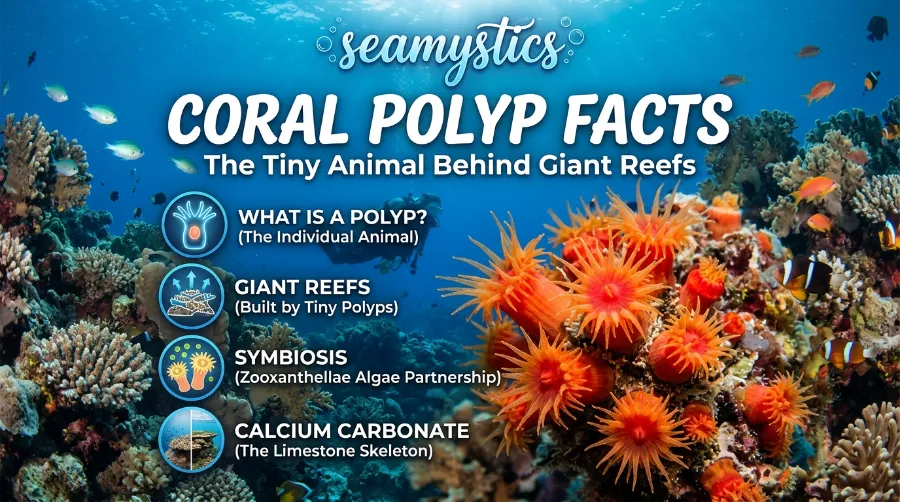
You can see the Great Barrier Reef from space, yet a single animal the size of a pencil tip built it. These coral polyp facts will change how you see every reef photo you have ever liked. Each polyp is soft, small and easy to overlook, but millions of them together create the largest living structures on Earth.
TL;DR: A coral polyp is a tiny animal that makes a hard skeleton and lives in huge groups called colonies. Over thousands of years, those colonies stack their skeletons into reefs. Heat stress now threatens that process, because polyps lose the algae that feed them.
Key Takeaways
| Topic | Quick fact |
|---|---|
| What it is | A small animal related to jellyfish and sea anemones |
| Typical size | A few millimeters wide for most reef polyps |
| Body plan | One mouth, a ring of tentacles and a sac-like gut |
| Main food source | Sugar from algae inside its tissue, plus tiny prey at night |
| Skeleton | Calcium carbonate, laid down below the polyp |
| Colony | Many polyps joined by shared tissue |
| Biggest threat | Marine heat waves that cause bleaching |
| Latest data | About 84% of world reef area faced bleaching-level heat from 2023 to 2025 |
What Is a Coral Polyp?
If you are asking “what is a coral polyp,” here is the short answer. It is an animal, not a plant and not a rock. It belongs to a group called cnidarians, so its close relatives are jellyfish, sea anemones and hydroids.
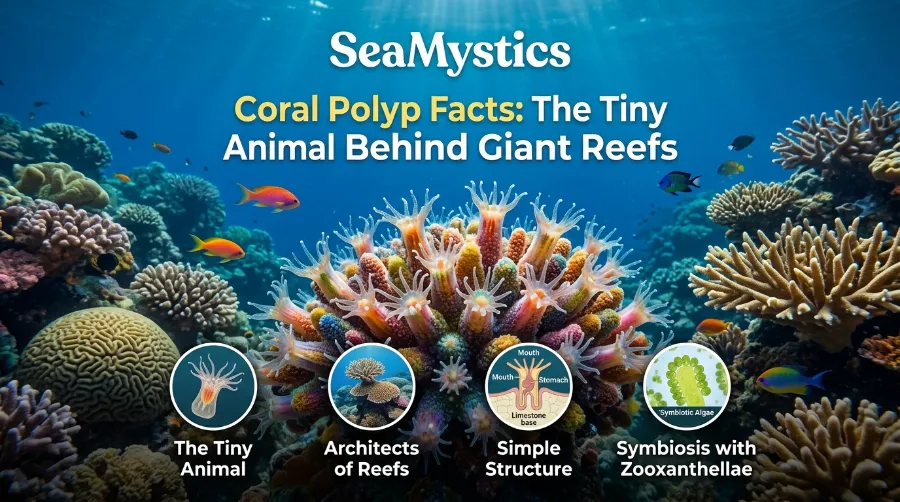
Most reef polyps are only 1 to 3 millimeters wide. Some solitary corals, such as mushroom corals, grow one polyp that can reach about 25 centimeters. Still, the typical reef builder is tiny.
A Simple Way to Picture It
Imagine a tiny cup with a ring of fingers around the rim. The cup is the body. The fingers are the tentacles. The hole in the middle is the mouth.
Now imagine millions of those cups side by side, each sitting on a stone base that it built itself. That picture is a reef in its simplest form.
Hard Corals and Soft Corals
Not every coral builds a stony reef. Hard corals, also called stony corals, make a solid skeleton of calcium carbonate. Soft corals, like sea fans, use flexible tissue and tiny hard pieces called sclerites.
Hard corals do the heavy construction work. In my own field notes, I always record which group I am looking at first, because it changes how I read the health of the whole reef.
If you want to compare other ocean animals by size and role, our ocean life sizes guide puts coral polyps next to many other small sea creatures.
Coral Polyp Anatomy: What Is Inside the Tiny Animal
Coral polyp anatomy is simple, and that simplicity is part of its success. A polyp has only two main tissue layers, with a jelly-like layer between them. The outer layer protects the animal and holds the stinging cells. The inner layer lines the gut and houses the algae.
Aquarium specialists also describe these parts well. The team at Corals Depot walks through the parts of a polyp in their coral polyp anatomy guide, which is a handy visual companion for beginners.
Manta Ray Facts: The Gentle Giants of Open Water
The Mouth and Tentacles
The mouth sits in the center of the polyp. It works as both the entrance and the exit for food and waste. That is one reason polyps look so different from animals with a full digestive tract.
Tentacles surround the mouth. Stony corals usually have tentacles in multiples of six. Soft corals usually have eight, and those tentacles look feathery.
Stinging Cells Called Nematocysts
Each tentacle carries thousands of stinging cells called nematocysts. When a tiny shrimp or larva brushes past, the cells fire a thread that grabs or paralyzes the prey. Then the tentacle pushes the food toward the mouth.
When I touch a small coral fragment with a fine needle under a microscope, the polyp pulls its tentacles inside within seconds. That quick reaction shows how sensitive these simple animals really are.
Ocean Life Sizes: From Microscopic Plankton to Giant Squid
The Gut Cavity and Shared Tissue
Below the mouth, a short tube leads to a hollow gut. Thin walls called mesenteries fold into this space and add surface area for digestion.
The gut also links to neighboring polyps through canals in shared tissue. As a result, one polyp can pass food and energy to another. This sharing turns a group of polyps into a true polyp colony coral.
The Skeleton Cup
At the base, the polyp makes a cup of calcium carbonate called a calicle. The polyp sits inside it and can pull back for safety. Over time, new layers pile on top of the old ones.
| Part | What it does | Why it matters |
|---|---|---|
| Mouth | Takes in food, releases waste | Single opening keeps the body simple |
| Tentacles | Catch prey, sweep water | Feed the polyp at night |
| Nematocysts | Sting and grab prey | Defend against threats |
| Gut cavity | Digests food | Shares nutrients through canals |
| Zooxanthellae layer | Makes sugar from light | Supplies most of the energy |
| Calicle | Holds and protects the polyp | Builds the reef frame |
For another explanation of the basics, Quantum USA gives a short definition of a coral polyp in their saltwater glossary, and it helps if you keep marine aquariums.
How Coral Polyps Eat and Stay Alive
Polyps have two ways to eat, and that combination is the secret to their success. First, they host tiny algae. Second, they catch food with their tentacles.
Whale Shark Facts: The Largest Fish in the Ocean
The Algae Partnership
Inside the polyp’s tissue live microscopic algae called zooxanthellae. They use sunlight to make sugar and share most of it with the polyp. In many reef corals, this can supply as much as 90 percent of the energy the animal needs.
In return, the polyp offers a safe home and waste nutrients that the algae use. Both partners win. That is why most reef-building corals live in clear, shallow, sunlit water.
The algae also give corals their color. When the algae leave, the tissue turns see-through and the white skeleton shows. That event is called bleaching.
Night Feeding on Plankton
During the day, many polyps stay partly closed. At night, they open and stretch their tentacles. The water fills with drifting animals, and the polyps catch them.
This is where plankton facts matter for reef health. Tiny zooplankton carry nitrogen and other nutrients that algae alone cannot supply. The same food web also links to krill facts, because both groups sit near the base of ocean food chains.
Barnacle Facts Explained: The Animal That Glues Itself for Life
What My Reef Surveys Taught Me
One practice insight stands out for beginners. Healthy polyps often look fuller and more puffed up at dusk. If I see tentacles that stay shriveled even at night, I treat that as an early warning sign and note the water temperature.
I also learned not to judge a reef by color alone. A pale coral may be bleached, but it may also be a naturally light species. Checking several colonies of the same species gives a much better answer.
Polyp Colony Coral: Life Together and Reproduction
A single polyp rarely lives alone on a reef. Most live in a polyp colony coral, where every member shares tissue and carries the same genes. Colonies grow by copying themselves, and this is the first key step in reef building.
Asexual Growth by Budding
Polyps grow by budding. A polyp splits, or a new one sprouts from the side, and the colony gets bigger. Each new polyp builds its own calicle and adds to the shared skeleton.
Because of this, a single colony can live for hundreds of years. Some massive corals have grown for centuries and record ocean conditions in their skeleton rings, a bit like tree rings.
Sexual Reproduction and Mass Spawning
Colonies also reproduce sexually, and the timing is amazing. On the Great Barrier Reef, many species release eggs and sperm together a few nights after a full moon in late spring, usually around November or December. In the Florida Keys, many corals spawn in late summer instead.
The eggs and sperm meet in open water and form larvae called planulae. Each larva swims or drifts for days to weeks, then settles on hard ground. There it becomes a new polyp, and the cycle starts again.
Here is the simple life cycle:
- Adult colonies release eggs and sperm during a mass spawning night.
- Fertilized eggs grow into swimming larvae called planulae.
- Larvae drift in the current and look for a clean, hard surface.
- A larva settles and turns into one new polyp.
- The polyp buds and grows into a new colony.
Settling space is limited. Barnacles, sponges and algae all compete for it, so a deeper look at barnacle facts shows how crowded hard surfaces can get in the sea.
Coral Reef Building Facts: How Tiny Animals Make Huge Reefs
Now we reach the part that surprises people most. Coral reef building facts show that the reef is mostly a skeleton, with a thin living skin on top. The polyps pull calcium and carbonate from seawater and turn them into limestone.
Reefs cover less than 1 percent of the seafloor, yet they host about a quarter of all marine species. That is a huge payoff for so little space.
Sea Turtle Species Guide: All 7 Types Explained
How Fast Do Reefs Grow?
Growth is slow compared to human life. Branching corals can add up to about 10 centimeters a year in good conditions. Big, round corals usually add only a few millimeters to about 2 centimeters a year.
Storms, fish and waves break skeletons into sand and rubble. Algae and other organisms then glue the pieces together. This cement turns loose rubble into solid reef rock.
| Coral shape | Typical growth | Reef role |
|---|---|---|
| Branching (staghorn type) | Up to about 10 cm per year | Fast builders and fish shelter |
| Plate and table | Several cm per year | Shade and fish habitat |
| Massive (boulder type) | About 0.5 to 2 cm per year | Strong, long-lasting frame |
| Encrusting | Slow, spreads thin | Covers and binds rock |
Three Reef Types Darwin Described
In 1842, Charles Darwin explained how three kinds of reefs connect. A fringing reef grows near the shore. A barrier reef sits farther out, with a lagoon behind it. An atoll forms a ring around a lagoon after an island sinks.
Darwin argued that coral keeps growing upward while the island slowly drops below the waves. Later drilling work supported his idea. It remains one of the great examples of a simple theory explaining a complex pattern.
The Great Barrier Reef by the Numbers
The Great Barrier Reef stretches about 2,300 kilometers off Australia and holds almost 3,000 individual reefs. Its living layer is only several thousand years old. Sea level rose after the last ice age, and corals grew upward along with it.
In the United States, the Florida Reef Tract runs for roughly 350 miles along the Keys and nearby coast. It is the only living barrier reef system next to the continental United States.
Sea Urchin Facts: The Spiky Architects of Reef Ecosystems
Reef Neighbors: Who Helps and Who Harms
A reef works like a city, and polyps share it with many other animals. Some neighbors help. Others do damage.
Sea urchins show how strongly one species can shape a reef. In 1983 and 1984, a disease killed more than 90 percent of long-spined sea urchins in parts of the Caribbean. Algae then grew over many corals because few grazers remained. You can read more about these grazers in our sea urchin facts article.
On the harmful side, the crown-of-thorns starfish eats coral polyps by pushing its stomach out over the colony. An adult can strip several square meters of coral in a year. Our sea star facts guide explains how these animals feed and why outbreaks matter.
Cold-Water Coral Polyps in the US and Europe
Not all coral lives in warm, clear water. Cold-water corals live in dark, cool seas and do not host algae. They feed only on drifting food.
Europe has some great examples:
- Røst Reef, Norway: A huge cold-water reef built by Desmophyllum pertusum (formerly Lophelia), found in 2002 and stretching roughly 40 kilometers.
- Darwin Mounds, Scotland: A field of small coral-topped mounds northwest of Scotland, found in 1998 and later protected.
- Mediterranean red coral: Corallium rubrum, a soft coral that people have harvested for jewelry for centuries.
- UK cup corals: Small solitary polyps, such as the Devonshire cup coral, live on rocky shores and in shallow seas around Britain.
In the United States, deep-sea coral gardens grow along the Atlantic, Gulf of Mexico and Pacific coasts, often below 200 meters. Many of them grow very slowly, so damage from bottom trawling can take centuries to repair.
| Feature | Warm-water reef coral | Cold-water coral |
|---|---|---|
| Algae partner | Yes | No |
| Typical depth | Shallow, sunlit | Deep, often 200 m or more |
| Temperature | Warm | Cool, often 4 to 12 degrees C |
| Energy source | Sugar plus plankton | Plankton and drifting food |
| Example | Staghorn coral | Desmophyllum pertusum |
Threats to Coral Polyps and the Latest Data
The biggest problem today is heat. Polyps live close to their upper temperature limit. Even a rise of about 1 degree C above the normal summer maximum, held for several weeks, can push them to expel their algae.
Bleaching does not always mean death. Corals can recover if the stress ends soon enough. Long or repeated heat waves, however, can kill them.
Sea Star Facts: How Starfish Regrow Their Own Arms
The Latest Global Bleaching Numbers
The newest figures are serious. NOAA found that bleaching-level heat stress reached about 84% of the world’s reef area, across 83 countries and territories, in the fourth global bleaching event. The event was confirmed on 15 April 2024, and scientists say it likely ended in mid-2025. You can read the official summary in NOAA’s note on the end of the fourth mass bleaching event. climatefactchecksgcrmn
| Global bleaching event | Share of reef area hit by heat stress |
|---|---|
| 1998 | 21% |
| 2010 | 37% |
| 2014 to 2017 | 68.2% |
| 2023 to 2025 | About 84% |
Not every reef area bleached, even in very hot water, and sea temperatures remain higher than they were 25 to 30 years ago. The Global Coral Reef Monitoring Network also reports that reefs are entering an era of near-annual bleaching, which makes it harder to say when one event ends and another begins. gcrmn
Two Real Case Studies
Great Barrier Reef, 2016 and 2017. Back-to-back heat waves hit the northern reef. A 2018 study led by Terry Hughes reported that about half of shallow-water corals died across the two years. The lesson is that two hot summers in a row leave little time to recover.
Florida Keys, July 2023. Record ocean heat reached extreme levels, and rescue teams moved coral from ocean nurseries to land-based labs to save them. Many wild and nursery corals still died. This case showed that even careful restoration projects cannot beat a hot enough sea.
Other Pressures
Heat is not alone. Ocean acidification makes it harder for polyps to build skeletons. Runoff brings extra nutrients that feed algae. Disease, overfishing and damage from boats also add stress.
Krill Facts Explained: Why This Small Animal Matters So Much
Practical Insights from Reef Work
After years of reef surveys and lab work, a few lessons keep coming back. These are not rules from a textbook. They are habits that help me read a reef quickly.
- Check the base, not only the top. Dead skeleton covered by algae tells you the story of an old bleaching event.
- Compare the same species. Color changes between species can mislead, so match like with like.
- Watch the polyps at dusk. Open, full tentacles usually point to a healthier colony.
- Record temperature with every note. A coral that looks fine today can bleach two weeks later.
- Remember that restoration helps, but it cannot replace cooler water. Growing fragments is valuable, yet the main fix is cutting heat-trapping emissions.
How You Can Help Coral Polyps
You do not need to live near a reef to help. Small choices add up, and they matter to readers in the United States and Europe as much as anywhere else.
- Choose reef-safe sunscreen and avoid products with known reef-harming ingredients.
- Never touch or stand on coral when you snorkel or dive.
- Buy seafood from sources that use less destructive fishing methods.
- Cut your energy use and support clean power, since heat is the biggest threat.
- Support reef groups and citizen science programs that track coral health.
Plankton Facts Explained: The Tiny Organisms That Feed the Whole Ocean
Frequently Asked Questions
What is a coral polyp in simple words?
A coral polyp is a tiny animal with a soft body, a mouth and a ring of tentacles. It builds a hard cup of limestone around itself. Many polyps together form a coral colony.
Are coral polyps plants or animals?
They are animals. Their algae partners are plant-like, but the polyp itself is an animal that eats, stings and reproduces.
How big is a coral polyp?
Most reef polyps measure only 1 to 3 millimeters across. A few solitary species can reach about 25 centimeters.
How do coral polyps build reefs?
They take calcium and carbonate from seawater and turn them into limestone skeletons. Generation after generation, the skeletons pile up. Algae and other organisms cement the pieces into solid reef.
Can bleached coral recover?
Yes, if the heat stress ends soon enough and the polyps regain their algae. Long or repeated heat waves can kill the colony.
Do all corals need sunlight?
No. Reef-building corals with algae need light. Cold-water corals live in the dark and feed on drifting food.
Quick Quiz: Test Your Coral Polyp Facts
1. What group of animals do coral polyps belong to?
A) Mollusks
B) Cnidarians
C) Sponges
2. What do zooxanthellae give the polyp?
A) Sugar from sunlight
B) Calcium
C) Stinging cells
3. How many tentacles do most stony coral polyps have?
A) Eight
B) A multiple of six
C) Two
4. What is the main threat that causes mass bleaching?
A) Marine heat waves
B) Too many fish
C) Cold rivers
5. Which of these is a European cold-water coral reef?
A) Great Barrier Reef
B) Røst Reef in Norway
C) Florida Reef Tract
Answers: 1) B, 2) A, 3) B, 4) A, 5) B
Conclusion
Coral polyps prove that small animals can build enormous things. A soft, millimeter-wide body, a stinging tentacle ring and a tiny algae partner together create reefs that shelter a quarter of ocean species. These coral polyp facts also show why heat matters so much: the partnership breaks when the water gets too warm. The more we understand polyps, the better we can protect them, so share this guide, explore the links above and pass the knowledge on.
References
- NOAA National Environmental Satellite, Data, and Information Service. World’s fourth mass coral bleaching event likely ended in 2025.
- Global Coral Reef Monitoring Network. The most intense global coral bleaching event on record has likely ended, NOAA confirms.
- NOAA Coral Reef Watch. Bleaching Alert Scale and global bleaching event summaries.
- Hughes, T. P., et al. (2018). Global warming transforms coral reef assemblages. Nature.
- Darwin, C. (1842). The Structure and Distribution of Coral Reefs.
- Corals Depot. Coral polyp anatomy guide.
- Quantum USA. Saltwater glossary: coral polyp.