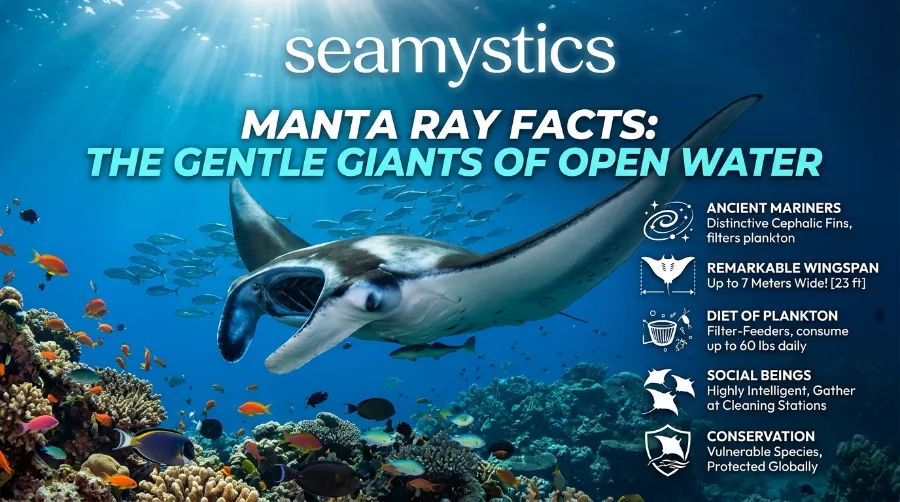

Manta Ray Facts: The Gentle Giants of Open Water
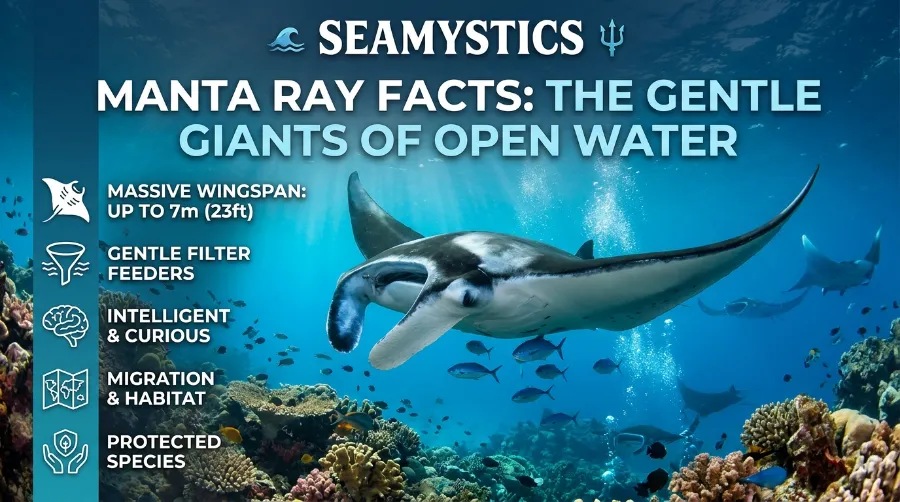
The first time a manta ray glides over your head, the whole ocean seems to go quiet. A shadow as wide as a small plane blocks the sun, and then it rolls gently and passes by like it has all the time in the world. These manta ray facts will show you why scientists call them gentle giants, and why people travel across the world just to see one.
Key Takeaways
| Topic | Quick Fact |
|---|---|
| Species | Giant oceanic manta (Mobula birostris) and reef manta (Mobula alfredi) |
| Size | Giant mantas reach about 7 m (23 ft) wide; reef mantas reach about 5 m (16 ft) |
| Diet | Zooplankton, mostly tiny crustaceans, filtered through special gill plates |
| Habitat | Warm and temperate seas, from reefs to the open ocean |
| Lifespan | At least 40 years, and probably longer |
| Babies | One pup every two to five years, after about 12 months of pregnancy |
| Main threats | Fishing, accidental capture, ghost nets and boat strikes |
| Status | Giant manta: Endangered. Reef manta: Vulnerable |
TL;DR: Manta rays are the largest rays on Earth. They filter plankton, live in warm seas around the world, and have the biggest brains of any fish. They breed very slowly, so even small losses from fishing and ghost nets can harm their numbers.
What Are Manta Rays? A Simple Introduction
A manta ray is a flat, wing-shaped fish related to sharks. Like sharks, it has a skeleton made of cartilage, not bone. That light frame helps it glide for hours with little effort.
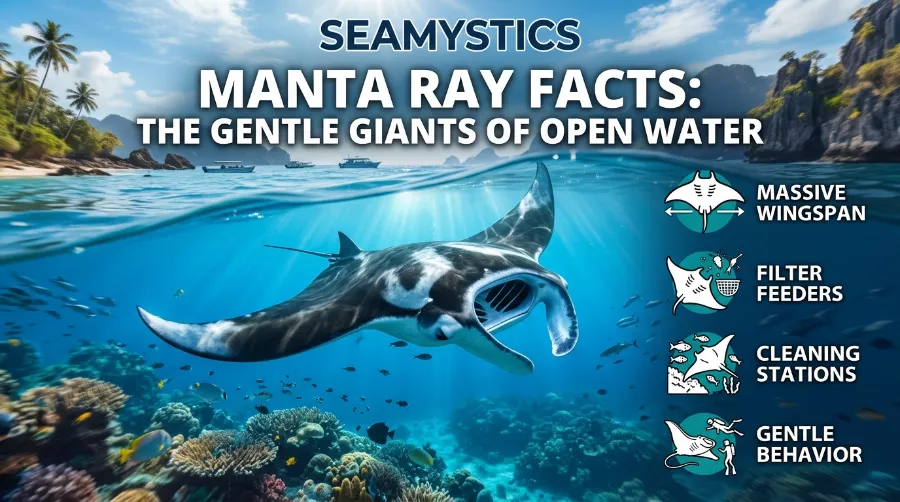
For a long time, people believed there was only one kind of manta. In 2009, researchers showed there are two. The reef manta lives near coasts, while the giant oceanic manta roams the open sea. Later, in 2017, scientists moved both into the genus Mobula, which also includes the smaller devil rays.
Many people ask about manta ray vs stingray. Both are rays, but they are not the same. Stingrays rest on the seafloor and carry a venomous spine. Mantas swim in open water and, for practical purposes, have no stinger. So when readers ask, “do manta rays sting?”, the answer is no. They are harmless to people unless someone harasses them.
Whale Shark Facts: The Largest Fish in the Ocean
Manta Ray Size: How Big Do They Really Get?
Manta ray size is the first thing most visitors notice. A giant oceanic manta can reach a wingspan, called disc width, of about 7 meters (23 feet). Most adults are smaller, around 4 to 5 meters. The largest ones can weigh over 1,300 kilograms, or about 3,000 pounds.
Reef mantas are smaller. They usually measure 3 to 3.5 meters across, and big ones reach about 5 meters. In the Maldives, researchers who track the same animals for years often find that females grow larger than males.
Here is how mantas compare with other ocean giants. If you enjoy size comparisons, our ocean life sizes guide puts them next to many other sea creatures.
| Animal | Typical Maximum Size | Feeding Style |
|---|---|---|
| Giant oceanic manta | About 7 m wide | Filter feeder |
| Reef manta | About 5 m wide | Filter feeder |
| Whale shark | Up to about 12 m long | Filter feeder |
| Spinetail devil ray | About 3 m wide | Filter feeder |
| Southern stingray | About 2 m wide | Bottom feeder |
Notice that the three biggest animals in this table all eat tiny food. Size in the ocean does not always mean teeth. If you want to meet the other giant on that list, read our whale shark facts.
Manta Ray Habitat: Where Do They Live?
Manta ray habitat covers most warm waters on Earth. Reef mantas stay close to coasts, islands and coral reefs. Giant mantas travel across entire ocean basins. Tracking studies have followed some giants for more than 1,000 kilometers, and a few dives have passed 1,000 meters deep.
Here are the best-known places to find them:
- Maldives: Hanifaru Bay is a UNESCO Biosphere Reserve, where well over 100 mantas can feed together in one season.
- Indonesia: Raja Ampat and Komodo have strong year-round sightings.
- Hawaii, USA: The Kona coast is famous for night snorkeling with mantas.
- Mexico: The Revillagigedo Islands host giant mantas that visit divers.
- Gulf of Mexico: Flower Garden Banks National Marine Sanctuary, off Texas, is a US home for giant mantas.
- Mozambique and Ecuador: Both are important for giants.
Healthy reefs matter here. Mantas use reefs as hotels and spas, and the tiny animals that build them are part of this story. You can learn how in our guide to coral polyp facts.
Cleaning stations are a key part of manta ray habitat. These are reef spots where small fish, such as cleaner wrasse, pick parasites off the manta’s skin. A manta may circle a station for several minutes, and the same animals often return day after day. When divers crowd these spots, mantas leave, so many guides now limit group sizes.
Sea Star Facts: How Starfish Regrow Their Own Arms
Manta Ray Diet Facts: What Do Mantas Eat?
Manta ray diet facts surprise many readers. Mantas have no need to hunt. Instead, they eat zooplankton, which are tiny drifting animals such as copepods and small shrimp-like creatures. You can read more about these tiny foods in our plankton facts and krill facts.
A manta feeds in a simple way. First, it opens its wide mouth. Then it pushes water over spongy gill plates. Finally, the plates trap the food, and the water flows out through the gills. The two long fins on its head, called cephalic fins, curl up like horns to funnel water into the mouth. Many people call mantas “devil rays” because of these fins, but the fins are really feeding tools.
Studies estimate that a manta eats about 5 percent of its body weight each day. For a big giant manta, that adds up to many kilograms of plankton daily. This is why mantas follow food, such as seasonal blooms and upwellings.
Mantas use a few feeding tricks:
- Barrel rolling: They flip in tight loops inside a plankton cloud.
- Chain feeding: Many rays swim nose to tail in a line, so the food stays in a tight stream.
- Surface feeding: They skim the top of the water when plankton rises at night.
One more thing: mantas do have teeth, but they are tiny and found only on the lower jaw. Researchers think they play a role in mating, not eating.
Manta Ray Behavior: Smart, Social and Playful
Manta ray behavior shows a surprising level of intelligence. Mantas have the largest brain of any fish, and the parts linked to learning are very well developed. A well-known 2016 study suggested that mantas might even recognize themselves in a mirror. Other scientists still debate that result, so it is best called “interesting, not proven.”
Here is what I have noticed repeatedly when watching mantas on survey dives. They are curious. A manta often changes course to look at a diver, and then circles back for a second look. They seem to prefer calm, still observers. Divers who kick or chase them lose the encounter fast.
Krill Facts Explained: Why This Small Animal Matters So Much
Mantas show several clear behavior patterns:
- Cruising: Slow, steady swimming to save energy.
- Cleaning visits: Hovering over reef stations to get parasites removed.
- Feeding: Barrel rolls and chains in rich plankton water.
- Courtship: A group of males follows one female for days, sometimes in “mating trains.”
- Breaching: Powerful leaps out of the water. Scientists are still not sure why they do it, but guesses include removing parasites and communicating.
Mantas must keep moving. Like many sharks, they push water over their gills by swimming, so they cannot stop for long. For this reason, a resting manta is usually still gliding.
Life Cycle: Babies, Lifespan and Slow Growth
Manta ray babies, called pups, take a long time to arrive. A mother carries one pup for about 12 to 13 months. Twins are rare. The pup is born rolled up like a tube, and it unfolds and swims away right after birth. At birth, it already measures well over a meter across.
After that, females rest for a while. In the Maldives, reef manta mothers often give birth only once every two to five years. A wild manta may live 40 years or more, but it only produces a modest number of pups in that time.
That slow pace is the heart of the conservation problem. Fast-breeding fish can recover from heavy fishing, but mantas cannot. If a population loses ten adults, it may take decades to rebuild.
Researchers identify each manta by the spot pattern on its belly. Like fingerprints, no two patterns match. Citizen science projects, such as the Manta Trust’s Manta Matcher, let tourists upload photos so scientists can count and track animals. A single photo from your dive may help.
Sea Turtle Species Guide: All 7 Types Explained
Manta Ray Predators and Natural Threats
Adult mantas have few natural enemies. Large sharks, such as tiger sharks, and orcas can attack them. Many wild mantas show bite scars on their wings, and these marks tell researchers that the animal survived an attack.
Young mantas face more danger, because they are smaller. For that reason, shallow reef nurseries are very valuable. Sadly, people are now the biggest predators.
Are Manta Rays Endangered? The Real Numbers
Yes, mantas are at risk. The IUCN Red List labels the giant oceanic manta as Endangered and the reef manta as Vulnerable. In the United States, NOAA listed the giant manta as Threatened under the Endangered Species Act in 2018, and you can read the agency’s overview on its giant manta ray page. In 2014, mantas were added to Appendix II of CITES, which means international trade must be controlled.
| Species | IUCN Status | Main Reason |
|---|---|---|
| Giant oceanic manta | Endangered | Fishing and bycatch |
| Reef manta | Vulnerable | Fishing and coastal pressure |
The biggest threat for years was the gill plate trade. Fishers catch mantas for their gill plates, which are sold in some markets as a traditional remedy. Scientists see no proof that the remedy works, but the trade has hurt wild populations.
Tourism gives us a strong reason to protect them. A well-known 2013 study published in PLOS ONE estimated that manta ray tourism earns about 140 million US dollars each year around the world. Many local guides say that a living manta is worth far more than a dead one. In 2014, Indonesia acted on this idea and created a huge manta sanctuary across its waters.
Sea Urchin Facts: The Spiky Architects of Reef Ecosystems
Ghost Nets: The Silent Killers Drifting Through the Deep Ocean
Ghost nets are fishing nets and lines that fishers lose or abandon at sea. They keep drifting and catching animals for years. They are one of the quietest threats mantas face.
Mantas are especially at risk because of how they feed. They swim with their mouths wide open and their head fins unrolled. A thin line or a loose net can snag a head fin easily. Once a manta is caught, it may not be able to pull water over its gills, because the net stops it from swimming freely.
Here is what we know:
- The Global Ghost Gear Initiative has long worked with fishers and governments to cut gear loss.
- A figure often quoted in reports is that about 640,000 tonnes of fishing gear enter the sea each year. Newer studies suggest this number is uncertain, but the problem is clearly large.
- Many rescued mantas show deep cuts around their head fins, where lines were wrapped for months.
Ghost nets harm many other animals as well. Sea turtles struggle in the same drifting mesh, and our guide to sea turtle species shows how many are in trouble. Even small reef animals suffer, because lost nets break coral and cover it in algae. Barnacles and other hitchhikers soon cover old nets, and if you want to know how they cling so well, see our barnacle facts.
What works to reduce ghost nets? Practical steps include:
- Mark gear with owner tags so lost nets can be traced.
- Pay fishers to return old nets, not dump them.
- Run diver cleanups on reefs and wrecks.
- Use gear that breaks down if it is lost.
In my experience on reef cleanup dives, a single net the size of a car can take a team of divers more than an hour to remove, and it is often already full of life. That is why prevention is so much cheaper than rescue.
Plankton Facts Explained: The Tiny Organisms That Feed the Whole Ocean
Interesting Manta Ray Facts You Can Share Today
Here are some fast manta ray facts for your next dinner conversation:
- Mantas can leap almost 2 meters above the surface.
- Mantas come in two color forms, including a black form with no white belly.
- A manta’s skin has a thin layer of mucus that protects it from infection, so touching it can cause harm.
- Remora fish often ride on a manta’s body and share its meals.
A group of mantas has been called a “squadron.”
Their gills lie underneath, in five pairs of slits.
Coral Polyp Facts: The Tiny Animal Behind Giant Reefs
How to See Mantas Responsibly
If you want to see mantas, travel with an operator who follows clear rules. Good guides keep groups small and stay a few meters away. They also never allow touching, flash photography or chasing.
Follow these simple tips:
- Stay calm and float at the surface or settle on the reef.
- Keep at least 3 meters away, and never block the manta’s path.
- Use reef-safe sunscreen, or wear a rash guard instead.
- Choose operators who support research or photo ID programs.
You can also help from home. Support groups such as the Marine Megafauna Foundation, read their detailed manta fact pages, and learn more about the species on the Shark Angels manta page. Choosing certified seafood also lowers the chance that you support gear that harms mantas.
Barnacle Facts Explained: The Animal That Glues Itself for Life
If you care about the wider web of life, explore more at Sea Mystics. Mantas are linked to the tiniest animals, such as sea stars and sea urchins, through the same reef food web. When reefs fall apart, the whole chain feels it.
Ocean Life Sizes: From Microscopic Plankton to Giant Squid
Frequently Asked Questions About Manta Rays
How big is a manta ray?
Giant mantas can be about 7 meters wide, while reef mantas reach about 5 meters.
What do manta rays eat?
They eat zooplankton, which they filter from the water with their gill plates.
Do manta rays sting?
No. Mantas do not have a working stinger, and they are not dangerous to humans.
How long do manta rays live?
Scientists believe they live at least 40 years, but exact numbers are still being studied.
Where do manta rays live?
They live in warm and temperate seas worldwide, from coral reefs to the open ocean.
Are manta rays endangered?
Giant mantas are Endangered and reef mantas are Vulnerable, according to the IUCN.
Can you swim with manta rays?
Yes, in many places, such as Hawaii and the Maldives. Please choose an ethical operator.
Conclusion
Manta rays are huge, smart and very gentle, yet they are fragile. Their size, habitat, diet and behavior all tell one story: this is an animal built for a slow, steady life. Because they breed so slowly, every manta counts. Ghost nets, bycatch and crowded dive sites can all be reduced if we choose carefully. Start by sharing these manta ray facts, and the next time you see a wing glide overhead, you will know exactly what a gift it is.
Test Your Knowledge: 5 Question Quiz
1. What do manta rays mainly eat?
a) Small fish
b) Zooplankton
c) Crabs
2. About how wide can a giant oceanic manta get?
a) 2 meters
b) 4 meters
c) 7 meters
3. How long is a manta ray’s pregnancy?
a) About 12 to 13 months
b) About 2 months
c) About 5 years
4. True or false: Manta rays have a venomous stinger.
5. In one sentence, why do ghost nets harm mantas?
Answers:
- b) Zooplankton.
- c) 7 meters.
- a) About 12 to 13 months.
- False. Mantas have no working stinger.
- Loose nets and lines tangle their head fins and mouths, which can stop them from swimming and breathing.
References
- IUCN Red List of Threatened Species, entries for Mobula birostris and Mobula alfredi: iucnredlist.org
- NOAA Fisheries, Giant Manta Ray species profile: fisheries.noaa.gov
- Marine Megafauna Foundation, Manta Ray Facts: marinemegafauna.org
- Manta Trust research and Manta Matcher: mantatrust.org
- Global Ghost Gear Initiative: ghostgear.org
- O’Malley, M. et al. (2013), “Global Manta Ray Tourism,” PLOS ONE
- Marshall, A. et al. (2009), manta species description, Zootaxa