

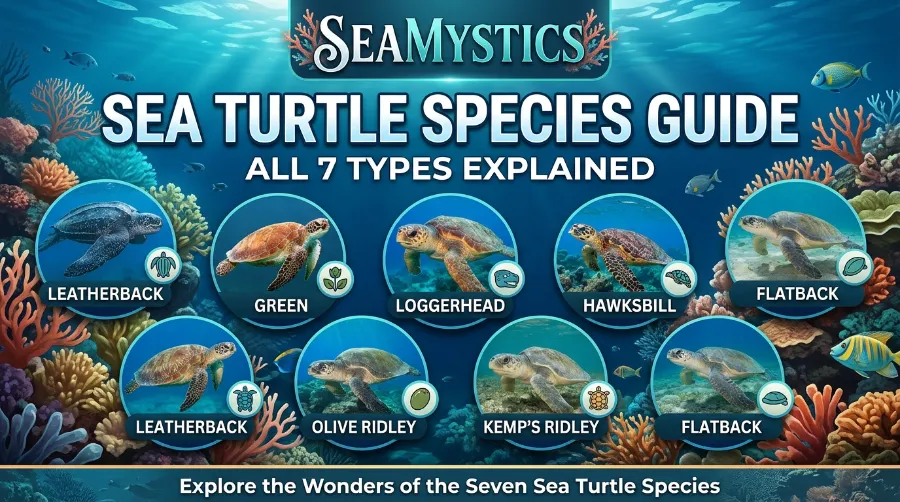
Sea Turtle Species Guide: All 7 Types Explained
Picture this: a turtle glides past you in warm water, and right away you wonder which one it is. Luckily, the answer hides in the shell, the head, and the place you stand. There are seven sea turtle species in the world, and each one looks, eats, and lives in its own way. I have spent more than 20 years on beaches and boats counting them. So in this guide, I will show you how to tell them apart, where each one stands in 2026, and why ghost nets still kill so many.
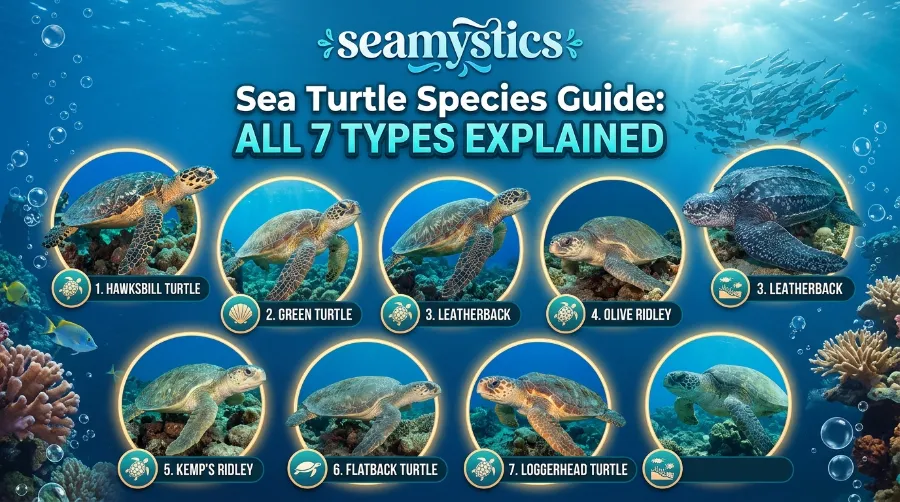
TL;DR: Seven types of sea turtles live in our oceans: green, loggerhead, leatherback, hawksbill, Kemp’s ridley, olive ridley, and flatback. You can tell them apart by shell shape, scale counts, and head size. In 2026, two are Critically Endangered, three are Vulnerable, one is Data Deficient, and the green turtle just moved to Least Concern.
Key Takeaways
| Question | Quick answer |
|---|---|
| How many types of sea turtles exist? | Seven |
| Largest type | Leatherback, up to about 900 kg |
| Smallest types | Kemp’s ridley and olive ridley, about 40 kg |
| Critically Endangered | Hawksbill and Kemp’s ridley |
| Vulnerable | Leatherback, loggerhead, olive ridley |
| Data Deficient | Flatback |
| Biggest 2025 news | Green turtle moved from Endangered to Least Concern |
| Deadly hidden threat | Ghost nets and other lost fishing gear |
Sea Turtle Facts Guide: What Makes These Reptiles Special
First, let me share a few basics. These facts explain why sea turtles are so hard to protect.
Manta Ray Facts: The Gentle Giants of Open Water
Built for the Water
Sea turtles come from a family line that goes back at least 110 million years, according to the SWOT report on the seven turtles. Today, they split into two groups. The leatherback sits alone in its own family, while the other six are hard-shelled turtles. So when someone says “turtle,” my first question is always: hard shell or soft?
Sea turtles also breathe air. They can rest underwater for hours, but in the end they must come up. This matters a lot later, because a turtle caught in a net cannot hold its breath forever.
Life Cycle Basics
Next, look at how their lives unfold. Here are a few facts that surprise most readers:
- Females return to the same region where they hatched, so beaches matter for generations.
- A nest holds about 100 eggs, although the number changes by type.
- Warm sand makes more females, and cool sand makes more males.
- Many scientists say only about 1 in 1,000 hatchlings reaches adulthood.
- Most types need 20 to 40 years or more to reach breeding age.
Because hatchlings are tiny, many start life eating drifting animals. If you want to see how small that food chain begins, read our guide to plankton facts. In addition, our ocean life sizes guide compares a leatherback with the smallest creatures in the sea.
Sea Turtle Species at a Glance: Types of Sea Turtles Compared
Now here is a simple side-by-side look at all seven. I built this table from the latest status data and from the notes I keep in the field.
| Type | Latin name | Typical adult weight | Main diet | Global status |
|---|---|---|---|---|
| Green | Chelonia mydas | 70 to 190 kg | Seagrass and algae | Least Concern (2025) |
| Loggerhead | Caretta caretta | 90 to 160 kg | Crabs, whelks, shellfish | Vulnerable |
| Leatherback | Dermochelys coriacea | 250 to 700 kg | Jellyfish | Vulnerable |
| Hawksbill | Eretmochelys imbricata | 45 to 70 kg | Sponges | Critically Endangered |
| Kemp’s ridley | Lepidochelys kempii | 35 to 45 kg | Crabs | Critically Endangered |
| Olive ridley | Lepidochelys olivacea | 35 to 45 kg | Crabs, shrimp, jellyfish | Vulnerable |
| Flatback | Natator depressus | About 70 kg | Sea cucumbers, soft prey | Data Deficient |
Next, look at the size gap in a simple chart. Each block equals about 20 kg of typical adult weight.
Leatherback   ██████████████████████  about 450 kg
Green         ████████                about 150 kg
Loggerhead    ██████                  about 115 kg
Flatback      ████                    about 70 kg
Hawksbill     ███                     about 60 kg
Kemp's ridley ██                      about 40 kg
Olive ridley  ██                      about 40 kg
As you can see, a leatherback weighs as much as ten Kemp’s ridleys. In fact, the biggest one ever recorded stranded in Harlech, Wales, in 1988. It weighed about 916 kg and measured nearly 3 metres. Clearly, that animal proves UK waters matter to turtles.
Sea Turtle Identification: How to Tell Them Apart
Good sea turtle identification starts with a calm look, not a quick guess. For this reason, I teach volunteers the same steps on every beach survey.
Whale Shark Facts: The Largest Fish in the Ocean
Six Steps to Name a Turtle
Follow these steps in order, and you will name most turtles in under a minute.
- Check the shell type. First, if the back looks leathery with long ridges, you have a leatherback. All the others have hard plates.
- Count the side plates. Next, count the costal scutes. Green, hawksbill, and flatback turtles have four pairs. In contrast, a loggerhead and a Kemp’s ridley have five, and an olive ridley often has six or more.
- Look between the eyes. Then check the front scales. A green turtle has one pair, but hawksbills and loggerheads have two.
- Study the head and beak. After that, compare heads. A hawksbill has a narrow, pointed beak, while a loggerhead has a huge, blocky head.
- Read the shell edge. Also, a hawksbill often has a saw-like back edge. Meanwhile, a flatback has a flat shell with curled edges.
- Think about where you are. Finally, use the map. Flatbacks live only around Australia, and Kemp’s ridleys stay mostly in the Gulf of Mexico and the US Atlantic coast.
Common Mistakes to Avoid
Even so, I see the same errors again and again:
- People call every large turtle a loggerhead, so always check the scale count first.
- People trust shell color. However, algae, sand, and age change color a lot.
- People forget the location clue, although it solves many puzzles.
In my own work, the head tells the truth faster than the shell. For example, a green turtle looks almost gentle, while a loggerhead looks ready to fight. Once you notice that, you rarely mix them up again.
For more help, the SEE Turtles species page gives a clean overview. Likewise, the Boca Raton sea turtle facts page explains the Florida nesting types well.
The 7 Types of Sea Turtles Explained One by One
Green Sea Turtle (Chelonia mydas)
The green turtle gets its name from the green color of its body fat, not its shell. Adults eat mostly seagrass and algae, and that diet gives the fat its color. As a result, they act like underwater lawn mowers. Similarly, sea urchins graze the seabed to keep it in balance, and you can read more in our sea urchin facts guide.
Krill Facts Explained: Why This Small Animal Matters So Much
The big news came in October 2025. At its congress in Abu Dhabi, the IUCN moved the green turtle from Endangered to Least Concern. The change rests on data showing that the global population grew by about 28% since the 1970s, according to Oceanic Society’s report. Therefore, it counts as one of the biggest recoveries on the Red List.
Still, experts warn that this is not a finish line. Brendan Godley of the University of Exeter told Mongabay that green turtles may be “conservation dependent.” In other words, they could fall fast if protection stopped.
Loggerhead Sea Turtle (Caretta caretta)
The loggerhead is easy to spot once you know the clue. First, its head is huge, and its jaws can crush crabs and whelks. Second, its shell is reddish brown, and many adults carry a small garden of barnacles on their backs. If you like those hitchhikers, our barnacle facts page explains how they cling on.
Loggerheads nest on warm beaches in the US Southeast. Likewise, they nest in the Mediterranean, where Greece, Turkey, and Cyprus host important beaches. For that reason, this turtle matters to European readers. Its global status is Vulnerable.
Here is a practice tip from my own survey work. Whenever a nest hatches, I check the beach lights first. Bright lights pull hatchlings inland instead of toward the sea. So simply switching off a porch light can save dozens of babies in one night.
Coral Polyp Facts: The Tiny Animal Behind Giant Reefs
Leatherback Sea Turtle (Dermochelys coriacea)
The leatherback is the giant of the group. Its soft, rubbery shell has seven ridges running from head to tail. Moreover, it dives deeper than any other sea turtle, reaching depths beyond 1,000 metres. Because of this, it travels across whole oceans in a single year.
Its diet is almost all jellyfish. Unfortunately, that is a risky choice, since a floating plastic bag looks a lot like a jellyfish. Jellyfish themselves feed on tiny drifting animals, and you can learn more about that base layer in our krill facts guide.
Worldwide, the leatherback is listed as Vulnerable. However, some regional groups are in far worse shape, especially in the Pacific. Meanwhile, many sightings in UK waters happen each summer when jellyfish bloom.
Sea Urchin Facts: The Spiky Architects of Reef Ecosystems
Hawksbill Sea Turtle (Eretmochelys imbricata)
The hawksbill wears the most beautiful shell, and sadly that beauty nearly wiped it out. For many years, people hunted it for “tortoiseshell” jewelry and combs. Later, trade bans helped, and CITES has listed the turtle under Appendix I since 1977. Even so, the hawksbill is still Critically Endangered.
Its narrow beak reaches into coral holes to pull out sponges. Although many sponges are toxic, the hawksbill eats them anyway. By doing so, it gives corals more room to grow. To understand the animals that build those reefs, read our guide to coral polyp facts.
Plankton Facts Explained: The Tiny Organisms That Feed the Whole Ocean
Kemp’s Ridley Sea Turtle (Lepidochelys kempii)
The Kemp’s ridley is the smallest of the group, and its story moves me most. In 1947, a film showed roughly 40,000 females nesting on one beach in Mexico in a single day. By 1985, however, the whole population laid only about 700 nests. That fall shocked the scientific world.
Then people acted. First, Mexico and the United States protected the nesting beach. Next, teams moved eggs to safe corrals. Finally, shrimp boats had to add turtle excluder devices, which are escape hatches that let turtles slip out of nets. As a result, the numbers rose for years. Later, nesting dipped again in the 2010s, which shows how fragile a recovery can be.
Today, the Kemp’s ridley remains Critically Endangered. It lives mostly in the Gulf of Mexico, and young turtles drift north along the US East Coast.
Olive Ridley Sea Turtle (Lepidochelys olivacea)
The olive ridley is the most numerous sea turtle, yet it is still listed as Vulnerable. Its heart-shaped shell has an olive tint. It is also famous for the arribada, a Spanish word that means “arrival.” During an arribada, thousands of females crawl onto the same beach within a few days to lay eggs.
Sea Star Facts: How Starfish Regrow Their Own Arms
For example, India’s Odisha coast and Costa Rica’s Ostional beach host some of the biggest events. These crowds look amazing, but they also face danger. In particular, fishing nets near the shore trap many adults before they even reach the sand.
Flatback Sea Turtle (Natator depressus)
The flatback lives only on the continental shelf of northern Australia, so no other turtle has such a small home. Its shell is pale gray-olive and flat, with curled edges. Adults weigh about 70 kg, and they hunt soft prey like sea cucumbers and jellyfish.
Its status is Data Deficient. However, that label does not mean “safe.” Instead, it means scientists need more facts. Consequently, every survey on those remote beaches adds something useful.
Barnacle Facts Explained: The Animal That Glues Itself for Life
Endangered Sea Turtles List: Where Each Type Stands in 2026
Many people search for an endangered sea turtles list, so here is the clearest answer. Interestingly, no sea turtle carries the exact label “Endangered” on the global Red List right now. The green turtle moved up, and the others sit in higher or lower groups. You can check the official table on the IUCN Marine Turtle Specialist Group page.
Red List Groups
| Red List group | Types |
|---|---|
| Critically Endangered | Hawksbill, Kemp’s ridley |
| Vulnerable | Leatherback, loggerhead, olive ridley |
| Least Concern | Green (since October 2025) |
| Data Deficient | Flatback |
US Law and Local Status
In US law, the picture looks different. For instance, the hawksbill, Kemp’s ridley, and leatherback are listed as endangered under the Endangered Species Act. In addition, some green, loggerhead, and olive ridley groups have their own rules. So a turtle can be “Vulnerable” globally and still need strict protection in one region.
I want to stress one point here. A global label hides local trouble. For years, scientists have argued that one worldwide label cannot describe every group. That is why the 2025 green turtle assessment looks at 11 regional groups. In short, a strong global score can sit next to a weak local one.
For deeper reading, the NOAA global status review covers trends for all seven types. Also, the SWOT turtle profiles give quick status charts.
Ghost Nets: The Silent Killers Drifting Through the Deep Ocean
Now let me talk about the threat that keeps me up at night. Sadly, it is also the one most people never see.
What Ghost Nets Are and How They Kill
Ghost nets are fishing nets and lines that people lose or throw away at sea. Because nylon and plastic last for decades, one lost net can kill for years. In other words, it keeps fishing long after the boat has gone home.
Sea turtles suffer a lot here. First, a tangled turtle cannot reach the surface, so it panics and drowns. Even if it survives, a tight line can cut into a flipper and cause deadly infections. Meanwhile, the net drifts on and catches more animals. Experts call this endless cycle “ghost fishing.”
Here is what I have seen in practice and in the research:
- Nets snag on coral and seagrass, and then they smother the life below. In addition, sea stars, urchins, and small reef animals suffer too. You can meet some of them in our sea star facts guide.
- Tangled turtles often wash up thin, with cuts on the front flippers.
- Olive ridleys, flatbacks, and greens are all hit across northern Australia.
A Case Study from Northern Australia
Northern Australia gives us a clear example. There, strong currents in the Gulf of Carpentaria sweep nets from all over Asia onto remote beaches. As a result, Indigenous ranger groups have pulled thousands of nets from the coast. Olive ridleys are among the most common victims. Every net removed protects turtles for years to come.
Estimates of how much gear is lost each year vary a lot. Still, scientists agree that lost gear is among the deadliest kinds of ocean trash for animals. Because the real number is hard to count, I tell readers to trust the pattern, not a single headline figure.
Ocean Life Sizes: From Microscopic Plankton to Giant Squid
What Works to Stop Ghost Nets
So what actually works? These steps have the best track record:
- Mark the gear. First, tagged nets let officials trace the owner.
- Make loss cheaper to report. Next, fishers need safe ways to report lost gear without fines.
- Run retrieval teams. Then, rangers and divers can find nets before they drift further.
- Recycle old nets. In addition, buy-back and recycling programs give nets a second life.
- Use turtle excluder devices. Finally, these escape hatches have saved many turtles in trawl nets.
What to Do If You Find an Entangled Turtle
First, stay calm and keep your distance from its mouth and flippers. Next, do not pull deep lines out of the skin, because that can cause more harm. Instead, call your local rescue group. In the UK, that means British Divers Marine Life Rescue. In the US, contact your state wildlife agency or stranding network.
Other Threats and Why Warm Sand Matters
Ghost nets are not alone. Plastic bags, boat strikes, coastal lights, and poaching all take a toll. Still, climate change may be the quietest threat of all.
Sea turtle eggs decide their sex by sand temperature. For example, a 2018 study in the journal Current Biology found that more than 99% of young green turtles from the warm northern Great Barrier Reef were female. That is a huge shift. At Raine Island, one of the biggest green turtle nesting sites, conservationists have also seen lower hatchling success because of rising heat and beach erosion.
Fortunately, people have found fixes. For instance, teams plant shade trees, water nests, and move eggs to cooler spots. Some beaches now use shade cloth. These actions are small, but together they buy time.
How You Can Help Sea Turtles Right Now
You do not need a boat or a degree to help. Try these simple actions:
- First, use fewer single-use plastics, especially bags and balloons.
- Next, turn off or shield bright lights near nesting beaches during nesting season.
- Also, fill in holes and knock down sandcastles before you leave the beach.
- Then, choose seafood from sources that use turtle-safe gear.
- In addition, join a local beach clean-up, and pick up any lost line you see.
- Meanwhile, give turtles space, and never touch a nesting female.
- Finally, support groups that remove ghost nets.
FAQ About Sea Turtles
How many sea turtle species are there?
Overall, there are seven: green, loggerhead, leatherback, hawksbill, Kemp’s ridley, olive ridley, and flatback.
Which sea turtle is the biggest?
The leatherback. In fact, adults commonly weigh 250 to 700 kg, and the record animal from Wales reached about 916 kg.
Which sea turtle is the most endangered?
The hawksbill and the Kemp’s ridley. Both are Critically Endangered, which is the highest risk group of the seven.
Is the green sea turtle still endangered?
No. In October 2025, the IUCN moved it to Least Concern. However, many local groups still need help.
How long do sea turtles live?
Many live 50 years or more. Still, exact ages are hard to prove because the animals roam so far.
Quick Quiz: Test What You Learned
- Which sea turtle has a leathery shell with seven ridges?
a) Loggerhead b) Leatherback c) Flatback - Which two types are Critically Endangered?
a) Green and olive ridley b) Hawksbill and Kemp’s ridley c) Flatback and loggerhead - What do leatherbacks mostly eat?
a) Seagrass b) Sponges c) Jellyfish - What is the Spanish word for mass nesting events?
- In what year did the IUCN move the green turtle to Least Concern?
Answers: 1) b. 2) b. 3) c. 4) Arribada. 5) 2025.
Conclusion
In the end, the seven sea turtle species share one ocean, yet each one needs a different kind of help. The green turtle gives us hope. However, the hawksbill and Kemp’s ridley still need urgent care, and ghost nets threaten them all. So learn the types, practice your sea turtle identification, and act where you live. After all, small choices on one beach can add up across the whole sea.
About the author: Dr. Rabica is a marine biologist with more than 20 years of experience in turtle surveys, nest protection, and coastal research. She writes for Sea Mystics to turn hard science into simple, honest guides for readers in the US and Europe.
References
- IUCN Marine Turtle Specialist Group, Red List Assessments: https://www.iucn-mtsg.org/statuses
- SWOT Report, Meet the Turtles: https://www.seaturtlestatus.org/s/SWOT19_04_Meet-the-Turtles.pdf
- SeaTurtleStatus.org, Conservation Status of Green Turtle Populations Worldwide: https://www.seaturtlestatus.org/articles/conservation-status-of-green-turtle-populations-worldwide
- Oceanic Society, Green Turtle Status Improvement (October 2025): https://www.oceanicsociety.org/news-and-announcements/green-sea-turtle-status-improvement-2025/
- Mongabay, Green turtle rebounds, moving from endangered to least concern (October 2025): https://news.mongabay.com/short-article/2025/10/green-turtle-rebounds-moving-from-endangered-to-least-concern/
- NOAA Repository, Status, trends and conservation of global sea turtle populations: https://repository.library.noaa.gov/view/noaa/67176/noaa_67176_DS1.pdf
- SEE Turtles, Sea Turtle Species: https://www.seeturtles.org/sea-turtle-species
- City of Boca Raton, Sea Turtle Facts: https://www.myboca.us/2155/Sea-Turtle-Facts
- Jensen et al. (2018), Environmental warming and feminization of one of the largest sea turtle populations in the world, Current Biology