
Whale Shark Facts: The Largest Fish in the Ocean
Picture a fish as long as a city bus, with a mouth wide enough to swallow a bicycle wheel, drifting past you with its mouth open. Then picture it eating shrimp-sized animals that are smaller than your fingernail. These whale shark facts sound unreal, but they are true, and they get stranger the closer scientists look. I am Dr. Rabica, and after years of reading tracking data and field reports on this animal, I still find it the most surprising fish in the sea.
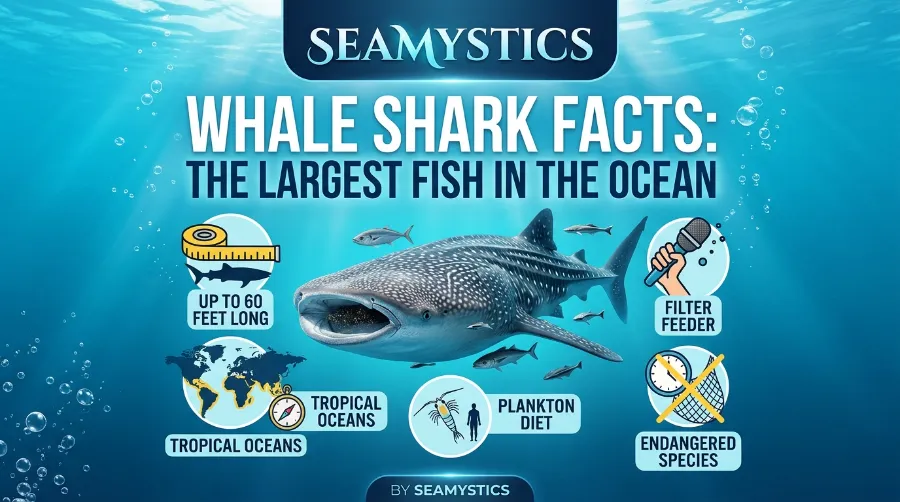
TL;DR: The whale shark is the largest fish in the ocean. Adults usually reach 8 to 12 metres, eat tiny plankton, and live in warm tropical seas. The species is Endangered, so it needs far better protection from fishing gear, ship strikes and crowded tourism.
Key Takeaways at a Glance
| Topic | Quick Answer |
|---|---|
| Scientific name | Rhincodon typus |
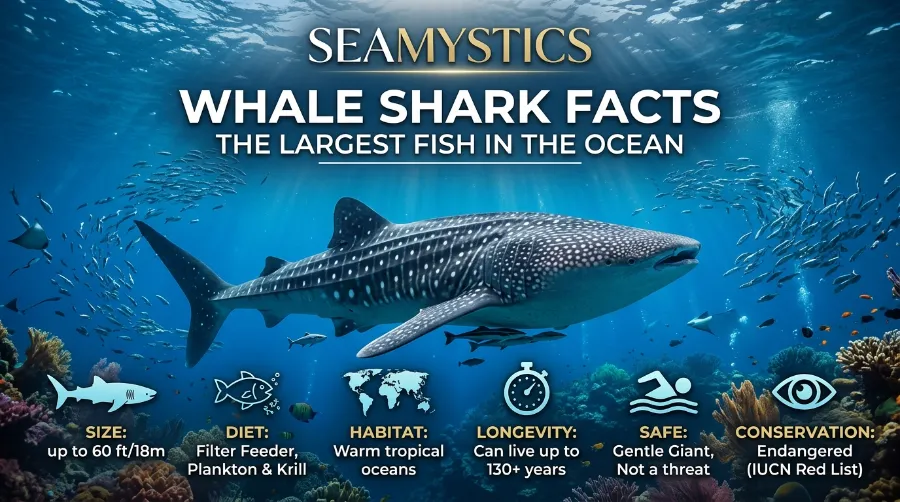
| Typical adult size | 8 to 12 m (26 to 40 ft) |
| Longest known | About 18 m (60 ft) |
| Weight | Up to roughly 20 tons |
| Diet | Plankton, krill, fish eggs, small fish and squid |
| Habitat | Warm tropical and warm temperate seas, not the Mediterranean |
| Lifespan | Possibly 100 to 150 years |
| Conservation status | Endangered (IUCN) |
What Makes the Whale Shark the Largest Fish in the Ocean?
The whale shark holds the title of largest fish in the ocean because no other living fish comes close. A whale is bigger, but a whale is a mammal, so it does not count. National Geographic lists the species as a fish with a weight of about 20.6 tons.
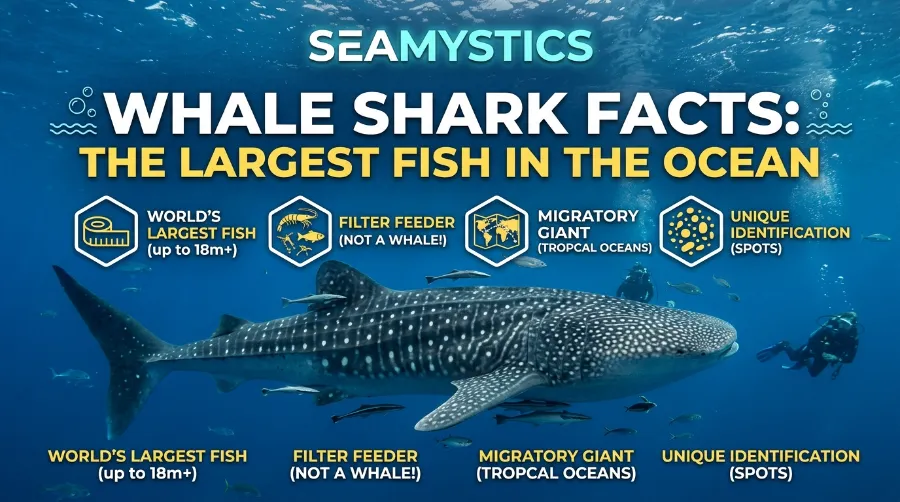
The name comes from two things. First, the animal is as long as some whales. Second, it feeds like a baleen whale, by filtering tiny food from the water. Only three shark species filter their food this way, and the other two are the megamouth and the basking shark. scubadivermag
The whale shark is still a true shark. It has a skeleton made of cartilage, not bone, just like a great white. It also has five large gill slits and two dorsal fins set far back on the body. The tail is large and has two lobes, and the top lobe is longer.
Manta Ray Facts: The Gentle Giants of Open Water
You can learn more about how this animal compares to other giants in our guide to ocean life sizes. That page shows where the whale shark sits between a tiny copepod and a blue whale.
Whale Shark Size: How Big Do They Really Get?
Whale shark size is one of the most searched questions about this animal, and the honest answer is “bigger than you think, but smaller than the legends.” Most adults measure 8 to 12 metres. The largest known size in the scientific literature is about 18 metres. Still, one Western Australian agency notes that the maximum size is uncertain. I treat the 18 metre figure as a record for a few animals, not a normal adult. frontiersindoc
Weight follows length. A big adult can weigh around 20 tons. That equals about three African elephants, or a full school bus.
Size Details That Surprise People
Some body parts are huge, and others are very small. Here is what I find most striking:
- The mouth is more than one metre wide.
- The mouth sits at the very front of the head, not underneath like most sharks.
- The eyes are about the size of golf balls.
- The throat is only about the size of a coin.
- The mouth holds around 3,000 tiny teeth that play almost no role in feeding.
Because the throat is so small, the shark cannot swallow large prey. That is one reason it cannot eat a person.
Males Grow Fast but Females Grow Bigger
For many years, scientists guessed whale shark ages from the bone bands in dead animals. The samples were small, so the guesses were rough. In 2020, a team led by Mark Meekan at the Australian Institute of Marine Science measured live sharks instead. They tracked 54 whale sharks that came back to Ningaloo Reef over up to a decade. anu
Their published study in Frontiers in Marine Science found a clear split between the sexes. Males reached about 8 metres at roughly age 30, when they became mature. Females grew more slowly, then reached about 14 metres at around age 50. Young sharks of both sexes grew fastest, at about 20 to 30 centimetres each year. voanewsYahoo News
Here is the data in one place.
| Measure | Males | Females |
|---|---|---|
| Size at maturity | About 8 m | About 14 m |
| Age at maturity | About 30 years | About 50 years |
| Growth pattern | Faster, then stops | Slower, then larger |
| Juvenile growth | 20 to 30 cm per year | 20 to 30 cm per year |
Why would females grow so large? Meekan explained that a female can carry up to 300 pups at one time, so a huge body is almost a requirement. That idea makes sense to me as a biologist. A bigger body means more room for a bigger litter. Yahoo News
One more fact backs the new picture. A mature male of 7.4 metres at Ningaloo has not changed in size in over two decades. So growth does not go on forever, which older models had assumed. frontiersin
Whale Shark Size Compared to Other Big Fish
The chart above shows how far ahead the whale shark is. The basking shark comes second among sharks, at around 8 metres. A great white averages about 5 metres. Even a huge ocean sunfish, which is the heaviest bony fish, is much shorter.
Size matters for more than bragging rights. A large body keeps heat, travels far on little energy, and scares off most predators. It also makes the animal easy to spot, which is why tourism and fishing have both found it.
Whale Shark Diet: What Does the Giant Actually Eat?
Whale shark diet surprises almost everyone. The biggest fish in the sea eats some of the smallest animals. Think of a whale shark as a living vacuum cleaner for plankton.
Its menu is wider than most websites say. It includes krill, fish eggs, sea jellies, small squid, anchovies, and even Christmas Island red crab larvae. Other sources add sardines, mackerel and small tunas. So the shark is not a strict plankton eater. It takes whatever dense, small food it finds. uw360doc
If you want to see how small the base of this food chain is, read our guides on plankton facts and krill facts. These two groups feed almost the entire ocean.
How Whale Sharks Feed
Whale sharks use two main methods. Each works well in a different place.
- Active feeding: The shark swims forward with its mouth wide open. Water flows in, and the gill rakers trap the food. The water leaves through the gills.
- Suction feeding: The shark floats near the surface, mouth up, and gulps water. Then it closes the mouth and pushes the water out through the gills. You can often see this in the Philippines and Mexico.
The filter system is very strong. A whale shark can pass more than 6,000 litres of water through its gills every hour. That is a lot of work for a throat the size of a coin. PBS
Why Food Decides Where They Go
Whale sharks follow food. They gather where plankton blooms, fish spawn, or coral releases eggs. Marine Megafauna Foundation is one group that studies these gatherings.
In my reading of tracking papers, one pattern repeats. The sharks do not wander at random. They return to the same feeding grounds each year, often within the same weeks. That habit helps scientists count them, but it also helps fishers and boat drivers find them.
Not all sharks are filter feeders, and not all filter feeders are sharks. Small reef animals, such as sea stars and sea urchins, feed in very different ways. Comparing them shows how many ways the ocean has solved the same problem of eating.
Sea Turtle Species Guide: All 7 Types Explained
Whale Shark Habitat: Where Do They Live?
Whale shark habitat covers most of the warm oceans. These sharks live in the Atlantic, Indian and Pacific oceans. They live in nearly all tropical and warm temperate seas, except the Mediterranean. So if you live in Europe, you will not see one in the Mediterranean, but you can see them on trips to the Red Sea, the Maldives or the Canary Islands region of the Atlantic. doc
They like warm water. Whale sharks rarely stay in water colder than about 70 degrees Fahrenheit, or 21 degrees Celsius. In New Zealand, for instance, a few turn up when sea surface temperatures reach about 21 to 23 degrees Celsius. PBSdoc
Famous Whale Shark Hotspots
| Region | What Draws Them |
|---|---|
| Ningaloo Reef, Australia | Coral spawning and plankton, peak in March to July |
| Philippines | Year-round feeding and a ban on commercial fishing since 1998 |
| Mexico (Caribbean side) | Fish egg blooms in summer |
| Maldives | Steady feeding in South Ari Atoll |
| Red Sea and Indian Ocean | Warm water and seasonal plankton |
Ningaloo Reef is a good example. The sharks arrive each year around the time coral spawns. That release of eggs and larvae fills the water with food. If you want to know more about the animals behind that event, read about coral polyps.
Deep Dives and Long Trips
For years, people assumed whale sharks stay near the surface. That is only part of the story. They can dive deeper than 1,000 metres. One tracked animal went to at least 1,928 metres, though scientists do not yet know why. shankariasparliamentuw360
Here is my own view on this. I think many of these deep dives are about food, since some small animals rise and sink each day in the water column. The dives could also help the shark cool down after hours in warm surface water. Neither idea is proven, so I treat them as open questions.
Krill Facts Explained: Why This Small Animal Matters So Much
The sharks also travel very far. Genetic work shows little difference between Atlantic, Indian and Pacific populations, which suggests that animals spread widely across ocean basins. A shark spotted in one country may be seen in another a few months later. doc
Life Cycle and Behaviour: Slow, Calm and Hard to Study
Whale sharks are gentle. They have no interest in people, and divers often swim beside them. They are not aggressive and are not bothered by scuba divers. shankariasparliament
Their life cycle moves slowly. Females give birth to live young, but the eggs hatch inside the mother. Scientists call this ovoviviparous. A pup measures about 55 to 64 centimetres at birth. One female can carry up to 300 embryos at different stages. docebsco
That number comes from a pregnant female caught in a fishery in 1995 off Taiwan. It remains the best look we have at whale shark birth, and it shows how little we know. Nobody has seen a wild whale shark give birth, and nobody knows where most pups grow up.
Lifespan and Predators
The best current estimate puts a whale shark’s life at 100 to 150 years. A 2020 study by Ong and colleagues used radiocarbon from nuclear tests to check the age of bone bands. Their work on whale shark vertebrae confirmed that the bands form once a year. That made the age estimates much more reliable.
Plankton Facts Explained: The Tiny Organisms That Feed the Whole Ocean
Adults have few enemies. Orcas have been known to attack them. Bites from large sharks, probably tiger sharks, have been seen on adults and younger animals at Ningaloo Reef. Young whale sharks face more danger, since smaller animals are easier to catch. ebscodoc
Spots, Hitchhikers and Skin
Every whale shark carries a unique spot pattern, much like a human fingerprint. Scientists photograph the area behind the gills and use software to match animals. This method lets teams follow the same shark for ten years or more without touching it.
The skin is thick, up to about 10 centimetres in places. Small passengers often ride along, including remoras and other hitchhikers. In other parts of the ocean, similar tiny riders such as barnacles attach to hard surfaces and whales. Seeing these living layers on a shark makes it feel like a moving reef.
Coral Polyp Facts: The Tiny Animal Behind Giant Reefs
Are Whale Sharks Endangered? The Real Numbers
Yes, whale sharks are endangered. The IUCN moved them to Endangered in 2016, and the population trend is still decreasing. natgeo
The numbers explain why. The Indo-Pacific population likely fell by about 63 percent over 75 years, and the Atlantic population fell by more than 30 percent. There is no global population estimate. That gap means conservation teams work with very little hard data. sharkstewardsdoc
| Conservation Fact | Detail |
|---|---|
| IUCN status | Endangered since 2016 |
| Indo-Pacific decline | About 63% over 75 years |
| Atlantic decline | More than 30% |
| Trade rules | CITES Appendix II |
| National protection example | Philippines ban on commercial fishing, 1998 |
The Biggest Threats
Several dangers overlap. The main ones are:
- Fishing and bycatch: Whale sharks die as bycatch, and some are caught on purpose for their fins and meat. sharkstewards
- Ship strikes: Whale sharks feed near the surface, right in busy shipping lanes.
- Tourism pressure: Boat propellers can injure the sharks, and crowds can interrupt feeding. PBS
- Climate change: Warmer water changes currents, food supply and where sharks gather. sharkstewards
- Plastic and ghost nets: Waste and lost gear fill the same waters where sharks feed.
Ghost Nets: The Silent Killers
Ghost nets deserve more attention than they get. These are fishing nets and lines that fishers lose or throw away. They drift for years and keep catching animals that never reach a market.
Sea Urchin Facts: The Spiky Architects of Reef Ecosystems
A whale shark cruises with its mouth open and its eyes on food, not on gear. That makes it easy to snag. A tangled shark may stop feeding, get cut by the line, or drown if it cannot swim and breathe. The same nets kill sea turtles and many other animals, so cleaning them up helps the whole ecosystem.
In my view, ghost nets are the most fixable threat on this list. Marked gear, return programmes for old nets, and clean-up dives all work. They cost far less than rebuilding a lost shark population that takes 30 to 50 years to reach maturity.
Swimming with Whale Sharks: Responsible Tourism
Whale shark tourism has real value. A living shark can bring in far more money over its life than a dead one sold for meat. Still, poor practice can do harm.
The Philippines offers a useful lesson. Feeding sharks by hand to hold them near a beach, as some Oslob operators did, can change their feeding routes and make them rely on people. Many scientists, including the team behind a respected set of whale shark facts, advise against it.
Before you book a trip, check the operator against this simple list:
- Do they limit the number of swimmers per shark?
- Do they ask you to stay about 3 metres from the head and 4 metres from the tail?
- Do they ban touching, flash photography and feeding?
- Do they keep boats at a slow, steady speed near the animals?
- Do they support research or share data with scientists?
If the answer is “no” to two or more, pick another company. Your money helps decide which style of tourism survives. For ideas on planning an ethical trip, Natural Habitat Adventures shares ten whale shark facts that travellers often find useful.
Barnacle Facts Explained: The Animal That Glues Itself for Life
Whale Shark Myths That Need to Go
A few false ideas keep coming back. Here are the ones I hear most.
- “Whale sharks are whales.” They are fish with gills, and they lay their eggs inside the body.
- “They are dangerous.” They have no interest in people and cannot swallow large prey.
- “They live in all seas.” They avoid cold water and are absent from the Mediterranean.
- “We know how many exist.” There is no reliable global count.
- “They only live near the surface.” Tracking shows deep dives beyond 1,000 metres.
Sea Star Facts: How Starfish Regrow Their Own Arms
What You Can Do to Help
You do not need to be a marine biologist to help. Small choices add up. Use these steps:
- Pick tour operators that follow strict contact rules.
- Cut single-use plastic, since plastic ends up in feeding grounds.
- Choose seafood from fisheries that report and reduce bycatch.
- Support groups that clean up ghost nets.
- Share photos of whale sharks with research projects that use spot matching.
Ocean Life Sizes: From Microscopic Plankton to Giant Squid
Frequently Asked Questions
How big is a whale shark?
Most adults measure 8 to 12 metres. The longest known reached about 18 metres. Weight can reach around 20 tons.
What do whale sharks eat?
They eat plankton, krill, fish eggs, small squid and small schooling fish such as sardines and anchovies. They filter food from the water with their gills.
Where do whale sharks live?
They live in warm tropical and warm temperate seas around the world. They do not live in the Mediterranean. Hotspots include Ningaloo Reef, the Philippines, Mexico and the Maldives.
How long do whale sharks live?
Scientists estimate 100 to 150 years. Males mature at about 30 years and females at about 50.
Are whale sharks dangerous to humans?
No. They are gentle and cannot swallow people. The main risk is to the sharks, from boats and crowds.
Are whale sharks endangered?
Yes. The IUCN lists them as Endangered, and the population is still falling.
Conclusion
The whale shark is the largest fish in the ocean, and it lives a slow life. It grows for decades, eats the smallest food in the sea, and may live longer than a human. Those same traits make it very hard to replace. A shark lost today is a shark that the ocean cannot regrow for 30 or 50 years.
The good news is that people can fix most of its problems. Better fishing rules, cleaner seas, fewer ghost nets and kinder tourism all help. If you remember one thing from these whale shark facts, let it be this: the biggest animals often need the most careful care. For more guides like this one, explore the rest of Sea Mystics.
Quick Quiz: Test Your Whale Shark Knowledge
1. What is the typical length of an adult whale shark?
A) 2 to 4 m
B) 8 to 12 m
C) 20 to 25 m
2. Which food does a whale shark mainly eat?
A) Large tuna and seals
B) Plankton and small fish
C) Whales
3. Where are whale sharks absent?
A) The Red Sea
B) The Maldives
C) The Mediterranean
4. Short answer: What is the IUCN status of the whale shark?
5. Short answer: What is one threat that comes from lost fishing gear?
Answers: 1) B. 2) B. 3) C. 4) Endangered. 5) Ghost nets can tangle sharks and stop them from feeding or breathing.
Sources Used
- National Geographic, Whale Shark overview
- PBS Nature, Whale Shark Fact Sheet
- New Zealand Department of Conservation, Whale Shark page
- Meekan et al., 2020, Frontiers in Marine Science, “Asymptotic Growth of Whale Sharks Suggests Sex-Specific Life-History Strategies”
- Ong et al., 2020, Frontiers in Marine Science, “Annual Bands in Vertebrae Validated by Bomb Radiocarbon Assays”
- Reuters report on the Ningaloo growth study, 2020
- Shark Stewards, “Wonderful Whale Sharks: the Ocean’s Biggest Fish”