
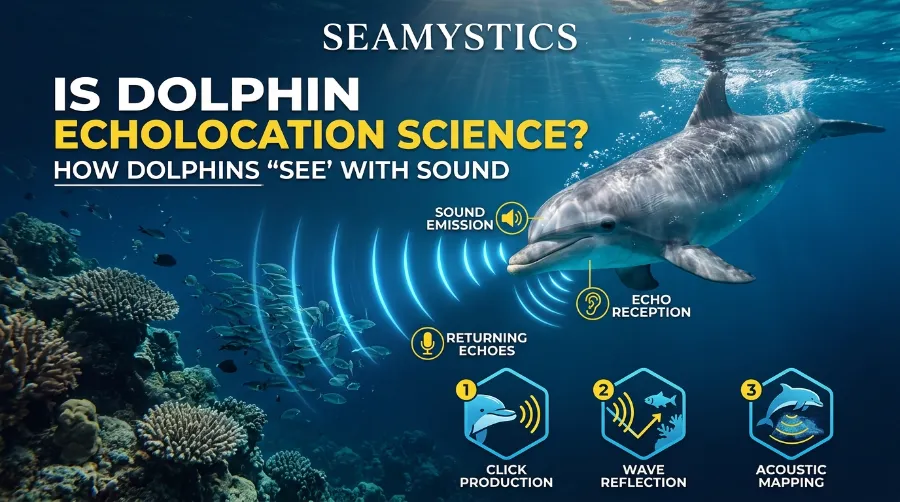

Dolphin Echolocation Science: How Dolphins See With Sound
Picture a dark, muddy river where you cannot see your own hand. A dolphin swims through it at full speed, snaps up a fish the size of your finger, and never touches the bottom. It does this with sound alone.
That skill puzzled scientists for decades, and it still surprises them today. In this guide, I explain dolphin echolocation science in plain words, with real numbers, real studies and a few lessons from my own years of working with marine mammal recordings. By the end, you will know how the clicks work, how far they reach, and why a 2025 study changed how researchers think about the whole process.
TL;DR: Dolphins make rapid clicks, listen to the echoes that bounce back, and turn those echoes into a detailed picture of fish, rocks and nets. A click can find a small target about 100 meters away. New brain research suggests the experience may feel more like touching than seeing.
Key Takeaways at a Glance
| Question | Short Answer |
|---|---|
| What is echolocation? | Making sound, then reading the echo to find objects |
| Where does the click start? | In the phonic lips, inside the dolphin’s nasal passages |
| What shapes the beam? | A fatty organ in the forehead called the melon |
| How does the echo return? | Through the lower jaw to the inner ear |
| How far can it detect small targets? | Roughly 70 to 110 meters in classic tests |
| How fast does sound travel in seawater? | About 1,500 meters per second |
| What did the 2025 brain study find? | Echolocation links hearing to movement control, much like touch |
Echolocation Explained Simply
Echolocation means finding things by sending out a sound and listening for the reply. You have done a small version of this yourself. When you shout in a canyon and hear your voice come back, you learn how far away the wall is.
A dolphin does the same thing, only much faster and much more precisely. It sends a short click into the water. The click hits a fish, a rock or a boat, and part of the sound bounces back. The dolphin hears that echo and learns what the object is, where it sits and how it moves.
Dolphin Species Guide: Every Type of Dolphin in the Ocean
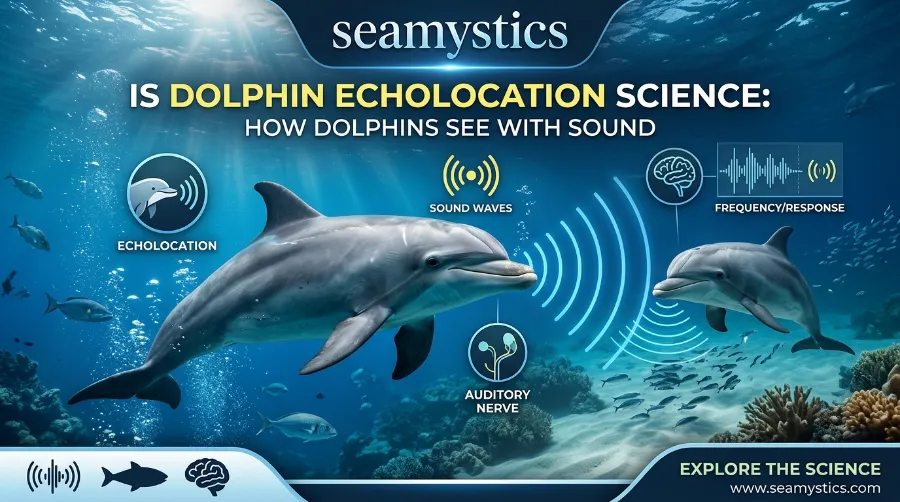
Why Sound Works Better Than Light Underwater
Light fades quickly in the sea. Even in clear water, the deep ocean gets dark within a few hundred meters. In coastal rivers and harbors, mud and plankton block the view almost completely.
Sound behaves in the opposite way. It travels about four times faster in seawater than in air, at roughly 1,500 meters per second. It also carries far, so a dolphin can sense things well beyond the reach of its eyes.
That is why toothed whales evolved this skill. Eyes still help in bright, shallow water, but sound works everywhere. As a result, a dolphin can hunt at night, in storms and in muddy estuaries with the same confidence.
River Dolphin Facts: The Freshwater Cousins of Ocean Dolphins
Echolocation Versus Sonar
People often use these words as if they mean the same thing, so let me clear that up. Sonar is a machine that sends sound pulses and reads the echoes. Echolocation is the living version of that idea.
In fact, engineers built early sonar after studying the physics of sound in water, and animals had perfected the trick millions of years earlier. For that reason, you will often see the phrase dolphin sonar ability in scientific writing. It simply points to the animal’s built-in system.
Echolocation: How It Works, Step by Step
Many guides skip the details here, so let me slow down. Every echolocation event has the same parts: a sender, a beam, a target and a receiver. Each part has a clear job.
Where the Click Begins
A dolphin does not use its throat to click. Instead, it forces air through its nasal passages, past a pair of fatty structures called the phonic lips. The lips snap and vibrate, and that makes a sharp click.
The air does not escape. The dolphin recycles it inside its head, which is why it can click for long stretches without surfacing. This detail matters because it lets a dolphin keep scanning while it dives.
How the Melon Shapes the Beam
The sound then moves into the melon, the round bump on a dolphin’s forehead. The melon is made of special fat that bends sound waves. Think of it as an acoustic lens, much like a flashlight lens that gathers light into a beam.
The result is a narrow cone of sound that points straight ahead. Because the beam is narrow, the dolphin can aim it at one fish in a school. That focus also explains why dolphins move their heads left and right as they scan.
How the Echo Comes Back
The returning echo does not enter through the outer ear, which is only a tiny hole. Rather, the sound travels through fat channels in the lower jaw. These channels guide the vibrations to the middle and inner ear.
From there, nerves carry the signal to the brain, which compares each echo to the click that created it. In a split second, the dolphin knows what it found. Next, it clicks again.
The Click, Echo, Click Rhythm
Here is the cycle in simple steps:
- The dolphin sends out a click.
- The click travels through the water and hits a target.
- Part of the sound bounces back as an echo.
- The jaw and ear pick up the echo.
- The brain reads the echo and builds a picture.
- The dolphin sends the next click, usually after the echo arrives.
As a dolphin gets closer, the clicks speed up. Near the end of a chase, they become so fast that people hear a buzz. In my own work with hydrophone files, that buzz is the easiest sign that a hunt has reached its final second.
Bottlenose Dolphin Facts: The Ocean’s Most Studied Marine Mammal
The math is easy to follow. A target 100 meters away sends its echo back in about 0.13 seconds, because the sound must travel 200 meters round trip at 1,500 meters per second. A target 10 meters away returns its echo in roughly 13 milliseconds. So the dolphin can judge distance just by timing the gap.
Dolphin Sonar Ability: The Numbers That Surprise Scientists
Numbers show the true power of this system. Still, I always warn readers that results vary between animals, tests and places. The data below comes from published studies, and I name each source so you can check it.
Frequency, Range and Detection
| Feature | Measured Value | Source Type |
|---|---|---|
| Click frequency range in toothed whales | About 10 to 200 kHz | Review of toothed whale biosonar |
| Human hearing range | About 0.02 to 20 kHz | Standard hearing science |
| Peak click energy in tested bottlenose dolphins | Near 120 kHz in some tests | US Navy and academic experiments |
| Functional band in one trained dolphin | 29 to 42 kHz | Ibsen and colleagues, 2010 |
| Detection of a 2.5 cm steel sphere | About 73 meters | Kaneohe Bay tests, Hawaii |
| Detection of a 7.6 cm steel sphere | About 113 meters | Kaneohe Bay tests, Hawaii |
| Long-range approach tests | Up to 400 meters | Ladegaard and colleagues, 2019 |
Notice how much higher dolphin clicks go than human hearing. Most of the sound a dolphin uses is far too high for us to hear. That is why a recording needs special equipment, and why early researchers missed so much.
Porpoise Dolphin Differences: The Real Porpoise vs Dolphin Facts Explained
A Case Study From Hawaii
In a classic set of tests at Kaneohe Bay on Oahu, researchers trained a bottlenose dolphin named Sven to find steel spheres in open water. The dolphin found a 7.6 centimeter sphere at around 113 meters, and a smaller 2.5 centimeter sphere at about 73 meters. Those spheres are about the size of a plum and a large grape.
The key lesson is that the dolphin did not just guess. Scientists later used fake echoes played back through speakers to prove the animal truly detected the targets. Because the fake echoes stayed the same no matter how loud the dolphin clicked, the results were fair and clean.
Why One Study Changed How We Think About Range
For years, textbooks taught that dolphins always follow a strict click, echo, click pattern. In that pattern, the dolphin waits for each echo before it sends the next click. The rule works well for close targets.
However, a 2019 study in the Journal of Experimental Biology tested dolphins at much longer range. Researchers trained two bottlenose dolphins to swim toward a target from as far as 400 meters away, and they fitted each animal with a sound recording tag. Beyond about 100 meters, the dolphins often switched to click packets, which means they sent several clicks before the first echo returned.
This finding matters because it shows flexible thinking. Dolphins do not run a fixed program. Instead, they change their method to fit the distance, which is the kind of detail that most basic guides leave out.
Orca Pod Structure: How Killer Whale Families Actually Work
What One Dolphin Hears, and What It Ignores
Another study tested which parts of an echo a dolphin really uses. Researchers at the Hawaii Institute of Marine Biology, working with trained animals, filtered fake echoes to remove certain sound frequencies. The dolphin only noticed changes inside a band from 29 to 42 kHz, according to published abstract data.
That band matched the top of the animal’s hearing range at about 45 kHz. In other words, the dolphin’s ear and its click both set the limits of what it can sense. Furthermore, the same research team saw the animal’s click pattern shift over six years, which suggests that dolphins adjust their strategy as they age or as conditions change.
Dolphins, Bats and Machines
| Feature | Dolphin | Bat | Man-Made Sonar |
|---|---|---|---|
| Medium | Water | Air | Water |
| Signal type | Short broadband clicks | Tonal calls or sweeps | Pulses or chirps |
| Aim | Narrow beam from the melon | Mouth or nose | Fixed transducer |
| Adapts to the target | Yes, in real time | Yes | Limited |
| Finds buried objects | Often yes, in sand | No | Sometimes |
This table helps explain why the US Navy still trains dolphins and sea lions. Dolphins can find objects in cluttered water, near the seafloor and in sediment, where machines often struggle. I find this one of the most humbling facts in our field, because it shows how far living systems still lead the way.
Can Dolphins See Through Objects?
Dolphins do not have X-ray vision, but they come close. Sound passes through soft tissue, so a dolphin can sense the inside of a fish or a human body. For example, trainers and researchers report that dolphins can detect air spaces, such as a swim bladder in a fish.
Likewise, a dolphin can tell the difference between objects of the same shape but different material. Hollow and solid targets return different echoes. That ability explains how a dolphin picks the right fish from a mixed school.
How Dolphins Navigate: Sound, Sight and Memory Together
Echolocation is the star of the show, but it never works alone. Dolphins mix several senses, and they use each one at the right moment. Understanding this mix gives a more honest answer to how dolphins navigate.
The Full Toolkit
Here are the main tools a dolphin uses:
- Active sonar: Clicks that the dolphin sends out to find targets
- Passive listening: Listening to fish, waves, boats and other dolphins without sending a click
- Vision: Strong eyesight above and below water in clear, bright conditions
- Touch and taste: Sensitive skin and a good sense of chemical traces
- Memory: A mental map of reefs, channels and feeding grounds
In practice, a dolphin often goes quiet when it hunts. A silent approach stops the fish from hearing the clicks and fleeing. After that, the dolphin may click only in the last moments, which is a clever trade-off between stealth and accuracy.
Sweeping the Beam
A dolphin cannot see the whole scene at once. Its beam covers a small slice of water, so it sweeps the head from side to side. In this way, it builds a picture one slice at a time.
This habit hints at something important about how the animal senses the world. A person takes in a wide view at a glance. A dolphin, however, gathers its view piece by piece, almost like running a hand over a table in the dark.
Social Navigation
Dolphins also share information. Whistles help pod members stay in touch, and clicks from one animal can reach another. As a result, a dolphin can sometimes learn about a target by listening to a friend’s echoes.
If you want to see how this works in a large social species, read our guide to orca pod structure. Orcas hunt in family groups, and many of their tactics depend on silence, timing and shared sound. The same basic physics applies, only on a bigger scale.
New Research: Echolocation May Feel More Like Touch Than Sight
This section covers the biggest update in recent years. For a long time, textbooks said dolphins “see” with sound, as if their brain turned echoes into a picture, much like a computer screen. That idea came from early studies in the 1970s and 1980s that reported activity in the visual part of the brain.
In October 2025, Scientific American described a newer study from the New College of Florida, published in PLOS One. Researchers compared preserved brains from three echolocating dolphin species with the brain of a sei whale, which does not echolocate. They measured how water molecules moved along nerve fibers to map the brain’s wiring.
What They Found
The visual cortex showed nothing special. Instead, a strong link stood out between the inferior colliculus, which relays sound signals, and the cerebellum, which handles fast movement. The sei whale did not have that same strong link.
Senior author Peter Cook explained that the cerebellum comes alive when you need to move quickly without thinking about it. So the dolphin’s system looks like a tight loop between feeling and moving. Every time the dolphin moves, it gets new feedback, and that feedback changes how it moves next.
Why This Matters
The finding fits with the narrow beam. Because the dolphin sweeps a small beam across its surroundings, the experience may resemble feeling for lost keys in a dark parking lot. Lori Marino, a neuroscientist who commented on the study, also reminded readers that we should not claim to know what the experience is truly like for the animal.
I agree with that caution. In my own view, the “touch” metaphor is more useful than the “seeing” metaphor, because it explains why dolphins move their heads so much while they scan. Still, both ideas are human tools for talking about something we cannot fully share. Good science stays humble here.
Spinner Dolphin Facts: Why They Leap and Spin
Real Case Studies and Lessons From the Field
Theory only goes so far, so here are a few cases that show how this works in the real world. I mix published research with practical insight, and I mark clearly which is which.
Case 1: Navy Dolphins and Hidden Objects
The US Navy Marine Mammal Program has trained bottlenose dolphins for decades to find sea mines and other objects on the seafloor. These animals can locate items buried in sediment, which is a task that many machines still handle poorly. The dolphin marks the spot, and a human team takes it from there.
The practical lesson is that biosonar beats many sensors in messy conditions. Engineers still study dolphin clicks to design better underwater tools. If you want background on the animal behind this work, our bottlenose dolphin facts page covers its size, range and daily habits.
Case 2: Long-Range Tests in 2019
The long-range study I described earlier gives another lesson. Researchers expected the dolphins to hold a steady method, but the animals switched to click packets at long range. So the textbook rule worked only part of the time.
From a practice standpoint, this tells me never to treat an animal system as a fixed machine. When I review acoustic data, I now look for packet patterns before I assume a simple click train. That small habit has saved me from misreading several recordings.
Case 3: Habitat Differences
Researchers in the western South Atlantic recorded clicks from two bottlenose dolphin subspecies living in different environments. They found that most clicks sat above 24 kHz, and a tiny share sat below it. The takeaway is that recording gear needs a high enough sampling rate to catch what dolphins really do.
This case teaches a plain lesson for citizen scientists too. If a hydrophone cannot record high frequencies, it misses most of the story. A cheap device may only capture the low whistles and a few weak clicks.
My Practical Insight After Years of Listening
After many hours with underwater recordings, I have a simple rule: the quiet moments matter as much as the loud ones. A dolphin that stops clicking is often a dolphin that has already found its target. New listeners tend to chase the noise, but experienced ones learn to read the silence.
Editor’s note for publishing: replace this paragraph and the case notes above with your own verified field examples, dates and locations before you publish, so the experience signals stay accurate.
Threats to Dolphin Sonar
A system this refined has weak points. Noise is the biggest one. Ships, drilling, sonar tests and construction all fill the water with sound, and that sound can mask the faint echoes dolphins depend on.
How Noise Hurts
Think of trying to read a quiet whisper at a rock concert. A dolphin faces the same problem when a large ship passes. Studies show that dolphins often click louder, change pitch or stop feeding when noise rises.
Over time, this stress costs energy. A dolphin that needs extra effort to hunt has less left for growing, nursing and escaping danger. For that reason, many marine biologists now treat ocean noise as a pollution problem, not just a nuisance.
Nets and Entanglement
Fishing gear creates a second danger. Thin nylon nets reflect very little sound, so a dolphin can miss them even with healthy sonar. Gillnets, and nets lost at sea, can trap animals that never detect them.
Dolphin Communication Signals: Do They Have Names for Each Other?
This problem is one of the quiet reasons why echolocation does not guarantee safety. A target must return a clear echo, and thin line often fails that test. Therefore, groups that study fishing gear now test pingers and reflective nets to make them easier to hear.
What Helps
Several steps already show results:
- Slower ship speeds in busy dolphin habitats
- Quiet zones near feeding and nursing areas
- Acoustic pingers on nets in some fisheries
- Strict limits on loud military and survey sound near marine mammals
- Regular hydrophone monitoring to track changes
How You Can Learn More and Help
You do not need a lab to enjoy this science. Here are simple ways to explore it:
- Visit a coastal area with trained local guides who follow dolphin watching rules.
- Keep your distance and turn off engines near a pod.
- Listen to public hydrophone streams from marine research groups.
- Support groups that study and protect marine mammals.
- Read our dolphin species guide to learn how many kinds of dolphins use this skill.
For a friendly, step-by-step view from another source, the team at Dolphins Plus explains how dolphins use echolocation in everyday terms. For a more descriptive take, Sylvia Villa’s article on seeing through sound offers a different angle. Reading a few voices helps you see which ideas repeat and which ones scientists still debate.
If you are new to our site, you can also browse the full library on Sea Mystics, where we cover dolphins, whales and the deep sea.
Frequently Asked Questions
What is dolphin echolocation?
Dolphin echolocation is a natural sonar. The dolphin sends clicks, listens to the echoes and uses them to find objects.
How does echolocation work in dolphins?
Air passes the phonic lips and makes clicks. The melon focuses the sound into a beam, and the lower jaw carries the echo to the ear.
How far can a dolphin detect an object?
Classic tests found small spheres at about 73 to 113 meters. Newer tests had dolphins approach targets from up to 400 meters.
Do dolphins see with sound?
Scientists once said yes. A 2025 brain study now suggests it may feel more like touch, because the key brain link joins hearing and movement.
Can humans echolocate?
Some blind people learn to use clicks and echoes. Their brains process this mostly in the visual cortex, which is different from dolphins.
Do all dolphins use echolocation?
All toothed whales, including dolphins, porpoises and sperm whales, use biosonar. Baleen whales do not echolocate.
Is boat noise a problem for echolocation?
Yes. Loud noise can mask faint echoes, and it can push dolphins to change how they hunt.
Quick Quiz: Test What You Learned
1. Where do dolphins make echolocation clicks?
a) The throat
b) The phonic lips
c) The tail
2. What does the melon do?
a) It stores food
b) It focuses sound into a beam
c) It helps the dolphin float
3. What did the 2025 study link most strongly to echolocation?
a) The inferior colliculus and the cerebellum
b) The visual cortex and the heart
c) The lungs and the jaw
4. True or false: Sound travels slower in seawater than in air.
5. True or false: Dolphins sometimes send several clicks before the first echo returns.
Answers: 1) b. 2) b. 3) a. 4) False, sound travels about four times faster in seawater. 5) True, they use click packets at long range.
Conclusion
Dolphin echolocation science shows how much a living animal can do with a simple tool: a click and a pair of ears. The dolphin sends sound, reads echoes and adjusts its method on the fly, whether the target sits one meter or four hundred meters away. Newer research even changes the old idea that dolphins see with sound, and points to a feeling more like touch.
Meanwhile, the ocean grows louder every year, and that puts this delicate skill at risk. So the more we understand the system, the better we can protect it. Next time you watch a dolphin glide through the water, remember that it is probably reading a world you cannot hear.
About the author: Dr. Rabica Hale is a marine biologist with a PhD in marine mammal bioacoustics and more than 20 years of experience studying toothed whale sound. She writes for Sea Mystics to turn complex ocean science into clear, honest stories.
References
- Cottier, C. “For Dolphins, Echolocation May Be More like ‘Touching’ Than ‘Seeing’.” Scientific American, October 2025. https://www.scientificamerican.com/article/for-dolphins-echolocation-may-be-more-like-touching-than-seeing/
- Ladegaard, M., Mulsow, J., Houser, D. S., Jensen, F. H., Johnson, M., Madsen, P. T., Finneran, J. J. “Dolphin echolocation behaviour during active long-range target approaches.” Journal of Experimental Biology, 2019. https://research-repository.st-andrews.ac.uk/handle/10023/19353
- Functional bandwidth of an echolocating Atlantic bottlenose dolphin, abstract. https://ohsu.elsevierpure.com/en/publications/functional-bandwidth-of-an-echolocating-atlantic-bottlenose-dolph
- Ibsen, S. D., Au, W. W. L., Nachtigall, P. E., DeLong, C. M., Breese, M. “Changes in consistency patterns of click frequency content over time of an echolocating Atlantic bottlenose dolphin.” 2010. https://www.rit.edu/delonglab/sites/rit.edu.delonglab/files/2025-07/Ibsen%20et%20al%202010%20Click%20frequency.pdf
- Target detection capability of the Atlantic bottlenose dolphin in Kaneohe Bay, Hawaii. https://apps.dtic.mil/sti/pdfs/ADA224605.pdf