


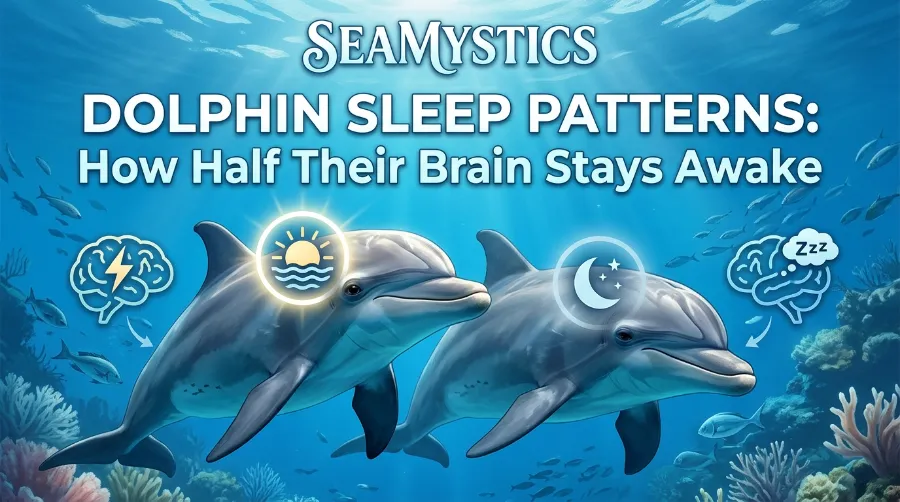
Dolphin Sleep Patterns: How Half Their Brain Stays Awake
Picture a dolphin gliding through dark water at 2 a.m. One eye is shut, while the other stays open and watches. Because this is one of the best examples of dolphin sleep patterns in the animal world, it still surprises me after years of reading sleep records from marine mammals.
TL;DR: Dolphins sleep with one half of the brain at a time, so they can keep breathing, watch for danger, and stay close to the pod. In one Navy study, for example, dolphins stayed alert for up to 15 days without losing performance. As a result, scientists now see this habit as a smart survival tool instead of a flaw.
Key Takeaways
| Question | Short answer |
|---|---|
| How do dolphins sleep? | One brain half rests while the other stays awake |
| What is the science term? | Unihemispheric slow-wave sleep |
| Why do they sleep this way? | They choose each breath on purpose and must watch for threats |
| Do they dream? | Researchers have found little or no REM sleep |
| Do newborns sleep? | Mothers and calves show very little sleep for about a month |
| Which eye stays open? | The eye linked to the awake brain half |
| Can noise harm their rest? | Boats and underwater noise can cut resting time |
Dolphin Sleep Patterns at a Glance
Dolphins do not sleep like we do, but the difference is easy to grasp. When a person falls asleep, both brain halves go quiet. A dolphin cannot afford that, since it must rise to the surface for every breath.
Here is the simple version. First, one brain half rests while the other half runs the body. Then the two halves swap roles. Scientists call this dolphin unihemispheric sleep, and “uni” simply means “one.”
Other marine mammals also use this trick. If you want the wider picture, our dolphin species guide shows how many kinds exist and how each one lives.
How Dolphins Sleep: Unihemispheric Slow-Wave Sleep
When I explain how dolphins sleep to students, I start with one fact. In fact, breathing is not automatic for a dolphin. A person keeps breathing during sleep because the brainstem handles it, but a dolphin chooses each breath. Therefore, a fully unconscious dolphin would drown.
What the brain does
First, researchers measure sleep with EEG, a tool that records brain waves. In a sleeping dolphin, one hemisphere shows slow, large waves that match deep rest. Meanwhile, the other hemisphere shows fast waves that match an awake brain.
Soviet scientists first recorded this pattern in bottlenose dolphins in the 1970s. Since then, other teams have repeated and expanded the work. Because the results held up, scientists now treat the pattern as a core fact about whales and dolphins.
What you can see from a boat
A resting dolphin looks calm, but its movement changes in clear ways:
- It swims slowly, often in a gentle loop.
- One eye closes while the other stays open.
- Its trips to the surface happen at regular times.
- Pod mates also stay close beside it.
The open eye links to the awake brain half. Since the optic nerves cross over, the closed eye belongs to the resting side. This makes sense, because the awake half needs eyesight to watch the surroundings.
Why Dolphins Cannot Switch Off Completely
Many people ask whether this is just a quirk. In fact, it is not. Instead, dolphins face at least three real problems that full sleep would make worse.
Breathing on purpose
Dolphins are mammals, so they need air. Their breathing is also voluntary, and that one fact shapes the whole sleep system.
Predators in open water
Sharks hunt dolphins, and in some places orcas hunt them as well. A half-awake dolphin, on the other hand, can still spot trouble and react fast. In the open ocean, however, deep sleep would leave an animal with no safe place to hide.
Life inside a pod
Dolphins live in social groups, and they look after each other. For that reason, a resting dolphin often stays next to a partner. Likewise, our guide on orca pod structure shows the same idea in bigger whales, where family groups rest side by side.
What the Research Shows
The best way to trust a claim is to see where it came from. For that reason, here is a short list of the studies that built our knowledge.
| Study focus | Animal | Main finding |
|---|---|---|
| Early EEG work, 1970s | Bottlenose dolphin | Brain halves sleep one at a time |
| Mother and calf study, 2005 | Bottlenose dolphin and orca | Very little sleep in the first month after birth |
| Sperm whale tagging, 2008 | Sperm whale | Deep sleep happens in short vertical naps, about 7 percent of the time |
| Navy vigilance study, 2016 | Bottlenose dolphin | Echolocation task held for up to 15 days with steady results |
| Fur seal work, 2018 | Northern fur seal | Seals switch between half-brain sleep in water and full sleep on land |
Table compiled from published marine mammal sleep research. Check the original papers for exact figures before you cite them.
Case study: the Navy dolphins
The most striking result, however, comes from the U.S. Navy Marine Mammal Program, which works with partners such as the National Marine Mammal Foundation. Researchers asked dolphins to listen for signals with echolocation, day and night. If you want to know how that sound-based sense works, our post on dolphin echolocation science explains it.
In fact, the dolphins stayed on task for up to 15 days. Unlike a human, they did not lose accuracy over time. Each brain half, meanwhile, rested in turns while the other half kept working. The team published the work in an open journal, so you can browse similar studies through PLOS ONE.
A simple chart: how long can each species stay alert?
Longest known alert stretch (days)

Human (famous 1964 record) ███████████ 11 days, with heavy mental decline
Dolphin (Navy study)       ███████████████ 15 days, with steady performance
The human record, for example, stands at 264 hours, or 11 days, set in 1964. By the end, that person struggled with memory, speech, and focus. The dolphins, in contrast, kept working. For me, this is the clearest way to show why half-brain sleep is such a good design.
Dolphin Brain Rest: What Happens Inside Each Hemisphere
Brain rest, however, is not the same as brain shutdown. The resting half still helps keep the body alive. Even so, it gets the slow-wave recovery that sleeping brains need.
Why scientists think rest still matters
For one thing, slow-wave sleep seems to help the brain repair cells and clear waste. It may also support memory. As a result, a dolphin with no rest would probably face the same problems a sleepless person faces.
Swapping sides
In fact, dolphins switch sides many times each night. Because each half gets its turn, the total rest looks fair across the day. Still, researchers have seen that one side sometimes rests a bit more than the other, and that topic remains an active area of study.
Awake does not mean busy
An awake hemisphere, however, can stay in a calm watch mode. While it guards, the dolphin keeps swimming but does not hunt or play. In other words, the animal rests its body and keeps a guard on duty.
Marine Mammal Sleep Cycle: Whales, Seals, and River Dolphins
Dolphins are not alone. In fact, the marine mammal sleep cycle varies a lot, and the differences show how each animal solved the same problem.
Whales
For example, sperm whales do something odd. According to tagging work, they hang upright in the water, nose up, for short naps. Those naps filled about 7 percent of their time. Other whales, meanwhile, rest near the surface in calm groups.
Seals and sea lions
Next, fur seals show the most flexible plan. In the water, they sleep with one brain half at a time, like dolphins. On land, however, they sleep with both halves, as we do. So the same animal can use two systems, depending on where it is.
River dolphins
Finally, river dolphins live in muddy water where sight is poor. Early studies suggest that they also rest in a half-brain style, but far fewer animals have been tested. For more on how these animals live and why they depend so much on sound, see our guide to river dolphin facts.
Quick comparison
| Animal | Sleep style | Where it happens |
|---|---|---|
| Bottlenose dolphin | One brain half at a time | Open water |
| Sperm whale | Short vertical naps | Open ocean |
| Northern fur seal | Half-brain in water, full sleep on land | Sea and shore |
| Human | Both brain halves | Bed |
Mothers and Calves: The No-Sleep Month
This part of the story moves me the most. After birth, both mother and calf stay awake almost all the time for roughly the first month. Researchers first recorded this in bottlenose dolphins and orcas in 2005.
Two reasons explain the pattern:
- The calf must learn to surface and breathe, so the mother stays close to help.
- Both animals must stay safe from predators while the calf is weak.
Even so, the mother and calf do not seem to suffer from the lost sleep. Scientists are still working out how they cope, and that question may teach us new things about sleep itself. For a closer look at how young dolphins grow up, read our bottlenose dolphin facts.
Do Dolphins Dream?
Dreaming in people happens mostly during REM sleep, which stands for rapid eye movement. In dolphins, however, researchers have found very little REM, and some studies found none at all.
So what does that mean? Nobody knows for sure, though. Some scientists think dolphins have a different kind of brain rest that does the same jobs. Others believe REM may be so brief that tools miss it. For that reason, I would not say that dolphins dream, and I would not say that they never do. The honest answer is that the question is still open.
Dolphin Sleep Patterns and Human Sleep Trends
Here is a fun twist. Lately, the word “dolphin” has crept into human sleep talk. Some sleep writers describe a “dolphin chronotype,” which means a person who sleeps lightly and wakes easily. The name, of course, comes from the idea of half-awake dolphin sleep.
A few sites cover this idea. For example, Sleep Doctor’s chronotype page explains the pattern, and Sleep State of Mind gives a similar view. In addition, KKJ Psychiatry compares several chronotypes side by side.
However, I want to add one clear caution. The human “dolphin” label is a popular idea, not a finding from dolphin research. A real dolphin does not suffer from insomnia, since it sleeps in a way that fits its life. If you have trouble sleeping, talk to a doctor instead of relying on animal labels.
How Noise and Boats Change Dolphin Rest
Because sleep supports health, disturbance is a worry. Researchers who watch dolphins near tour boats have reported less resting time when boats come close. Moreover, constant engine noise may hide the sounds that dolphins use to stay in touch.
When I read these reports, one lesson stands out: a calm approach protects the animals. So here are habits that help:
- Keep a safe distance from resting groups.
- Avoid chasing or circling dolphins.
- Slow down near pods and calves.
- Also, choose tour companies that follow local wildlife rules.
Readers in the United States can find official viewing guidance on the NOAA Fisheries bottlenose dolphin page. European readers, however, should check local marine park rules, because they differ by country.
Common Myths About Dolphin Sleep
Many people mix up the facts, so let me clear up a few.
Myth 1: Dolphins never sleep. In reality, they do sleep, but they do it in halves.
Myth 2: Half the brain is dead during sleep. Actually, the resting half stays alive and active in a slower way.
Myth 3: All sea animals sleep like dolphins. On the contrary, fish, turtles, and seals each have their own styles.
Myth 4: Captive dolphins sleep the same as wild ones. Although pool dolphins often rest near the wall or the surface, their routines can differ from open-water pods.
Practical Insights for Wildlife Watchers
If you ever see dolphins at rest, a few clues help you understand the scene. Resting groups often move slowly and stay tight together. Their breaths also line up, which is a good sign that the pod feels safe.
Notice the eyes, too. If you can see a dolphin up close from a safe, legal distance, you may spot one closed eye. That small detail tells you the animal is mid-rest. So enjoy the moment quietly, and do not try to wake the group.
Frequently Asked Questions
How do dolphins sleep without drowning?
A dolphin rests one brain half while the other half controls breathing. As a result, it can still rise to the surface at regular times for air.
How long do dolphins sleep each day?
Estimates, however, vary by species and setting. Many researchers report that dolphins spend a large part of the day in rest-like states, but exact numbers differ between studies.
What is dolphin unihemispheric sleep?
In this kind of sleep, one half of the brain shows slow-wave rest while the other half stays awake. Then the two halves swap turns during the night.
Do dolphins close both eyes?
Usually they close one eye at a time, because the closed eye matches the resting brain half.
Do baby dolphins sleep?
Newborn calves and their mothers show very little sleep for about the first month. Even so, they seem to cope well, and researchers still study how.
Do dolphins dream?
Researchers have found little or no REM sleep in dolphins. Therefore, whether they dream is still unknown.
Which other animals sleep with half a brain?
Besides dolphins, other whales, porpoises, fur seals, and some birds use half-brain sleep.
Conclusion
Overall, dolphin sleep patterns show how life solves a hard problem in a clever way. Because a dolphin must breathe on purpose, watch for danger, and stay with its pod, it rests one brain half at a time. From early EEG work to the Navy study, the science behind dolphin unihemispheric sleep shows that this system is a strength, not a weakness.
So next time you think about your own sleep, remember that our planet holds animals that never fully switch off. If you want to learn more, start with our dolphin species guide and follow the links to each species.
Quick Quiz: Test Your Knowledge
1. What is the science term for dolphin half-brain sleep?
A. Bilateral REM sleep
B. Unihemispheric slow-wave sleep
C. Hibernation
D. Torpor
2. Why can’t dolphins fall into deep, full-brain sleep?
A. Fear of the dark
B. A lack of eyelids
C. The need to choose each breath on purpose
D. No brain waves at all
3. Which animal sleeps in short vertical naps?
A. Bottlenose dolphin
B. Sperm whale
C. River otter
D. Sea turtle
4. True or false: Dolphins show a lot of REM sleep.
5. True or false: Mother and calf pairs sleep very little in the first month.
Quiz Answers
- B
- C
- B
- False. Researchers have found little or no REM sleep in dolphins.
- True.
References
- Mukhametov, L. M. (1984). Sleep in marine mammals. Experimental Brain Research Supplement.
- Lyamin, O. I. et al. (2005). Animal behaviour: Continuous activity in cetaceans after birth. Nature.
- Miller, P. J. O. et al. (2008). Sperm whales sleep vertically at the sea surface. Current Biology.
- Branstetter, B. K. et al. (2016). Dolphins can maintain vigilant behavior through echolocation for 15 days without interruption or cognitive impairment. PLOS ONE.
- Lyamin, O. I. et al. (2018). Fur seals suppress REM sleep for very long periods without subsequent rebound. Current Biology.
- Constantine, R., Brunton, D. H., and Dennis, T. (2004). Dolphin-watching tour boats change bottlenose dolphin behaviour. Biological Conservation.