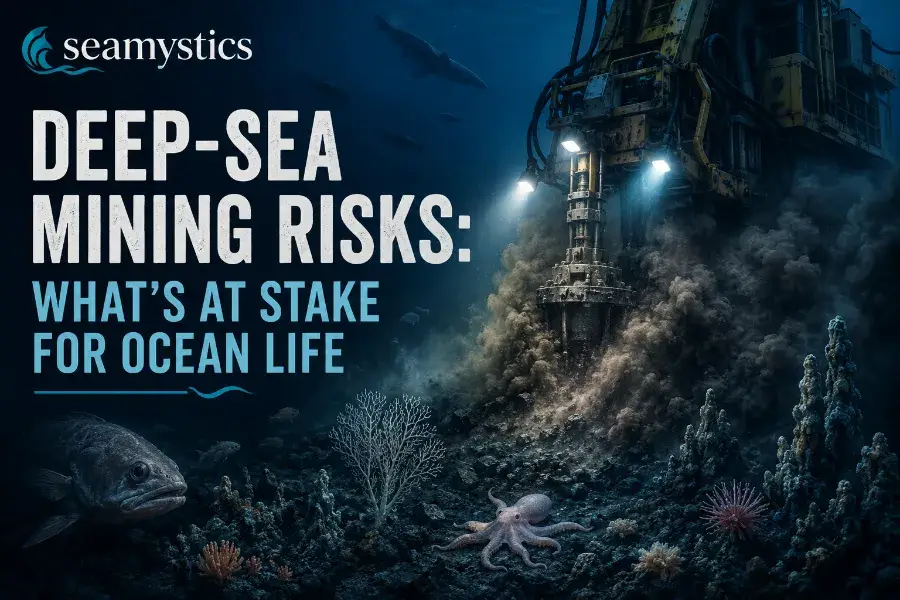

Imagine diving miles beneath the ocean surface into a world of complete darkness, where bizarre creatures thrive in freezing waters. This remote twilight zone holds a delicate balance of life, but a new industrial threat is knocking at the door. Companies want to drop heavy, robotic machinery onto the ocean floor to collect valuable minerals. Consequently, understanding the deep sea mining risks has become an urgent priority for ocean advocates, scientists, and global policymakers. As a marine biologist, I see how these undisturbed habitats face irreversible harm. We are on the verge of altering ecosystems that have taken millions of years to form. Therefore, it is critical to look closely at the scientific facts regarding this extraction process.
you read my blog protect our oceans
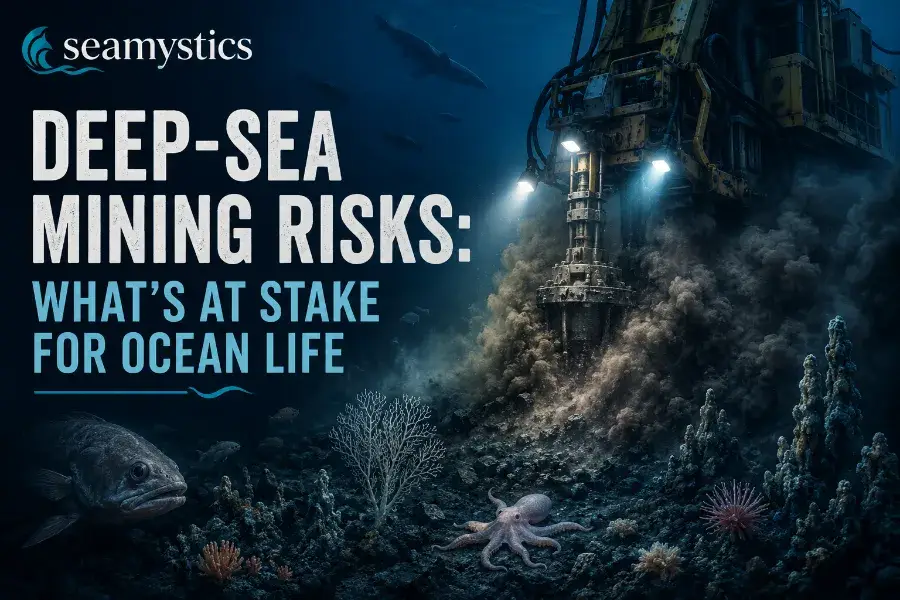
Key Takeaways of Seabed Mining Threats
| Risk Category | Main Environmental Threat | Expected Recovery Time |
| Habitat Destruction | Direct crushing of benthic life and removal of rocky substrates | Centuries to millennia |
| Sediment Plumes | Smothering of filter feeders and blockage of midwater light | Decades for settling |
| Noise & Light Pollution | Disruption of marine mammal communication and blind organisms | Continuous during operations |
| Microbial Rupture | Destruction of carbon-storing deep-sea bacteria | Unknown, potentially permanent |
What is Deep-Sea Mining and Why is It Happening?
Deep-sea mining involves extracting mineral deposits from the ocean floor, specifically in areas thousands of meters deep. Industries target three main sources: polymetallic nodules, seafloor massive sulphides at hydrothermal vents, and cobalt-rich crusts on seamounts. These rocks contain valuable metals like cobalt, nickel, copper, and manganese. Many tech companies want these minerals to build electric vehicle batteries and green energy tech.
However, getting to these resources requires massive tracked vehicles that scrape the ocean floor. The primary zone for this activity is the Clarion-Clipperton Zone (CCZ) in the Pacific Ocean. Because this area covers millions of square kilometers, the scale of operation is unprecedented. The push for these materials has sparked a major international debate. While some countries want to rush operations, scientists warn that our understanding of these environments is extremely limited.
Furthermore, independent data suggests that alternative solutions already exist. For example, a report by Benchmark Mineral Intelligence highlighted that rapidly changing battery technologies are reducing the global long-term demand for cobalt. Investing in a circular economy could reduce plastic mineral demand by up to 58%. Thus, destroying the deep ocean may not even be necessary for our green transition.
The Major Deep Sea Mining Risks to Marine Ecosystems
The potential damage from seabed extraction spreads across multiple layers of the ocean. When heavy machines claw at the seabed, they create multiple hazards for marine life. Let us look at the most dangerous threats.
1. Direct Destruction of Unique Habitats
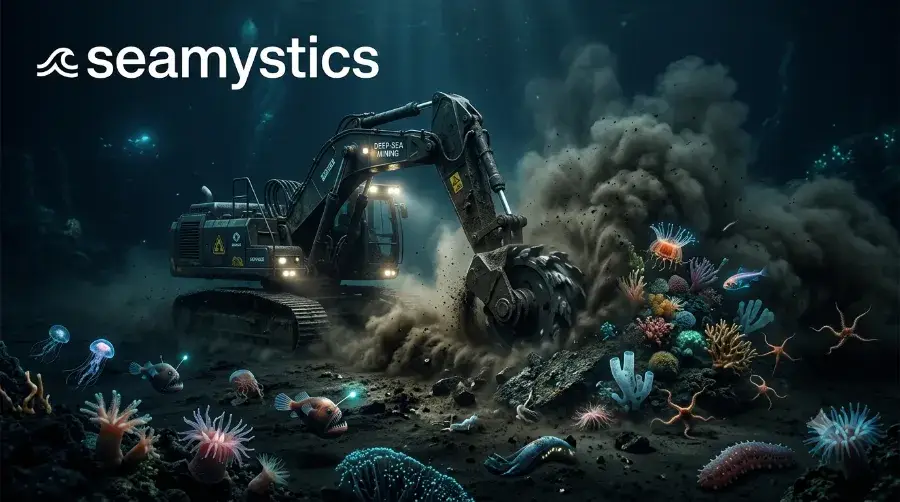
The most immediate of all deep sea mining risks is the total destruction of benthic habitats. Machines weighing several tons crawl over the soft sediment, crushing everything in their path. For instance, polymetallic nodules take millions of years to form and serve as the only hard anchoring points for deep-sea sponges and corals.
-
Loss of biodiversity: Over 90% of the species discovered in the CCZ are entirely new to science.
-
Slow recovery: A UK-based study monitoring a test site found that biological impacts persist even four decades after a nodule test mining event.
-
Fragile ecosystems: Creatures here grow very slowly and reproduce infrequently, making them highly vulnerable to extinction.
2. Suffocating Sediment Plumes
When mining vehicles scrape the seabed, they kick up massive clouds of fine sediment. Additionally, the mining ships pump dirty wastewater back into the ocean, creating midwater plumes. These clouds can travel for miles before settling.
Filter-feeding animals, like deep-sea anemones and glass sponges, rely on clean water to pull in nutrients. As a result, sediment plumes clog their delicate respiratory and feeding organs. This can cause widespread choking and starvation. Furthermore, these particles reduce water clarity in the twilight zone, which disrupts organisms that use bioluminescence to hunt or find mates. You can explore our detailed overview of pelagic food chains in our [/ocean-food-webs-guide].
3. Noise and Light Pollution in the Dark Abyss
The deep sea is a naturally quiet, completely dark environment. Animals here have evolved specialized senses to survive without sunlight. The introduction of industrial noise and bright lights disrupts their entire way of living.
-
Acoustic stress: Heavy machinery creates low-frequency vibrations that can travel hundreds of miles through the water.
-
Communication failure: These sounds mask the communication signals of migrating whales and deep-diving mammals.
-
Visual damage: Blinding lights from robotic rovers can permanently damage the sensitive eyes of deep-sea creatures adapted to absolute darkness.
Geopolitical Stances and Legal Battles
The governance of international waters falls under a specific United Nations framework. The International Seabed Authority (ISA) is responsible for organizing and controlling all mineral activities in the international seabed area. According to the UN Convention on the Law of the Sea (UNCLOS), this area is the “common heritage of humankind.”
      [ UN Convention on the Law of the Sea (UNCLOS) ]
                             │
                             ▼
            [ International Seabed Authority (ISA) ]
                             │
           ┌─────────────────┴─────────────────┐
           ▼                                   ▼
[ Environmental Regulations ]       [ Exploitation Controls ]
During the ISA sessions, the debate reached a boiling point. More than 37 countries have now called for a precautionary pause or an outright moratorium on commercial seabed mining. Leaders like French President Emmanuel Macron declared a moratorium an “international necessity.” Similarly, the UN Secretary-General stated that the deep sea cannot become a lawless frontier.
On the other hand, some nations are attempting to bypass these multilateral systems. Unilateral moves have created intense legal friction, as the ISA reaffirmed that any commercial exploitation without its explicit authorization violates international law. For a look at past international ocean protective laws, check out our [/marine-protection-history].
Disruption of Global Carbon Cycling
The deep ocean plays a monumental role in regulating our planet’s climate. It acts as a massive carbon sink, storing vast amounts of carbon dioxide away from the atmosphere. Microscopic communities of deep-sea bacteria are key players in these global biogeochemical cycles.
When mining operations disturb these deep sediment layers, they risk releasing stored carbon back into the water column. This disruption could alter the ocean’s capacity to absorb greenhouse gases. Consequently, mining might accidentally accelerate the global climate crisis rather than solve it. Protecting these microbial systems is essential for long-term climate stability. To learn more about how our oceans trap greenhouse gases, see our [/ocean-carbon-sinks] article.
Frequently Asked Questions
Why are deep sea mining risks considered irreversible?
Deep-sea ecosystems exist in extreme cold and low energy conditions, meaning animals grow and reproduce at incredibly slow rates. When a habitat like a nodule field is destroyed, it takes millions of years for those rocks to reform, making the biological loss permanent on a human timescale.
Can technology make deep seabed mining safe?
Currently, independent scientists agree that there is no technological way to avoid environmental harm. The creation of sediment plumes, habitat destruction, and underwater noise are inherent to the extraction process itself.
How does seabed mining affect commercial fisheries?
Midwater sediment plumes and toxic metal releases can travel vast distances into shallower waters. This can contaminate open-ocean fish stocks like tuna, directly threatening global seafood supply chains and coastal economies.
Conclusion
The growing evidence surrounding deep sea mining risks shows that the environmental cost of extracting these minerals far outweighs the economic benefits. From suffocating sediment plumes to the permanent destruction of ancient habitats, the impacts threaten the core of ocean life. As we look to sustainable futures, the solution lies in building a circular economy and advancing battery recycling, rather than pillaging the fragile abyss. We must protect this mysterious, vital part of our planet before it is altered forever.
Author Bio
Dr. Rabica is a senior marine biologist and editor for Sea Mystics with over 20 years of research experience in deep-sea ecosystems. She has participated in multiple oceanic expeditions mapping benthic biodiversity and serves as an advisor on international marine policy.