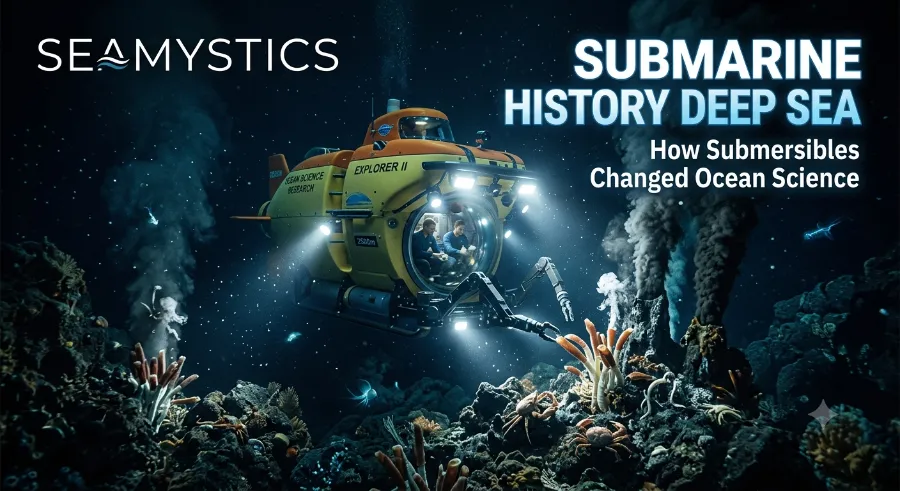

Picture this. A tiny steel ball drops into pitch-black water. It sinks past sunlight, past twilight, and keeps falling for hours. Finally, at nearly seven miles down, two men peer out a thick window and see something no human has ever seen before: the floor of the deepest place on Earth. That moment, in 1960, changed ocean science forever, and it’s the reason we’re talking about submarine history deep sea exploration today.
For most of human history, the ocean floor was a total mystery. We knew more about the surface of the moon than we knew about our own seabed. So, naturally, curiosity pushed engineers and scientists to build machines that could survive crushing pressure and total darkness. As a result, submarines and their smaller cousins, submersibles, became our eyes, hands, and voice in a world we could never visit on our own.
In this guide, we’ll walk through how these vessels rewrote textbooks, sparked new fields of biology, and continue to surprise researchers even now, in 2026. Along the way, you’ll see real dates, real numbers, and real discoveries, not just theory.
Key Takeaways
| Topic | What You Need to Know |
|---|---|
| First deep dive | Trieste reached the Challenger Deep (10,935 m) in 1960 |
| Most famous research sub | Alvin, launched in 1964, is still diving today |
| Modern tragedy | The Titan submersible imploded on June 18, 2023, killing 5 people |
| Newest discovery | A 2,500 km hadal ecosystem was found in 2025 between Russia and Alaska |
| Next frontier | Subsea habitat “Vanguard” is set to launch in the Florida Keys, expanding long-term ocean living |
A Quick Look at Submarine History Deep Sea Exploration
Before submersibles existed, explorers relied on diving bells and simple pressure suits. These early tools, however, could only reach shallow depths. Consequently, the true deep sea, anything below about 200 meters, stayed completely hidden from science for centuries.
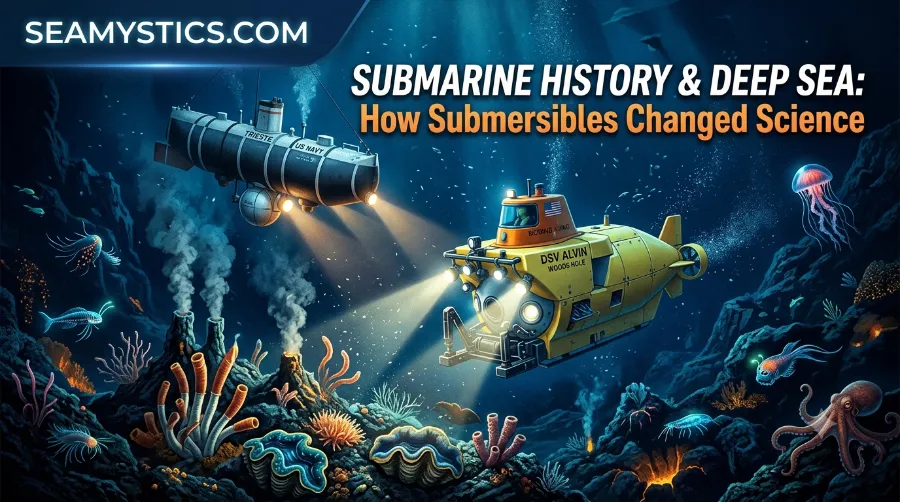
Then, in the mid-20th century, engineering caught up with curiosity. Auguste Piccard and his son Jacques designed the bathyscaphe Trieste, a vessel built to survive extreme pressure. On January 23, 1960, Jacques Piccard and US Navy Lieutenant Don Walsh piloted Trieste to the bottom of the Challenger Deep in the Mariana Trench, roughly 10,935 meters down. That single dive proved something huge: life could exist even in the most crushing, sunless part of the planet.
Because of that success, nations began investing heavily in undersea research. Soon after, in 1964, Woods Hole Oceanographic Institution and the US Navy built a new research submersible named Alvin, in honor of oceanographer Allyn Vine. Alvin was originally 22 feet long and weighed about 16.5 tons, and it completed its first test dive in 1964. Remarkably, Alvin is still operational today, though it has received many major upgrades over the decades. Smithsonian OceanSmithsonian Ocean
How Submersibles Changed Marine Biology Forever
Once scientists could actually reach the deep ocean, everything changed. Suddenly, theories about lifeless ocean floors fell apart. Instead, researchers found entire ecosystems thriving in total darkness, and this discovery reshaped biology textbooks around the world.
Hydrothermal Vents and the Birth of a New Science
In 1977, Alvin carried scientists to the Galápagos Rift, where they found something astonishing: tube worms, giant clams, and bacteria living around hydrothermal vents. These creatures didn’t rely on sunlight at all. Instead, they used chemosynthesis, a process where bacteria convert chemicals like hydrogen sulfide into energy. This single dive basically created an entirely new branch of biology overnight.
Modern Deep Sea Discoveries Keep Surprising Scientists
Fast forward to today, and submersibles are still rewriting the rules. For example, in 2025, geochemist Mengran Du and her team used the Chinese submersible Fendouzhe to explore trenches between Russia and Alaska. Du had just 30 minutes left in her dive when she noticed unusual creatures at depths between 5,800 and 9,500 meters, an area known as the hadal zone. Her team ultimately documented a roughly 2,500-kilometer stretch of what they believe is the deepest known ecosystem powered by methane instead of sunlight. CNNCNN
That’s not an isolated case, either. Here’s a short list of major finds from the past two years alone:
- 2025: A joint Japanese expedition using the Shinkai 6500 submersible confirmed 38 new species and identified 28 more potential new species in the Nankai Trough and Shichiyo Seamount Chain. Oceannews
- 2025: Schmidt Ocean Institute researchers captured the first-ever video footage of a colossal squid in its natural habitat, filmed about 2,000 feet below the surface in the South Atlantic. Scientific American
- 2025: China’s Fendouzhe submersible completed 32 dives along the Arctic’s Gakkel Ridge, reaching a maximum depth of 5,277 meters during a 98-day polar mission. China Daily
Together, these examples show that deep sea exploration isn’t slowing down. If anything, it’s speeding up, thanks to better submersible technology and international collaboration.
Submersibles vs. Traditional Submarines: What’s the Difference?
People often mix these terms up, so let’s clear it up quickly. A submarine is typically a large, self-sufficient vessel that can operate independently for long stretches, often for military purposes. A submersible, on the other hand, is smaller and usually needs a support ship on the surface.
| Feature | Submarine | Submersible |
|---|---|---|
| Typical use | Military, long-range travel | Scientific research, tourism |
| Independence | Self-sufficient for weeks | Needs a mothership |
| Example | US Navy nuclear subs | Alvin, Trieste, Shinkai 6500 |
| Typical depth | Under 500 meters | Can exceed 10,000 meters |
| Crew size | Dozens to over 100 | 1 to 5 people |
Understanding this difference matters because most deep-sea science actually comes from submersibles, not traditional submarines. If you’re curious about how these vessels are engineered, check out our /related-guide on how deep-sea vehicles handle extreme pressure.
When Deep Sea Exploration Goes Wrong
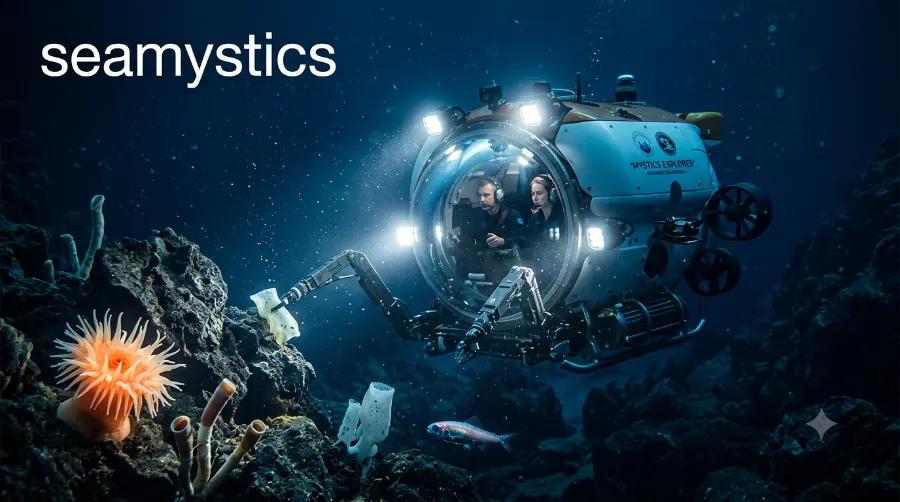
Of course, exploring the deep ocean isn’t without serious risk. Pressure at extreme depths is unforgiving, and even small design flaws can turn deadly. The clearest recent example is the Titan submersible disaster.
On June 18, 2023, the Titan submersible, operated by Ocean Gate, imploded during an expedition to view the Titanic wreck in the North Atlantic. All five people aboard were killed, and the tragedy prompted a US Coast Guard investigation that lasted more than two years. According to the National Transportation Safety Board’s final report, OceanGate’s engineering process was inadequate and resulted in a carbon fiber pressure vessel that contained multiple structural anomalies.
This tragedy served as a harsh reminder. Deep sea travel demands rigorous testing, proper certification, and transparent safety culture, not shortcuts. As a result, the industry is now facing tighter scrutiny, and several nations are pushing for new international standards for crewed submersibles.
Why This Matters for Ocean Conservation
Here’s the thing: submarine history in the deep sea isn’t just about cool discoveries. It’s also about protecting what we’re finding before we lose it. Every new ecosystem we map gives conservationists better data to argue for marine protected areas.
For instance, researchers involved in the Global Hadal Exploration Program, co-led by UNESCO and the Chinese Academy of Sciences, are building international networks specifically to study these fragile trench ecosystems. Similarly, groups like NOAA continue funding submersible research through programs focused on understanding how deep-sea species adapt to extreme pressure and darkness. You can read more about ongoing efforts on our /ocean-conservation-guide.
The Next Chapter: Living Beneath the Waves
Interestingly, the story doesn’t stop at exploration. Engineers are now working on permanent underwater habitats, not just vehicles that dive and return. A startup called Deep recently unveiled Vanguard, described as the world’s first new subsea habitat in nearly four decades, which will let teams of four scientists live and work on the seabed for a week at a time near the Florida Keys. MIT Technology Review
This matters because divers working at extreme depths normally face serious limits from decompression sickness. However, Vanguard’s cabin pressure matches the surrounding water, so aquanauts only need to decompress once, at the end of their stay, potentially allowing many hours of diving each day. If this technology scales up successfully, it could unlock a completely new era of ocean science. MIT Technology Review
Want to see how this connects to broader ocean technology trends? Take a look at our /future-of-ocean-tech resource for a deeper breakdown.
Frequently Asked Questions
What was the first submarine to reach the deepest part of the ocean?
The bathyscaphe Trieste was first, reaching the Challenger Deep in the Mariana Trench on January 23, 1960, piloted by Jacques Piccard and Don Walsh.
How deep can modern research submersibles go?
Many modern submersibles, like Fendouzhe and Shinkai 6500, can reach depths beyond 6,000 meters, with some models rated for the full ocean depth of nearly 11,000 meters.
Why did the Titan submersible implosion happen?
Investigators concluded that OceanGate’s inadequate engineering and testing process led to a weakened carbon fiber hull, which ultimately failed under pressure during the vessel’s 88th dive.
Are new deep sea species still being discovered?
Yes. In 2025 alone, expeditions in Japan, the Southern Ocean, and the Bering Sea region confirmed dozens of new species, proving there’s still much left to learn.
What’s the difference between a submarine and a submersible?
A submarine is typically larger and self-sufficient for military or long-range travel, while a submersible is smaller, needs a support ship, and is mainly used for scientific research.
Conclusion
From a single steel sphere sinking into the Challenger Deep in 1960 to today’s methane-fueled ecosystems discovered near Alaska, submarine history in the deep sea has completely reshaped what we know about our own planet. Every dive, successful or tragic, has taught us something new about pressure, biology, and the limits of engineering. Looking ahead, projects like Vanguard suggest we’re moving from simply visiting the deep sea to actually living in it. One thing is clear either way: the ocean still has secrets left to give up, and submersibles remain our best tool for finding them.
References
- CNN Scientists discover undiscovered hadal ecosystem, 2025
- Smithsonian Ocean Exploration: Deep-Sea Submersibles
- Nature Earth’s deepest ecosystem discovered six miles below the sea, 2025
- Wikipedia / NTSB / USCG Titan submersible implosion investigation reports
- MIT Technology Review The first new subsea habitat in 40 years, 2025
- Oceana 5 Species From 2025
About the Author
Dr. Elena Rabica is a marine biologist with over 15 years of hands-on experience studying deep-sea ecosystems and submersible-based research across the Pacific and Arctic. She writes for Sea Mystics to translate complex ocean science into stories that everyday readers can actually enjoy.