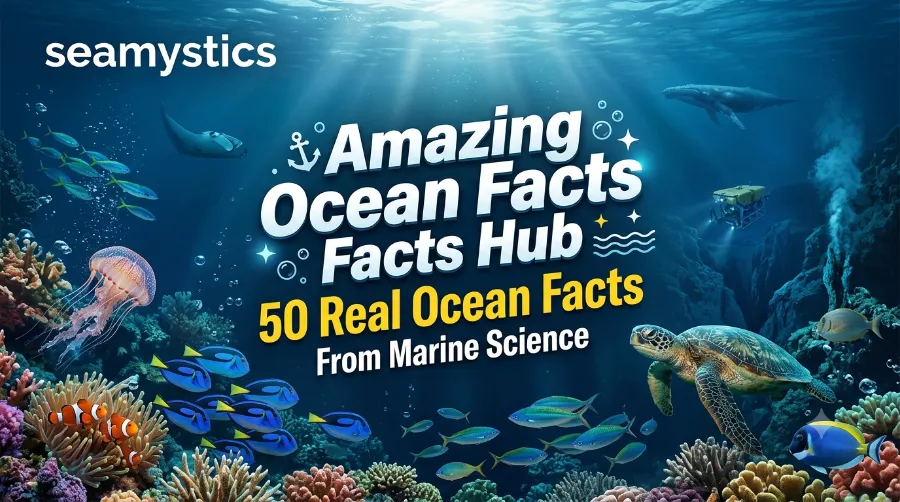

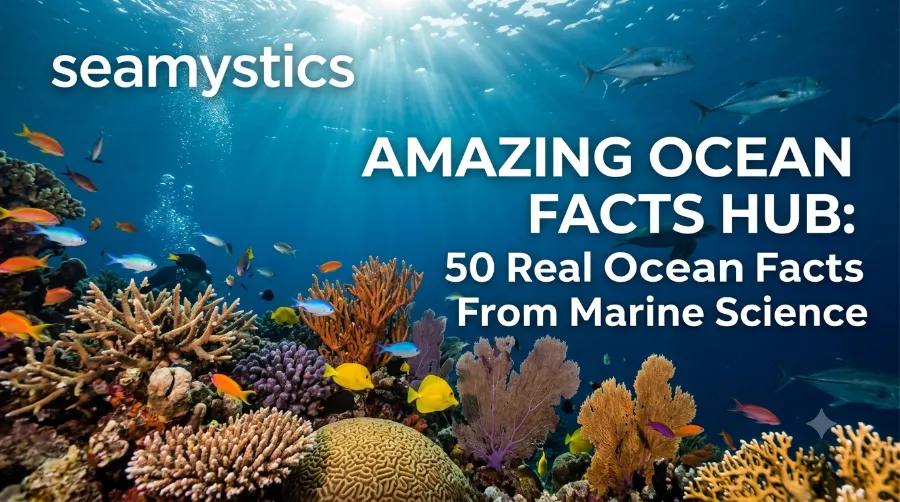
The ocean covers about 70 percent of our planet. Yet most people know more about the moon than the seafloor near their own coast. This amazing ocean facts hub was built to change that. Below, you will find 50 real, research backed facts about the sea. Each one comes from marine science, government agencies, or conservation groups. So you get numbers you can actually trust.
If you want to learn more about Write whatOrigins of Earth’s oceans explainedout our detailed guide for practical tips and expert advice.
I am a working marine biologist. Over the years, I have read through survey data, watched bleaching events unfold on reef monitors, and explained these numbers to students who assumed the ocean was already fully mapped. It is not. This guide focuses on facts that are current, sourced, and useful, not recycled trivia.
If you want to learn more about Why the Ocean Tastes Salty, check out our detailed guide for practical tips and expert advice.
Key Takeaways
| Category | Fact | Number |
|---|---|---|
| Exploration | Deep seafloor visually observed by humans | Less than 0.001% |
| Mapping | Global seafloor mapped in high resolution (2024) | 26.1% |
| Species | Estimated total ocean species | 700,000 to 1,000,000 |
| Carbon | Carbon stored in the ocean vs on land | 37,700 vs 2,000 gigatonnes |
| Coral | Great Barrier Reef affected by 2024 bleaching | Over 90% |
| Fisheries | Monitored fish stocks overfished (2021 data) | 37.7% |
| Sound | Loudest recorded marine animal clicks | 230 decibels |
Ocean Facts About Size, Depth and Exploration
Before we get to strange creatures and climate numbers, let’s look at scale. Size explains why so much of the ocean stays unknown. These ocean facts set the stage for everything else in this amazing ocean facts hub.
To get a better understanding of the real reason the ocean is blue our guide breaks down exactly what to expect.
How Big and Deep the Ocean Really Is
- The global ocean covers roughly 70 percent of Earth’s surface. Its surface area reaches about 360 million square kilometers, based on NOAA ocean facts data.
- The average ocean depth sits near 3,682 meters. That is deeper than most people picture when they think of the sea.
- The Mariana Trench holds the deepest known point on Earth. It plunges to roughly 10,935 meters below the surface.
- As of June 2024, only 26.1 percent of the global seafloor had been mapped with modern sonar, according to NOAA Ocean Exploration.
- A 2025 study in Science Advances found something surprising. Humans have visually seen less than 0.001 percent of the deep seafloor. That area is roughly the size of Rhode Island, as NPR reported
- To get a better understanding of tides explained ocean science, our guide breaks down exactly what to expect.
Why So Much Remains Unexplored
- More than 90 percent of the ocean counts as deep ocean. It sits below 200 meters. Sunlight never reaches it.
- Scientists have logged over 43,000 deep sea dives since 1958. Most dives happened near the United States, Japan, and New Zealand.
- If you want to learn more about Write what how the ocean shapes global weather out our detailed guide for practical tips and expert advice.
- The Indian Ocean remains one of the least explored basins on the planet. This leaves large gaps in marine data.
- We understand the surface of Mars better than our own seafloor. Discover Magazine covered this gap in detail, and it says a lot about where research funding goes.
- Exploration keeps advancing each year. New robotic vehicles and AI powered sonar are speeding up discovery.
- To get a better understanding of how ocean depth affects temperature our guide breaks down exactly what to expect.
Ocean FaIf you want to learn more about Write what percentage of ocean still unexplored out our detailed guide for practical tips and expert advice.cts About Marine Life and Species
Life in the sea is more diverse than most textbooks suggest. This next set of ocean facts focuses on creatures and the numbers behind them.
If you want to learn more about Write what actually drives ocean currentscheck out our detailed guide for practical tips and expert advice
Big Numbers Behind Ocean Species
- Scientists estimate the ocean holds 700,000 to 1,000,000 species. Roughly two thirds of these have not yet been formally described.
- Around 2,000 new marine species get accepted by science every year. The list keeps growing.
- Blue whales remain the largest animals ever known to exist. They outsize every dinosaur discovered so far.
- Sperm whales produce clicks that reach 230 decibels. That makes them the loudest recorded animals in the ocean.
- Anglerfish have been recorded living near 4,000 meters deep, close to the Mariana Trench. No sunlight reaches that depth.
Small but Surprising Marine Facts
- Hydrothermal vent microbes were first discovered in the 1970s. They survive without sunlight, running on chemical energy instead.
- Coral reefs cover less than 1 percent of the ocean floor. Still, they support about a quarter of all marine species.
- Sea turtles have existed for more than 100 million years. They outlived the dinosaurs by a wide margin.
- Octopuses have three hearts and blue blood. This helps them survive in cold, low oxygen water.
- A parasite called Cymothoa exigua fully replaces a fish’s tongue. It is the only known parasite that replaces an organ in its host.
For species specific breakdowns, check our marine life guide. It covers everything from reef fish to deep sea invertebrates.
Weird and Wild Ocean Facts You Won’t Forget
Some ocean facts sound made up simply because the real ocean is stranger than fiction. These entries tend to get shared the most.
Strange Behaviors in the Sea
- Starfish push their stomachs outside their bodies to digest prey like mussels. Then they pull the stomach back in.
- Whales exhale through a blowhole. This releases mucus and vapor that drones called snotbots now collect to check whale health.
- NOAA recorded a mysterious sound called The Bloop in 1997. Scientists later traced it to icequakes in Antarctica.
- Researchers first recorded a Bryde’s whale sound called a biotwang in 2014. They now use it to track migration.
- The Pacific Ocean shrinks by 2 to 3 centimeters each year as tectonic plates shift. Meanwhile, the Mariana Trench grows slightly deeper.
Strange Biology in the Sea
- Seahorses are among the only animals where males carry and give birth to offspring.
- Some jellyfish species are biologically immortal. They can revert to an earlier life stage instead of aging.
- The ocean floor holds more mountains than any continent. Some chains stretch far longer than the Andes.
- Most animals below 1,000 meters can produce their own light, according to bioluminescence researchers.
- Sharks existed before trees. Fossil evidence places early sharks around 400 million years ago.
Ocean Facts About Climate, Carbon and Heat
Climate data forms one of the most important parts of any amazing ocean facts hub. The sea quietly regulates the planet’s temperature. These numbers come from conservation and government sources, not estimates.
How Much Carbon the Ocean Stores
The ocean stores about 37,700 gigatonnes of carbon. Land stores roughly 2,000 gigatonnes, according to the Marine Conservation Society. That means the sea holds over 18 times more carbon than every forest, soil, and plant on land combined. Most of this carbon stays locked away for thousands of years. This keeps it out of the atmosphere.
Seagrass meadows absorb roughly 35 times more carbon dioxide than rainforests of the same size. This makes them one of the most efficient carbon sinks on Earth. Meanwhile, the Gulf Stream moves about 550 trillion calories of heat energy across the North Atlantic every second. That number helps explain why coastal Europe stays milder than its latitude suggests.
Ocean Facts Data Table: Heat and Carbon Numbers
| Metric | Figure | Source Year |
|---|---|---|
| Carbon stored in ocean | 37,700 gigatonnes | Current estimate |
| Carbon stored on land | 2,000 gigatonnes | Current estimate |
| CO2 absorbed by seagrass vs rainforest | 35x more | Ongoing research |
| Gulf Stream heat transport | 550 trillion calories/second | Ongoing measurement |
| Great Barrier Reef coral affected by bleaching | Over 90% | 2024 |
| Ocean acidity increase | 30% in 200 years | Current estimate |
Warming Water and Coral Bleaching
In 2024, over 90 percent of coral across the Great Barrier Reef went through a global bleaching event. Rising ocean temperatures caused it, based on Marine Conservation Society data. This event shows how directly warm water threatens reefs worldwide, not just in Australia. Ocean water has also grown 30 percent more acidic over the past 200 years. That shift is happening faster than any known change in ocean chemistry over the last 50 million years.
Ocean Facts About Threats and Conservation
Understanding threats matters just as much as celebrating the ocean’s wonders. This section covers fisheries, protection gaps, and bycatch, using the latest available figures.
Fisheries and Bycatch Numbers
A 2024 industry report found that 37.7 percent of monitored fish stocks were overfished in 2021. That figure rose 2.3 percent from 2019 levels. This trend matters because overfishing pressures predator species and coastal communities alike. Bycatch adds another problem. Roughly 40 percent of global marine catches consist of species caught by accident, including turtles, sharks, and marine mammals.
UK Conservation Gaps
Over 1,000 cetaceans, such as dolphins, porpoises, and whales, die each year through UK fishing activity, per MCS tracking data. The UK has also lost around 92 percent of its historic seagrass meadows over the past century. This removed a habitat that once protected coastlines and stored carbon. Today, 377 Marine Protected Areas cover 38 percent of UK seas. Yet only 38 of them fully ban bottom towed fishing gear. That leaves major protection gaps.
Here is where conservation efforts currently stand:
- Marine Protected Areas covering UK seas: 38 percent
- MPAs with a full bottom trawling ban: 38 sites
- UK seagrass lost since the last century: about 92 percent
- Global catches classified as bycatch: roughly 40 percent
- Monitored fish stocks overfished in 2021: 37.7 percent
Frequently Asked Questions
How many ocean facts are backed by real marine science?
Every fact in this amazing ocean facts hub comes from a documented source. These include NOAA, the Marine Conservation Society, and peer reviewed research published through 2025.
What percentage of the ocean has actually been explored?
Humans have visually seen less than 0.001 percent of the deep seafloor. About 26.1 percent of the global seafloor had been mapped in high resolution as of June 2024.
Why do ocean facts about carbon storage matter?
The ocean stores over 18 times more carbon than land. Any disruption to that system directly affects global climate stability.
Are ocean facts about overfishing still relevant today?
Yes. The most recent industry data from 2024 shows overfishing has increased since 2019. It remains an active, growing concern.
Conclusion
The ocean remains one of the least understood parts of our planet. That is exactly what makes it worth exploring further. These ocean facts, from carbon storage numbers to bleaching events, show a system that is both powerful and fragile. This amazing ocean facts hub will keep updating as new research comes in. Bookmark it and check back for fresh data.
If today’s facts sparked your curiosity, explore more marine science breakdowns on our homepage. New ocean research gets translated into plain, useful language there every month.
References
- NOAA Ocean Exploration. How much of the ocean has been explored?
- NOAA Office for Coastal Management. Ocean facts and observations.
- Marine Conservation Society. Ocean facts and stats.
- NPR. Humans still haven’t seen 99.999 percent of the deep seafloor, May 2025.
- Discover Magazine. 99.999 Percent of the Deep Ocean Is Unexplored.