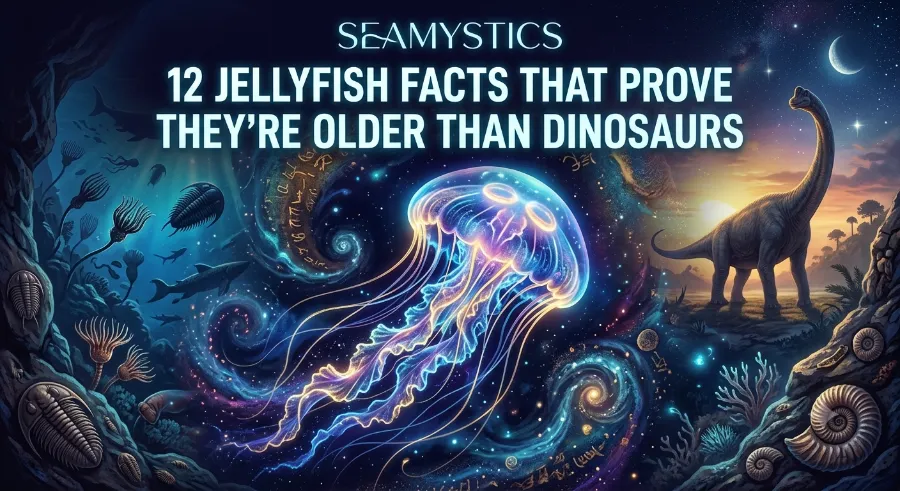

Picture this. A T. rex has not been born yet. The continents still sit close together. And somewhere in a shallow, ancient sea, a soft, pulsing creature drifts through the water, hunting without a single bone, blood cell, or beating heart. That creature is a jellyfish, and it was already old news long before the first dinosaur took a breath.
To get a better understanding of how seahorse facts ocean life breaks down exactly what to expect.
Most people assume dinosaurs were the original rulers of Earth. In truth, jellyfish beat them to the planet by a staggering length of time. These strange, glowing drifters survived five mass extinction events, outlasted entire dinosaur dynasties, and are still floating through our oceans today, largely unchanged. If you care about jellyfish facts ocean life has quietly protected for half a billion years, you are about to meet a creature far tougher than its delicate looks suggest.
To get a better understanding of how colorful sea slug species facts breaks down exactly what to expect.
In this guide, Dr. Rabica breaks down twelve verified facts, backed by fossil evidence, recent studies, and real research dates, that show exactly why jellyfish deserve a spot among the oldest survivors on the planet. Grab a coffee, because this one gets weird fast.

Key Takeaways
| Fact | Quick Insight |
|---|---|
| Jellyfish fossil age | Oldest confirmed fossils date back roughly 505 to 508 million years |
| Dinosaur comparison | Jellyfish predate the earliest dinosaurs by more than 250 million years |
| Body composition | Jellyfish are made of about 95 percent water |
| Nervous system | They survive without a brain, heart, or blood using a nerve net instead |
| Immortality | Turritopsis dohrnii can reverse its own aging process |
| Largest species | The lion’s mane jellyfish can stretch longer than a blue whale |
| Vision | Box jellyfish carry 24 eyes across their bodies |
| Survival record | Jellyfish outlived five separate mass extinction events |
1. Jellyfish Fossils Predate the First Dinosaurs by Over 250 Million Years
Dinosaurs first appeared roughly 240 to 245 million years ago. Jellyfish, on the other hand, were already thriving long before that. Fossil evidence pulled from the Burgess Shale in British Columbia and from ancient rock layers in Utah shows jellyfish swimming in Earth’s oceans as far back as 505 to 508 million years ago.
That gap is difficult to picture, so here is a simpler way to think about it. If dinosaurs represent a Tuesday afternoon, jellyfish had already been swimming since the previous Friday. They are some of the Earth’s oldest animals, having been around for roughly more than 500 million years, which is about 250 million years older than the earliest dinosaurs. Consequently, jellyfish were not just early arrivals. They were practically ancient history by the time dinosaurs showed up. Popular Science
Because jellyfish have no bones or shells, fossils this well preserved are rare. This makes every confirmed jellyfish fossil an important scientific find. Researchers who study ocean life call these fossils a rare window into a world that existed before most animal body plans had even evolved.
2. A 2023 Discovery Confirmed the Oldest Swimming Jellyfish Ever Found
In August 2023, scientists at Toronto’s Royal Ontario Museum made headlines with a discovery that reshaped what we know about jellyfish history. Researchers found 182 fossils encased within the rock of the famed Burgess Shale fossil site, belonging to a previously unknown species called Burgessomedusa phasmiformis. CNN
This finding mattered for one big reason. Before this, scientists debated whether ancient jellyfish could actually swim freely or simply drifted with currents. The new fossils settled the debate. In life, the umbrella shaped animal was about seven inches across and draped with more than 90 short tentacles trailing beneath it. Smithsonian Magazine
The study, published in the journal Proceedings of the Royal Society B, proved that free swimming, bell shaped jellyfish were already fully formed predators over 500 million years ago. That is a level of evolutionary polish most modern animals never reach, let alone one that appeared before complex life had even diversified.
If deep sea discoveries like this fascinate you, our weird ocean creatures hub covers dozens of similar finds pulled straight from the ocean floor.
3. Jellyfish Have No Brain, Heart, or Blood, Yet They Still Hunt and Survive
Here is where things get genuinely strange. Jellyfish do not have a brain. They do not have a heart. They do not even have blood. And somehow, they still manage to hunt, swim, avoid predators, and reproduce successfully.
Instead of a central nervous system, jellyfish rely on something called a nerve net. This is a web of nerve cells spread evenly across the body rather than concentrated in one organ. Jellyfish can hunt, feed, reproduce, migrate, and avoid threats, all without a single neuron reporting to a central command. Dana Wharf
This design actually gives jellyfish an odd advantage. Because there is no single control center, damage to one part of the body rarely shuts the whole system down. In fact, if a chunk of a jellyfish’s bell is damaged or torn off, the rest of the animal keeps functioning normally. Try that with almost any other animal and it simply would not work. Dana Wharf
This decentralized survival strategy is part of why jellyfish adapted so easily across hundreds of millions of years of changing ocean conditions.
4. One Species Can Reverse Its Own Aging Process
If jellyfish being older than dinosaurs was not impressive enough, meet Turritopsis dohrnii, nicknamed the immortal jellyfish. This species is one of the few known animals capable of completely reverting to a sexually immature, polyp stage after having already reached full adulthood. Wikipedia
In simple terms, when this jellyfish faces stress, injury, or starvation, it does not simply die. Instead, it can transform its own cells back into an earlier life stage and start over. Scientists call this process transdifferentiation, and it works a little like a caterpillar reversing itself back into an earlier form rather than moving forward into a butterfly.
This species was first discovered in the 1880s in the Mediterranean Sea, and can hit the reset button and revert to an earlier developmental stage if it is injured or otherwise threatened. As of 2025, researchers are still actively studying its genetic pathways, hoping the discovery might one day inform human aging research. American Museum of Natural History
This does not mean the jellyfish cannot die at all. Predators, disease, and physical damage still take a toll. However, its built-in reset button remains one of the strangest survival tricks in the animal kingdom, and a strong reason biologists consider it a living link to ancient ocean life patterns.
5. The Largest Jellyfish Can Grow Longer Than a Blue Whale
Most people picture jellyfish as small, delicate blobs. The lion’s mane jellyfish destroys that image entirely. The largest recorded individuals, found in the Arctic Ocean, measured as much as 2.4 metres, about 8 feet, in diameter and 36.5 metres, roughly 120 feet, in length, which is about 23 feet longer than the longest known blue whale. Britannica
To put that into perspective:
- A blue whale, the largest animal on Earth, typically reaches around 98 feet in length
- The largest recorded lion’s mane jellyfish stretched to 120 feet
- That means the jellyfish’s tentacles alone can outstretch the planet’s biggest mammal
The largest recorded specimen was measured off the coast of Massachusetts back in 1865, with a bell diameter of 7 feet and tentacles around 120 feet long. Even modern specimens routinely reach 30 to 100 feet in tentacle length in colder Arctic and North Atlantic waters. Wikipedia
If enormous marine creatures are your thing, our guide on giant squid facts revealed is worth exploring next.
6. Box Jellyfish Have 24 Eyes Spread Across Their Bodies
Since jellyfish lack a brain, you would assume they cannot see much. Box jellyfish break that assumption completely. Box jellyfish have eyes, 24 of them, located in structures called rhopalia that are spread across the bell, giving them a form of 360 degree vision. Marine Conservation Society
Some of these eyes are simple light detectors. Others are far more advanced. The upper and lower lens eyes resemble human eyes and include a cornea, lens, pupil, and retina. That is an extraordinary amount of visual sophistication for an animal with no centralized brain to process the information. ScienceABC
Even more surprising, recent research suggests these jellyfish can learn. A 2023 study published in Current Biology found that Caribbean box jellyfish learned to spot and avoid mangrove roots using visual signals processed directly through their rhopalia, without any central brain involved. This challenges long held assumptions that learning requires a brain at all. Snexplores
7. Jellyfish Survived Five Mass Extinction Events
Dinosaurs went extinct after a single, catastrophic asteroid impact roughly 66 million years ago. Jellyfish, meanwhile, were already ancient by that point and simply kept swimming. In fact, jellyfish have survived every one of Earth’s five major mass extinction events, including the Permian-Triassic extinction around 252 million years ago, often called the Great Dying, which wiped out over 90 percent of marine species.
How did such a fragile looking animal survive catastrophes that ended entire dynasties? A few likely reasons stand out:
- Their simple body structure requires very little to sustain life
- Their fast reproduction cycle allows populations to rebound quickly
- Their tolerance for changing oxygen levels and temperatures gives them flexibility other species lack
- Their decentralized nervous system means damage rarely proves fatal
This survival record places jellyfish among the most resilient organisms in the history of ocean life, arguably rivaling sharks and horseshoe crabs for evolutionary staying power.
8. Their Bodies Are Almost Entirely Made of Water
Roughly 95 percent of a jellyfish’s body is water. That is part of what makes fossilization so rare and every confirmed fossil so scientifically valuable. The soft bodied animals are made of 95 percent water, which makes exceptionally well preserved fossils a remarkable find. CNN
This high water content also explains their almost ghostly, translucent appearance. Since jellyfish lack bones, shells, or cartilage, their entire structure relies on water pressure to hold its shape, similar to how a water balloon keeps its form.
This simplicity is not a weakness. It is arguably one of the biggest reasons jellyfish required so little energy to survive across hundreds of millions of years while more complex creatures faced repeated extinction pressure.
9. Jellyfish Follow a Two Stage Life Cycle That Predates Complex Evolution
Most people only recognize the classic umbrella shaped medusa stage, but that is only half the story. Jellyfish begin life as tiny, free swimming larvae called planulae. Eggs grow into larva called planula, which have been described as looking like furry tic-tacs, and they start swimming until they find somewhere to stick themselves. Orlando Science Center
Once settled, the larva transforms into a stationary polyp attached to a rock or hard surface. Eventually, that polyp begins producing small, stacked discs that separate and swim away as juvenile jellyfish. This entire two stage life cycle, alternating between a fixed polyp and a free swimming medusa, was already fully developed hundreds of millions of years ago, long before more complex reproductive systems evolved in other species.
This ancient life cycle blueprint still exists in modern species today, largely unchanged, which is part of why researchers consider jellyfish a living fossil in the truest sense.
10. Even Dead Jellyfish Can Still Sting You
This fact tends to surprise beachgoers the most. Each stinging cell contains a coiled, harpoon-like structure loaded with venom, and when triggered by physical contact, it fires in microseconds, injecting venom automatically, without requiring a brain, a decision, or even a nerve signal. Dana Wharf
Because this stinging reflex is entirely mechanical, a jellyfish washed up on shore, even one that has been dead for hours, can still deliver a painful sting if its tentacles are touched. This is exactly why lifeguards across the United States and Europe warn beachgoers never to touch stranded jellyfish, no matter how harmless they appear.
For a deeper look at another creature with a surprising defense system, check out our vampire squid facts explained guide.
11. Some Jellyfish Species Weigh as Much as an Adult Human
While the lion’s mane jellyfish wins on length, other species compete on sheer mass. Nomura’s jellyfish can weigh up to 400 pounds, roughly the weight of a large adult grizzly bear. Meanwhile, the lion’s mane jellyfish is not far behind, with the Guinness Book of World Records recognizing certain specimens as weighing close to 1,000 kilograms in extreme cases. A-Z Animals
These massive jellyfish blooms have become more frequent in recent years across parts of the Sea of Japan and the Yellow Sea, occasionally overwhelming fishing nets and even shutting down power plants that rely on ocean water for cooling systems. Warmer ocean temperatures and reduced numbers of natural predators are widely considered the leading causes behind these growing blooms.
12. Their Ancient Design Still Works Better Than Most Modern Animal Body Plans
Perhaps the most remarkable jellyfish fact is not a single event, but a pattern. Despite lacking a brain, heart, bones, or blood, jellyfish have persisted essentially unchanged for over 500 million years while entire kingdoms of far more complex animals rose and disappeared.
Their body plan proves that evolutionary success does not always require complexity. Sometimes, the simplest design, refined by hundreds of millions of years of trial and error, becomes nearly impossible to beat. This is precisely why marine biologists studying ocean life continue to treat jellyfish as one of nature’s most efficient survival blueprints.
Jellyfish Timeline Compared to Major Earth Events
| Event | Approximate Time |
|---|---|
| Oldest confirmed jellyfish fossils | 505 to 508 million years ago |
| Permian-Triassic mass extinction | 252 million years ago |
| First dinosaurs appear | 240 to 245 million years ago |
| Dinosaur extinction event | 66 million years ago |
| Modern human species emerges | Roughly 300,000 years ago |
This timeline alone shows why jellyfish deserve far more credit than they usually get. They were already ancient before dinosaurs existed and continued swimming long after dinosaurs vanished entirely.
Frequently Asked Questions
Are jellyfish really older than dinosaurs?
Yes. Fossil evidence confirms jellyfish existed at least 505 million years ago, while the earliest dinosaurs did not appear until roughly 240 to 245 million years ago, a gap of over 250 million years.
Do jellyfish have brains?
No. Jellyfish rely on a nerve net spread throughout their bodies instead of a centralized brain, yet they can still hunt, swim, and avoid predators effectively.
Can jellyfish actually live forever?
One species, Turritopsis dohrnii, can reverse its aging process under stress, making it biologically capable of avoiding natural death, though predators and disease can still kill it.
What is the largest jellyfish species?
The lion’s mane jellyfish holds the record, with recorded specimens stretching up to 120 feet in tentacle length, longer than a blue whale.
Why are jellyfish populations increasing in some regions?
Warmer ocean temperatures, reduced predator numbers, and nutrient rich waters from agricultural runoff have contributed to larger jellyfish blooms in several coastal regions worldwide.
Conclusion
Jellyfish rarely get the recognition they deserve. They lack a brain, a heart, and even blood, yet they managed to outlive dinosaurs, survive five mass extinction events, and continue thriving in oceans across the globe today. From the ancient Burgessomedusa fossils to the self-resetting biology of the immortal jellyfish, these creatures prove that survival often favors simplicity over complexity. The next time you spot one drifting near the shoreline, remember you are looking at a living connection to a world that existed long before dinosaurs ever walked the Earth. To explore more astonishing deep sea survivors, visit our weird ocean creatures hub for more research backed guides.
References
- Royal Ontario Museum, published in Proceedings of the Royal Society B, August 2023, Burgessomedusa phasmiformis fossil discovery
- CNN, “Remarkable fossils reveal jellyfish that lived 505 million years ago,” August 2023
- Smithsonian Magazine, “These 508-Million-Year-Old Fossils May Be Earth’s Oldest Swimming Jellyfish,” August 2023
- Britannica, “Lion’s mane jellyfish,” species and size data
- ScienceAbc, “Do Jellyfish Have Brains? How Do They Function Without A Heart Or Brain?”
- Current Biology, box jellyfish learning study, September 2023
- Marine Sanctuary, Sea Wonder: Moon Jelly
- Champions for Wildlife, Jellyfish Learning Resource