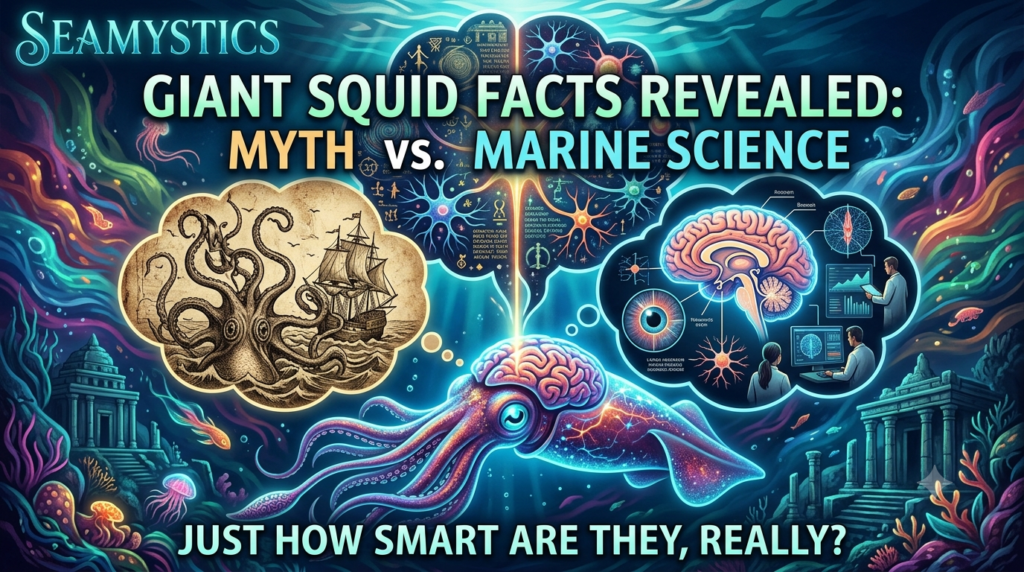

Sailors once swore that ship-sized monsters lived beneath the waves, dragging whole crews into the deep. For centuries, nobody believed them. Then, in 2004, Japanese researchers finally photographed a live giant squid in its own habitat, and the legend suddenly looked a lot less like fiction. This article gets into the real giant squid facts revealed by decades of ocean life research, and it separates what sailors imagined from what marine biologists have actually confirmed.
If you want to learn more about Write what weird ocean creatures facts out our detailed guide for practical tips and expert advice.
Giant squid are real animals, not sea monsters, though their true biology is stranger than most myths give them credit for. Below, we walk through their size, their senses, their diet, and the newest discoveries from 2025 and 2026 that are reshaping how scientists study deep sea cephalopods.
If you want to learn more about Write what anglerfish facts deep sea out our detailed guide for practical tips and expert advice.
Key Takeaways
| Topic | What Science Confirms |
|---|---|
| Maximum length | Up to 13 meters (43 feet), including tentacles |
| Eye size | Largest in the animal kingdom, about 25 to 27 centimeters wide |
| Habitat depth | Usually found 300 to 1,000 meters below the surface |
| Attack ships? | No confirmed record of a giant squid sinking or attacking a vessel |
| First live footage | Captured in 2004 off Japan; first free-swimming video followed in 2012 |
| Closest living relative in size | Colossal squid (Mesonychoteuthis hamiltoni) |
| Latest scientific breakthrough | Giant squid DNA detected off Western Australia in 2026 after a 25-year gap |
What Is a Giant Squid, Really?
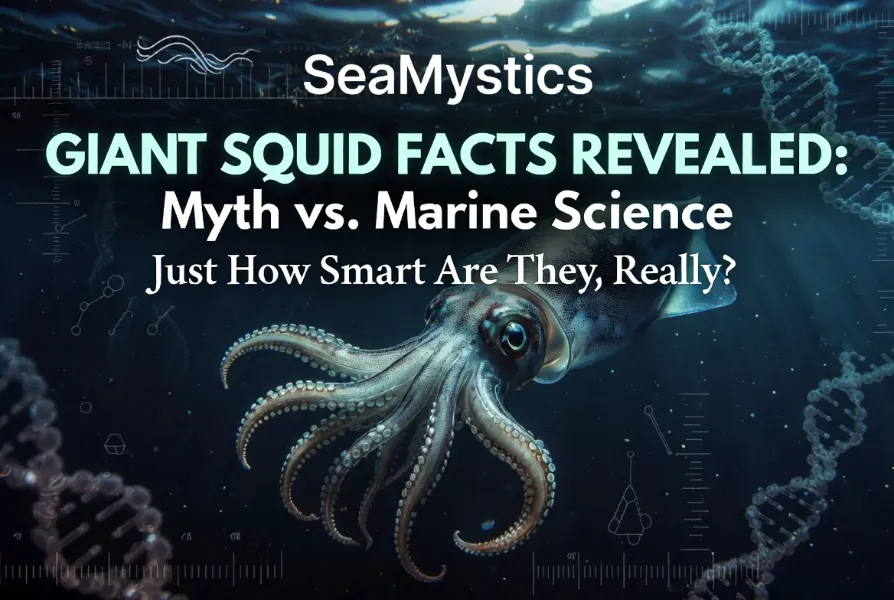
The giant squid, known to scientists as Architeuthis dux, is a deep ocean dwelling cephalopod. It belongs to the same broader family as octopuses, cuttlefish, and nautiluses. Unlike its cousins, though, this animal spends nearly its entire life far below sunlight, often between 300 and 1,000 meters deep, according to peer reviewed research on the species. nih
For a long time, almost everything known about giant squid came from dead specimens. Fishermen occasionally pulled up carcasses, or bodies washed ashore after storms. As a result, early naturalists had to guess at how the animal actually behaved in the wild. That guesswork, mixed with old sailor stories, is exactly where the kraken myth took root.
If you want to learn more about Write what octopus intelligence facts explained out our detailed guide for practical tips and expert advice.
If you enjoy learning about strange creatures that live far from land, our weird ocean creatures hub covers dozens of similar deep sea animals worth exploring.
If you want to learn more about out blobfish facts deep seaour detailed guide for practical tips and expert advice.
Giant Squid Facts Revealed: Size, Eyes, and Body Structure
This is the part most people want to know first, so let’s get straight to it. Giant squid are enormous, though not quite as enormous as folklore claims.
If you want to learn more about out vampire squid facts explained detailed guide for practical tips and expert advice.
How Big Do Giant Squid Actually Get?
Confirmed specimens have reached roughly 13 meters, or 43 feet, in total length once tentacles are included, and this figure comes from measured, examined animals rather than eyewitness guesses, per Britannica’s review of documented specimens. The mantle itself, meaning the main body without arms or tentacles, usually measures around 2 meters. Meanwhile, the two long feeding tentacles can stretch out separately and add most of the extra length. Britannica
Females tend to grow noticeably larger than males. One well documented female, caught off northern Spain in July 2005 and now displayed at the Smithsonian, measured about 36 feet long and weighed 330 pounds, with tentacles reaching 22 feet on their own, based on Smithsonian records of the specimen. Flickr
The Eyes That Started the Legend
Giant squid have the largest eyes of any known animal, and this single fact explains a lot of old sailor stories. Their eyes can reach up to 10 inches across, roughly the size of a dinner plate or a human head, according to Smithsonian Ocean’s research on cephalopod vision. Scientists now believe these giant eyes evolved not mainly to spot prey, but to detect large predators such as sperm whales approaching from a distance in the dark. Smithsonian Ocean
Here is a quick comparison table so you can see how giant squid stack up against other record holding sea creatures.
| Animal | Max Length | Notable Feature |
|---|---|---|
| Giant squid | 13 m (43 ft) | Largest eye in the animal kingdom |
| Colossal squid | 14 m (45 ft), disputed | Heavier and more robust body |
| Blue whale | 30 m (98 ft) | Largest animal ever known |
| Whale shark | 12 m (40 ft) | Largest living fish |
| Oarfish | 8 m (26 ft) | Longest bony fish |
Body and Movement
A giant squid’s body is soft, streamlined, and built for the deep. Ammonium chloride circulates through their tissue, which is lighter than seawater and helps them stay buoyant without much effort, based on Smithsonian’s description of the species’ physiology. This is also why their flesh tastes strongly bitter, a detail few people expect to hear about a legendary sea monster. Flickr
Two long feeding tentacles end in wide, paddle-shaped clubs covered in sharp suckers. These clubs shoot out to grab prey, then pull it back toward eight shorter arms and a sharp beak. In short, the same features that once terrified sailors are simply feeding tools built for total darkness.
To get a better understanding of how jellyfish facts ocean life breaks down exactly what to expect.
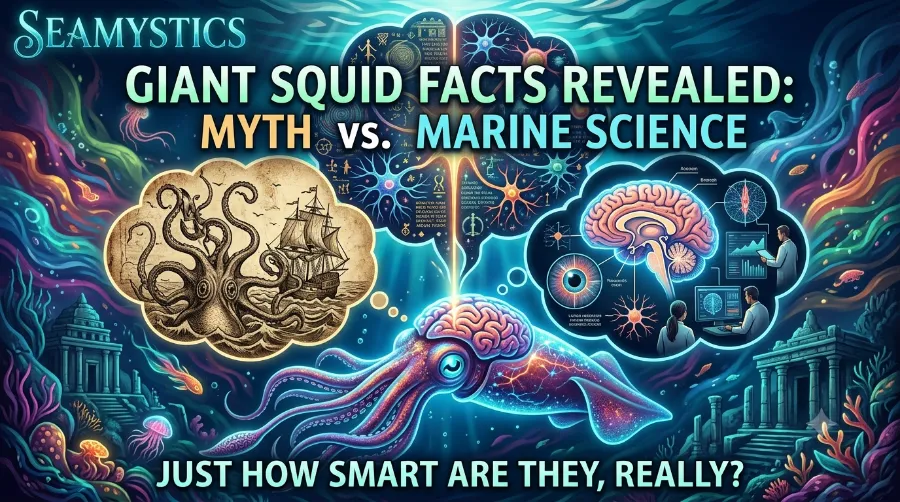
Myth vs. Marine Science: Where the Kraken Legend Went Wrong
Now let’s actually compare what old legends claimed against what marine biologists have confirmed. This comparison matters because it shows how a real, fascinating animal became exaggerated into folklore over hundreds of years.
- Myth: Giant squid drag entire ships underwater. Science: There is no verified case of a giant squid sinking or seriously damaging a vessel; most historical “attacks” likely involved confused sightings of dead or dying squid at the surface.
- Myth: They grow to 60 feet or more. Science: Reliable, examined specimens top out around 43 feet, though media reports of larger sizes appear frequently without solid proof, as noted by marine biology researchers who reviewed size claims. MarineBio
- Myth: Kraken sightings described monk-like sea creatures. Science: Historical “sea monk” reports from 1500s Denmark are now believed to describe giant squid carcasses, misread by people unfamiliar with cephalopod anatomy, according to Smithsonian Ocean’s history of early sightings. Smithsonian Ocean
- Myth: Giant squid actively hunt humans. Science: They live too deep, generally below 300 meters, to ever encounter swimmers or divers under normal conditions.
Interestingly, the actual formal identification of these squid didn’t happen until the mid-1800s, when Danish professor Japetus Steenstrup connected old “sea monk” folklore to real squid anatomy, a shift detailed on our related deep sea page about the kraken legend and giant squid. If you’re curious how another feared sea creature compares, the anglerfish facts guide covers a similarly misunderstood deep water predator.
Recent Discoveries Reshaping Ocean Life Research
Ocean life research on giant squid has moved faster in the last two years than in the previous two decades combined. New tools now let scientists find evidence of these animals without ever catching or even seeing one directly.
To get a better understanding of how seahorse facts ocean life breaks down exactly what to expect.
A Major 2026 Breakthrough Off Australia
In May 2026, researchers from Curtin University explored deep canyons off Western Australia’s Ningaloo coast and detected giant squid DNA in six separate water samples. This was the first confirmed giant squid record in that region in more than 25 years, based on findings reported by Discover Wildlife. The team used environmental DNA, often shortened to eDNA, which picks up tiny genetic traces that animals shed through skin, mucus, and waste as they swim by. Discover Wildlife
This technique is a genuine game changer. Instead of waiting years for a rare physical sighting, scientists can now confirm a species was present just by sampling seawater. As a result, entire hidden ecosystems are being mapped for the first time.
The Colossal Squid’s First Ever Live Footage
While not technically the same species, the closely related colossal squid made headlines when its first confirmed live footage was captured on March 9, 2025, near the South Sandwich Islands, filmed by the ROV SuBastian at a depth of 600 meters, according to Schmidt Ocean Institute’s official report. The animal filmed was only about 30 centimeters long, a juvenile, proving that even after 100 years of formal scientific classification, almost nothing was known about how this species actually looks alive. ScienceDaily
Notably, marine biologist Dr. Kat Bolstad clarified during coverage of the discovery that colossal squid and giant squid are not the same animal; colossal squid live only in Antarctic and sub-Antarctic waters, while giant squid range much more widely across the world’s oceans, as explained in CNN’s reporting on the expedition. CNN
Here is how scientists typically confirm a giant squid or colossal squid sighting today:
- Deploy a remotely operated vehicle (ROV) to depths below 600 meters.
- Record continuous video footage in low light or infrared conditions.
- Collect nearby water samples for eDNA testing as backup evidence.
- Send footage to independent global cephalopod experts for identification.
- Cross reference sucker marks on sperm whales, since these often indicate recent squid encounters.
If you’re fascinated by how researchers study elusive deep sea animals, our guide on octopus intelligence facts explores similar cutting edge cephalopod research methods.
Where Giant Squid Live and What They Eat
Giant squid are found in every ocean except the polar regions, typically along continental slopes where the seafloor drops off steeply. They prefer cool water, since warmer temperatures interfere with how their blood carries oxygen, based on research from Dr. Ole Brix at the University of Bergen. This is part of why they stay so deep and rarely rise toward the surface. Animal Diversity Web
Their diet mostly consists of deep sea fish and other squid species, including smaller members of their own order. They use their long tentacles to strike from a distance, then draw prey toward a sharp beak capable of tearing flesh apart. Sperm whales are their main known predator, and scarred sucker marks on whale skin have long served as indirect proof of these encounters.
To get a better understanding of how colorful sea slug species facts breaks down exactly what to expect.
For readers based in the United States and Europe, it’s worth noting that most confirmed giant squid specimens have washed ashore or been caught near Spain, New Zealand, and Japan, though the 2026 Australian discovery shows their range is likely far broader than researchers previously assumed.
Frequently Asked Questions
Are giant squid dangerous to humans?
No. Giant squid live far too deep to encounter swimmers, and there are no verified attacks on people.
How long do giant squid live?
Scientists estimate a lifespan of roughly one to five years, though exact figures remain uncertain due to limited long term study.
Is the kraken a real animal?
The kraken legend likely grew from real giant squid sightings, exaggerated over centuries by sailors who had never actually seen one up close.
What is the biggest giant squid ever recorded?
The largest confirmed specimen measured close to 13 meters, or 43 feet, including its tentacles.
Why are giant squid so hard to study?
They live in extreme depths, avoid light, and rarely surface, which makes direct observation extremely rare even today.
Conclusion
Giant squid earned their monstrous reputation the old fashioned way, through fear, distance, and centuries of guesswork. Yet the real animal, once you actually look at the evidence, is arguably more impressive than any myth. It carries the largest eyes on Earth, survives in crushing darkness, and continues to surprise scientists with new discoveries as recently as 2026. As ocean life research keeps advancing through tools like eDNA and deep sea ROVs, the gap between kraken folklore and confirmed marine science keeps shrinking, and that gap is exactly where the truth has been hiding all along. To keep exploring the ocean’s strangest residents, visit Sea Mystics for more research backed deep sea guides.
References
- Smithsonian Ocean, “How Big is the Giant Squid?”
- Smithsonian Ocean, “Largest Eye in the World, Giant Squid”
- Britannica, “Giant Squid: Description, Size, and Facts”
- Schmidt Ocean Institute, “First Confirmed Footage of a Colossal Squid”
- CNN, “Rare Colossal Squid Swims Into View in First Deep-Sea Footage” (April 2025)
- Discover Wildlife, “Giant Squid Detected in Deep-Sea Canyon off Coast of Australia” (May 2026)
- MarineBio.org, “Giant Squid, Architeuthis dux”
- Animal Diversity Web, “Architeuthis dux Information”