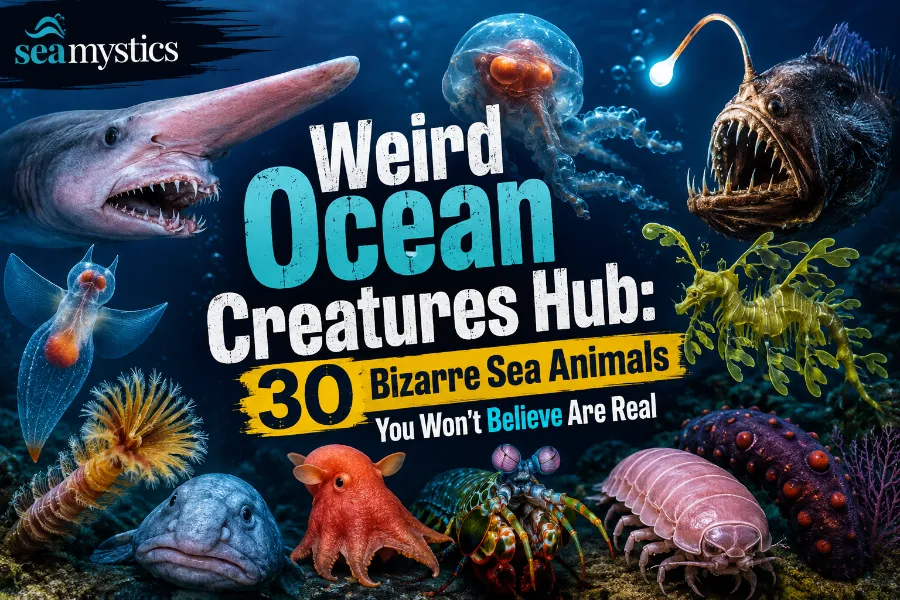

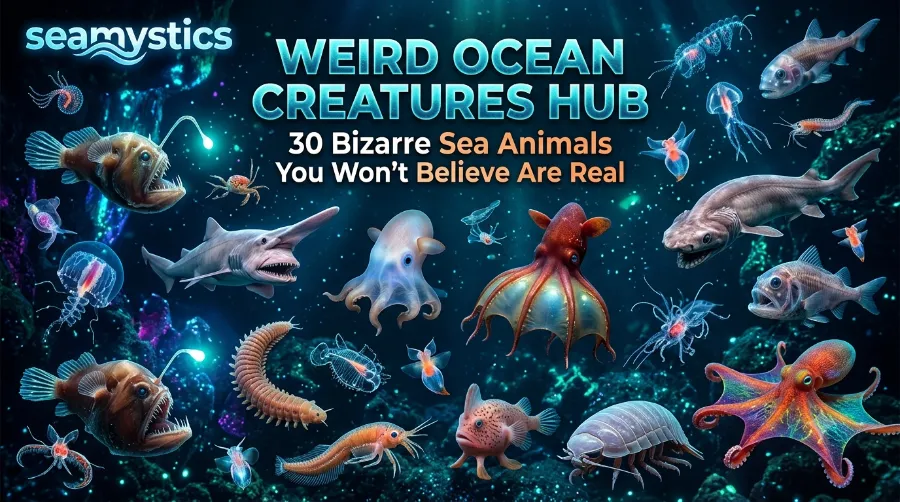
The ocean hides more strange life than any horror movie writer could dream up. In fact, scientists at the Ocean Census announced that researchers found 1,121 new marine species in a single year, and many of them look like they belong in a nightmare or a fairy tale. This weird ocean creatures hub was built for exactly that kind of wonder. So if you think you have seen it all, from glowing worms to see through squid, get ready to meet 30 real sea animals that will make you look twice.
If you want to learn more about Write what weird ocean creatures facts out our detailed guide for practical tips and expert advice.
Ocean life below the surface plays by different rules than life on land. Pressure, darkness, and freezing cold push animals to evolve in ways that seem impossible. Below, you will find a quick summary table, then a full breakdown of the strangest creatures found in oceans around the world, including brand new species named in 2025 and 2026.
If you want to learn more about Write what giant squid facts revealedout our detailed guide for practical tips and expert advice.
Key Takeaways
| Fact | Detail |
|---|---|
| Total new marine species found in one year | 1,121, announced May 2026 by Ocean Census |
| Deepest confirmed snailfish sighting | 8,336 meters, off Japan |
| Newest deep sea isopod named after a movie villain | Bathynomus vaderi, found in a Vietnam seafood market |
| Public naming event | Over 8,000 name suggestions for a chiton called Ferreiraella populi |
| Recent expedition hotspot | Mar del Plata Canyon, Argentina, nearly twice as deep as the Grand Canyon |
| Twilight zone discovery | 20 new species found near Guam after 8 years underwater |
| Average time from discovery to formal naming | 13.5 years |
Why Ocean Life Gets So Weird
Ocean life below 200 meters lives without sunlight, so color, eyesight, and body shape stop following normal rules. Because food is rare down there, many animals grow huge jaws, glowing lures, or stretchy stomachs so they never miss a meal. Meanwhile, the crushing pressure means soft, jelly like bodies often survive better than bony ones. As a result, this part of the planet has produced some of the strangest looking animals on Earth, and new ones keep showing up every year.
If you want to learn more about Write what anglerfish facts deep sea out our detailed guide for practical tips and expert advice.
If you want a broader look at ocean biodiversity and conservation, our ocean life guide breaks down the layers of the sea and what lives in each one. You can also browse our full marine species directory for creature profiles we update monthly. For readers who want the short version first, our deep sea basics primer explains terms like twilight zone and hadal zone in plain language.
If you want to learn more about Write what octopus intelligence facts explained out our detailed guide for practical tips and expert advice.
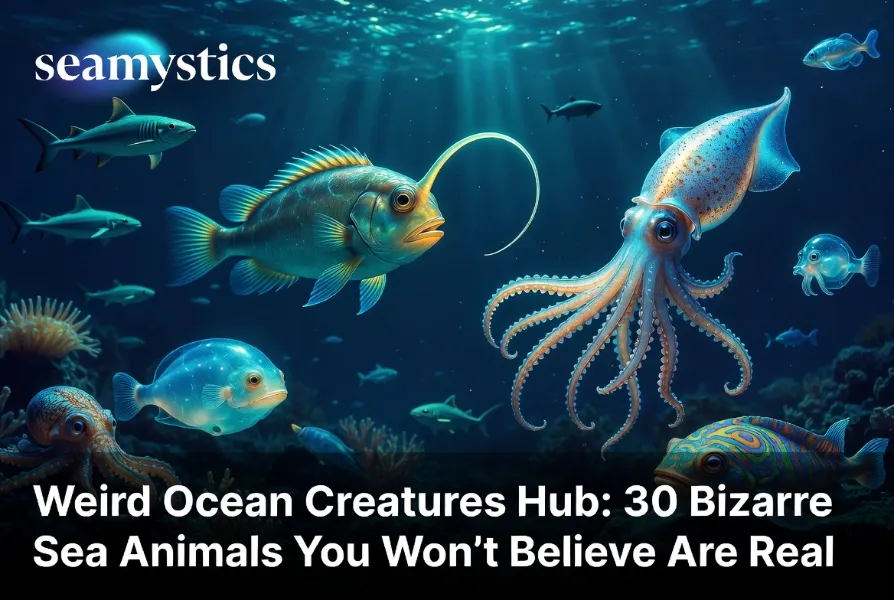
1 to 10: Deep Sea Nightmares
These first ten animals live where sunlight never reaches. They are proof that the deep sea is one of the last truly unmapped places on Earth.
- Anglerfish. This fish carries its own glowing fishing rod on its head to lure prey close before it strikes.
- Giant Isopod (Bathynomus vaderi). Named after a famous movie villain because its head looks like a helmet, this new isopod species was first found not on a research ship, but in a seafood market in Vietnam.
- Vampire Squid. Despite the scary name, this creature does not hunt live prey. It drifts through the dark eating marine snow, the slow fall of dead plankton and waste.
- Goblin Shark. Its jaw shoots forward like a slingshot to snatch prey, then snaps back into place.
- Fangtooth Fish. This small fish has the largest teeth relative to body size of any fish in the ocean.
- Barreleye Fish. Its head is transparent, and its tube shaped eyes rotate inside its skull to look straight up through its own face.
- Sponge Ambusher Worm. Collected roughly 1,000 meters below the surface using the submersible Jiaolong, this predator worm hides inside the hollow body of a glass sponge and ambushes anything that swims too close.
- Iskra’s Glitter Worm. Described by researchers at Scripps Institution of Oceanography, this shimmering, scale covered worm was named by a high school student who won a science competition, and she named it after her childhood dog.
- Elven Abyss Tunicate. This deep sea sea squirt got its name from a line of Elvish poetry written by J.R.R. Tolkien, chosen because its mouth stays open wide like a yawning abyss while it waits for prey.
- Unidentified Creature of Suruga Bay. Filmed drifting at 9,100 meters off Japan, scientists still cannot classify this pale, symmetrical animal, so for now it carries the label Animalia incerta sedis, which simply means its place in the animal kingdom is uncertain.
- If you want to learn more about out vampire squid facts explained detailed guide for practical tips and expert advice.
11 to 20: Colorful and Bizarre Reef and Midwater Life
Not every strange animal lives in total darkness. Some of the oddest creatures live in shallower water, where color and camouflage matter more.
- Blue Dragon Sea Slug. This tiny sea slug eats venomous jellyfish and stores their stinging cells in its own body for defense.
- Mimic Octopus. It can flatten its body and change color to imitate a flounder, a lionfish, or a sea snake within seconds.
- Leafy Sea Dragon. Covered in leaf shaped fins, it drifts through kelp forests looking exactly like floating seaweed.
- Christmas Tree Worm. Its spiral, tree shaped feeding tentacles pop out of a coral tube in a rainbow of colors.
- Blue Sea Dragon Slug (Glaucus atlanticus). Related to but distinct from the blue dragon slug, this animal floats upside down on the ocean surface using surface tension.
- Frilled Shark. Sometimes called a living fossil, its snake like body and rows of needle teeth barely changed in millions of years.
- Helmet Jellyfish. Recently filmed pulsing through the Mar del Plata Submarine Canyon off Argentina, this deep red jelly uses its color as camouflage since red light barely reaches those depths.
- See Through Goby. Found near Guam in the ocean’s twilight zone, its skeleton is visible right through its paper thin skin.
- Spotted Sea Slug. Also collected near Guam, this slug wears bright yellow polka dots that look almost painted on.
- Dottyback Fish. Its bulging, googly looking eyes make it one of the more comical looking finds from recent reef surveys.
- To get a better understanding of how jellyfish facts ocean life breaks down exactly what to expect.
21 to 30: Giants, Ghosts, and Brand New Discoveries
The last group covers the true giants of ocean life, plus some of the newest species named in the past two years.
- Colossal Squid. Scientists recently captured the first confirmed footage of a baby colossal squid, a species that can grow far larger than the giant squid as an adult.
- Giant Oarfish. Reaching lengths of over 8 meters, this ribbon shaped fish is likely the real story behind old sea serpent legends.
- Supergiant Amphipod (Alicella gigantea). Recorded scavenging at 7,000 meters off Japan, this shrimp like animal can grow far larger than typical amphipods, which are usually the size of a fingernail.
- Translucent Telescope Octopus. Filmed floating through Argentina’s Mar del Plata Canyon, its body is almost completely see through.
- Pastel Pink Lobster. Found ambling across the seafloor in packs during the same Argentina expedition, its blush pink color works as camouflage in deep, red light poor water.
- King Crab With Hitchhikers. One crab spotted during the expedition was carrying about 100 barnacles attached to its shell.
- Ferreiraella populi Chiton. Found nearly three miles down in the Izu-Ogasawara Trench, this mollusk became an internet star after more than 8,000 people submitted name suggestions online.
- Blue Galápagos Octopus. About the size of a golf ball, this new octopus species was confirmed nearly 6,000 feet beneath the waters of the Galápagos Islands.
- Ghost Shark (Chimaera). A distant relative of sharks and rays that split off on its own evolutionary path close to 400 million years ago, long before dinosaurs existed.
- Deep Sea Ghost Chiton (Dracograllus miguelitus). Discovered near an inactive hydrothermal vent, this nematode species shows how much of vent ecosystem life is still a total mystery to science.
- To get a better understanding of how seahorse facts ocean life breaks down exactly what to expect.
Where Scientists Are Finding These Weird Ocean Creatures
New discoveries are not slowing down. If anything, better cameras, deeper submersibles, and public science projects are speeding things up.
| Expedition or Project | Location | Depth Range | Notable Finds |
|---|---|---|---|
| Ocean Census Global Effort | Worldwide, 13 expeditions | Surface to 6,575 meters | 1,121 new species in one year, including a new ghost shark |
| Schmidt Ocean Institute, Falkor (too) | Mar del Plata Canyon, Argentina | Roughly 3,200 meters | Over 40 possible new species, pink lobsters, translucent squid |
| University of Guam and California Academy of Sciences | Twilight zone near Guam | 55 to 100 meters | 20 new species after 8 years on artificial reef structures |
| Minderoo UWA Deep Sea Research Centre | Japan, Ryukyu, and Izu-Ogasawara trenches | Up to 9,100 meters | Unidentified creature, record deep snailfish sighting |
| National Oceanography Centre, Southampton | Clarion-Clipperton Zone, Pacific | Deep sea floor | 24 new amphipod species, including a new superfamily |
This spread of activity shows that ocean exploration is picking up speed almost everywhere at once, not just in one famous trench. For readers who want deeper technical detail on any of these zones, the team at Active Wild has put together a solid roundup of weird sea creatures worth checking out. The Monterey Bay Aquarium also runs an excellent ongoing feature on deep sea creatures with updated photos from their own research partners.
How New Weird Ocean Creatures Get Discovered and Named
Finding a strange new animal is only step one. After that, a long process kicks in before the species gets an official name.
- Researchers collect the specimen using a submersible, trawl net, or remotely operated vehicle, often thousands of meters below the surface.
- Scientists compare it against known species using both physical traits and DNA barcoding.
- If it truly is new, a formal paper gets written and submitted to a scientific journal.
- The species receives a two part scientific name following rules set by international naming bodies.
- The paper gets published, and the species officially becomes part of recorded science.
- To get a better understanding of how colorful sea slug species facts breaks down exactly what to expect.
On average, this entire process takes about 13.5 years from first discovery to formal naming. That gap matters, because some species may quietly go extinct before science even finishes confirming they existed.
A Quick Snapshot of Recent Weird Ocean Creatures Hub Highlights
| Year | Species or Event | Why It Matters |
|---|---|---|
| 2024 | Ferreiraella populi first collected | Found living only on sunken wood at 5,500 meters |
| 2025 | Mar del Plata Canyon expedition | 40 plus possible new species in three weeks |
| 2025 | Bathynomus vaderi described | First Bathynomus species recorded from Vietnam |
| 2025 | Guam twilight zone ARMS retrieval | 20 new species after 8 years underwater |
| 2026 | Ocean Census global report | 1,121 new marine species announced worldwide |
| 2026 | Amphipod superfamily discovery | 24 new species found in the Clarion-Clipperton Zone |
Frequently Asked Questions About Weird Ocean Creatures
What is the weirdest ocean creature ever found?
That title changes often, since new species get discovered every year. Right now, strong contenders include the unidentified animal filmed at 9,100 meters off Japan and the translucent telescope octopus spotted in Argentina’s Mar del Plata Canyon.
How many species live in the ocean that we have not found yet?
Nobody knows for sure, but experts estimate that most ocean life, especially among small invertebrates, still has not been documented. The recent Ocean Census report alone added 1,121 new species in a single year.
Why do so many deep sea creatures look scary or strange?
Extreme pressure, no sunlight, and scarce food push evolution toward unusual traits like glowing lures, huge jaws, or stretchy see through bodies. These traits help animals survive where normal rules of biology do not apply.
Are weird ocean creatures dangerous to humans?
Most of these animals live so deep or so far offshore that humans almost never encounter them. A handful, like certain jellyfish or venomous slugs, can sting if handled, so it is best to observe rather than touch marine life you cannot identify.
Where can I learn more about ocean life and conservation?
You can explore our full weird ocean creatures hub for regular updates on new discoveries, plus our related guides linked throughout this article.
Final Thoughts
The ocean still holds far more mystery than most people realize, and that is exactly what makes this weird ocean creatures hub so much fun to explore. From glowing anglerfish in total darkness to pastel pink lobsters marching across an Argentine canyon floor, ocean life keeps proving that reality can be stranger than fiction. New species get named almost every month, so this list will likely need updates again soon. If this kind of discovery excites you, keep checking back, because the next weird ocean creature is probably already swimming somewhere, just waiting to be found.
References
- ScienceDaily, 24 new deep sea species found including a rare new branch of life, March 2026
- Phys.org, From whale falls to 4,000 meters deep, Two new species spotlight deep sea life, March 2026
- ScienceDaily, This weird deep sea creature was named by thousands of people online, 2026
- ScienceDaily, Scientists discover 14 strange new species hidden in the deep sea, November 2025
- World Register of Marine Species, Ten remarkable new marine species from 2025
- Discover Wildlife, Scientists drop cameras 9,100m deep off coast of Japan, April 2026
- Ocean Census, Over 1,100 new marine species discovered, May 2026
- Scientific American, Pastel pink lobsters and goofy looking squid among deep sea oddities, October 2025
- Mongabay, Deep sea hotels reveal 20 new species hiding in Pacific Ocean twilight zone near Guam, December 2025
- Active Wild, Weird Sea Creatures, https://www.activewild.com/weird-sea-creatures/
- Monterey Bay Aquarium, Deep Sea Creatures, https://www.montereybayaquarium.org/about-us/stories/deep-sea-creatures