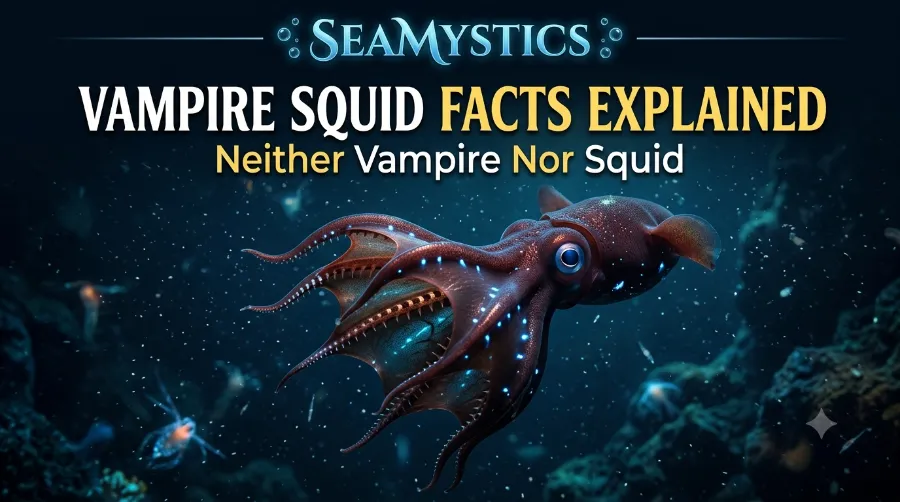

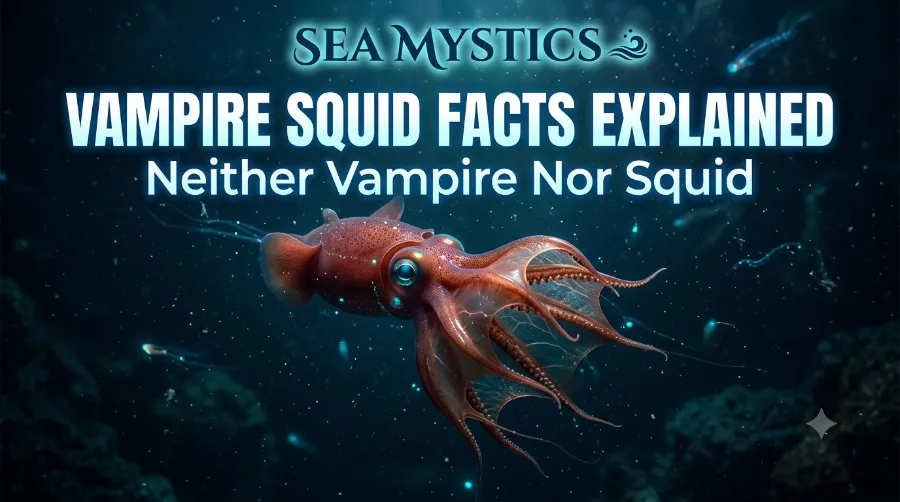
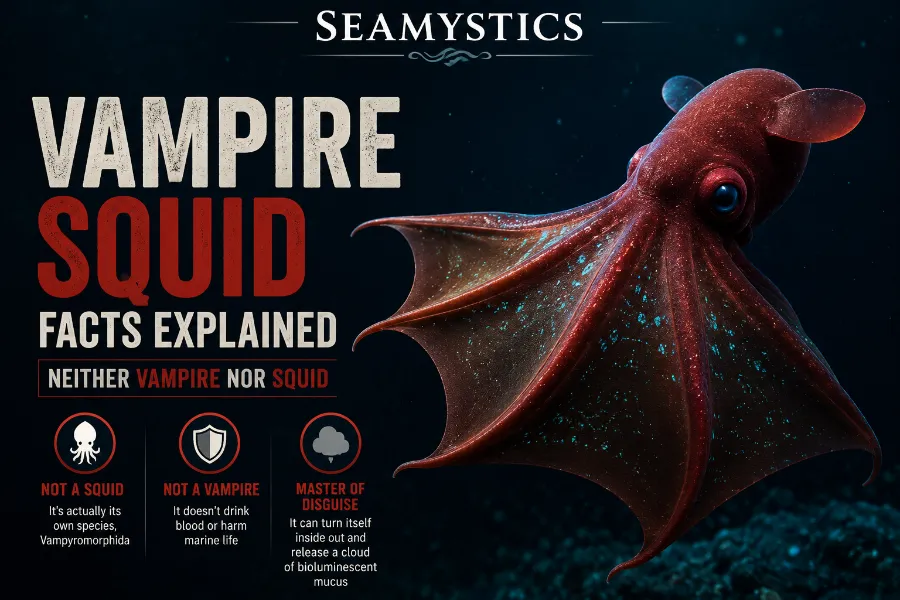
Picture a creature with blood red skin, glowing blue eyes, and a cloak that wraps around its body like a vampire’s cape. Now picture it floating quietly in total darkness, a mile below the waves, eating nothing but drifting bits of ocean waste. That is the real story behind these vampire squid facts explained in plain, simple language for anyone curious about the strangest corner of ocean life. Despite the spooky name, this small cephalopod has never bitten anything in its life. It does not hunt, it does not attack, and it is not even technically a squid.Before we go deeper, here is a quick snapshot of what makes this animal so unusual.
To get a better understanding of how colorful sea slug species facts breaks down exactly what to expect.
To get a better understanding of how jellyfish facts ocean life breaks down exactly what to expect.
Key Takeaways
| Fact | Detail |
|---|---|
| Scientific name | Vampyroteuthis infernalis |
| Meaning of name | Vampire squid from hell |
| First named | 1903, by zoologist Carl Chun |
| Typical depth | 600 to 1,200 meters |
| Maximum recorded depth | Up to 3,000 meters |
| Body size | Up to 30 cm, about the size of a football |
| Diet | Marine snow, no live prey ever |
| Defense trick | Bioluminescent mucus cloud, glows up to 10 minutes |
| Blood type | Blue, copper based hemocyanin |
| Conservation status | Not evaluated, currently stable |
Meet This Ancient Piece of Ocean Life
Long before dinosaurs walked the earth, ancestors of this animal were already gliding through deep water. Scientists place this species in its own order, separate from true squids and true octopuses. Because of that lonely branch on the family tree, this creature is often called a living fossil.
To get a better understanding of how seahorse facts ocean life breaks down exactly what to expect.
It shares a few traits with squids and a few traits with octopuses, yet it truly belongs to neither group. Researchers have confirmed it split off from octopus relatives soon after octopuses and squids parted evolutionary ways, with V. infernalis placed together with the Octopoda in the clade Octopodiformes after diverging from octopods soon after the separation of Octopodiformes and Decapodiformes in the early Triassic. That means this odd little animal has been swimming around, largely unchanged, for well over 200 million years. Nature
Where Does the Name Come From?
The name was never meant to be literal. In 1903, zoologist Carl Chun studied a preserved specimen and gave it the scientific title Vampyroteuthis infernalis, which translates to vampire squid from hell, reflecting its dark habitat and cloak like webbing. The dark red color, the webbing between the arms, and the glowing red eyes reminded him of gothic vampire imagery, so the name stuck. A-Z Animals
However, real vampire folklore involves blood drinking, and this creature does the exact opposite. As experts at the Aquarium of the Pacific point out, the dark blood red coloration and eye color gave rise to the false idea that it sucked blood out of victims, though in reality the squid simply floats peacefully and waits for food to drift toward it. So the next time someone brings up vampire squid facts explained at a dinner party, you can correct the record politely. aquariumofpacific
Vampire Squid Facts Explained in Simple Terms
Here are the basics stripped down to plain language:
- It is not a true squid, but a distant cousin of octopuses.
- It does not bite, sting, or attack humans or fish.
- It survives on dead material sinking from above, not on hunting.
- It glows in the dark using its own light producing organs.
- It has the largest eyes relative to body size of any known animal.
Because these traits sound almost too strange to be real, many people search for reliable, simple explanations. That curiosity is exactly why this species keeps showing up on lists of the weirdest animals in the ocean.
Where Do Vampire Squids Live?
This species avoids sunlight almost entirely. Vampire squids occupy a stretch of ocean called the mesopelagic and bathypelagic zone, generally between 300 and 3,000 meters down. Most individuals cluster between 600 and 1,200 meters, where water temperature sits at a chilly 2 to 6 degrees Celsius. aquariumofpacific
This zone is nicknamed the oxygen minimum layer, and for good reason. Oxygen levels there can drop below 5 percent saturation, a level that would suffocate most sea creatures within minutes, since most cephalopods cannot function below 50 percent oxygen saturation. Researchers at the Monterey Bay Aquarium Research Institute recorded vampire squids thriving at an average depth of 690 meters, where oxygen levels measured just 0.22 milliliters per liter, among the lowest tolerated by any known animal with a backbone or without one. aquariumofpacific
How It Breathes Where Nothing Else Can
Survival in such a hostile zone takes special biology. The blood of this creature carries oxygen using hemocyanin, a copper based molecule, instead of the iron based hemoglobin found in human blood. As a result, its blood actually runs blue rather than red.
On top of that, gill surface area is unusually large for its body size, and its metabolism runs at a slow, energy saving pace. Together, these adaptations let it stay active in water that would leave most predators gasping.
| Habitat Feature | Measurement |
|---|---|
| Typical depth range | 600 to 1,200 meters |
| Maximum depth on record | Up to 3,300 meters |
| Water temperature | 2 to 6 degrees Celsius |
| Oxygen saturation | Often below 5 percent |
| Global range | Found in every tropical and temperate ocean |
| Latitude limit | Roughly 40 degrees north to 40 degrees south |
Physical Traits That Make It Stand Out
This animal looks like nothing else in the sea, and its body is built entirely around surviving in darkness with almost no food. It measures up to 30 centimeters long, roughly the size and shape of a football, and its skin ranges from jet black to a soft reddish brown depending on lighting.
A web of skin connects all eight of its arms, giving it a cloak like appearance when the arms are spread. When threatened, it pulls this webbing up over its body in what scientists call the pineapple posture, hiding its head and turning itself into a spiky, unappealing ball.
Two long, thin filaments extend from pockets between its arms, and these can stretch out to twice the length of its whole body. Unlike normal squid tentacles, these filaments are used for sensing food rather than grabbing prey.
Several traits deserve a closer look:
- Eyes: Its eyes are, proportionate to body size, the largest in the entire animal kingdom, giving it excellent low light vision.
- No ink sac: Unlike true squids, it cannot squirt ink, so it relies on glowing mucus and its cloak posture instead.
- Photophores: Light producing organs cover its skin and the tips of its arms, letting it flash, glow, or fully switch off its light at will.
- Fins that change over time: Juveniles grow a second pair of fins as they mature, then reabsorb the original pair once the new set takes over, a transformation seen in no other cephalopod.
This last trait, the fin swap, genuinely puzzled early researchers, since nothing else in the animal kingdom does exactly this during growth.
What Do Vampire Squids Eat?
Every other known cephalopod hunts. Squid chase fish, octopuses ambush crabs, and cuttlefish stalk shrimp. This species breaks that pattern entirely, since it is the only cephalopod that refuses live prey and instead survives on marine snow, a slow drizzle of dead plankton, waste, and organic debris falling from the sunlit surface far above, since instead of hunting down prey, Vampyroteuthis feeds on marine snow, a flurry of dead plankton, waste, mucus, and other organic material sinking from the waters above. MBARI
The feeding process itself follows a clear pattern:
- One long filament extends outward, covered in sticky cirri, searching the water for drifting particles.
- Once particles stick to the filament, it retracts slowly toward the arms.
- Mucus produced by the suckers binds the debris into a small, sticky ball.
- Soft finger like structures pass the food ball toward the mouth for eating.
Because this feeding style takes almost no energy, it fits perfectly with a slow metabolism built for low oxygen survival. Marine biologists studying beak samples from over 100 specimens found something surprising too. Unlike most cephalopods, which eat higher on the food chain as they age, this species does the opposite, since juveniles hunt tiny zooplankton while larger adults shift toward filtering particulate matter, showing a rare ontogenetic decrease in trophic level rather than the usual increase. That quiet, patient feeding style also helps recycle carbon and nutrients back through the deep ocean food web, a role that keeps entire ocean life systems running smoothly.
Reproduction and the Life Cycle
Breeding habits here look nothing like typical squid courtship. There is no defined mating season, and eggs appear year round rather than during a single spawning event. Males transfer a small sperm packet directly into the female’s body, where it can be stored until she is ready to use it.
Fertilized eggs measure a tiny 3.3 millimeters across and drift freely rather than being guarded by either parent. Hatchlings emerge at roughly 8 millimeters long, already resembling miniature adults, though they still lack full webbing and rely on a yolk sac for early nutrition.
Because deep water offers so little food, growth happens slowly, and females may release several small batches of eggs across their lifetime rather than one large clutch. Scientists describe this pattern as iteroparous reproduction, a strategy well suited to an unpredictable food supply far below the surface.
Vampire Squid vs Other Ocean Life
It helps to compare this creature against other unusual sea animals to see how unique its lifestyle really is. For a deeper look at other deep sea oddities, our weird ocean creatures hub covers several more strange species worth exploring.
| Creature | Diet | Depth | Notable Trait |
|---|---|---|---|
| Vampire squid | Marine snow, no live prey | 600 to 1,200 m | Only cephalopod that never hunts |
| Giant squid | Fish, other squid | 300 to 1,000 m | Largest eyes among true squids |
| Anglerfish | Fish, ambush hunter | Up to 2,000 m | Uses glowing lure to attract prey |
| Octopus | Crabs, shellfish | Shallow to deep | Considered highly intelligent |
| Blobfish | Small invertebrates | 600 to 1,200 m | Gelatinous body adapted to pressure |
Unlike its cephalopod relatives such as the giant squid, this species never chases prey. And unlike octopuses, which are famous for problem solving skills, it survives through patience rather than intelligence based hunting. This comparison shows just how varied ocean life becomes once you travel below the reach of sunlight.
A New Discovery Shook Things Up
For over a century, scientists believed only one species existed within this group. That changed in 2024, when researchers described a second species, Vampyroteuthis pseudoinfernalis, found across wide areas of the deep Pacific. The discovery excited marine biologists worldwide, since it suggested this ancient lineage was more diverse than anyone had assumed.
However, follow up genetic research published in 2025 and 2026 reexamined the specimens and concluded that the newly described animal was actually the same species after all, not a separate one. So, as of now, Vampyroteuthis infernalis remains the sole confirmed member of its entire family. This back and forth is a good reminder that deep sea research keeps evolving, and even settled facts sometimes get revisited.
Conservation Status
Because this species lives so far from human activity, it faces few direct threats. The IUCN Red List has not formally evaluated it, largely because there is no commercial fishing interest and population data remains limited. Aquarium experts currently classify its status as safe for now.
Still, climate change may pose an indirect risk. Warming oceans can shrink oxygen minimum zones or shift their depth, and since this animal depends heavily on that exact environment, any major change could eventually affect where it can survive. Continued deep sea research, much of it led by institutions like MBARI, remains the best way to track these long term shifts.
Frequently Asked Questions
Is a vampire squid dangerous to humans?
No. It lives far too deep to ever encounter swimmers or divers, and it has no ability to bite or sting people.
Why is it called a vampire squid if it is not a squid?
Early researchers named it based on its dark, cloak like appearance rather than its actual biology, and later genetic study confirmed it belongs to its own separate group.
What color is vampire squid blood?
Its blood runs blue because it uses copper based hemocyanin instead of iron based hemoglobin to carry oxygen.
How long do vampire squids live?
Exact lifespan remains unclear due to the difficulty of long term deep sea tracking, though researchers estimate several years based on growth patterns and slow metabolism.
Can vampire squids be kept in aquariums?
Very rarely. Their need for extreme pressure, cold temperature, and low oxygen makes them almost impossible to display, so most public knowledge comes from remotely operated vehicle footage instead.
Conclusion
Once you strip away the spooky name, what remains is one of the calmest, most patient animals in the entire ocean. It does not hunt, it does not attack, and it thrives quietly in a zone that would overwhelm most other creatures within minutes. These vampire squid facts explained here show a species built entirely around survival through efficiency rather than aggression, a strategy that has clearly worked for over 200 million years. As deep sea exploration continues to expand, this ancient little cephalopod will likely keep surprising scientists, proving once again that some of the strangest stories in ocean life are hiding just beyond the reach of sunlight.
References
- Sea Coast Science Center. Vampire Squid Species Profile (PDF). https://www.seacoastsciencecenter.org/wp-content/uploads/2023/01/Vampire-Squid.pdf
- Aquarium of the Pacific. Vampire Squid, Vampyroteuthis infernalis. https://www.aquariumofpacific.org/onlinelearningcenter/species/vampire_squid
- MBARI. Vampire Squid, Animals of the Deep. https://www.mbari.org/animal/vampire-squid/
- Golikov, A. V. et al. The first global deep-sea stable isotope assessment reveals the unique trophic ecology of Vampyroteuthis infernalis. Scientific Reports, Nature. https://www.nature.com/articles/s41598-019-55719-1