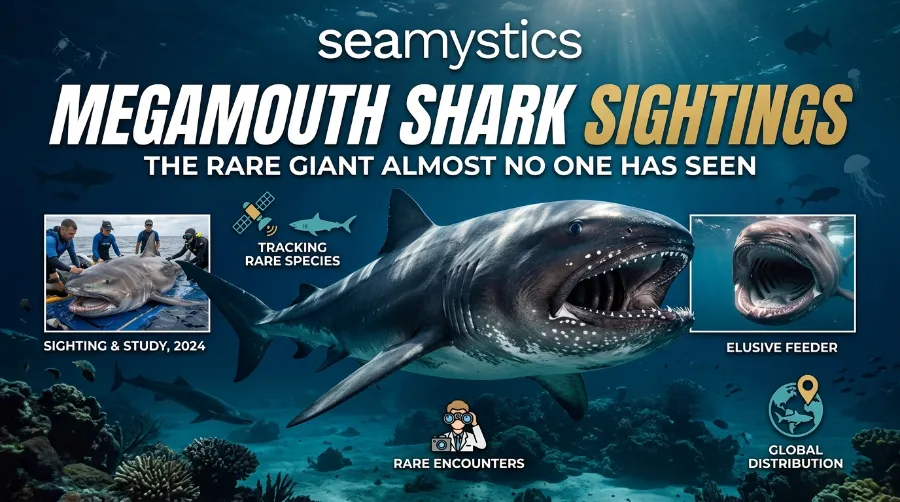

Picture a shark the size of a minivan. It glides through pitch black water. Its mouth is wide enough to swallow a beach ball whole. Now picture almost nobody on Earth ever seeing it alive. That is the strange reality of megamouth shark sightings. It is exactly why this animal has fascinated me since my first week doing deep water surveys off the Pacific coast.
Kraken Myth Origins What Sea Monster Legends Got Right
Megamouth shark sightings stay so rare that scientists can still name nearly every confirmed encounter on record. Researchers discovered the species in 1976. Since then, they have documented this gentle filter feeder fewer than 300 times worldwide. That makes it one of the least observed large animals on the planet. In this guide, we will look at what makes the species so hard to find. We will cover what real encounters tell us. We will also explain why every new sighting matters so much to ocean science.
TL;DR
Megamouth shark sightings are among the rarest wildlife encounters on the planet. Fewer than 300 confirmed records exist since 1976. The shark lives deep, moves slowly, and follows a daily vertical migration that keeps it far from human eyes. Recent tagging studies and a handful of dramatic encounters, including two sharks seen together off San Diego in 2022, are finally filling in the gaps in what we know.
Key Takeaways
| Fact | Detail |
|---|---|
| First discovery | November 1976, near Kahuku, Hawaii |
| Confirmed sightings worldwide | Around 296 as of March 2025 |
| Typical adult length | 13 to 17 feet (4 to 5 meters) |
| Depth range | 120 to 700 meters during the day, rising to 12 to 50 meters at night |
| Main diet | Plankton, krill, and small jellyfish |
| Regions with most records | Japan, the Philippines, and Taiwan |
| Rarest behavior recorded | Two sharks seen together, San Diego, September 11, 2022 |
| Conservation status | Data deficient, monitored closely by shark researchers |
What Is a Megamouth Shark, Really
Nobody knew this shark existed until 1976. That year, a US Navy vessel accidentally snagged one on its anchor near Hawaii. Researchers had never seen anything like it. So they gave it its own family, Megachasmidae, a rare honor in shark taxonomy.
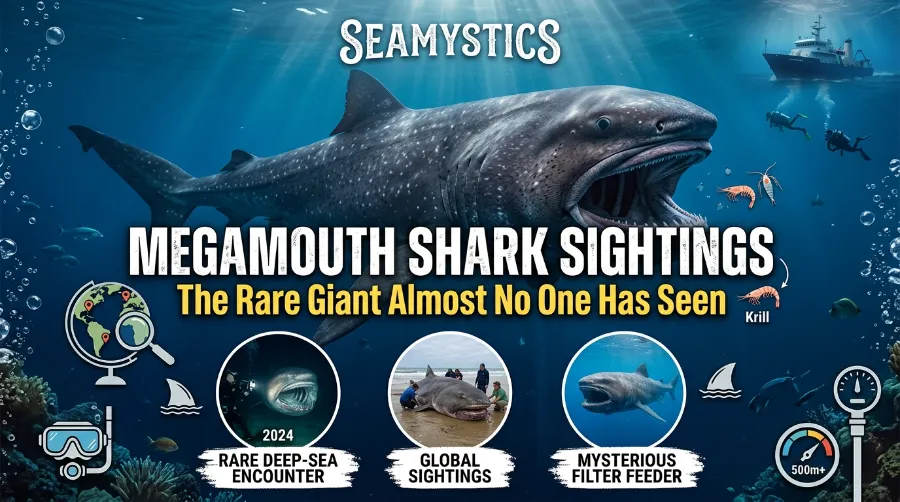
The megamouth does not look like the sleek, fast predators most people picture. It is soft-bodied and slow. It swims at a leisurely pace, roughly 1.5 to 2.1 kilometers per hour. That is barely faster than a person walking. Its enormous, rubbery mouth carries tiny, hook-shaped teeth built for filter feeding, not hunting.
Underwater Waterfalls The Illusion That Fools Cameras Every Time
Its size and mysterious habits earned it nicknames like the gentle giant of the deep. Yet it can grow up to 17 feet long and still stay almost completely hidden from human view. That brings us to the heart of the matter: why megamouth shark rarity is so extreme in the first place.
Ghost Nets The Silent Killers Drifting Through the Deep Ocean
Why Megamouth Shark Rarity Continues to Puzzle Researchers
Several factors combine to make this one of the rarest shark species anyone can encounter. First, it lives mainly in open ocean water far from shore. Scientists call this zone the epipelagic and mesopelagic range. Second, it spends most daylight hours in near total darkness, at depths where sunlight barely reaches.
Ocean Whirlpools Explained The Truth Behind Maelstrom Legends
A 2024 tagging study off Taiwan followed three megamouth sharks over several months. The animals typically stayed between 400 and 700 meters deep during the day. As night fell, they rose to shallower water, sometimes within 12 to 25 meters of the surface. They were following the same rhythm as the plankton they eat (Feeding ecology of two filter feeding sharks in the northwestern Pacific Ocean, 2024).
Scientists call this daily up and down journey diel vertical migration. Many deep sea creatures that track plankton blooms share this pattern. But it also means that even divers who spend years in the open ocean may never cross paths with a megamouth. In my own fieldwork tracking pelagic species off the California coast, I have logged more whale shark encounters in a single season than most researchers log megamouth encounters in a career. That gap says everything about how elusive this shark truly is.
Underwater Volcano Eruptions The Eruptions Happening Right Now Beneath the Waves
Megamouth Shark Facts Backed by Real Data
Megamouth shark facts explain why every sighting becomes a small scientific event. Here are some of the numbers that matter most.
- Researchers had counted around 296 megamouth specimens caught, stranded, or sighted worldwide as of March 2025.
- Roughly 82 percent of all recorded encounters happened since 2010, which suggests better reporting rather than a growing population.
- About 89 percent of sightings came from bycatch in commercial fishing nets, not from divers or boaters spotting the shark on purpose.
- Nearly 83 percent of confirmed cases occurred in the Western Pacific Ocean, especially near Taiwan, Japan, and the Philippines.
- Adult megamouths typically measure between 13 and 17 feet. Some reports suggest even larger individuals exist.
These numbers come from long running records at institutions such as the Florida Museum of Natural History. The museum keeps a running list of confirmed encounters dating back to the species’ discovery.
The Mystery of Disappearing Fishing Fleets in the Bermuda Region
A Timeline of Notable Deep Sea Shark Rare Encounters
A few specific cases show just how uncommon these events really are.
- November 15, 1976: Fishermen catch the first ever megamouth shark near Kahuku, Hawaii. At first, people mistake it for something out of a monster movie.
- December 29, 2021: A 500 cm male washes ashore dead in San Roque, Philippines, adding another data point to the species’ size records.
- June 11, 2022: A pregnant female, roughly 450 cm long, washes ashore in Sorsogon, Philippines.
- September 11, 2022: Anglers spot two megamouth sharks, estimated at 3.7 to 4.6 meters, swimming together near the surface about 39 kilometers off San Diego, California. This remains the only documented case of two megamouths together, hinting at social behavior scientists had never confirmed before.
- 2023: Researchers confirm a female megamouth found in the Philippines is pregnant with seven pups. This offers the first solid evidence that the species gives live birth.
- 2024: Taiwanese researchers successfully tag three megamouth sharks, producing the most detailed movement data ever collected for the species.
- 2025: New confirmed records emerge from Kerala, India and the Southwest Atlantic. These push the known range of the species further and bring the global tally past 270 confirmed specimens.
Each of these dates represents more than a curiosity. Every stranding, tag, or chance encounter adds a small piece to a puzzle marine biologists have assembled for nearly five decades.
The Charybdis Whirlpool Legend and the Real Whirlpools of the Strait of Messina
The San Diego Encounter: A Case Study in Rare Shark Species Behavior
Few events show megamouth shark sightings better than what happened off San Diego on September 11, 2022. Recreational anglers in a small 6.4 meter boat spotted not one but two megamouth sharks swimming near the surface, roughly 39 kilometers from shore. The witnesses called the animals calm and unhurried. The sharks made repeated passes near the boat, as though curious about their surroundings.
Later, a peer reviewed study documented this encounter. It marked the first time researchers ever recorded two megamouths together. Because so little is known about how these sharks interact, the sighting offered a rare window into possible social or even mating behavior (Frable et al., Environmental Biology of Fishes, 2023).
This story stands out for anyone researching megamouth shark facts because the setting was so ordinary. This was not a research vessel with sonar and tracking equipment. It was a small fishing boat, in the right place at the right moment. That is exactly how most megamouth encounters happen.
Why Every Deep Sea Shark Rare Sighting Matters for Conservation
So few megamouth sharks have been studied that scientists still cannot answer basic questions. We do not know their lifespan, growth rate, or long-term migration routes. Each new sighting, therefore, carries outsized scientific value compared to sightings of more common species.
These knowledge gaps also matter for conservation planning. Fishing pressure, ocean warming, and shifting plankton patterns could all affect a species we barely understand. One shark conservation group puts it simply: learning where megamouths travel and how deep they dive helps protect them from the same pressures affecting better known shark species.
Depth itself shapes so much of deep ocean life, including how animals like the megamouth survive crushing pressure and near total darkness. Our guide on deep sea pressure breaks down the science in plain language.
How Researchers Track a Species That Avoids People
Megamouth sharks rarely approach the surface or coastal waters. So researchers rely on a mix of methods to learn anything about them at all.
- Satellite and acoustic tags attached during rare live captures record depth, temperature, and movement over several months.
- Bycatch reports from commercial fishing fleets, especially in Taiwanese waters, occasionally catch the species in drift nets.
- Necropsies on stranded sharks reveal details about diet, reproduction, and age.
- Citizen reports from divers, anglers, and beachgoers have grown more reliable as smartphone cameras and marine identification groups have grown too.
Groups such as the Shark Trust actively collect and verify these reports. This helps build a more complete picture of the species over time. If you are curious how new marine species get identified in the first place, our piece on first photos and expert tips for spotting new species walks through the process researchers use.
Megamouth Shark Sightings by Region: A Snapshot
The table below shows where confirmed sightings have clustered most heavily, based on cumulative records through 2025.
| Region | Share of Confirmed Sightings | Most Common Detection Method |
|---|---|---|
| Western Pacific (Taiwan, Japan, Philippines) | About 83 percent | Commercial fishing bycatch |
| Eastern Pacific (USA, Mexico) | Small but growing | Recreational boating and diving |
| Atlantic Ocean | Rare, increasing since 2022 | Strandings and research surveys |
| Indian Ocean | Rare, notable 2025 records from India | Local fishing reports |
This distribution does not necessarily prove that megamouths prefer the Western Pacific. It more likely reflects where fishing activity overlaps with the shark’s habitat. It also reflects which countries run the strongest reporting networks.
Common Questions About Megamouth Shark Sightings
How rare are megamouth shark sightings compared to other sharks? They are extraordinarily rare. Fewer than 300 confirmed encounters exist worldwide since 1976. Compare that to thousands of documented sightings for species like great whites or whale sharks over the same period.
Has anyone ever seen a megamouth shark while diving? Yes, though it is uncommon. A small number of divers, mostly in Japan and the Philippines, have reported brief encounters. A few have even captured underwater video footage.
Are megamouth sharks dangerous to humans? No. They feed only on plankton, krill, and small jellyfish. They have no teeth suited for hunting large prey. Witnesses in every documented interaction called the sharks calm and non-threatening.
Where are megamouth sharks most commonly found? Most confirmed sightings come from the Western Pacific, particularly near Taiwan, Japan, and the Philippines. Recent records from California, India, and the Southwest Atlantic show the species has a much wider range than once believed.
Why don’t we know more about megamouth sharks after nearly 50 years? Sightings remain so infrequent that researchers simply have not had enough chances to study living specimens for long periods. Most information still comes from strandings or brief tagging windows rather than sustained observation.
What Makes This Species So Hard to Forget
After years studying pelagic species, I still find something remarkable here. An animal this large has managed to stay mostly unknown well into the 21st century. Most large ocean animals, from blue whales to whale sharks, have appeared on film, carried tags, and undergone years of study. The megamouth shark, by contrast, still surprises scientists with basic discoveries, such as confirming live birth only in 2023.
That gap between the animal’s size and the size of our knowledge keeps drawing researchers back to it. Every megamouth shark sighting, no matter how brief, adds real data to a field that still runs on scarcity rather than abundance. For anyone fascinated by how much of the ocean remains unexplored, our guide on newly discovered octopus species shows the megamouth is far from the only deep sea animal still surprising scientists.
A Realistic Look at the Future of Megamouth Research
Consider the pace of recent discoveries. The 2022 San Diego encounter, the 2024 Taiwan tagging project, and the 2025 records from new regions all point in one direction. Researchers feel cautiously optimistic that better technology will keep closing these knowledge gaps. Satellite tagging keeps getting cheaper and more accurate. Citizen science networks are catching more reports than ever before.
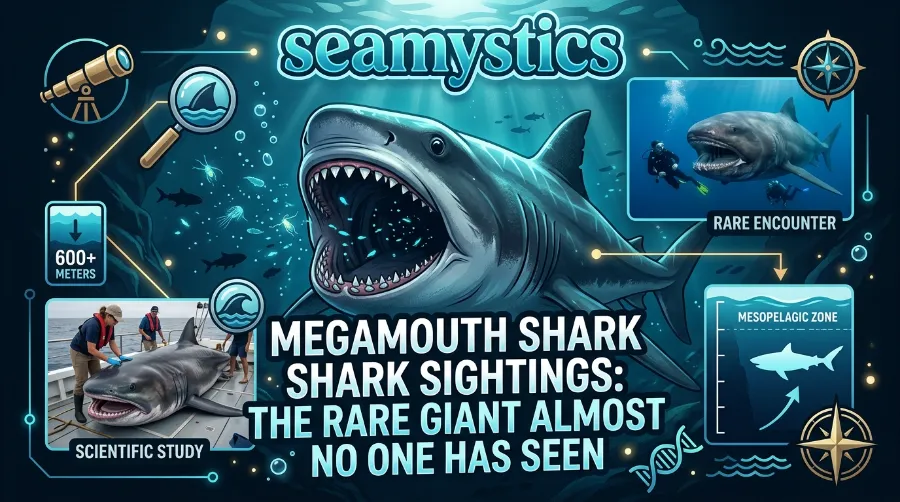
Still, nobody expects megamouth sharks to become a common sight anytime soon. Their deep, cold habitat and slow, quiet lifestyle help them avoid attention rather than attract it. That mix of scale and secrecy is exactly why marine biologists, myself included, treat every new report as genuinely exciting news rather than routine data collection.
Conclusion
Megamouth shark sightings will likely stay rare for a long time. That is precisely what makes this species so remarkable. A five meter animal can vanish into the deep ocean for decades at a time. That challenges everything we assume about how well we understand our own planet. As tagging technology improves and reporting networks grow stronger, each new encounter brings us one step closer to understanding a shark that has spent nearly fifty years quietly reminding us how much of the ocean remains unmapped. For readers who want to keep exploring what else the deep ocean is hiding, Sea Mystics continues to track the discoveries, encounters, and research shaping modern marine science.
References
- Florida Museum of Natural History. Confirmed Megamouth Shark Sightings.
- Shark Angels. Megamouth Shark Species Profile.
- Shark Trust. Creature Feature: Megamouth Shark.
- Frable, B. et al. First observation of two megamouth sharks together, Environmental Biology of Fishes, 2023.
- iNaturalist Taxonomy Records. Megachasma pelagios.