
I still remember the first time a colleague handed me a jar with a sea spider inside it. He asked me to guess its size before I looked. I guessed wrong, badly. That is the thing about a new sea spider: it almost never behaves the way the textbooks say it should. The newest ones from the Ross Sea and the methane seeps off the US Pacific coast are proving that all over again. Researchers have spent the last few years describing pycnogonid species that grow far past the size anyone expected for their family. The reasons behind that growth are reshaping how marine biologists think about cold water, oxygen, and survival at the bottom of the ocean.
Key Takeaways
| Finding | Detail |
|---|---|
| New Antarctic species | Austropallene halanychi, described in 2023 from the Ross Sea at roughly 1,850 feet deep |
| Standout feature | Oversized, boxing glove shaped claws, unusually large for its genus |
| New Pacific species | Three unnamed Sericosura sea spiders found at methane seeps off California, announced in 2025 |
| Leading size theory | The oxygen-temperature hypothesis: cold water holds more oxygen, allowing larger bodies |
| Known sea spider count | Roughly 1,300 to 1,500 described species worldwide, and the list keeps growing |
| Depth range studied | From shallow tide pools to more than 1,800 feet below the surface |
TL;DR: A newly described sea spider species from Antarctica and a trio of unnamed Pacific relatives are both bigger and stranger than researchers expected. Cold water chemistry appears to be the reason. Scientists now think high oxygen levels in freezing seas let these creatures grow past the limits seen in warmer waters. Researchers call this pattern polar gigantism.
What Counts as a New Sea Spider Discovery
Sea spiders are not spiders at all. They belong to their own class, Pycnogonida, a group of marine arthropods that has crawled along seafloors for roughly 400 million years. Scientists typically confirm a new sea spider through a mix of physical measurement, DNA sequencing, and comparison against every known relative in the same genus. A discovery is never just a lucky net haul. It takes months, sometimes years, of lab work before a specimen earns a scientific name.
According to the Monterey Bay Aquarium, these animals feed through a long sucking tube called a proboscis. Oddly enough, they breathe and digest food through their legs rather than a centralized gut. That single fact explains a lot about why size matters so much to a pycnogonid new species. More leg surface generally means more room to absorb oxygen. That becomes very important once you understand where the biggest ones tend to turn up.
New Bioluminescent Species Found How Scientists Confirm Glowing Animals
For readers who want the full backstory on how researchers verify an animal is genuinely new to science, our pillar guide on newly described abyssal species walks through the naming process from specimen to publication in more depth than we can cover here.
Meet the Giants: Sizes That Surprised Scientists
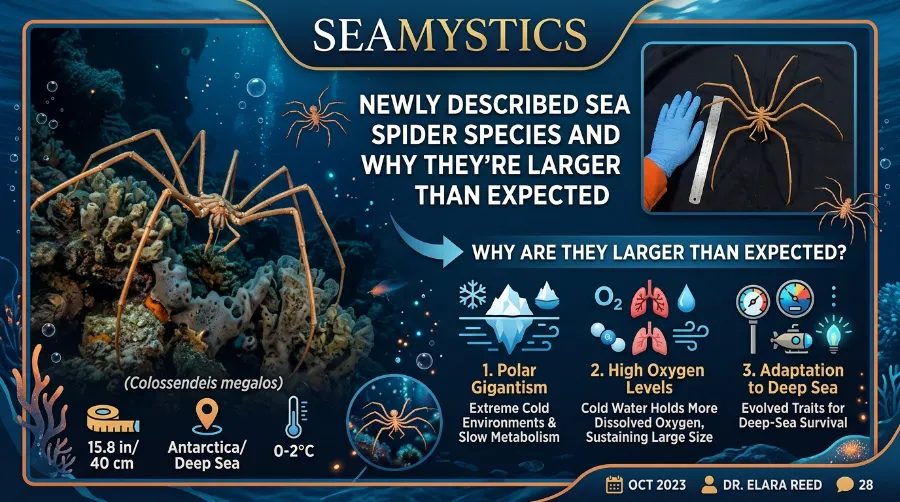
Most sea spiders are small enough to sit on a fingertip. Some Antarctic and deep sea species, however, stretch their leg span past 10 inches, roughly the size of a dinner plate. That gap in scale is exactly what makes a giant sea spider so useful to biologists studying how cold, oxygen rich water shapes marine life.
A few numbers help put the size difference in perspective:
- Average shallow water sea spider: leg span under 1 inch
- Austropallene halanychi, the 2023 Ross Sea species: notably larger than close relatives in its genus, with oversized chelifore claws
- Colossendeis megalonyx, a well known Antarctic giant: leg span up to roughly 25 centimeters, about 10 inches
- Newly found Sericosura methane seep spiders: much smaller, around 0.4 inch, showing that gigantism is not universal even within the same order
| Species or Group | Approx. Size | Habitat | Year Described or Noted |
|---|---|---|---|
| Austropallene halanychi | Larger than genus average | Ross Sea, Antarctica, ~1,850 ft | 2023 |
| Colossendeis megalonyx | Up to ~10 in leg span | Antarctic and subantarctic seas | Long studied, cited widely in size research |
| Unnamed Sericosura trio | ~0.4 in body length | Methane seeps, US West Coast | 2025 |
| Typical temperate sea spider | Under 1 in | Coastal tide pools worldwide | Ongoing |
This is where the phrase Antarctic sea spider earns its reputation. Cold Southern Ocean water is genuinely different from the water most marine life evolved in. That difference shows up directly in body size.
The Ross Sea Discovery: A Closer Look at Austropallene halanychi
In 2013, researchers from Central Michigan University collected a sample during an Antarctic expedition aboard the research vessel Nathaniel B. Palmer. It sat unresolved for years. Then biology professor Andrew Mahon and graduate student Jessica Zehnpfennig ran a full morphological and mitochondrial DNA analysis. In November 2023, they formally described the animal in the journal ZooKeys as Austropallene halanychi, a new species in the family Callipallenidae.
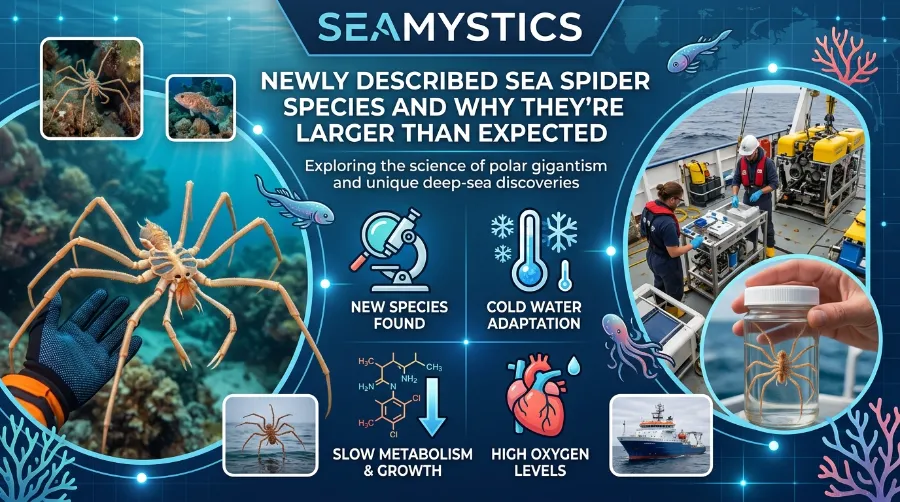
Newly Described Sea Spider Species and Why They’re Larger Than Expected
What sets this pycnogonid new species apart is not just its size. It has claws shaped almost like boxing gloves, likely used to grip soft bodied prey. Subtle differences in its chelifore structure also separate it from its closest relative, Austropallene cornigera. The team returned to Antarctica in 2023 to collect more samples on the less studied east side of the continent, and analysis of additional specimens continues.
New Anglerfish Species Discovered in the Pacific Abyss
If you are curious about how naming disputes and taxonomy debates play out for other ocean animals, our article on how scientists name new octopus species covers a similar process from a different corner of the invertebrate world. It gives a good sense of exactly what to expect when a new name gets proposed. (Internal link — replace # with your actual post URL.)
Methane Powered Sea Spiders Off the US Coast
Antarctica is not the only place turning up surprises. In June 2025, a research team led by Bianca Dal Bó of Occidental College reported, in a study published in PNAS, three previously unknown Sericosura sea spider species living at methane seeps off the coast of California. That group includes a site near Del Mar that researchers first discovered in 2015. These spiders are tiny compared to their Antarctic cousins, but their biology is arguably just as strange.
Museum Specimens Reclassified Old Samples That Turned Out to Be New Species
Rather than hunting in the usual pycnogonid way, these animals appear to farm bacteria directly on their exoskeletons. The bacteria convert methane and methanol seeping from the seafloor into usable energy, and the sea spiders seem to feed on that bacterial layer. Scientists suspect this partnership even passes down to hatchlings, giving the next generation a built in food source from birth.
This kind of expedition based discovery is becoming more common as remotely operated vehicles reach depths that were previously too dangerous or expensive to survey routinely. ScienceAlert’s coverage of the discovery has more detail on the seep sites and collection methods. If you want a broader picture of how modern research vessels are finding these animals, our recap of a recent deep sea expedition breaks down the equipment and methods involved. (Internal link — replace # with your actual post URL.)
Why Are These New Sea Spider Species So Large?
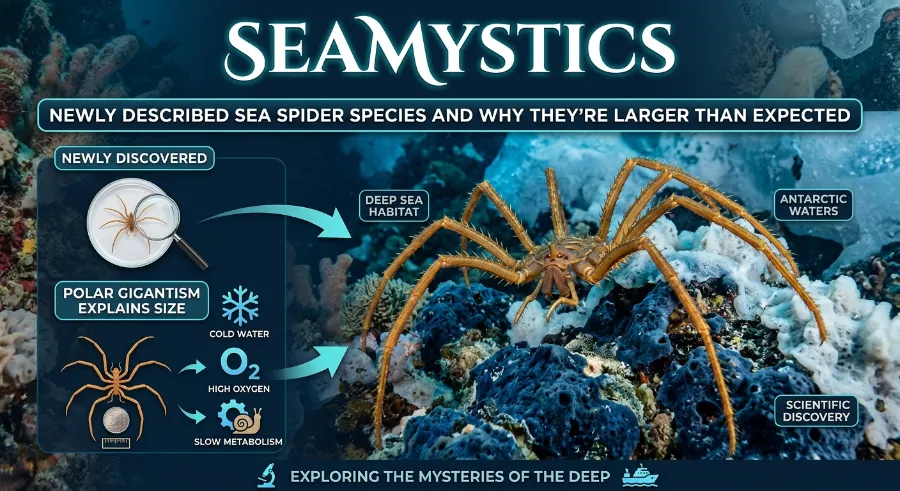
This is the question that keeps coming up whenever a giant sea spider makes headlines. Honestly, it is the one I get asked most often at conferences. The leading explanation is called the oxygen-temperature hypothesis, first proposed by researchers Chapelle and Peck in 1999. Cold water holds more dissolved oxygen than warm water. Combine that with the naturally slower metabolism of a cold blooded animal in freezing temperatures, and you get a body that can afford to grow larger without running out of breathable oxygen.
Pycnogonids make an especially good test case because they lack lungs or gills in the way most animals have them. Instead, oxygen diffuses directly through pits and channels across their exoskeleton. The Discover Wildlife guide to sea spiders notes that this network covers a substantial portion of the cuticle’s surface. As body size increases, that cuticle actually becomes more porous in some giant species. This appears to help compensate for the added distance oxygen has to travel to reach internal tissue.
New Ray Species Identified Off Unexpected Coastlines
That said, the science is not fully settled. Some follow up studies, including thermal performance experiments on Colossendeis and Ammothea species, found real limits to how well the oxygen hypothesis explains size on its own. A few researchers argue that self righting ability, predation pressure, and food availability likely play supporting roles too. In short, cold water gigantism is probably the result of several factors working together rather than one single rule.
Undersea Volcano Discoveries New Species Found Near Hydrothermal Vents
There is a genuine concern buried in this research as well. If warming ocean temperatures reduce dissolved oxygen in polar seas, these oversized specialists could be among the first casualties. Their bodies are tuned to a narrow set of conditions that took millions of years to settle into.
How Researchers Confirm a Sea Spider Is Genuinely New
Describing a pycnogonid new species is a slower process than most people assume. A team typically works through these steps before a name is ever published:
- Collect the specimen during a dedicated expedition or survey, often at depths beyond normal diving range
- Preserve the sample properly, since soft tissue degrades fast in warmer lab conditions
- Measure and photograph every physical feature, from leg segments to claw shape
- Sequence mitochondrial DNA and compare it against known relatives in public genetic databases
- Build a phylogenetic tree to confirm the specimen sits apart from its closest known cousins
- Submit findings to a peer reviewed journal, where independent experts check the work before publication
Only after all six steps line up does a species get an official scientific name. That is why a single new sea spider discovery can represent years of unpublicized lab work behind one short news headline.
What This Means for Ocean Conservation
Every new sea spider description adds another data point to a much bigger picture. Scientists still do not have a complete map of life on the ocean floor. A 2023 University of Wisconsin-Madison feature on sea spider evolution noted that pycnogonids offer researchers a genuinely useful window into how arthropod body plans evolved, precisely because they look so unlike their land based relatives.
That matters for conservation planning too. Methane seep habitats, like the one hosting the newly found Sericosura trio, still lack strong protection in most ocean policy frameworks. Part of the problem is that so few people know they exist or what lives there. Antarctic waters face a separate but related pressure, since warming and acidification threaten the very oxygen levels that allow polar gigantism to happen in the first place.
For readers interested in how other unusual invertebrates are turning up in similarly overlooked habitats, our coverage of a newly identified nudibranch species and a recently described anglerfish species show that sea spiders are far from the only group getting a scientific update this decade. (Internal links — replace # with your actual post URLs.)
Frequently Asked Questions
Are sea spiders actually spiders? No. Sea spiders belong to the class Pycnogonida, a separate branch of marine arthropods. They share a distant ancestor with true spiders but evolved along a completely different path.
How big can a giant sea spider get? Some Antarctic species reach a leg span of roughly 10 inches, though most sea spiders worldwide stay under 1 inch. Size varies enormously depending on habitat and species.
Why do Antarctic sea spiders grow larger than tropical ones? The leading theory points to cold water holding more dissolved oxygen combined with a slower metabolism. Together, these factors allow larger body sizes without oxygen becoming a limiting factor.
Is climate change a threat to giant sea spiders? Yes, potentially. If ocean warming lowers dissolved oxygen in polar seas, species that depend on high oxygen levels to support large bodies may struggle to survive at their current size.
How many sea spider species exist? Estimates put the number between roughly 1,300 and 1,500 described species, and new ones are still being added as deep sea and polar research expands.
Conclusion
A new sea spider rarely makes global headlines, yet each one quietly reshapes what marine biologists thought they understood about survival at the extremes. Between the oversized claws of Austropallene halanychi in the Ross Sea and the bacteria farming Sericosura trio off California, 2023 through 2025 turned out to be a genuinely important stretch for pycnogonid research. The pattern connecting them, cold water, unusual oxygen chemistry, and body sizes that defy expectation, is a reminder that the seafloor still holds far more surprises than our maps admit. For anyone who finds that exciting rather than unsettling, there has never been a better time to follow deep sea research closely. The next giant sea spider discovery is probably already sitting in a lab sample somewhere, waiting to be named.
References
- Zehnpfennig, J.R. and Mahon, A.R. (2023). Austropallene halanychi sp. nov., a new species of sea spider (Pycnogonida, Callipallenidae) from the Ross Sea, Antarctica. ZooKeys, 1185, 163-180.
- Dal Bó, B. et al. (2025). Methane-powered sea spiders: Diverse, epibiotic methanotrophs serve as a source of nutrition for deep-sea methane seep Sericosura. PNAS, 122(26).
- ScienceAlert coverage of the 2025 methane seep Sericosura discovery, led by Bianca Dal Bó, Occidental College.
- Chapelle, G. and Peck, L.S. (1999). Polar gigantism dictated by oxygen availability. Journal of Experimental Biology, polar gigantism and oxygen-temperature hypothesis studies on Antarctic pycnogonids.
- Monterey Bay Aquarium, sea spider species profile.
- Discover Wildlife, guide to sea spiders.
- University of Wisconsin-Madison News, sea spider evolution research feature.