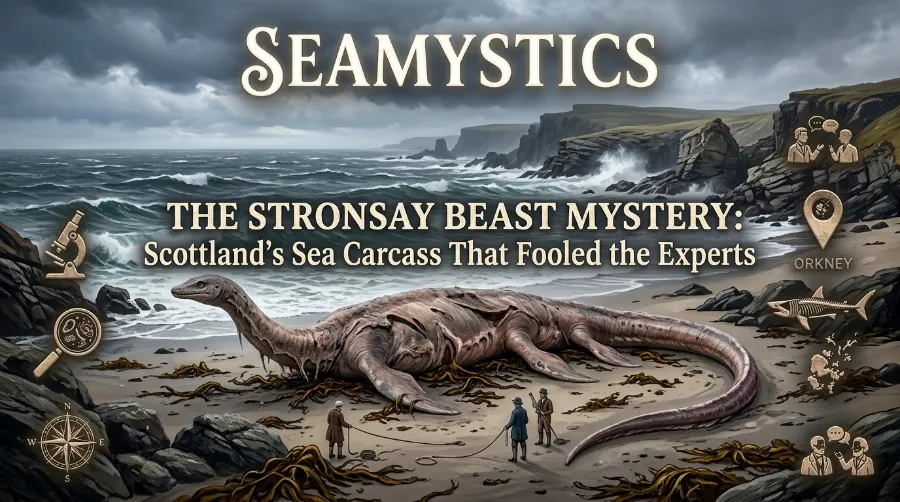

A storm hit the Orkney Islands in September 1808. When it cleared, islanders found something nobody on Stronsay had ever seen before. A carcass, more than fifty feet long, lay draped over the rocks at Rothiesholm Head. It had a long neck, a small head, and paddles where fins should be. The Stronsay Beast mystery began that morning, and people still argue about what actually washed ashore.
This is not just an old fishing tale. Scientific societies got involved. Samples traveled all the way to London, and two respected anatomists reached opposite conclusions. That disagreement still shapes how we talk about sea monsters today.
Key Takeaways
| Fact | Detail |
|---|---|
| Location | Rothiesholm Head, Stronsay, Orkney Islands, Scotland |
| Date discovered | 25 September 1808, after a storm |
| Reported length | 55 feet (16.8 m), with part of the tail missing |
| First scientific verdict | New species of sea serpent, named Halsydrus pontoppidani |
| Later verdict | Decomposed basking shark, per anatomist Sir Everard Home |
| Modern consensus | Almost certainly a basking shark, though its size remains debated |
| Why it matters | One of the earliest documented “globster” cases with physical evidence |
TL;DR: In 1808, a decomposing sea creature washed up on Stronsay in the Orkney Islands. Edinburgh naturalists initially called it a brand-new species of sea serpent. London anatomist Sir Everard Home later examined preserved vertebrae and argued it was a rotting basking shark, since basking sharks decay in a way that tricks the eye. Most researchers today back the shark explanation, though the reported size still bothers a few skeptics.
What Was the Stronsay Beast, Exactly?
The Stronsay Beast history begins with a fisherman named John Peace. He spotted the carcass first while working near the shore, and word spread fast across the small island. Curious residents made their way to Rothiesholm Head to see it for themselves. What they found was strange enough to spark a genuine scientific controversy.
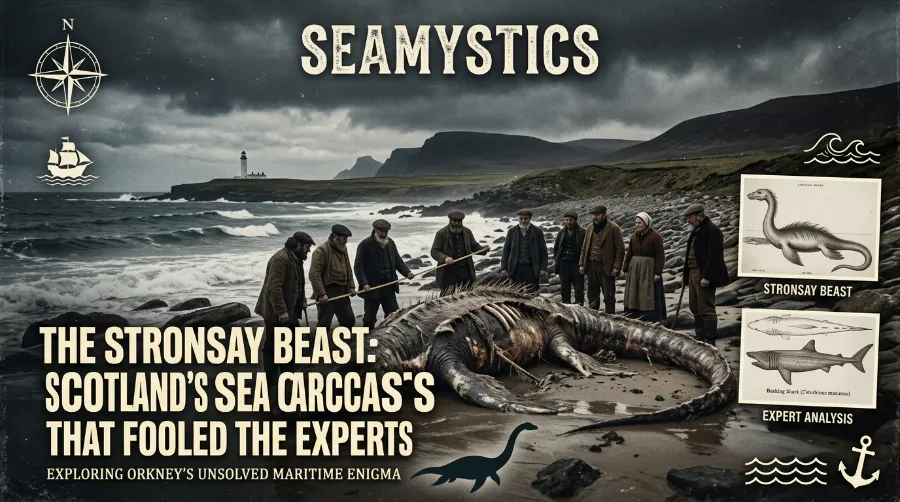
Witnesses measured the body at 55 feet long and 4 feet wide, with a circumference of roughly 10 feet. They described the skin as smooth when stroked from head to tail, and rough the other way, almost like a cat’s tongue. Three pairs of appendages extended from its sides. Onlookers called them “paws” or “wings.”
Trunko Carcass Mystery: The Bizarre Carcass That Baffled the World
The creature also had a mane. Coarse bristles ran down its back and along its fins, giving it a monstrous look in the candlelight sketches made at the time. None of this matched any creature the locals recognized. Naturally, rumors escalated quickly.
A Storm, a Beach, and an Unfamiliar Body
A carpenter and two farmers took the measurements. They were ordinary islanders, not trained scientists, and that detail matters. Their observations became the foundation for a debate that eventually reached the Wernerian Natural History Society in Edinburgh. The society could not match the remains to any known animal, so it declared the Stronsay Beast a new species entirely.
Scottish naturalist Patrick Neill gave the creature a scientific name: Halsydrus pontoppidani. He chose it to honor the Scandinavian bishop Erik Pontoppidan, who had written about sea serpents decades earlier. For a short while, Scotland believed it had physical proof that sea serpents were real, not just sailors’ stories passed around harbors.
Scotland Sea Monster Carcass: The Scientific Tug of War
Preservationists packed up samples of the Stronsay Beast, including vertebrae and pieces of skin, and shipped them south to London for further study. This is where the story gets genuinely interesting. Two respected men of science looked at the same evidence and walked away with opposite conclusions.
Edinburgh anatomist John Barclay believed the remains belonged to an undiscovered giant sea serpent, and he pushed that view hard in scientific circles. London anatomist Sir Everard Home disagreed almost immediately. After examining the vertebrae, Home argued that the body was nothing more exotic than a large, badly decomposed basking shark.
Home’s reasoning turned out to be scientifically sound, even though it disappointed people hoping for a real monster. Basking sharks decay in an unusual way, and that decay pattern can trick even careful observers.
Why the Stronsay Beast Basking Shark Theory Makes Sense
Basking sharks are enormous filter feeders, second in size only to the whale shark. Fishermen and researchers still spot them regularly in the cold waters around Orkney today. When a basking shark dies and starts to rot, its heavy jaw and gill structure often drop away first, since only a small piece of flesh holds them to the skull. What remains looks disturbingly like a long, thin neck topped with a small head. Researchers call this the “pseudo-plesiosaur” effect.
The fins can separate too, drifting into positions that resemble paddles or flippers instead of shark fins. Frayed muscle fibers along the spine can look like a bristly mane once the surrounding tissue rots away. In other words, decomposition explains almost every unusual feature reported at Stronsay.
In 1849, decades after the original controversy, Scottish professor John Goodsir examined the surviving evidence on his own. He reached the same conclusion Home had reached years earlier. Two anatomists, working decades apart, landed on the same answer: a shark, not a serpent.
Why the Size Still Bothers Some Researchers
Here is where the mystery refuses to fully close. Marine biology records list the largest reliably measured basking shark at about 40 feet long. Three separate witnesses measured the Stronsay Beast at 55 feet, on more than one occasion. That gap is hard to explain away.
Cryptozoologist Karl Shuker has flagged this discrepancy for years. He argues that decomposition can stretch soft tissue and distort an animal’s apparent length, but it should not add fifteen feet to a shark’s actual body. Shuker suspects the Stronsay Beast may have been an unusually large basking shark, or possibly a related species science has never formally documented.
Most working marine biologists still favor the basking shark explanation, mainly because every anatomical detail lines up so cleanly. A few unresolved feet on a decomposing carcass, measured by non-scientists two centuries ago, form a thin thread for hanging an entirely new species on. Still, the case is not airtight. That small gap is exactly why the story refuses to die.
Here is a quick side-by-side of the numbers people keep arguing over:
| Measurement | Stronsay Beast (1808) | Largest confirmed basking shark |
|---|---|---|
| Length | 55 ft (16.8 m) | 40 ft (12.2 m) |
| Width | 4 ft (1.2 m) | Varies, roughly proportional |
| Circumference | ~10 ft (3.1 m) | Varies by individual |
| Verified by | 3 witnesses, multiple measurements | Marine biology field records |
How the Stronsay Beast Fits Into a Bigger Pattern
The Stronsay case did not happen in isolation. It belongs to a wider category of marine mysteries. Cryptozoologists call these cases globsters: unidentified organic masses that wash ashore too decomposed for easy identification. Our deep dive into the globster mystery explained covers several other cases with strikingly similar features, if you enjoy tracing these connections.
Sea serpent reports were common along Scottish and Scandinavian coastlines throughout the 1700s and 1800s. Stronsay briefly seemed to offer the physical proof that decades of eyewitness accounts had lacked. Our roundup of sea serpent sightings traces how these reports evolved across that same era.
Stronsay also invites comparison to more recent globster cases on the other side of the Atlantic. The Montauk Monster appeared on a New York beach in 2008, exactly two hundred years after Stronsay, and sparked an almost identical cycle: speculation first, then a mundane biological explanation. These patterns repeat because decomposition plays similar tricks on carcasses regardless of century or coastline.
Our pillar guide to deep-sea cryptids organizes the most documented cases by region and likely explanation, and it makes a good next stop after this article.
Real-World Parallels: When Decomposition Creates Monsters
The Stronsay pattern has repeated itself several times since 1808, and each repeat strengthens the basking shark theory.
- In 1970, a decomposed carcass with a long neck and small head washed ashore near Zuiyo Maru, off the coast of New Zealand. A Japanese fishing crew initially reported it as a possible plesiosaur, but later tissue analysis pointed strongly toward a basking shark.
- In 1990, another decayed carcass appeared on a beach in Bermuda. It showed the same neck-and-flipper illusion, and researchers again traced it back to shark decomposition once they examined it closely.
- Scottish and Scandinavian fishing communities described similar “sea serpent” carcasses throughout the 1800s. Scientists later reclassified several of these cases once photography and formal necropsy became more common.
These repeated cases suggest something important. The Stronsay Beast was not a one-off oddity. It was an early example of a decomposition pattern that has fooled observers across multiple centuries and continents.
What Modern Marine Biology Tells Us
Basking sharks remain a familiar sight in Orkney waters, especially between May and September, when plankton blooms draw them close to shore. Scotland’s Sea Watch Foundation and similar conservation groups have tracked a steady pattern of sightings around the Northern Isles for decades. That data gives researchers a strong baseline for how these animals look, move, and decay.
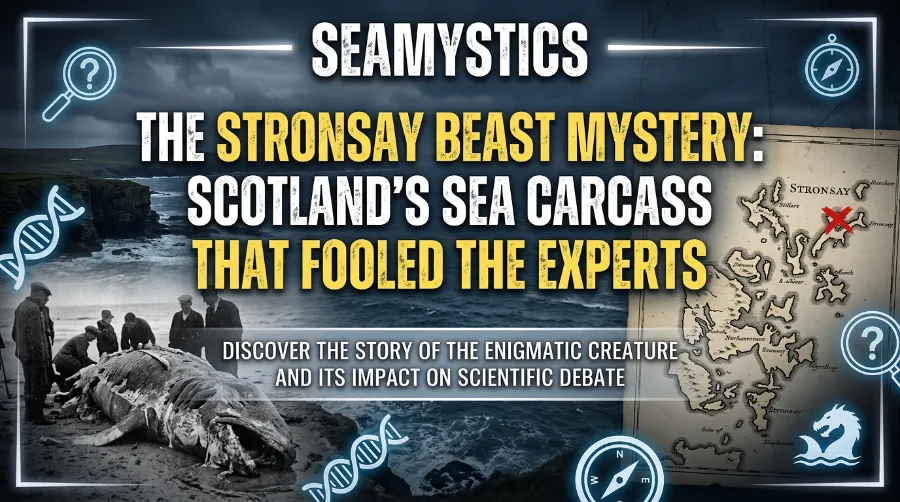
Modern necropsies on stranded basking sharks consistently reproduce the pseudo-plesiosaur effect that fooled observers in 1808. Marine biologists studying carcass decomposition have confirmed that jaw detachment, fin drift, and muscle fraying can happen within days in cold North Atlantic water. That timeline lines up neatly with what happened at Stronsay. Given how consistently this pattern shows up in modern strandings, 1808 starts to look far less like a special exception.
Visiting Stronsay Today
The island of Stronsay still leans into its strange bit of local history. Visitors can walk the same stretch of coastline where the carcass washed ashore. Local heritage groups maintain records and walking routes connected to the story, and you can explore them through Visit Stronsay’s own mysteries and legends page if a trip to Orkney is on your list.
The Royal Society’s journal Notes and Records published a detailed historical analysis of the testimony and scientific debate, and it rewards readers who enjoy primary-source history as much as the monster angle. Futility Closet offers a shorter, well-sourced summary, and Kurungabaa’s account of the Stronsay Beast leans into the folklore side of the story.
Fans of Scottish sea mysteries might also enjoy our coverage of the ongoing Loch Ness debate. It shares some of the same tension between “known animal” and “something new” that defined the Stronsay case.
Lessons the Stronsay Beast Still Teaches Us
Two centuries later, this case still ranks among the best early examples of testing eyewitness testimony against physical evidence. The Wernerian Society acted in good faith, and so did Barclay, but both worked from incomplete information. Home settled the debate because he examined actual tissue samples instead of relying purely on witness descriptions.
That same lesson applies directly to modern cryptid reports. A blurry photo or a dramatic description can spark excitement, but only physical evidence, properly examined, tends to hold up over time. The Stronsay Beast mystery persists mainly because so few carcasses from that era survived well enough for later scientists to double-check.
Frequently Asked Questions
What was the Stronsay Beast actually identified as? Most naturalists, past and present, identify it as a decomposed basking shark. The unusual “neck,” small head, and paddle-like fins matched the known decay pattern of that species closely.
How big was the Stronsay Beast compared to real basking sharks? Witnesses measured it at 55 feet. The largest confirmed basking shark on record measured around 40 feet, leaving a gap that some researchers still find hard to fully explain.
Is any physical evidence from 1808 still around? A few preserved vertebrae and skin samples sit in historical museum collections today. Most of the original carcass was lost or discarded soon after examination.
Why do decomposed sharks look like sea serpents? A shark’s heavy jaw and gills detach after death, and the remaining spine and skull create a long, thin “neck” shape. Researchers call this the pseudo-plesiosaur pattern.
Are basking sharks dangerous to humans? No. Basking sharks eat plankton, and they pose essentially no threat to swimmers or boats despite their massive size.
Quick Quiz: Test What You Just Learned
- In what year did the Stronsay Beast wash ashore? a) 1798 b) 1808 c) 1849
- Which anatomist argued the carcass was a decomposed basking shark? a) Patrick Neill b) John Barclay c) Sir Everard Home
- What effect causes decomposing basking sharks to resemble sea serpents? a) Bioluminescent decay b) Pseudo-plesiosaur effect c) Salt crystallization
- How long was the largest reliably confirmed basking shark? a) 25 feet b) 40 feet c) 60 feet
- What scientific name was initially given to the Stronsay Beast? a) Cetorhinus maximus b) Halsydrus pontoppidani c) Architeuthis dux
Answers: 1-b, 2-c, 3-b, 4-b, 5-b
Conclusion
The Stronsay Beast mystery survives because it sits right at the edge of what eyewitness testimony can actually prove. A storm, a strange carcass, and a handful of untrained observers convinced a respected scientific society that Scotland had found a living sea serpent. Careful anatomical work, plus some scientific stubbornness from Sir Everard Home, eventually brought the story back down to something more grounded, though not entirely tidy. You can land on “basking shark,” or keep a little room for doubt about that extra fifteen feet. Either way, the case remains one of the most well-documented sea monster stories in British history, and it still teaches a useful lesson: decomposition can turn the familiar into the unbelievable.
References
- Royal Society Publishing, Notes and Records, “The ‘Stronsay Beast’: testimony, evidence and authority in early nineteenth-century natural history,” Volume 77, Issue 3, 2023.
- Futility Closet, “The Stronsay Beast,” futilitycloset.com, 2007.
- Kurungabaa, “The Stronsa Beast,” kurungabaa.wordpress.com, 2012.
- Visit Stronsay, “Mysteries & Legends,” visitstronsay.com.
- Wikipedia contributors, “Stronsay Beast.”