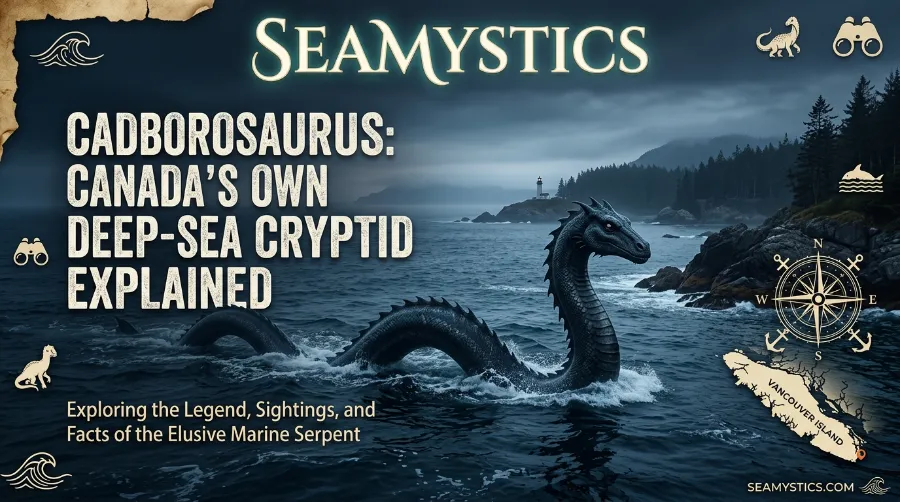

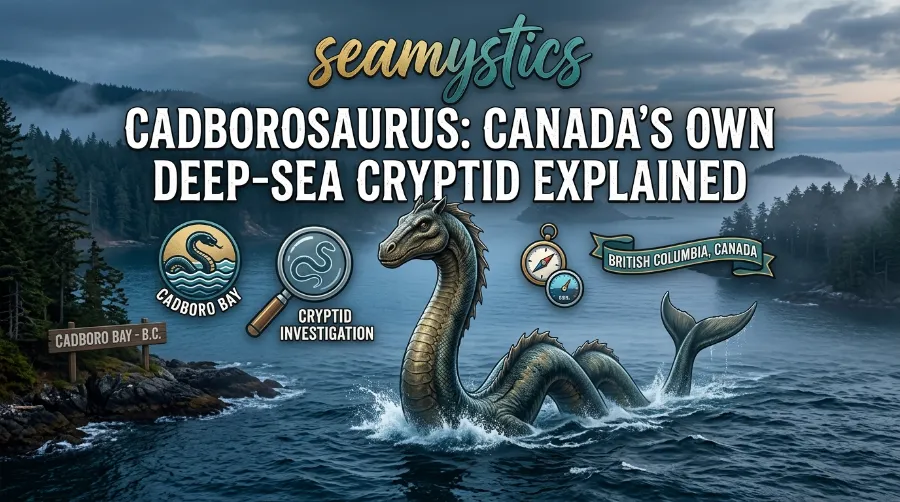
Somewhere off the misty coastline of Vancouver Island, fishermen tell the same story again and again. A long neck breaks the surface. A horse-shaped head turns toward the boat. Then it vanishes. This is the Cadborosaurus sea creature, known locally as Caddy, and it remains one of North America’s most persistent marine mysteries. Unlike many cryptids, Caddy leaves an actual paper trail: newspaper archives, museum records, and even a formal scientific name. That mix of folklore and documentation is what makes the story worth taking seriously, even if you never expect to see the animal yourself.
Key Takeaways
| Topic | Quick Fact |
|---|---|
| Name origin | Journalist Archie Wills coined it in 1933 after sightings near Cadboro Bay, Victoria, BC |
| Typical description | 30 to 50 foot serpentine body, horse or camel-like head, flippers, humped back |
| Sighting range | Roughly 600 miles of coastline, Sitka, Alaska to San Francisco Bay |
| Scientific name | Cadborosaurus willsi, proposed by Bousfield and LeBlond in 1995 |
| Leading skeptical explanations | Oarfish, basking sharks, or lines of swimming sea lions |
| Most famous physical evidence | The 1937 Naden Harbour carcass, found inside a whale’s stomach |
TL;DR: Cadborosaurus is a legendary sea serpent reported along the Pacific Northwest coast since the late 1800s. Most sightings cluster near Cadboro Bay, British Columbia. Researchers proposed a formal species name in 1995, but most marine biologists still attribute the reports to known animals like oarfish, basking sharks, or sea lions swimming in a line. No one has ever recovered a confirmed physical specimen.
What Is the Cadborosaurus Sea Creature
The Cadborosaurus sea creature holds the title of best-known North American sea serpent, and arguably the most thoroughly documented one. Darren Naish, a researcher who has written extensively on the case, notes that witnesses describe Caddy with striking consistency: a large-eyed, horse-like or camel-like head, often with short horns, a long neck, a serpentine body, a pair of flippers, and a split, horizontal tail. That consistency across decades of independent witnesses helps explain why the story has stuck around so long.
Where the Name Comes From
The name has a clean, traceable origin. Archie H. Wills, an editor at the Victoria Daily Times, gave the creature its name in 1933. He combined Cadboro Bay, the sighting hotspot near Victoria, with the Greek root for lizard or reptile. Locals shortened it almost immediately to Caddy, and the nickname has outlived nearly everything else about the case.
For readers who enjoy parallel legends, our deep-sea cryptids hub rounds up similar cases worldwide, and our piece on the Loch Ness debate covers the closest international comparison.
The Gloucester Sea Serpent: New England’s Most Famous Ocean Mystery
Cadborosaurus Sightings History: A Timeline Worth Knowing
Cadborosaurus sightings history stretches back further than most people expect. It spans multiple decades and many different types of witnesses, not just one era or one storyteller.
Early and Mid-Century Reports
- 1791: A crew member aboard the ship Columbia, under fur trader Captain Robert Gray, reportedly saw the earliest documented case.
- 1897: Osmond Fergusson watched a 25-foot animal with a long neck near the Queen Charlotte Islands on June 26, 1897.
- 1932: F. W. Kemp and his family watched an 80-foot maned animal from a Chatham Island beach on August 10, 1932.
- 1933: Dorothea Hooper and a neighbor spotted a serpentine, serrated-backed animal about 400 yards away in Cadboro Bay. Days later, Major W. H. Langley and his wife saw a dark green creature with serrated markings while sailing in Haro Strait.
Later Reports and Renewed Attention
- 1937: Whalers found the Naden Harbour carcass inside a whale’s stomach, giving the case its most famous piece of physical evidence.
- 1968: Captain William Hagelund reportedly found a small, unfamiliar creature at Pirate’s Cove and released it after keeping it briefly.
- 1998: Hugh and Sally Campbell saw a sea monster in Saanich Inlet on July 17, 1998, and told the Victoria Times Colonist they had become believers.
- 2009: Alaskan fishermen filmed footage that later aired on a Discovery Channel special, reigniting national interest.
That last case pulled in a credentialed voice. Paul LeBlond, former head of the Department of Earth and Ocean Sciences at the University of British Columbia, called the 2009 footage very genuine despite rough filming conditions. LeBlond was no fringe figure. He co-authored the book that first tried to formalize Caddy as a species, which brings us to the case’s most scientifically interesting chapter.
The Naden Harbour Carcass and the Push for a Real Species
In 1937, workers at a whaling station in the Queen Charlotte Islands opened a sperm whale and found something unusual inside its stomach. They sent samples to the Provincial Museum in Victoria, where curator Francis Kermode identified the remains as a fetal baleen whale. That should have closed the case. It did not.
A Formal Species Proposal
Decades later, two researchers revisited the case with fresh eyes. Edward Bousfield and Paul LeBlond formally described Caddy as a new species, Cadborosaurus willsi, and devoted an entire 1995 supplement of the journal Amphipacifica to the paper. They even proposed one of the Naden Harbour photographs as the holotype, the reference specimen for the new species. Bousfield and LeBlond leaned toward a reptilian identity, suggesting the animal might represent a surviving plesiosaur lineage.
Trunko Carcass Mystery: The Bizarre Carcass That Baffled the World
Here’s where things stand today: the scientific community never accepted Cadborosaurus willsi, and modern methods have since reclassified the original carcass tissue as a known marine mammal, not an unknown reptile. The name still appears in cryptozoology writing, but it carries no formal taxonomic weight. For the deeper skeptical breakdown, Scientific American’s Tetrapod Zoology coverage offers one of the most thorough public rebuttals available, and it makes a genuinely fun read even for skeptics.
British Columbia Sea Monster Lore: Why This Coast in Particular
Every good cryptid needs a home turf. For this one, that’s unmistakably British Columbia. The province’s cold, deep fjords, heavy boat traffic, and strong maritime storytelling tradition created ideal conditions for a legend like this to take root and survive for over a century.
Indigenous Roots Predating the Modern Name
A genuine Indigenous dimension runs through this story, and it predates any newspaper headline. First Nations people of the region told stories of a creature called Haietlik long before European settlers arrived. Some researchers point to carved images at coastal archaeological sites as possible early depictions of a similar animal. The carvings remain debated, but they suggest that stories of a large, serpentine sea animal along this coast run considerably older than the 1933 coverage that gave the creature its modern name.
Caddy isn’t even the only well-known cryptid tied to this province. Some researchers draw a direct line between it and Ogopogo, the freshwater cryptid of Lake Okanagan, arguing the two share a similar body plan. If lake-based cryptids interest you more than ocean ones, our guide to sea serpent sightings covers several inland cousins.
Pacific Northwest Cryptid Sightings: How Far Does the Range Stretch
One surprising detail: the reported range runs remarkably large. Reports of Cadborosaurus stretch across more than 600 miles of Pacific coastline, from Sitka, Alaska, down to San Francisco Bay. That’s a wide territory for a single alleged animal, and it’s one reason skeptics argue that multiple different species probably get lumped together under one nickname.
This wide range puts Caddy in an interesting category among Pacific Northwest cryptid reports generally. It doesn’t stay confined to one lake or one narrow strait the way some regional legends do. For a broader look at how coastal mystery-animal reports get investigated, our coverage of the globster mystery and the Montauk Monster identification both walk through cases where an alleged unknown creature turned out to be something science already knew, once someone ran the actual tests.
What Science Actually Says: The Leading Explanations
Marine biologists who study Caddy reports generally settle on a handful of candidate explanations, rather than treating every sighting the same way.
- Giant oarfish. This species can reach 11 meters, or about 36 feet, and weigh up to 300 kilograms, or roughly 660 pounds. Scripps Institution of Oceanography scientist H. J. Walker describes them as long and silvery, undulating like a serpent as they swim. An oarfish surfacing briefly could easily explain a serpentine sighting from a distance.
- Decomposing basking sharks. Researchers later identified several supposed Caddy carcasses, including a 30-foot specimen found on Henry Island in 1934, as decomposing basking sharks. As these sharks break down, their lower jaw and gill structures fall away first, leaving a small head and long neck shape that looks eerily reptilian.
- Lines of swimming sea lions. One frequently cited account describes a witness realizing mid-sighting that a single “long undulating body” was actually a bull sea lion leading six others. Their surfacing and diving pattern created the illusion of one continuous animal.
- Misidentified whale remains. Juvenile or malformed whale tissue, like the sample eventually linked to the Naden Harbour case, has repeatedly fooled observers before proper examination.
None of these explanations covers every report, and that gap is exactly what keeps cryptozoologists like Bousfield and LeBlond arguing for something new rather than something misidentified. Together, though, they account for the overwhelming majority of documented cases. That’s why most working marine biologists don’t treat Cadborosaurus as an open scientific question.
If you enjoy misidentification stories, our article on giant squid legends covers a case where the “monster” turned out to be entirely real, just stranger than fiction ever imagined. Our piece on the Gloucester sea serpent walks through a nearly identical East Coast pattern: sightings followed by scientific reassessment.
The Stronsay Beast Mystery: Scotland’s Sea Carcass That Fooled the Experts
Reported Lengths Across Historical Sightings
One pattern stands out across the historical record: the reported size of the animal varies wildly between witnesses. The chart below compares several of the most cited accounts.
(Chart: Reported Cadborosaurus Length by Witness Account — Fergusson 1897: 25 ft, Kemp 1932: 80 ft, MacDonald 1933: 50 ft, Eagles 1933: 60 ft, Henry Island carcass 1934: 30 ft)
That kind of variation gives skeptics a strong clue. A single species rarely produces such inconsistent descriptions unless witnesses are looking at several different things, at different distances, under different lighting and weather, and rounding numbers up from memory.
For an independent read on the Naden Harbour specimen, the Cadborosaurus.ca history archive has compiled original newspaper clippings and photographs that are hard to find elsewhere. The Puget Sound Monster Club’s writeup offers a good regional perspective from just south of the Canadian border, in the Salish Sea itself.
Caddy Sea Monster Canada: Why the Legend Still Matters
It’s easy to dismiss the Caddy sea monster Canada story as a century-old tourist gimmick, and Victoria has certainly leaned into that reputation. But there’s a more useful way to look at it. Every unresolved case like this quietly pushes marine science forward, because someone eventually has to go check. Museum staff examined the 1937 carcass. A credentialed oceanographer analyzed the 2009 video. Each round of scrutiny adds to what we actually know about oarfish, basking shark decomposition, and sea lion swimming behavior, even when the original mystery animal turns out to be something else entirely.
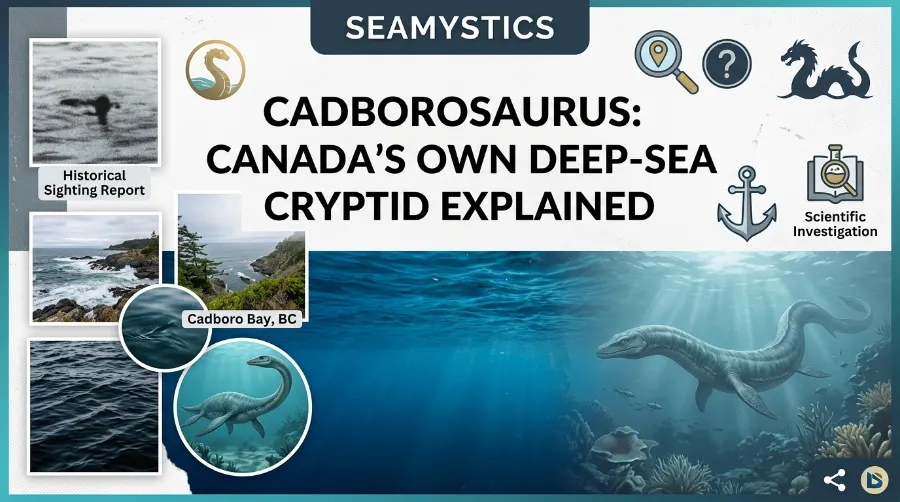
That’s the throughline across cryptozoology’s more credible cases. The creature itself may not exist as described, but investigating it tends to produce real marine biology along the way.
Frequently Asked Questions
Is Cadborosaurus a real, scientifically recognized species?
No. Researchers proposed the name Cadborosaurus willsi in 1995, but the broader scientific community never accepted it, and it holds no valid taxonomic status today.
Where are most Cadborosaurus sightings reported?
Most reports cluster around Cadboro Bay and the wider Salish Sea near Victoria, British Columbia. Some witnesses claim sightings as far north as Sitka, Alaska, and as far south as San Francisco Bay.
What is the most likely explanation for Caddy sightings?
Most marine biologists point to giant oarfish, decomposing basking sharks, or lines of swimming sea lions, depending on the specific details of each report.
Has anyone ever recovered a real Cadborosaurus body?
No. The 1937 Naden Harbour remains, the case’s most famous piece of physical evidence, turned out to belong to a fetal baleen whale, according to the original examining curator.
Is Cadborosaurus related to the Loch Ness Monster?
Not directly, but the two cases share a pattern: witnesses have consistently reported a long-necked, humped serpentine creature in one body of water for decades, with no confirmed physical evidence ever produced.
Conclusion
The Cadborosaurus sea creature sits in a strange, interesting middle ground between folklore and real marine biology. It carries a paper trail most sea monster stories never get: named witnesses, dated sightings, a museum specimen, and even a formal, if ultimately rejected, scientific description. Caddy may be a genuine undiscovered animal, or a century of overlapping oarfish, sharks, and sea lions. Either way, the story has kept people watching the waters off British Columbia closely, and every close look teaches marine science something real, even when the monster slips away again.