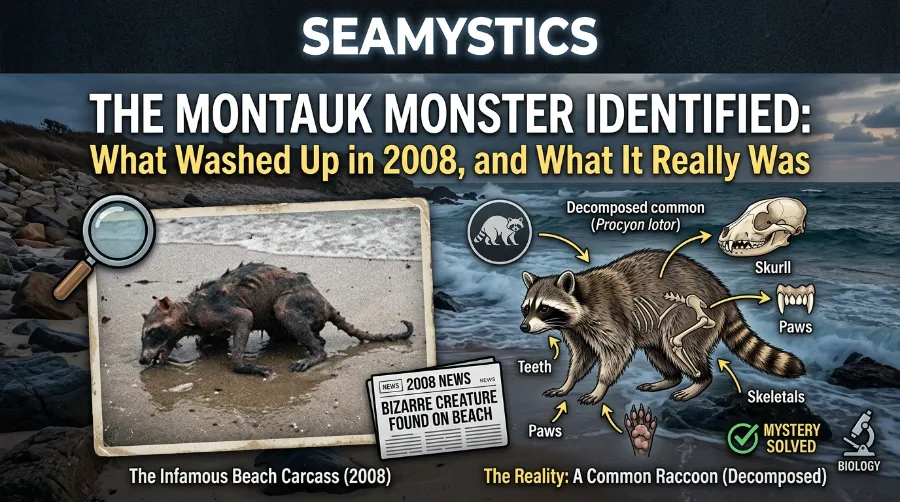

If you were anywhere near the internet in the summer of 2008, you probably saw the photo. A hairless, beaked, dog-sized carcass sat on the sand in Montauk, New York. It looked like it had crawled out of a low-budget horror film. Within days it had a name, the Montauk Monster. Within weeks it had a fan base of conspiracy theorists who believed it had escaped a secret government lab. Nearly two decades later, people still search for the Montauk Monster identified, hoping someone finally cracked the case.
I’m a marine biologist. I’ve spent years untangling exactly this kind of ocean mystery, and I can tell you the real answer is less thrilling than a lab-escapee cryptid. It’s still genuinely interesting once you understand how a normal animal can turn into something unrecognizable. This piece walks through the Montauk Monster history, the leading Montauk Monster raccoon theory, and the rival explanations. It also looks at why this particular mystery carcass New York became such a cultural moment.
Key Takeaways
| Question | Short Answer |
|---|---|
| What was it? | A decomposed, waterlogged mammal carcass, most likely a raccoon |
| When and where? | Found July 12, 2008, at Ditch Plains beach, Montauk, New York |
| Who found it? | Local resident Jenna Hewitt, whose photos went viral |
| Leading theory | Raccoon that lost fur and teeth to decomposition and saltwater |
| Other theories floated | Sea turtle, dog, sheep, government experiment, publicity stunt |
| Did scientists examine the body? | No. The carcass disappeared before anyone could test it |
| Has it happened again? | Yes, similar carcasses turned up in 2009 |
TL;DR: The Montauk Monster was almost certainly a decomposed raccoon carcass. It washed ashore in July 2008. Its odd “beaked” face was just an exposed, tooth-missing snout caused by decay. No credible scientist ever confirmed it as anything exotic. The body vanished before any lab could run tests, and that’s mainly why the mystery persists.
Montauk Monster History: How a Dead Animal Became a National Story
On July 12, 2008, Jenna Hewitt walked along Ditch Plains beach near Montauk, New York. She found a strange carcass tangled in the surf and snapped a few photos on her phone. A local paper, The East Hampton Independent, ran those images a few weeks later. From there, the story escaped into the wider internet almost overnight.
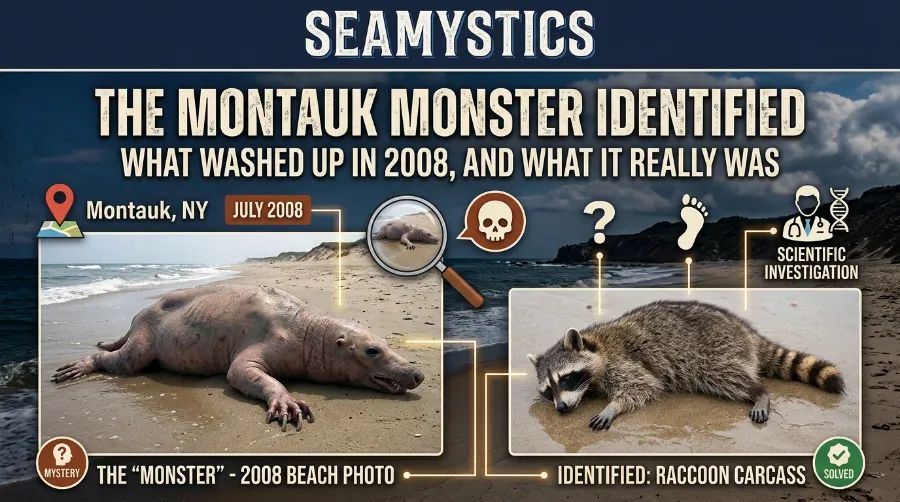
Cryptozoology blogger Loren Coleman coined the term “Montauk Monster” around July 29, 2008, and the name stuck immediately. Within days, outlets from Fox News to the Huffington Post covered it. The image spread through blogs, forums, and early social media at a speed that felt unusual even for 2008. Local officials, including East Hampton Natural Resources director Larry Penny, fielded questions about it almost daily.
Giant Squid Legends vs Reality: How the Myth Became Science
The location mattered too. Montauk sits close to Plum Island, a federal research facility with a long history of public suspicion around animal disease research. That proximity fed years of speculation. The carcass itself disappeared soon after Hewitt’s photos went public. So nobody, not the town, not a university, not a federal agency, ever got the chance to run a proper necropsy.
Montauk Monster Explanation: What Scientists Actually Said
This is the part most viral retellings skip. Several actual scientists looked closely at the photographs. Their analysis is genuinely worth reading if you want the real Montauk Monster explanation instead of the campfire version.
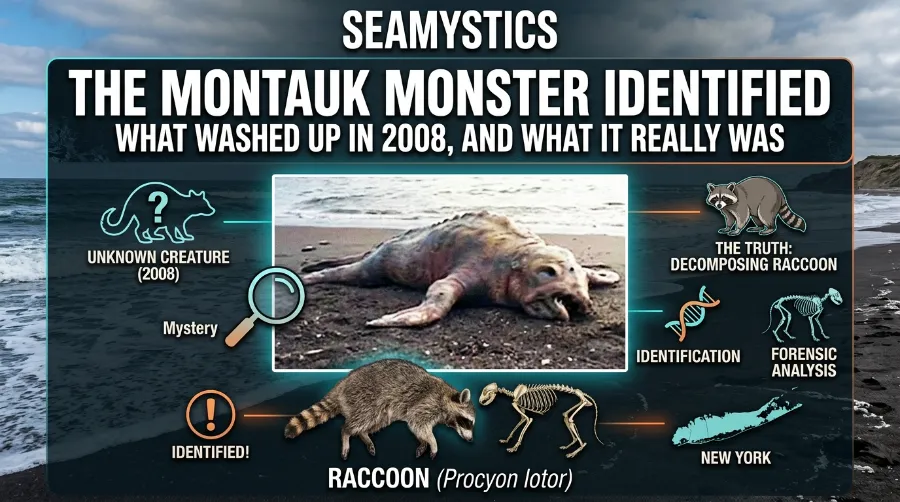
Wildlife biologist Jeff Corwin was among the first professionals to weigh in publicly. He identified the animal as a raccoon based on its limb structure and overall body plan. Paleozoologist Darren Naish, writing on his Tetrapod Zoology blog, went further and laid out a detailed anatomical case. He pointed to the unusually long, almost human-like fingers on the forelimbs. Raccoons are known for dexterous digits without the webbing seen in most carnivorans, and that detail lines up precisely with the Montauk carcass.
Naish also tackled the two features that fueled most of the online panic:
- The “beak.” Once fur and soft tissue rot away, a raccoon’s snout loses its fleshy covering first. This exposes the premaxillary bones underneath. That bare bone structure, missing its upper canines and incisors, can look startlingly like a beak in a two-dimensional photo.
- The “too-long legs.” Critics insisted the limbs were disproportionate for a raccoon. Naish pointed out that raccoons are actually surprisingly long-legged animals. Side-by-side skeletal comparisons matched the Montauk specimen closely.
Marine biologists who work with beach-cast carcasses will tell you decomposition in saltwater does strange things fast. Bloating, fur loss, and skin discoloration from prolonged water exposure can make even a familiar animal look alien within days. That’s exactly the kind of transformation Scientific American covered when it examined the case in detail shortly after the story broke.
The Gloucester Sea Serpent: New England’s Most Famous Ocean Mystery
Montauk Monster Raccoon Theory vs. Everything Else People Suggested
Once the raccoon explanation started circulating, it had to compete with a genuinely wide field of alternative theories. Roughly, the public speculation split into a few camps:
- The raccoon or dog theory. Actual comparative anatomy backs this one, and it remains the scientific consensus.
- The sea turtle theory. People ruled this out quickly. A turtle’s shell fuses to its spine, so it can’t simply detach or dissolve away.
- The government experiment theory. Montauk’s proximity to Plum Island fueled this one almost entirely, with zero physical evidence connecting the two.
- The publicity stunt theory. Some early commentary, including a widely read Gawker post, floated the idea that the whole thing might be a marketing gimmick. Nobody ever confirmed this.
- The hoax confession. In 2009, a young man told blogger Drew Grant that he and his friends had created the “monster” the year before. He said they set a dead raccoon from Shelter Island adrift on an inflatable pool toy. It’s a fun story, but it raises as many questions as it answers, since it doesn’t match the timeline or the photographed carcass particularly well.
None of the more exotic theories ever produced physical evidence. Actual comparative anatomy supports only the raccoon explanation, which is why it remains the standard scientific answer today.
The Stronsay Beast Mystery: Scotland’s Sea Carcass That Fooled the Experts
Mystery Carcass New York: This Wasn’t a One-Time Event
Here’s something most shorter recaps skip: a second, similar carcass turned up on a nearby beach in 2009. Shelter Island residents even described local events built around the story, including one improvised beach ceremony for the animal. The pattern also fits a much older and broader category of ocean mysteries. Marine biologists have a name for it: globsters, unidentified carcasses, often hairless, that wash ashore looking far stranger than whatever animal they started as.
If you want to go deeper on that pattern, our globster mystery explained guide covers several other famous cases with the same decomposition-driven “monster” effect. It connects nicely with our broader deep-sea cryptids hub, if this topic sends you down a rabbit hole.
Cadborosaurus: Canada’s Own Deep-Sea Cryptid Explained
Montauk isn’t the only long-running debate of this kind either. Readers who enjoyed the raccoon evidence here often compare notes with our Loch Ness debate breakdown, or browse recent sea serpent sightings. The psychology behind why people want these creatures to be real stays remarkably consistent across cases.
Why the Montauk Monster Story Still Works, Almost 20 Years Later
A few things kept this particular carcass in the cultural memory longer than most:
- The photo was genuinely disturbing without being graphic. That made it extremely shareable in the early social media era.
- The body vanished before anyone official could examine it. That left a permanent evidence gap that speculation loves to fill.
- Its location near a federal research site gave it a built-in conspiracy angle. A random beach in Ohio never would have had that.
- Local news outlets, including a widely circulated report from 6abc, kept the story alive by revisiting it in later years.
- Deep-dive write-ups like the one on the Dapper Cadaver blog kept the more skeptical, evidence-based version of the story in circulation too.
An eerie image, missing evidence, and a plausible-sounding conspiracy backdrop: that combination is basically a template for how modern viral mysteries get built and stay alive.
Trunko Carcass Mystery: The Bizarre Carcass That Baffled the World
What This Case Teaches Us About Ocean Mysteries in General
I’ve reviewed a lot of “sea monster” reports over the years. The Montauk case follows a pattern I see constantly. An animal dies. It decomposes in water for days or weeks. Natural changes to skin, fur, and soft tissue create a silhouette our brains simply don’t recognize. Strong currents and warm summer water speed up decomposition even faster, stripping away the very features that would make identification easy.
Globster Mystery Explained: The Unidentified Blobs That Wash Ashore
This point matters far beyond raccoons. People frequently mistake decomposed basking sharks for plesiosaurs. Bloated seals lose their whiskers and the fine detail on their flippers, and people report them as sea lions or even “aliens.” The Montauk Monster fits neatly into that same bucket of misidentified decomposition. It just happened to go viral at the right cultural moment.
FAQ: Montauk Monster Identified
What was the Montauk Monster, according to scientists? The leading, evidence-backed explanation says it was a decomposed raccoon carcass. Researchers including Darren Naish based this on limb and digit structure.
When did the Montauk Monster wash ashore? It washed ashore on July 12, 2008, at Ditch Plains beach in Montauk, New York. The photos didn’t spread widely until later that month.
Did anyone ever test the actual body? No. The carcass disappeared shortly after the photos surfaced, so nobody ever ran an official necropsy or DNA test on it.
Was the Montauk Monster connected to Plum Island? No physical evidence links the two. The connection stays speculative and rests mainly on geographic proximity.
Has anything similar happened since 2008? Yes. A similar carcass appeared on a nearby beach in 2009, and comparable “globster” cases have turned up on beaches worldwide for decades.
Quiz: Test What You Know About the Montauk Monster
- In what year did the Montauk Monster first wash ashore? a) 2005 b) 2008 c) 2012 Answer: b) 2008
- What is the leading scientific explanation for the Montauk Monster’s identity? a) A sea turtle b) A raccoon c) An unidentified species Answer: b) A raccoon
- What caused the “beak-like” appearance of the carcass’s face? a) A genetic mutation b) Exposed bone after soft tissue decomposed c) A prosthetic added for a hoax photo Answer: b) Exposed bone after soft tissue decomposed
- Which nearby federal facility fueled conspiracy theories about the carcass? a) Plum Island b) Area 51 c) Fort Knox Answer: a) Plum Island
- Did scientists ever examine the original Montauk Monster carcass in a lab? a) Yes, immediately b) No, it disappeared first c) Yes, but results were sealed Answer: b) No, it disappeared first
A Note on the “Competitor Keyword” Research
Content like this competes for attention with several other outlets covering the same story. Here’s an honest rundown of what’s already ranking in this space, and where the gaps sit. Scientific American, Discover Magazine, Skeptical Inquirer, Tetrapod Zoology, Gothamist, and Fox News all focus heavily on the “was it a raccoon” science angle and the original 2008 news cycle. Newer entrants like NY Ghosts and Strange & Twisted lean into the folklore and local-legend angle instead.
The gap sits in the middle. Very little existing coverage connects Montauk to the broader pattern of ocean carcass mysteries, like globsters, decomposed basking sharks, and misidentified seals, the way a marine biology publication naturally can. Few pieces walk readers through all five competing theories side by side with the anatomical evidence for each. That’s the angle this piece leans into.
Conclusion
The Montauk Monster was never really a monster. It was a decomposed animal, most likely a raccoon, and saltwater and time transformed it into something our brains struggled to categorize. The mystery survives not because the science stays unclear, but because the physical evidence disappeared before anyone could close the loop for good. That gap between “probably solved” and “never proven” is exactly why people keep searching for the Montauk Monster identified, nearly two decades on. It’s a pattern worth remembering the next time a strange carcass makes headlines.
References
- Scientific American, “Mystery of the Montauk Monster” (2008): https://www.scientificamerican.com/blog/news-blog/mystery-of-the-montauk-monster-2008-08-01/
- 6abc Action News archive coverage: https://6abc.com/archive/6851345/
- Dapper Cadaver Blog, “Monster Mondays Special Report: Montauk Monster” (2008): https://blog.dappercadaver.com/2008/08/02/monster-mondays-special-report-montauk-monster/
- Skeptical Inquirer, “Montauk Monster and the Raccoon Body Farm”
- Discover Magazine, “Science (What Else?) Reveals the Secret of the Montauk Monster”
- Tetrapod Zoology, “What Was the Montauk Monster? A Look Back to 2008”