
The deep sea sits closer to us than the moon in distance, yet we know far less about it. In fact, researchers have visually surveyed less than 0.001 percent of the deep seafloor, and the deep ocean remains 99.999 percent unknown to us, according to a Science Advances study from May 2025researchers have visually explored less than 0.001 percent of the deep sea floor, and 99.999 percent of the deep ocean remains unknown to us. This is where ROV ocean discovery changes the game. Remotely operated vehicles, or ROVs, now dive into places no human could safely reach, and they find new species almost every time they go down.
New Jellyfish Species Found Why Jellies Are Still Being Discovered
At Sea Mystics, we track these discoveries closely because they matter for conservation, climate research, and simple human curiosity. Every year, teams using ROV deep sea technology bring back footage of creatures no one has ever described before. This article breaks down how these robots work, what they have found recently, and why this field moves faster than most people realize.
Citizen Science Ocean How Regular People Are Finding New Species
Key Takeaways
| Point | What It Means |
|---|---|
| ROVs let scientists explore without risking human lives | Remote piloting means dives can go deeper and longer than manned submersibles |
| New species turn up on almost every major expedition | Recent trips by Schmidt Ocean Institute and NOAA each logged dozens of new finds |
| Imaging and DNA tools work together | Cameras capture shape, genetic barcoding confirms the species is truly new |
| The public can watch live | Many ROV dives stream online, turning viewers into citizen scientists |
| Most of the ocean stays unmapped | Over 80 percent of the world’s oceans remain unexplored as of 2026 |
TL;DR: ROV ocean discovery uses underwater robots equipped with cameras, sensors, and sampling arms to explore deep sea zones that humans cannot reach directly. These machines have helped scientists confirm dozens of new species in single expeditions, including a colossal squid filmed alive for the first time and a cold water coral reef the size of Vatican City. As of 2026, over 80 percent of the ocean floor remains unmapped, so this pace of discovery should continue.
New Coral Species Discovered What Makes Reef Taxonomy So Difficult
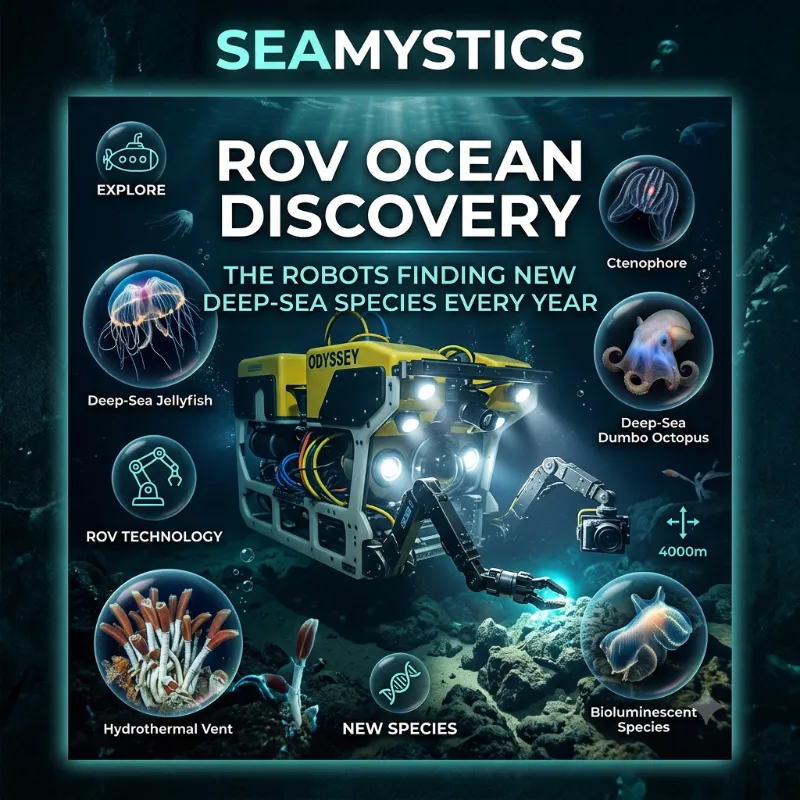
What Is ROV Technology and Why It Matters for Ocean Discovery
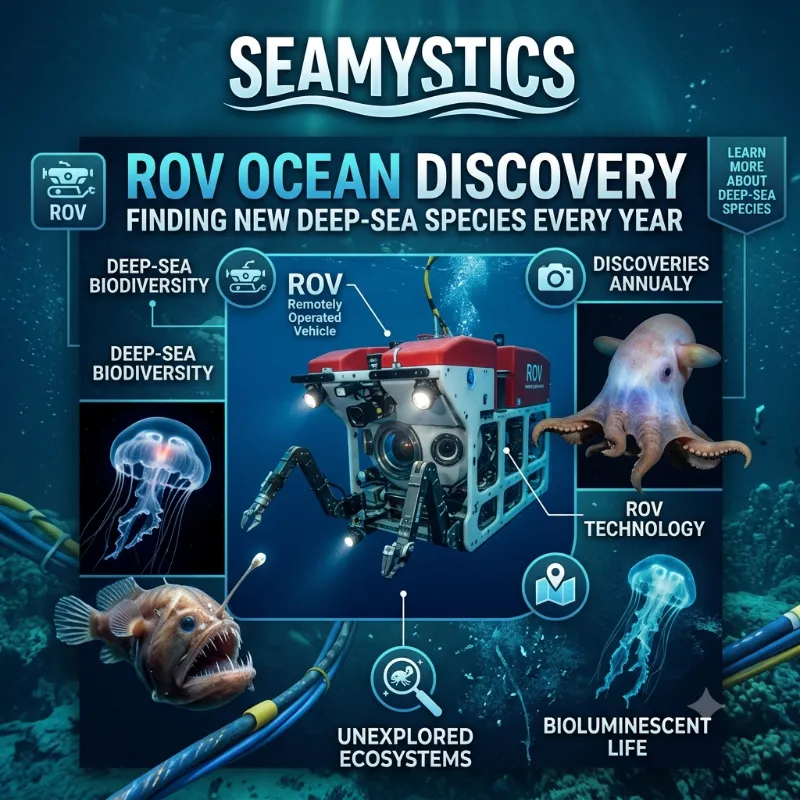
An ROV, short for remotely operated vehicle, is an underwater robot that a team controls from a ship on the surface. Pilots sit in a control room and guide the machine through a tether cable that sends power down and carries video back up. Unlike a submarine, no person ever leaves the surface, so the risk to human life stays close to zero.
Rediscovered vs New The Difference Between a Lost Species and a New One
This matters because the deep sea ranks among the most extreme environments on the planet. Pressure at 4,000 meters can crush most equipment, and sunlight disappears after around 200 meters. Because of this, underwater robot exploration has become the main way scientists study life below the sunlit zone.
Most modern ROVs carry a mix of tools, including:
- High definition cameras for real time footage
- Robotic arms for collecting samples
- Sonar systems for mapping the seafloor
- Temperature and chemical sensors
- Specialized imaging rigs for soft bodied creatures
How a Remote Operated Vehicle Ocean System Actually Works
A typical ROV mission starts when a research vessel positions itself above a target site, often a seamount, trench, or coral reef. A winch lowers the ROV into the water, and pilots then steer it using thrusters while watching a live video feed. Because a tether links the vehicle to the ship, data and video stream back instantly, so scientists on board can react to what they see in real time.
This live connection gives ROVs a major advantage over older tools like trawl nets. Nets damage fragile creatures and cannot tell scientists exactly where an animal was living. An ROV, on the other hand, lets researchers watch behavior, record depth, and note the surrounding habitat before ever touching the animal.
Hybrid Ocean Species When Two Marine Animals Interbreed Naturally
Real ROV Deep Sea Expeditions Making Headlines
Talking about ROV technology in theory is one thing, but the real proof shows up in recent expeditions. Over the past two years, several missions produced results that surprised even experienced marine biologists. Below are some of the clearest examples.
Schmidt Ocean Institute and the ROV SuBastian
The Schmidt Ocean Institute runs one of the most active ROV programs in the world aboard its research vessel, Falkor (too). Its ROV, SuBastian, has led some of the most significant deep sea finds of the past two years.
South Atlantic Species Boom
In 2025, the team spent time in the South Atlantic Ocean, where SuBastian collected a juvenile glass squid at 779 meters depth, and the crew photographed it aboard R/V Falkor using a prototype multiview macro camera systemThis juvenile glass squid, collected by ROV SuBastian at 779 meters depth in the South Atlantic, was photographed on R/V Falkor using a prototype multiview macro camera system. During that same trip, researchers documented over two dozen species that no one had ever recorded before, including a transparent tunicateAn international team of experts discovered over two dozen new marine species on a recent expedition off the coast of Brazil in the tropical South Atlantic Ocean. DivePhotoGuideUniversity of Alaska Fairbanks
DNA Barcoding Species How Scientists Prove a New Species Is Real
First Live Colossal Squid Footage
Even more striking, this same institute achieved something marine biologists had chased for decades. In March 2025, near the South Sandwich Islands, the ROV captured the first confirmed live footage of a colossal squid, a species scientists had only ever seen as remains beforeThis is the first confirmed live observation of the colossal squid, Mesonychoteuthis hamiltoni, in its natural habitat. That 35 day voyage also turned up new hydrothermal vents and coral gardens that researchers believe host entirely new species.
The Ocean Census Project Inside the Global Hunt for New Marine Life
Bathelia Reef and 28 New Species
Then in 2026, the team explored a massive cold water coral structure off Argentina known as the Bathelia candida reef. This single expedition confirmed 28 new species, including a chiton that citizen scientists helped nameTheir recent discovery of 28 new species off the Argentine Coast speaks to those efforts. If you want to see how researchers confirm a sighting is officially a new species, our guide on new species confirmation breaks down that entire process step by step. aol
Nazca Ridge Seamount Discovery
Meanwhile, further west along the Nazca Ridge off Chile, the same organization mapped and named a previously unknown seamount in 2024. The formation, which the team cataloged as KW-14176, covers about 70 square kilometers and rises more than 3,100 meters from the surrounding seafloorThe seamount covers an area of about 70 sq km. The summit depth is 994m and the base is at 4,103m giving it a prominence of 3,109m over the surrounding seafloor. By the end of that campaign, the team had explored around 25 seamounts across the Nazca and Salas y Gómez Ridges, and their marine technician noted that the findings kept revealing gaps in how little we understand seamount ecosystems. Schmidt Ocean Institute
NOAA Ocean Exploration and the Okeanos Explorer
NOAA runs its own long standing ROV program, operating two vehicles, Deep Discoverer and Seirios, from the ship Okeanos Explorer. Between July and October 2025, the team mapped 113 seamounts in the Palau Exclusive Economic Zone aloneBetween July and October, NOAA Ocean Exploration collected high-resolution mapping data in the Palau Exclusive Economic Zone, mostly in the Palau National Marine Sanctuary, mapping 113 seamounts. This kind of mapping work does more than fill in blank spots on a chart, since every new seamount is a potential habitat for undiscovered life. NOAA Ocean Exploration
NOAA’s ROVs have also made history in unexpected ways. In March 2025, the team reached the wreck of USS Nevada at 4.7 kilometers deep, and the crew broke that record the following month with two dives on USS Yorktown, which rests at nearly 5 kilometersThe dive on Nevada at 4.7 kilometers in depth in March was broken in April when we conducted two dives on Yorktown, which rests at a depth of approximately 5 kilometers. These missions show that ROV deep sea technology serves both biology and history at once. NOAA Ocean Exploration
New Crustacean Species The Crabs and Shrimp Still Being Named
Nearby, the Ocean Exploration Trust’s vessel Nautilus ran its own program in 2025. Between May 7 and 28, the crew mapped over 20,504 square kilometers of seafloor around the Mariana Islands and completed nine ROV dives, surveying underwater volcanoes and ancient seamountsBetween May 7-28, E/V Nautilus supported an expedition that explored deep-sea habitats around the Mariana Islands. During 21 days at sea, the team mapped over 20,504 km2 of seafloor, in addition to completing nine successful ROV dives. To see how these organizations coordinate with volunteer researchers back on land, take a look at our piece on citizen science in ocean research. Nautilus Live
How ROV Marine Research Confirms a Species Is Actually New
Finding a strange looking creature on camera is only the first step. Before scientists officially recognize a species, it has to go through a confirmation process that combines technology with old fashioned taxonomy. This is where ROV marine research really shows its value.
Non-Invasive Imaging Tools
Modern ROVs now carry imaging systems that let scientists study an animal without ever touching it. One example is DeepPIV, a laser based tool that the Monterey Bay Aquarium Research Institute built, which measures water movement and captures 3D shapes of soft bodied animals like jellyfishDeepPIV and EyeRIS are sophisticated, non-invasive tools for scanning marine animals; they use lasers to scan organisms and create 3D images of them. When researchers pair this system with a shadowgraph camera from Japan’s marine science agency, they can capture fine detail on creatures that a net would otherwise damage. Google
This combination proved its worth during the 2025 South Atlantic expedition. The team encountered far more life in the midwater zone than researchers expected, including a female octopus feeding on a jellyfish at 800 meters, an interaction that scientists had rarely observed beforeA female octopus (Haliphron atlanticus) consumes a jellyfish at 800 meters depth. Observing feeding interactions helps scientists understand how midwater communities function. Without this imaging technology, researchers would likely never have recorded that kind of natural behavior. Google
DNA Barcoding and Genetic Confirmation
Once imaging suggests a creature might be unknown to science, DNA analysis usually settles the question. Researchers sequence a small genetic sample and compare it against existing databases. If no match turns up, that finding gives strong evidence the animal is a new speciesBy sequencing their genomes, the researchers were able to quickly identify new species. Discover Wildlife
This method has sped up the confirmation process dramatically compared to older techniques, which sometimes took years. Our detailed explainer on DNA barcoding for species identification walks through exactly how this genetic matching works in a lab setting. Together, imaging and genetic tools now form the backbone of underwater robot exploration.
ROV Ocean Discovery by the Numbers
Expedition Results at a Glance
To understand the scale of what these robots are finding, it helps to see the numbers side by side. The table below pulls together figures from several recent expeditions.
| Expedition | Location | Year | ROV Used | New Species Found |
|---|---|---|---|---|
| South Atlantic Midwater Survey | Brazil coast | 2025 | SuBastian | 31 |
| South Sandwich Islands | Southern Ocean | 2025 | SuBastian | Multiple, plus first live colossal squid footage |
| Bathelia Reef Expedition | Argentine Sea | 2026 | SuBastian | 28 |
| Nazca Ridge Seamounts | Chile coast | 2024 | SuBastian | New seamount, biodiversity documented |
| Palau EEZ Mapping | Palau | 2025 | Deep Discoverer / Seirios | 113 seamounts mapped |
| Mariana Islands Survey | Western Pacific | 2025 | Nautilus ROV | 20,504 km² mapped |
How Much of the Ocean Remains Unknown
A simple way to picture how much ocean stays unknown is to look at exploration coverage. The most recent data show roughly how the numbers break down.
Ocean floor visually explored     [░ ] under 0.001%
Ocean floor mapped in some form   [░░░░░░░░  ] roughly 20%
Ocean floor still unmapped        [██████████████████████████████████████] over 80%
As of 2026, more than 80 percent of the world’s oceans remain unmapped and unexploredAs of 2026, more than 80 percent of the world’s oceans are still unmapped and unexplored. On top of that, researchers estimate the ocean holds between 700,000 and one million species, and scientists have yet to discover or officially describe roughly two thirds of themScientists estimate there may be between 700,000 and 1 million species in the ocean. Roughly two-thirds of these species, possibly more, have yet to be discovered or officially described. In other words, the current wave of discoveries likely marks just the beginning. aolNOAA Ocean Exploration
The Role of Citizen Scientists in ROV Discoveries
Live Streams Turn Viewers Into Scientists
One thing that sets modern ROV missions apart from older research is how open they stay to the public. Many organizations, including Schmidt Ocean Institute, stream their dives live on YouTube, so anyone can watch a robot explore the seafloor in real time. Viewers have even helped name new species, as happened with a chiton the team found during the Argentine Sea expedition.
Why Public Access Builds Accountability
This kind of openness builds trust between scientists and the public, and it also speeds up outreach. Groups such as Ocean Discovery work to connect classrooms and volunteers with real ocean data, which helps train the next generation of marine researchers. For readers who want to get involved directly, our internal guide on citizen science ocean projects lists current ways to contribute from home.
Public engagement also creates a kind of accountability. When thousands of people watch a live feed, governments and companies feel more pressure to protect the habitats the footage shows. This has become especially important as deep sea mining proposals increase around seamounts and hydrothermal vents.
Challenges and Limits of Remote Operated Vehicle Ocean Exploration
The Cost Barrier
As impressive as this technology is, it comes with real limits. ROVs cost a great deal to build, operate, and maintain, and a single research vessel deployment can run tens of thousands of dollars per day. Because of this, mostly well funded institutions and government agencies run deep sea missions today.
Physical and Technical Limits
Physical limits also apply. A tethered ROV can only travel as far as its cable allows, which restricts how much ground it can cover compared to a fully autonomous vehicle. Deep water pressure, strong currents, and limited battery life on support equipment all add further constraints.
Some of the main challenges researchers face include:
- High operating costs for ship time, fuel, and specialized crew
- Limited battery and cable length restricting range per dive
- Data overload, since a single dive can generate hours of footage to review
- Difficulty preserving fragile specimens once they reach the surface
- Funding gaps that leave smaller research institutions behind larger organizations
Companies like DeepOcean work on more efficient subsea systems that could lower these costs over time. Meanwhile, engineering teams at the Schmidt Ocean Institute’s robotic platforms division continue refining vehicles capable of reaching depths up to 4,500 meters, which expands the range of what is physically possible.
What This Means for the Future of Ocean Science
Faster Confirmation Through Better Tech
Looking ahead, the pace of ROV ocean discovery should speed up rather than slow down. NOAA has already scheduled shakedown expeditions for 2026 to test new equipment before the full field season begins, with plans to explore seamounts, coral habitats, and abyssal zones off Hawaii and American Samoa. Newer imaging systems, faster genetic sequencing, and better cable technology all keep shortening the time between a sighting and an official species confirmation.
Interest is also growing in pairing ROVs with autonomous underwater vehicles, which need no tether at all. This hybrid approach could let research teams cover far more ground in a single trip. As mapping technology improves, expect researchers to add more seamounts, trenches, and reef systems to the record every year.
Why This Progress Matters for Conservation
From a conservation standpoint, this progress matters more than most people realize. You cannot protect a habitat that no one has ever mapped, and you cannot manage a species that no one has ever named. Every dive brings scientists one step closer to understanding an ecosystem that covers most of the planet yet remains almost entirely in the dark.
Frequently Asked Questions
What does ROV stand for in ocean exploration?
ROV stands for remotely operated vehicle. It is an underwater robot that a pilot controls from a ship using a cable that sends power down and carries video back up in real time.
How deep can an ROV go?
Most research grade ROVs can reach depths between 4,000 and 6,000 meters, though some specialized vehicles go even deeper. The Schmidt Ocean Institute’s SuBastian, for example, operates down to 4,500 meters.
How many new species do ROVs find each year?
The number varies by expedition, but recent trips have logged anywhere from a dozen to over 30 new species in just a few weeks at sea. Given how much of the ocean stays unexplored, this number will likely keep climbing.
Are ROVs the same as submarines?
No, submarines and manned submersibles carry people inside them, while ROVs run fully remote with no crew on board. This setup makes ROVs safer and often cheaper to operate for long research missions.
Can the public watch ROV dives live?
Yes, several organizations stream their dives online, including Schmidt Ocean Institute and NOAA Ocean Exploration. Viewers can watch discoveries happen in real time and sometimes even help name newly found species.
Conclusion
ROV ocean discovery has quietly become one of the most important tools in modern marine biology. From researchers filming a colossal squid alive for the first time to finding a coral reef the size of Vatican City, these underwater robots keep proving that the deep sea still holds far more mysteries than answers. As mapping technology, imaging tools, and genetic analysis continue to improve, the coming years should bring even faster discoveries. For now, one thing stays clear: every dive reminds us that most of our planet remains unexplored, and the robots doing that exploring are only getting started. To follow along with new confirmations as they happen, visit Sea Mystics for ongoing coverage.
References
- Schmidt Ocean Institute, 2025 Expeditions and South Atlantic Species Discoveries, schmidtocean.org
- Schmidt Ocean Institute, Thriving Antarctic Ecosystems in Wake of Detached Iceberg, schmidtocean.org
- Schmidt Ocean Institute, New Seamount and Species Discovered Along Nazca Ridge, schmidtocean.org
- Colossal, First Live Footage of a Colossal Squid, thisiscolossal.com, May 2025
- NOAA Ocean Exploration, 2025 Annual Report, oceanexplorer.noaa.gov
- NOAA Ocean Exploration, Deep-Sea Biological Discoveries: 20 Years of Ocean Exploration, oceanexplorer.noaa.gov
- Discover Magazine, 99.999 Percent of the Deep Ocean Is Unexplored, May 2025
- Nautilus Live, Exploring the Pacific Ocean: 2025 Field Season Summary, nautiluslive.org
- University of Alaska Fairbanks News, Deep-Sea Expedition Uncovers Dozens of New Species