
A single coral colony that looks like one species can actually be five. That is not a guess. Researchers reexamined table coral across the Great Barrier Reef and found that a group scientists once described as three species actually held at least sixteen, five of which had no name before.An international team of scientists rewrote the family tree on one of the world’s most iconic coral groups with the discovery and description of five new-to-science species. This single case shows why identifying coral ranks among the hardest jobs in marine science today, and why new coral species keep surfacing even in reefs that people have studied for decades.
New Jellyfish Species Found Why Jellies Are Still Being Discovered
TL;DR: Scientists keep finding new coral species across shallow reefs and the deep sea, often because corals that look alike carry different genes. Reef taxonomy stays difficult because corals change shape with their environment, lack clear physical markers, and usually need DNA testing to confirm as a true species. Tools like DNA barcoding, ROVs, and citizen science now help scientists name and protect coral faster than before.
The Ocean Census Project Inside the Global Hunt for New Marine Life
Key Takeaways
| Point | What It Means |
|---|---|
| Coral looks can trick scientists | Environment changes coral shape, so two identical-looking corals can be different species |
| DNA now settles the argument | Genetic testing confirms species that shape alone cannot |
| The deep sea holds most of the mystery | Most new coral finds since 2025 come from waters below 500 meters |
| Naming takes years | A new coral can take over a decade to move from discovery to formal description |
| Citizen divers help too | Everyday divers and photographers flag unusual coral for scientists to study |
Coral reefs cover less than one percent of the ocean floor, yet they support close to a quarter of all marine life. Despite that outsized importance, scientists still lack a complete list of which corals actually exist. New coral species turn up almost every year, sometimes in places researchers have dived a hundred times before. That gap between how much we think we know and how much we actually know drives coral taxonomy’s most stubborn puzzles.
Why New Coral Species Keep Turning Up in 2025 and 2026
Coral ranks among the most studied animal groups in the ocean, yet it still holds surprises. Most of the ocean floor has never crossed human eyes, which leaves enormous stretches of reef and deep water essentially unmapped. Scientists have directly seen less than 0.001 percent of the seafloor. Ocean Census
Deep Pacific Discoveries
Recent finds back this up clearly. In late 2025, a team from the Senckenberg institute and the UK’s National Oceanography Centre described Deltocyathus zoemetallicus, the first stony coral scientists have ever found living directly on polymetallic nodules.The coral was found more than 4,000 meters below the surface in the Clarion Clipperton Zone of the Pacific Ocean, and this is the first known hard coral species to live attached to these mineral nodules. Dr. Guadalupe Bribiesca-Contreras from the National Oceanography Centre and Senckenberg scientist Dr. Nadia Santodomingo led the research team behind this discovery. WoRMSWoRMS
Discoveries Near Japan and Hawaii
A few months earlier, in September 2025, marine biologists spotted a striking new species off Hawaii and the Mariana Trench. Its long, hairy branches earned it the nickname “Chewbacca coral.”The coral, formally named Iridogorgia chewbacca, is known for its long, flexible branches and shiny surface, and it earned its nickname because its hairy looking branches reminded researchers of the Star Wars character. Earth.com
Hybrid Ocean Species When Two Marine Animals Interbreed Naturally
Then in February 2026, scientists confirmed something even rarer near Japan’s Minamidaito Island. A bright yellow deep-sea coral called Corallizoanthus aureus turned out to be a new species, and it emits green light when disturbed, marking the first known case of bioluminescence documented inside a deep-sea cave. If you want to see how a full confirmation process for a find like this works, our pillar guide on new species confirmation walks through every stage. biorxiv
A Surge Across Global Expeditions
These stories add up to a bigger trend. Between April 2025 and March 2026, the Ocean Census initiative, one of the largest marine discovery programs in the world, logged an enormous jump in new finds. Researchers officially discovered 1,121 new species through 13 expeditions and nine species discovery workshops involving leading scientists around the globe. That figure marks a 54 percent increase in annual identifications compared to the year before. Ocean CensusOcean Census
What Makes Reef Taxonomy So Difficult
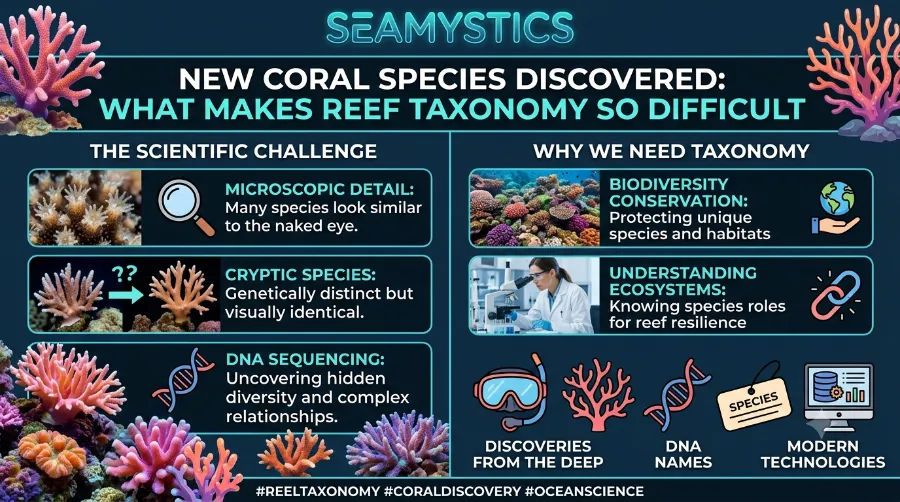
Reef taxonomy, the science of sorting and naming coral species, sounds simple on paper. In practice, it ranks as one of the messiest branches of marine biology. Three main problems keep tripping up even experienced taxonomists.
Rediscovered vs New The Difference Between a Lost Species and a New One
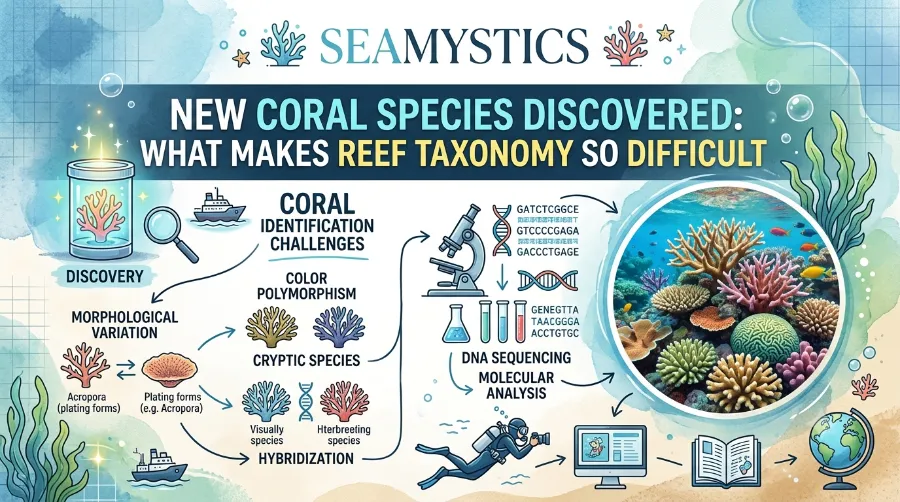
Corals Change Shape Depending on Where They Grow
Unlike a fish or a bird, coral does not carry a fixed body plan you can measure with a ruler. The same coral species can grow as flat plates in calm water and as thick branches in rough currents. Wave action, light, depth, and water temperature all reshape a coral colony over its lifetime.
This means two colonies that look nothing alike might belong to the same species, while two colonies that look almost identical might represent completely different ones. Early taxonomists who worked only from shape and skeleton structure got this wrong constantly, and scientists are only now correcting some of those old classifications.
Cryptic Species Hide in Plain Sight
A cryptic species looks identical to another species but carries distinct genes. Coral holds plenty of them. This single issue explains why the table coral story works as such a strong example of coral taxonomy challenges in action.
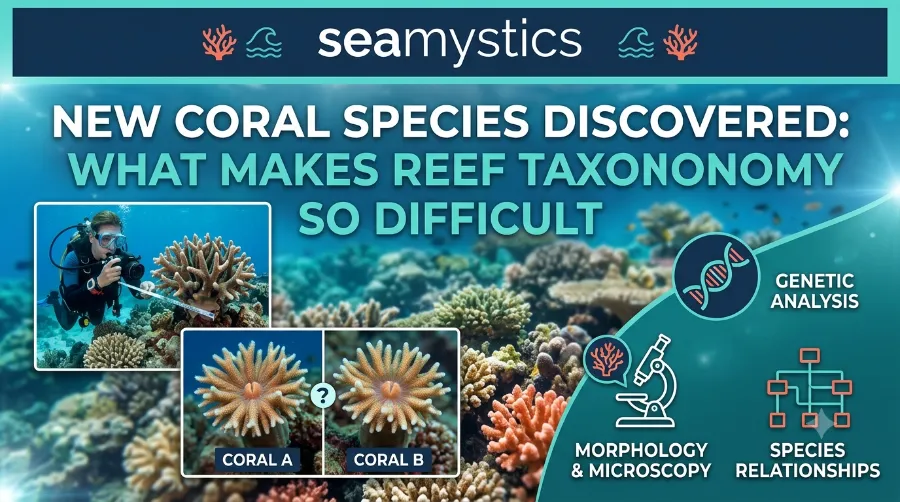
New Coral Species Discovered What Makes Reef Taxonomy So Difficult
Researchers who ran genetic sequencing on Acropora hyacinthus, a coral long assumed to be one widespread species, found something unexpected. The lineage once thought to be just three species of table coral turned out to be a complex group of at least sixteen distinct species, five of which were previously unknown to science. Dr. Peter Cowman, who led the study, described the method plainly: the team combined genomic-scale DNA analysis and machine learning with a fresh look at century-old museum specimens to uncover evolutionary details never seen before. househouse
Coral Taxonomy Challenges in the Deep Sea
Shallow reef coral already presents a challenge to classify. Deep sea coral makes it worse, because collecting a usable specimen from 500 or 4,000 meters down costs a lot of time and money. Fishing crews sometimes pull up new species by accident as bycatch from unrelated surveys.
That is exactly how one recent precious coral species turned up. Fishing crews collected specimens of Hemicorallium osmanthogemmum as bycatch during a deep-sea fishery off Cape Ashizuri, Japan, at a depth of approximately 550 meters. The genus itself shows how unsettled deep coral taxonomy remains. The genus Hemicorallium includes species that live in particularly deep water where sampling opportunities stay limited, so scientists believe many undescribed species in the group still exist. MongabayMongabay
Even the higher-level classification keeps shifting. Scientists once classified the coral family Coralliidae into three genera based on morphological and molecular data, but a more recent study restructured the group into 14 genera by integrating 11 molecularly supported genera, and researchers later described two additional new genera, bringing the total to 16. If the family tree of a well-known coral group can change this dramatically within a decade, a brand-new species rarely earns confirmation quickly. Mongabay
How Scientists Confirm a New Coral Species
Finding an odd-looking coral only marks the first step. Confirming it as an official new species takes a long process with several checkpoints. Here is roughly how it works today.
- Field collection. A diver, submersible, or ROV collects a physical sample, along with photos and location data.
- Morphological review. Taxonomists compare the skeleton shape, polyp structure, and coloring against known species records.
- DNA barcoding. A lab sequences a genetic sample and checks it against reference databases to rule out known species. Our guide on DNA barcoding for species identification breaks this step down in more detail.
- Peer review and publication. Other scientists review the findings before the species earns formal acceptance.
- Registration. The species enters global databases such as the World Register of Marine Species.
-
New Crustacean Species The Crabs and Shrimp Still Being Named
This full pipeline moves slowly. The identification and official registration of a new species can take up to 13.5 years, meaning some species may go extinct before scientists even document them. That delay pushed organizations like Ocean Census to separate “species discovered” from “species described.” The workflow differentiates between species described, those formally classified through the traditional scientific process, and species discovered, those identified as likely new based on expert opinion and DNA sequence data where possible. This shortcut lets scientists flag likely new coral species years before the full paperwork catches up. Scientific AmericanOcean Decade
Tools Driving New Reef Species Discovery
A few technologies have quietly transformed how fast scientists can find and confirm coral. None of them work alone, but together they explain the recent surge in new reef species.
- Remotely operated vehicles (ROVs) let researchers reach depths that divers cannot safely access, and most recent coral discoveries have happened there. Our ROV ocean discovery guide covers how these vehicles work on real expeditions.
- DNA barcoding gives scientists a fast, reliable way to tell apart corals that look nearly identical.
- Citizen science platforms now let recreational divers submit photos of unusual coral for professional taxonomists to review. Our piece on citizen science and ocean research explains how amateur divers contribute real data.
- Large-scale collaborative programs, like the one our Ocean Census project overview describes, pool resources from multiple countries to speed up formal species description.
Groups outside academia push this work forward too. Nonprofits focused on coral restoration regularly publish field updates on new finds and ongoing reef monitoring, and their restoration blog offers a useful way to track ongoing projects. Dive-focused outlets have also covered specific discoveries in detail, including one report on American researchers uncovering unknown deep-sea corals that shows how these expeditions unfold on the water.
Real Examples: New Coral Species From the Last Two Years
The table below lays out several confirmed and newly reported coral discoveries from 2025 and early 2026, along with what made each one scientifically notable.
| Species | Location | Depth | Why It Matters |
|---|---|---|---|
| Deltocyathus zoemetallicus | Clarion Clipperton Zone, Pacific | Over 4,000 m | First stony coral found on polymetallic nodules |
| Iridogorgia chewbacca | Near Hawaii and Mariana Trench | Deep sea | Rare branching structure new to the region |
| Corallizoanthus aureus | Minamidaito Island, Japan | Cave entrance | First bioluminescent coral found in a deep-sea cave |
| Hemicorallium osmanthogemmum | Kochi Prefecture, Japan | About 550 m | New precious coral, part of a 25-species genus |
| Five new Acropora species | Great Barrier Reef | Shallow reef | Revealed a hidden 16-species complex within table coral |
Deep water discoveries do not tell the whole story either. Off the coast of Argentina, a research team spent two expeditions aboard the vessel Falkor, one in July 2025 and another spanning December 2025 into January 2026, mapping what may be one of the largest cold-water coral reefs anyone has ever found.Scientists discovered what might be one of the world’s largest deep-sea, cold-water reefs over the course of two expeditions aboard the research ship R/V Falkor. Conservation groups also track record-breaking coral discoveries like this one, including a recent write-up on the world’s largest coral colony from a marine sanctuary research team. Forbes
Why This Matters for Conservation
None of this stays purely academic. When scientists cannot name a coral species correctly, they cannot track how threatened it is, protect its habitat, or measure how climate change affects it. A misidentified coral can slip through conservation planning entirely.
The polymetallic nodule coral offers a clear example of the stakes involved. If mining removes the nodules, this newly discovered species could lose its only known habitat, potentially before scientists fully understand its biology or ecological role. Naming a species quickly and accurately can decide whether a habitat gets protection in time or disappears before anyone realizes what lived there. WoRMS
The scale of what remains unknown still staggers researchers. With up to 90 percent of ocean species still undiscovered, the findings highlight both the sheer scale of life yet to be documented and the importance of building the scientific data that policymakers and marine managers need to protect the ocean. Every properly confirmed coral species adds one more piece to that puzzle. Forbes
Frequently Asked Questions
How many new coral species do scientists discover each year?
The number changes year to year, but recent totals have grown quickly. Ocean Census alone logged 1,121 new marine species across all groups, including coral, in the twelve months leading into 2026, a jump of over fifty percent from the year before.
Why do two corals that look the same turn out to be different species?
The environment shapes coral heavily, not just its genetics. Two colonies can look nearly identical because they grew in similar conditions, even though their DNA shows they share no close relation at all.
What does coral species identification rely on today?
Modern identification combines traditional shape and skeleton analysis with DNA barcoding. Genetic testing now decides the question when shape alone cannot settle whether a coral counts as a new species or a known one.
Do most new coral species come from shallow reefs or deep water?
Recent discoveries lean heavily toward deep water, often below 500 meters, simply because that environment has seen the least exploration. Shallow reef surprises still happen, as the table coral reclassification shows, but they occur less often now.
How long does it take to officially confirm a new coral species?
It can take a long time. Full scientific confirmation and registration of a new marine species can take up to 13.5 years from first discovery to official acceptance.
Conclusion
Coral taxonomy is not falling behind because scientists work carelessly. It falls behind because coral itself resists easy classification, changing shape with its surroundings and hiding genetic differences behind near-identical appearances. Between 2025 and 2026 alone, researchers confirmed striking new species from the deep Pacific, the waters near Hawaii, the caves of southern Japan, and even a hidden complex of species within one of the most familiar reef corals on the planet. As DNA barcoding, ROV technology, and citizen science keep expanding what scientists can see and test, new coral species will likely keep surfacing, and so will the pressure to name and protect them before they disappear.
References
- National Oceanography Centre. Hidden gems of the abyss: New Deep-Sea Coral Found Living on Nodules Targeted for Mining. noc.ac.uk
- Oceanographic Magazine. Five new coral species found as scientists rewrite the family tree. oceanographicmagazine.com
- University of Hawaii News. Chewbacca coral: New deep-sea species spotted in waters off Hawaii, Mariana Trench. hawaii.edu
- Earth.com. Scientists discover a new deep sea creature that glows in the dark. earth.com
- PMC. A new species of Hemicorallium (Anthozoa, Octocorallia, Coralliidae). pmc.ncbi.nlm.nih.gov
- Ocean Census. Over 1,100 New Marine Species Discovered. oceancensus.org
- Scientific American. Ocean census reveals more than 1,100 new species. scientificamerican.com
- Mongabay. One of the world’s largest deep-sea coral reefs discovered off Argentina. news.mongabay.com