
A fisherman off South Africa once pulled up a strange blue fish. Scientists thought this fish died out with the dinosaurs. That single catch in December 1938 became one of the most famous cases of a rediscovered marine species in history. It still shapes how marine biologists think about lost and new species today. Ocean headlines often blur these two ideas together. They call every strange creature a “new discovery,” even when the animal has swum around for millions of years. Understanding the difference between a rediscovered marine species and a genuinely new one matters for science, conservation funding, and public trust.
Hybrid Ocean Species When Two Marine Animals Interbreed Naturally
Key Takeaways
| Aspect | Rediscovered Species | New Species |
|---|---|---|
| Definition | Known to science, then lost, then found again | Never formally described before |
| Example | Coelacanth, found again in 1938 | Kodama jujutsu pygmy squid, described 2023 |
| Scientific status before finding | Already has a name and record | Has no scientific name yet |
| Common cause | Habitat loss, limited surveys, remote range | Limited deep sea exploration, new tech |
| Conservation impact | Sparks urgent protection for a known species | Adds to global biodiversity records |
| Detection tools | Field surveys, citizen reports, old records | DNA barcoding, ROV footage, taxonomy |
TL;DR
A rediscovered marine species is one scientists already knew about. They just had not seen it for years, so many assumed it went extinct. A new marine species has never been named before. It only becomes official after DNA testing, physical study, and publication. Both events matter for ocean conservation. But they tell very different stories about what humans still do not know.
New Crustacean Species The Crabs and Shrimp Still Being Named
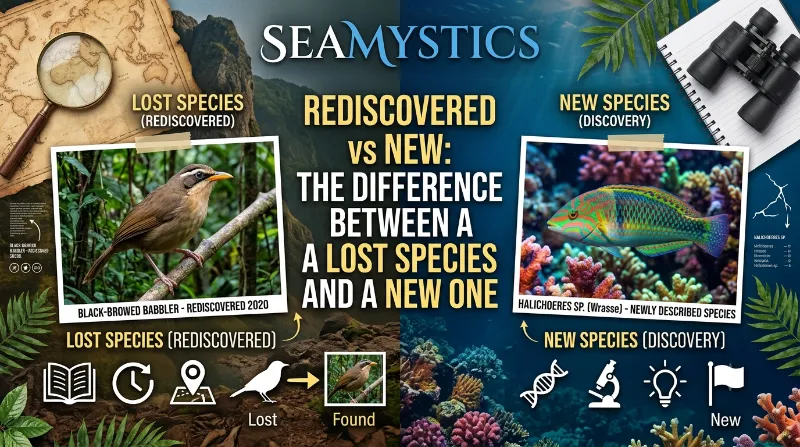
What Does “New Species” Actually Mean in Marine Biology?
A new species has never appeared in any scientific record before. Researchers cannot just call a strange looking creature new. They must run it through a strict confirmation process first. This process often takes years.
It usually starts with a specimen. A team collects it during a survey, a submersible dive, or even a lucky catch by a local fisher. Taxonomists then compare its body structure and genetics against every known relative. Only after this comparison, plus formal publication, does the creature earn official new species status. Our new species confirmation guide explains this process in more depth.
How Scientists Confirm a Brand New Species
Confirming a new species takes more than a guess. Marine biologists follow a fairly consistent set of steps. Skipping any step can get a claim rejected by peer reviewers.
- Collect a physical specimen or high resolution imagery from the field
- Run genetic sequencing and compare it against DNA databases, a process our DNA barcoding for species identification guide covers further
- Study the internal and external anatomy under a microscope
- Compare findings with related species already on record
- Publish a formal taxonomic description with a scientific name
- Deposit a reference specimen, called a holotype, in a recognized collection
WoRMS, the World Register of Marine Species, named ten standout marine species in 2023 alone. The list ranged from a carnivorous sponge collected by the research vessel Falkor to a giant fossil penguin reconstructed from ancient bones. That count is fairly typical for a single year. Thousands of ocean organisms still sit in labs, waiting their turn. Newsweek
Modern tools have sped this process up a lot. Remotely operated vehicles, or ROVs, now reach depths human divers cannot safely explore. Our ROV ocean discovery guide breaks down how these machines work. As a result, researchers document ocean life faster than ever before.
What Is a Rediscovered Marine Species?
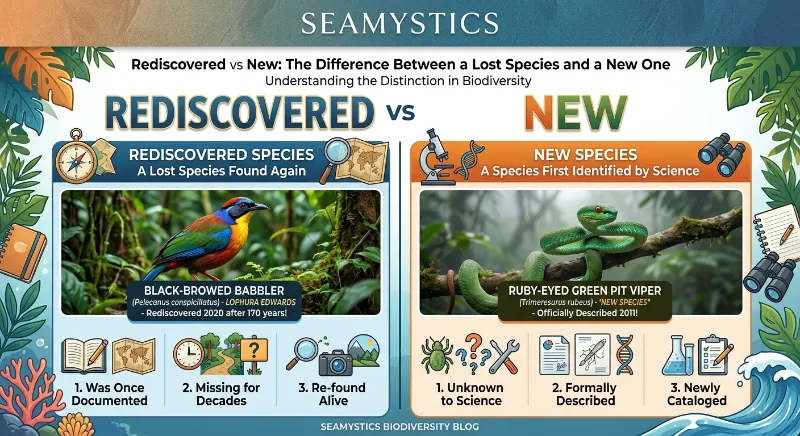
A rediscovered marine species already has a name, a described body, and a known range. But researchers stopped seeing it for so long that many assumed it went extinct. Someone eventually spots it again, whether through a fishing net, a survey camera, or a lucky dive. Scientists then formally reclassify it as “rediscovered.”
This differs a lot from finding something brand new. The biology already sits in textbooks and databases. The real discovery here proves survival, not existence. These creatures often become symbols of hope for conservation teams working against long odds.
The “Lazarus Species” Concept
Biologists often call these animals Lazarus species. The term borrows from the biblical story of a man raised from the dead. The Conversation reports that researchers have rediscovered more than 100 species this way across land and sea. Marine examples make up some of the most dramatic cases on record. All That’s Interesting
The coelacanth remains the gold standard example. Fossil records placed its extinction around 66 million years ago, right alongside the dinosaurs. Then in December 1938, a South African museum curator named Marjorie Courtenay-Latimer spotted a live specimen among a trawler’s catch. She quickly arranged for it to be studied. Scientists later confirmed a second living population off Indonesia in 1997. The species had survived in isolated pockets for tens of millions of years. ECOticias.com
Rediscovery is not just a story from the history books. In late 2023, researchers confirmed that houting, a whitefish officially declared extinct in the North Sea in 2008, was actually thriving in abundance throughout the sea. Just a year later, in 2024, scientists confirmed a single living Mesopotamian barbel. This critically endangered fish had not been scientifically documented since 2011. Discover WildlifeWorld Economic Forum
Rediscovered vs New: Key Differences at a Glance
The confusion between these two categories usually comes from sloppy headlines. Journalists sometimes write “scientists discover” for both situations. But the underlying science works very differently. The table below breaks it down.
| Question | Rediscovered Species | New Species |
|---|---|---|
| Did it have a name before? | Yes, already described | No, gets named for the first time |
| Was it previously studied? | Yes, often for decades | No prior formal research exists |
| What triggers the story? | Proof it survived after years unseen | Proof it exists at all |
| Typical media reaction | Emotional, hopeful, conservation focused | Curious, exploratory, science focused |
| Example timeline | Coelacanth, lost 66 million years, found in 1938 | Prince Albert’s sea daisy, described 2023 |
These differences also explain some public confusion. Occasionally a population blends traits of known relatives in strange ways. Our hybrid marine species guide covers these tricky, borderline cases in more detail.
Real-Life Examples: New Species Discoveries Making Headlines
New species discoveries have surged in recent years. Expanded deep sea missions and better imaging technology drive most of this growth. Ocean Census, a global collaboration focused on speeding up species discovery, documented 1,121 new marine species within a single year of coordinated expeditions. That list includes a translucent “ghost shark,” a sponge nicknamed the death ball, and a worm living inside a glass-like structure. Re:wild
MarineBio has tracked similar numbers. Its report shows Ocean Census findings of over 900 new marine species confirmed in a single year. This shows how much of the ocean floor still remains uncatalogued. A separate team under the Senckenberg Ocean Species Alliance published findings on eleven new marine invertebrate species, collected from depths as shallow as 5.2 meters and as deep as 7,081 meters. New species turn up everywhere, from tide pools to the deep abyss. biorxiv
Some standout new species categories worth knowing include:
- New coral species, explored further in our new coral species guide, including reef building varieties found near volcanic vents
- New jellyfish species, covered in our new jellyfish species guide, including a striking find called the St. George’s Cross Medusa
- New crustacean species, detailed in our new crustacean species guide, many living near hydrothermal vents threatened by deep sea mining
So many of these species live in extreme habitats. Projects like the Ocean Census project have become central to modern marine biology. Their new digital platform, called NOVA, lets researchers log a discovery within days. Older methods once took over a decade to formally describe a species.
Real-Life Examples of Species Rediscovery Across the Ocean
New species stories tend to focus on strange, alien-looking creatures. Species rediscovery ocean stories usually carry more emotional weight instead. These are animals people already knew and had grieved as lost. Their return feels like a second chance.
Omura’s whale offers one of the strangest cases in marine science. It sits right on the line between rediscovery and new discovery. Scientists formally named the species in 2003 using only dead specimens. They did not confirm a living population until years later, off the coast of Madagascar. The story blends both categories into one. All That’s Interesting
Ocean Conservancy has documented several standout marine finds worth reading directly. Check out five recently discovered ocean species that surprised researchers for a useful comparison read. SEA LIFE has also compiled a public friendly roundup of newly discovered sea creatures. It explains these concepts well for a general audience.
The leopard barbel gives another dramatic rediscovery story. It lives in freshwater and brackish zones connected to major river systems. Researchers had not documented it since 2011. One team member said he felt ready to travel to the ends of the earth just to see the fish alive again after its rediscovery in early 2024. ScienceDaily
Why the Difference Matters for Conservation and Policy
Confusing a rediscovered species with a new one is not just semantics. Conservation funding, legal protections, and public urgency often depend on the correct category. A rediscovered species already carries an extinction risk profile. Its return usually triggers immediate protective action instead of years of baseline research.
New species need a different approach. They often require years of population studies before anyone can estimate their risk level. This creates a strange gap. A brand new species could already be critically endangered the moment scientists name it, simply because its habitat shrinks faster than researchers can study it. Conservation groups now push for faster identification pipelines. They want protection efforts to keep pace with discovery.
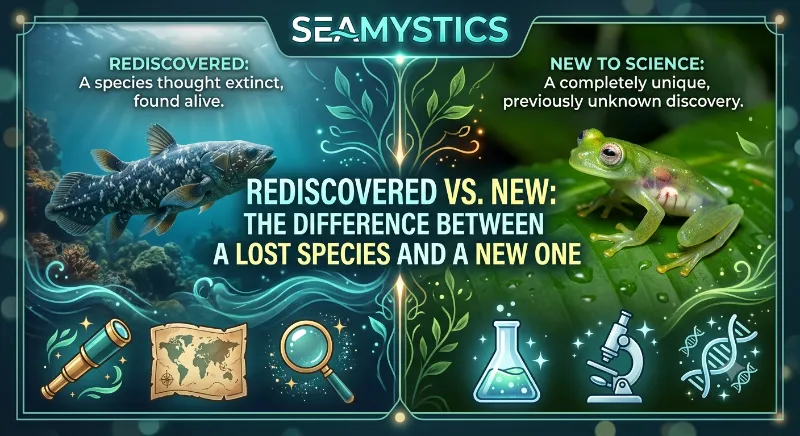
This distinction also shapes public interest and expedition funding. Emotional rediscovery stories, like the coelacanth or the houting, tend to draw huge public engagement and donations. New species discoveries build long term scientific value in a quieter way. They map out how much biodiversity still exists in unexplored ocean regions.
How Citizen Science and Technology Are Changing the Game
Ordinary people now play a bigger role in both types of stories. Trail cameras, underwater drones, and smartphone reporting apps let non-scientists contribute real evidence. Professional researchers later verify these tips. Our citizen science ocean guide explains exactly how volunteers can get involved.
Technology has transformed confirmation speed too. ROVs now survey depths beyond 7,000 meters. They document creatures that stayed unreachable just a few decades ago. Genetic sequencing tools have shrunk years of lab work down to a few weeks. This speeds up the entire pipeline for both categories of species.
These advances explain the sharp rise in ocean discovery over the past few years. Earlier researchers relied almost entirely on physical specimens pulled from nets. Today’s teams combine imaging, genetics, and global data sharing to confirm findings faster and with more confidence. Readers can browse the Sea Mystics homepage for more related expeditions and reports.
Frequently Asked Questions
What counts as a rediscovered marine species?
A rediscovered marine species already has a name and a scientific history. Scientists lost track of it for years or decades. They later confirmed it alive again through new sightings or specimens.
How is a new species different from a rediscovered one?
A new species has never been named before. A rediscovered species already had a name and history before it vanished from records.
Why do some species get declared extinct and then turn up alive?
Extinction declarations rely on the best evidence available at the time. Remote habitats, low survey funding, and small populations can hide a species for years.
How long does it typically take to confirm a new marine species?
Research shows the average gap runs around 13.5 years, from first discovery to formal description. Faster digital platforms are now shrinking that timeline.
Are rediscovered species automatically protected by law?
Not always. Legal protection usually depends on national or international listings. Conservation groups often push for updated status right after a confirmed rediscovery.
Conclusion
The ocean still holds far more mystery than most people realize. Both rediscovered and new marine species remind us how much work remains. A rediscovered marine species tells a story of survival against long odds. A new species reveals just how vast and unexplored the ocean truly is. Either way, every confirmed find adds another piece to a puzzle scientists are only beginning to solve.
References
- WoRMS, World Register of Marine Species, Ten Remarkable New Marine Species From 2023
- Newsweek, Animals Believed to Be Extinct Were Found All Over the World This Year
- Re:wild, Lost Species Found
- World Economic Forum, 6 Rediscovered Species That Were Once Lost to Science
- ScienceDaily, The Race to Discover Biodiversity: 11 New Marine Species
- Discover Wildlife, Back From the Dead: Meet 10 Incredible Animals Once Thought Extinct
- The Conversation, Meet the Lazarus Creatures
- Smithsonian Ocean Portal, Coelacanth
- MarineBio, Ocean Census Found Over 900 New Marine Species in a Single Year
- Ocean Conservancy, 5 Recently Discovered Ocean Species
- SEA LIFE, Newly Discovered Sea Creatures