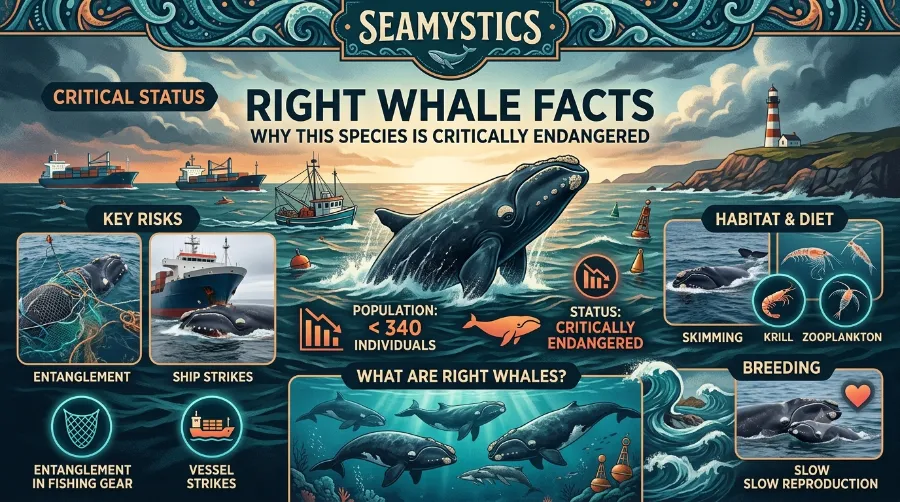

A whale the size of a school bus should be easy to protect. Yet fewer than 400 North Atlantic right whales remain on this planet. That number tells a story most people have never heard. These right whale facts are not just trivia for a nature documentary. They explain how a species that once numbered in the tens of thousands ended up on the edge of extinction. They also explain why the next ten years may decide whether it survives at all. If you care about ocean life or endangered species, this guide breaks it down in plain language.
Minke Whale Facts The Ocean’s Smallest Baleen Whale
Fin Whale Facts The Second Largest Animal on Earth
Key Takeaways
| Fact | Detail |
|---|---|
| Current population | Around 384 individuals (2024 estimate, released October 2025) |
| Conservation status | Critically endangered since 1970 under the US Endangered Species Act |
| Reproductively active females | Only about 70 remain |
| Top causes of death | Vessel strikes and fishing gear entanglement |
| Historical low point | 358 individuals in 2020 |
| Calving grounds | Coastal waters of Georgia and Florida |
| Feeding grounds | Gulf of Maine, Bay of Fundy, Cape Cod Bay |
| Average lifespan (unimpeded) | 70 years or more |
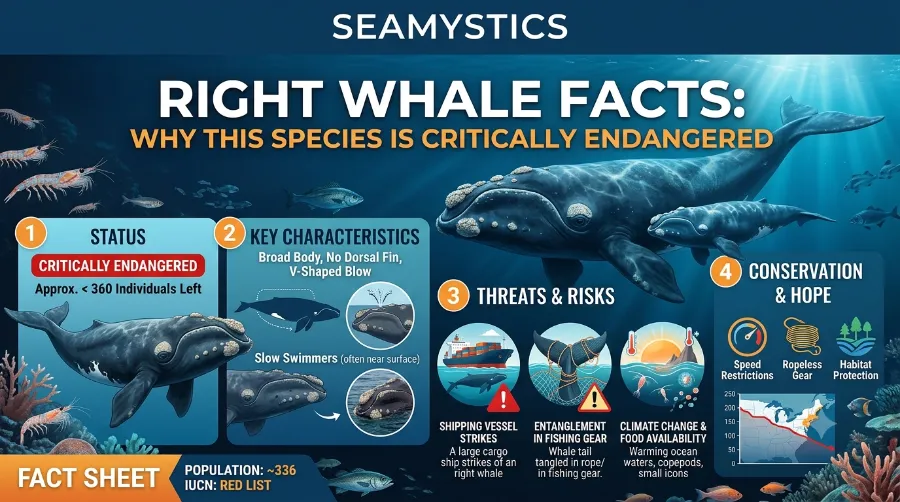
TL;DR: North Atlantic right whales are critically endangered because of ship strikes, fishing gear entanglement, and slow reproduction. Only around 384 individuals remain as of the 2024 count. The population has grown slightly for four straight years, but scientists warn this recovery is fragile.
Quick Right Whale Facts You Should Know
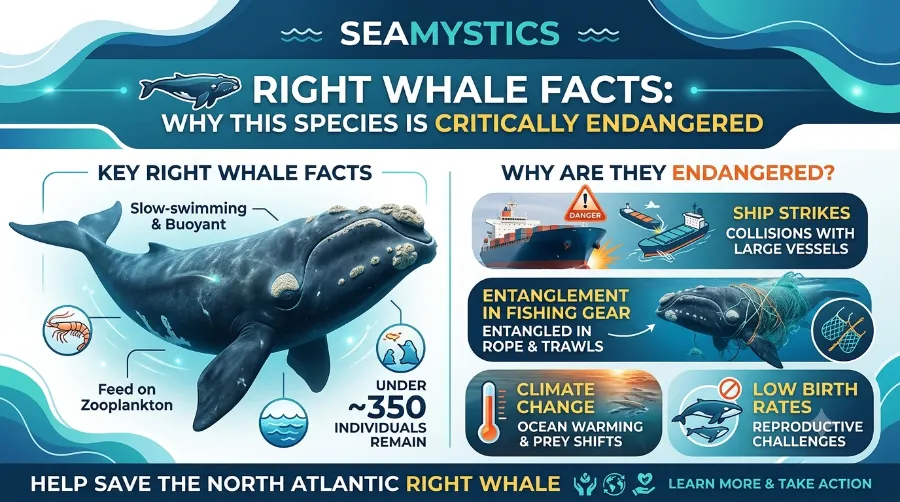
Before we look at the threats, let’s understand what makes this whale unique. North Atlantic right whales are baleen whales. They filter tiny prey through comb like plates instead of hunting with teeth. Their survival depends on finding dense patches of a small copepod called Calanus finmarchicus in cold northern waters.
Whale Blubber Explained How It Keeps a 100-Ton Animal Warm
Right whales grow up to 52 feet long. They can weigh as much as 70 tons. Their skin carries rough, white patches called callosities. No two whales share the same pattern, so researchers use these markings like fingerprints. Scientists at the New England Aquarium have named hundreds of whales this way, including a female called Monarch. She was spotted with a new calf in Cape Cod Bay in April 2025.
Here are some essential right whale facts:
- They can live 70 years or longer under normal conditions, though most now die far younger because of human causes.
- A single whale can filter thousands of gallons of water per hour while feeding near the surface.
- Gestation lasts about a year. Mothers usually calve once every three to ten years, which limits population recovery.
- Their name comes from old whaling days. Hunters called them the “right” whale to kill because they moved slowly and floated after death.
- North Atlantic right whales are close relatives of southern right whales. The two populations never mix, since they live in opposite hemispheres.
Why Is the North Atlantic Right Whale Critically Endangered
The short answer is human activity. But the full picture involves several overlapping problems. The Conservation Law Foundation notes that this species survived centuries of commercial whaling. Now it faces a new set of modern dangers tied to shipping and fishing.
Vessel Strikes
Ships moving through whale habitat cause one of the two leading causes of death. Right whales spend long stretches near the surface while feeding or resting. This makes them especially vulnerable to collisions with large vessels. In 2024 alone, researchers recorded eight vessel strikes. That number shows how much shipping lanes overlap with critical whale habitat along the eastern United States and Canada.
Speed restrictions in certain zones have helped. Enforcement, however, remains inconsistent. Conservation groups keep pushing for expanded slow speed zones during peak migration months.
Fishing Gear Entanglement
Entanglement in fishing gear causes chronic injuries. Ropes used in lobster and crab traps are the main culprit. These injuries can take months or years to kill a whale. In 2024, scientists documented 16 entanglements. Ten of those whales still carried gear on their bodies. One whale, catalog number 5110, showed up in Cape Cod Bay in 2025 with lines still wrapped around its mouth, even after responders tried to free it, according to the New England Aquarium.
This kind of injury often leads to infection. It also reduces feeding ability and can cause slow starvation. Even whales that survive an initial entanglement may not live much longer.
Habitat and Climate Shifts
Warming ocean temperatures have pushed the whales’ main food source further north. This forces right whales into new areas that lack the same legal protections as their traditional feeding grounds. Copepod populations track water temperature closely. So even small shifts in the Gulf of Maine can push whales into unprotected shipping lanes off Canada. This partly explains why Canadian waters have seen more whale sightings and related incidents over the past decade.
Low Calving Rates
Right whales reproduce slowly compared to many other whale species. Females typically do not give birth until they are around ten years old. Calving intervals have also stretched longer in recent years. Poor body condition, linked to chronic stress from entanglement, plays a major role here. In 2024, only 11 calves were born. Four of those came from first time mothers. That number barely keeps pace with the whales lost to human causes each year, per the Smithsonian Ocean program.
Right Whale Population Trends Through the Years
To understand where this species stands today, we need to look at the bigger picture. Commercial whaling nearly wiped out the North Atlantic right whale by the early 1900s. Perhaps a hundred or fewer individuals remained in the western Atlantic. An international whaling ban took effect in 1935. Numbers slowly climbed after that, though the recovery has never been steady.
| Year | Estimated Population | Notable Event |
|---|---|---|
| Early 1900s | Fewer than 100 | Near extinction from commercial whaling |
| 1970 | Unknown, believed very low | Listed as endangered under US law |
| 2011 | Around 480 | Historical peak in modern records |
| 2017 | Sharp decline begins | Unusual Mortality Event declared |
| 2020 | 358 | Historical low point in recent decades |
| 2023 | 376 | Third consecutive year of slow growth |
| 2024 | 384 (+10/-9) | 2.1 percent increase, fourth straight year without decline |
This table shows something important. The current right whale population sits below where it stood just over a decade ago. Recent years, though, show cautious improvement. The North Atlantic Right Whale Consortium calls the trend encouraging but fragile. A single bad year of ship strikes or entanglements could undo years of slow gains.
Where North Atlantic Right Whales Live and Migrate
North Atlantic right whales follow a predictable seasonal pattern each year. They move between calving grounds and feeding grounds along the eastern coast of North America.
- Winter (November through April): Pregnant females travel south to give birth in the shallow, warm coastal waters off Georgia and Florida.
- Spring: Whales move north again, often passing through busy shipping corridors along the mid Atlantic coast.
- Summer through fall: The whales gather in the Gulf of Maine, Bay of Fundy, and Cape Cod Bay to feed on dense copepod patches.
-
Whale Stranding Causes Why Whales Beach Themselves
This migration route places right whales directly in the path of some of the busiest ports on the East Coast. Boston, New York, and Norfolk all sit along this corridor. That overlap between whale habitat and shipping activity explains why so many conservation efforts focus on vessel speeds and shipping lane changes.
Right whale migration shares some similarities with other large whale species. Our guide on gray whale migration covers one of the longest known mammal migrations on Earth. It offers useful context for comparing how different species adapt to changing ocean conditions.
What Is Being Done to Save the Species
Government agencies, nonprofits, and scientists now work together on several fronts. IFAW points to seasonal speed restrictions, gear modification rules, and expanded aerial monitoring as key tools in this fight.
Some of the most notable current strategies include:
- Mandatory vessel speed limits of 10 knots or less in designated seasonal management areas.
- Ropeless fishing gear trials, which remove the vertical lines that cause most entanglements.
- Acoustic monitoring devices called SoundTraps, which record whale calls to track movement patterns.
- Photo identification catalogs that follow individual whales like Monarch across decades.
NOAA Fisheries updated its population modeling methods in 2025. The new model factors in calves more precisely. It also shows that mortality rates, while still too high, have slowed compared to the worst years between 2017 and 2019.
How You Can Help Protect Endangered Whale Species
Individual choices add up, especially around seafood sourcing and boating habits. A few practical steps make a real difference:
- Choose seafood labeled as whale safe or sourced from fisheries using ropeless gear where available.
- Support organizations that fund disentanglement teams and aerial survey programs.
- Slow down and report whale sightings if you boat along the East Coast during migration season.
- Stay informed about policy changes, since public comment periods often shape new regulations.
Learning about whale behavior builds appreciation for what is at stake. Our related piece on how whales sleep explains a surprisingly complex process that differs quite a bit from how land mammals rest.
Right Whale Extinction: How Close Is It, Really
The term right whale extinction shows up often in headlines, and for good reason. Only about 70 reproductively active females remain. That leaves the species with a very narrow path to recovery. Marine Mammal Commission data shows that between 2017 and early 2025, at least 151 whales were confirmed dead, seriously injured, or affected by illness under an ongoing investigation.
Pilot Whale Facts Why They’re Actually Giant Dolphins
Extinction, though, is not guaranteed. The population has grown for four consecutive years now, even if slowly. Scientists call this a narrow window of opportunity rather than a guaranteed recovery. A handful of extra deaths per year from ship strikes or entanglement could easily tip the trend back into decline.
How Right Whales Compare to Other Endangered Whale Species
Right whales are not the only large whale under pressure. Their situation, though, ranks among the most severe. The beluga whale faces different regional threats tied to Arctic development and pollution. Right whales deal with a more direct danger from ship traffic and fishing gear. Our guide on beluga whale facts highlights how geography changes the type of conservation challenge each species faces.
Frequently Asked Questions
How many North Atlantic right whales are left in 2026?
The most recent official estimate, released in October 2025, put the number at roughly 384 individuals as of the 2024 count. New figures usually come out each fall.
Why are right whales called critically endangered instead of just endangered?
The species has held federal endangered status since 1970. Its small population size and ongoing human caused deaths place it in the most severe risk category tracked by conservation scientists.
What is the biggest threat to right whales today?
Vessel strikes and fishing gear entanglement remain the two leading causes of death and serious injury, according to NOAA Fisheries.
Can North Atlantic right whales still recover?
Yes, though recovery depends heavily on cutting human caused deaths. The population has grown slightly for four straight years. Scientists warn this trend could still reverse without continued protection.
Where do right whales give birth?
Calving mainly happens in shallow coastal waters off Georgia and Florida during winter. Mothers and calves then migrate north together.
Conclusion
The story of the North Atlantic right whale is not just about a species fading away in some remote corner of the ocean. This whale swims through some of the busiest coastal waters in the world. It carries the weight of centuries of whaling history alongside modern threats from ships and fishing gear. The right whale facts covered here show a population that is small and fragile, yet still recovering in fits and starts. Continued protection and safer fishing gear could turn a fragile increase into a lasting comeback, as long as momentum does not slow down.
References
- Conservation Law Foundation, “Fascinating Right Whale Facts,” https://www.clf.org/blog/fascinating-right-whale-facts/
- International Fund for Animal Welfare, “North Atlantic Right Whale Facts,” https://www.ifaw.org/international/journal/north-atlantic-right-whale-facts
- Smithsonian Ocean, “North Atlantic Right Whale,” https://ocean.si.edu/ocean-life/marine-mammals/north-atlantic-right-whale
- NOAA Fisheries, “North Atlantic Right Whale,” https://www.fisheries.noaa.gov/species/north-atlantic-right-whale
- New England Aquarium, “North Atlantic Right Whale Population Continues Slow Growth,” October 2025
- Marine Mammal Commission, “North Atlantic Right Whale,” Priority Topics