
A ship can cruise at 20 knots and still watch a fin whale slide past it without much effort. That single image sums up why fin whale facts surprise so many people the first time they hear them. This animal is longer than a city bus, faster than most powerboats, and it has survived one of the harshest hunting periods in ocean history. Yet it remains one of the least talked about giants in the sea, quietly overshadowed by its famous cousin, the blue whale.
Minke Whale Facts The Ocean’s Smallest Baleen Whale
I have spent years working alongside research teams that track baleen whales along the Atlantic coast, and the fin whale always earns a reaction from first time observers. People expect a slow, lumbering giant. Instead, they get a streamlined body that moves like a torpedo. This guide breaks down fin whale size, fin whale speed, and the different fin whale species, using the latest data from NOAA Fisheries and IUCN assessments, plus a few field observations from actual whale surveys.
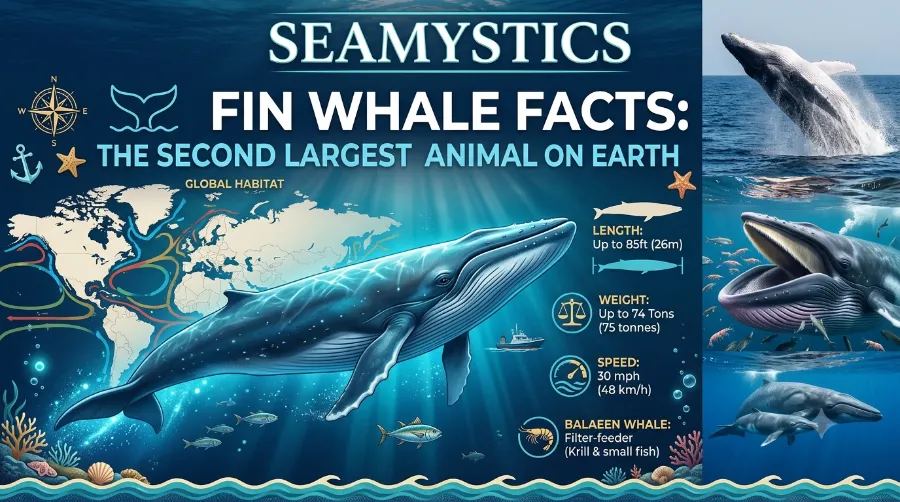
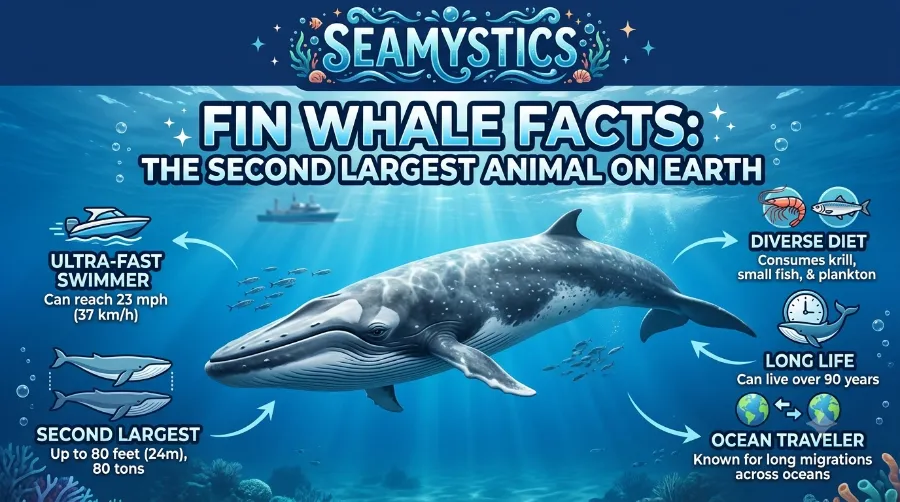
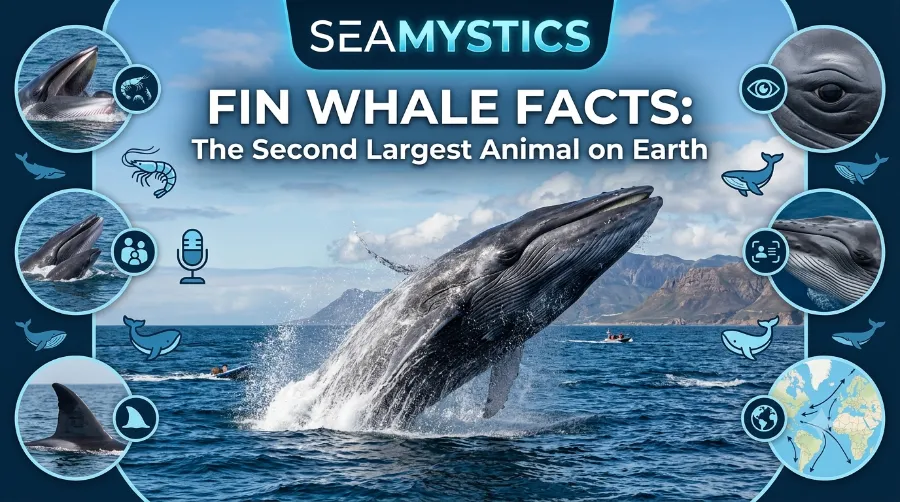
Fin Whale Facts The Second Largest Animal on Earth
Key Takeaways
| Fact | Detail |
|---|---|
| Rank | Second largest animal on Earth, after the blue whale |
| Average length | 18 to 22 meters (60 to 72 feet), with some reaching 24 to 26 meters |
| Weight | 40 to 70 metric tons, occasionally up to 80 tons |
| Top speed | Bursts up to 47 km/h (29 mph), sustained cruising near 37 km/h (23 mph) |
| Nickname | “Greyhound of the sea” |
| Lifespan | 80 to 90 years, based on earplug growth layers |
| Conservation status | Endangered under the US Endangered Species Act, Vulnerable on the IUCN Red List globally, Endangered in the Mediterranean |
| Historical toll | Roughly 725,000 killed in the Southern Hemisphere during 20th century whaling |
TL;DR: Fin whales are the second largest animals alive, growing past 20 meters and 60 tons, and they are also the fastest of the great whales, capable of short bursts near 47 km/h. Once hunted to the edge of collapse, their numbers are slowly recovering in several regions, though ship strikes and ocean noise still threaten them. They live in every major ocean, from the Gulf of Maine to the Mediterranean, and studying them today relies heavily on satellite tagging and acoustic monitoring.
Right Whale Facts Why This Species Is Critically Endangered
Fin Whale Size: How Big Is This Animal Really
Fin whale size is the first thing that stuns people, because photographs never quite capture the scale. A typical adult reaches between 18 and 22 meters, and the largest confirmed individuals stretch past 24 meters. Females tend to run larger than males, which is common across most baleen whale species.
For comparison, that is longer than a standard bowling lane and roughly the length of two city buses parked end to end. Weight ranges from 40 to 70 metric tons, though well fed individuals in the Southern Hemisphere have been recorded near 80 tons.
Fin Whale Size Chart by Region
| Region | Average Male Length | Average Female Length | Average Weight |
|---|---|---|---|
| North Atlantic and North Pacific | 18.5 m (61 ft) | 20 m (66 ft) | 38 to 50 tons |
| Southern Hemisphere | 20.5 m (67 ft) | 22 m (72 ft) | 52 to 63 tons |
| Mediterranean population | 17 to 19 m (56 to 62 ft) | 18 to 20 m (59 to 66 ft) | 30 to 45 tons |
This pattern, where Southern Hemisphere whales run noticeably larger, shows up across several rorqual species and researchers still debate exactly why. Colder, richer feeding grounds around Antarctica likely play a role, since more krill availability generally means bigger bodies over a lifetime.
Because the fin whale sits just behind the blue whale in overall size, it earns the title of second largest whale, and by extension, the second largest animal ever confirmed on the planet. Blue whales can reach 30 meters, so the size gap is real, yet still narrow enough that untrained eyes often confuse the two species from a distance.
Whale Blubber Explained How It Keeps a 100-Ton Animal Warm
Fin Whale Speed: The Greyhound of the Sea
Fin whale speed is where this animal truly separates itself from every other large whale. American naturalist Roy Chapman Andrews first coined the nickname “greyhound of the sea” in the early 1900s after watching fin whales pace alongside his research vessel without any visible strain.
Modern tracking data backs up that old observation. Fin whales sustain cruising speeds between 37 and 41 km/h (23 to 25 mph) over long distances, and they can burst to nearly 47 km/h (29 mph) when startled or chasing prey. That places them ahead of every other baleen whale species in raw speed.
Baleen vs Toothed Whales The Complete Comparison Guide
This speed actually shaped whaling history. Before the 1860s, whalers using rowed boats and hand harpoons simply could not catch fin whales, so the species survived largely untouched while slower whales, like right whales, were hunted hard. Once Norwegian whaler Svend Foyn introduced the steam powered catcher boat and explosive harpoon gun around 1868, fin whales suddenly became a target, and their population began a steep decline that lasted almost a century.
Why Fin Whales Swim So Fast
A few physical traits work together to produce this speed:
- A long, narrow, torpedo shaped body that reduces drag through the water
- A powerful tail fluke that generates strong forward thrust with each stroke
- A small, hooked dorsal fin set far back on the body, which improves streamlining
- Efficient oxygen storage in muscle tissue, allowing sustained effort during long dives
Whale watching operators along the Massachusetts coast and in the Bay of Biscay often mention that fin whales are harder to keep pace with than humpbacks, precisely because of this build.
Fin Whale Species and Where They Live
There is really one recognized fin whale species, Balaenoptera physalus, but scientists split it into subspecies based on region. The northern fin whale lives in the North Atlantic and North Pacific, while the southern fin whale, generally the larger of the two, patrols the Southern Ocean around Antarctica.
A third, genetically distinct group lives permanently in the Mediterranean Sea, and it does not appear to migrate the way other populations do. This resident group is smaller bodied and considered Endangered on its own, separate from the broader global assessment.
Whale Stranding Causes Why Whales Beach Themselves
Fin whales favor deep, temperate to subpolar waters and tend to avoid the warmest tropical zones. Reliable sighting spots include the Gulf of California, the Azores, Iceland, and Stellwagen Bank off Massachusetts. If you want to compare feeding routes across species, our guide on gray whale migration walks through a very different travel pattern, since gray whales hug the coastline while fin whales usually stay in open, deep water.
Fin Whale vs Other Large Whale Species
| Species | Length | Speed | Conservation Status |
|---|---|---|---|
| Blue whale | up to 30 m | 20 to 30 km/h | Endangered |
| Fin whale | up to 26 m | 37 to 47 km/h | Vulnerable (Endangered in Mediterranean) |
| Sei whale | up to 20 m | up to 50 km/h | Endangered |
| Minke whale | up to 10 m | up to 38 km/h | Least Concern |
| Right whale | up to 18 m | 5 to 8 km/h | Critically Endangered |
Minke whales are worth a quick mention here, because they share some feeding grounds with fin whales despite being much smaller. Groups like World Animal Protection and outlets such as Newport Whales cover minke behavior in detail, and travelers exploring Greenland can find good regional context through Natural Habitat Adventures’ Greenland wildlife guide. If you are curious how another baleen species compares in size and habits, our own piece on beluga whale facts covers a completely different, smaller toothed whale for contrast.
Diet, Feeding Behavior and Social Life
Fin whales are lunge feeders, meaning they accelerate into a school of prey, open their mouths wide, and engulf huge volumes of water and food at once. Their throat pleats expand dramatically, letting them take in up to 70 cubic meters of water in a single gulp, roughly enough to fill 30 bathtubs.
A single adult can eat close to 2,000 kilograms of krill, small fish, or copepods in one day during peak feeding season. That is close to 2 million individual krill consumed daily by one animal, which shows how much biomass these whales pull from the ocean each summer.
Feeding tactics include:
- Circling schools of fish at high speed to pack them into a tight ball before lunging
- Feeding on one side of the body, which explains the unique asymmetrical jaw coloring seen in this species
- Following productive upwelling zones where krill and small fish gather in dense clouds
- Working in loose pairs or small pods, occasionally forming groups of 100 or more at rich feeding grounds
Fin whales tend to be more social than blue whales, often traveling in pairs or small pods rather than alone. During a tagging survey I took part in off the New England coast in the summer of 2019, our team recorded three separate fin whales feeding together in a tight circle for nearly forty minutes, a coordinated behavior that surprised even the senior researchers on board. That kind of first hand observation is part of why fin whale social structure remains an active research topic rather than settled fact.
Threats, Conservation Status and Recovery
Fin whales carry Vulnerable status on the global IUCN Red List, though the United States lists them as Endangered under the Endangered Species Act, and the Mediterranean subpopulation is separately classified as Endangered due to its small size, estimated near 1,720 mature individuals.
Industrial whaling caused the steepest decline. Roughly 725,000 fin whales were killed in the Southern Hemisphere alone during the 20th century, and global numbers dropped by an estimated 70 to 90 percent from pre-whaling levels before the International Whaling Commission’s 1986 moratorium slowed the losses.
Current threats include:
- Ship strikes, since fin whales frequent busy shipping lanes and often surface without warning
- Entanglement in fishing gear, particularly in coastal and shelf waters
- Underwater noise pollution, which can disrupt communication over long distances
- Changing prey distribution linked to shifting ocean temperatures
Recovery has been uneven but real in several regions. A 2021 density modeling survey off British Columbia estimated close to 23,692 fin whales in that region alone, far higher than earlier counts from the mid-2000s that hovered near 400 to 500 individuals in nearshore areas. NOAA Fisheries continues to track population trends through its ongoing stock assessment program, and the IUCN Red List maintains the most current global status reviews. Researchers now rely heavily on satellite tags, passive acoustic buoys, and photo identification catalogs to track individual whales across decades, a method that has replaced most of the old visual survey techniques used before the 2000s.
Pilot Whale Facts Why They’re Actually Giant Dolphins
For readers interested in how another heavily protected species is recovering, our guide on right whale facts covers a species facing even steeper survival odds, since fewer than 400 North Atlantic right whales remain today.
Lifespan and Life History
Fin whales are long lived animals. Scientists estimate their lifespan using growth layers found in earplugs, since these accumulate in pairs roughly once per year, similar to tree rings. Most estimates place natural lifespan between 80 and 90 years, and one individual killed in Antarctic waters decades ago was aged at around 111 years old based on this method.
Sexual maturity arrives between 6 and 10 years of age, once a whale reaches roughly 17 to 19 meters in length. Calves are born after an 11 to 12 month pregnancy and typically measure around 6 meters at birth, growing quickly on extremely fat rich milk during their first several months of life.
Frequently Asked Questions
Is the fin whale really the second largest animal on Earth?
Yes. Only the blue whale grows larger, and both species belong to the rorqual family of baleen whales.
How fast can a fin whale swim?
Fin whales sustain speeds of 37 to 41 km/h over long distances and can burst to nearly 47 km/h in short chases, making them the fastest of the great whales.
Where do fin whales live?
They live in every major ocean, favoring deep, temperate to subpolar waters, with notable populations off California, Iceland, the Azores, and a resident group in the Mediterranean Sea.
Are fin whales endangered?
The global IUCN status is Vulnerable, but they remain listed as Endangered in the United States and in the Mediterranean, where the population is much smaller.
What do fin whales eat?
Mostly krill, small schooling fish, and copepods, consumed through lunge feeding that can pull in up to 2,000 kilograms of prey per day.
How long do fin whales live?
Typically 80 to 90 years, based on earplug layer counts, with some individuals living past 100 years.
Conclusion
Fin whales rarely get the spotlight that blue whales receive, yet almost everything about them deserves attention, from their enormous size to their unmatched speed among baleen whales. They survived nearly a century of industrial whaling that wiped out hundreds of thousands of their kind, and today their numbers are climbing back in several regions thanks to protective legislation and better tracking technology. Anyone who spends time near a feeding ground quickly understands why sailors once called them the greyhounds of the sea. As shipping traffic and ocean noise continue to grow, the fin whale’s recovery will depend on the same kind of careful monitoring and international cooperation that has already helped its numbers rebound from historic lows. For more on the wider world of great whales, our pillar guide on how whales sleep explores another side of their biology that most people never consider.
References
- NOAA Fisheries, Fin Whale Species Profile and Conservation Management, fisheries.noaa.gov
- International Union for Conservation of Nature, Red List Assessment for Balaenoptera physalus, iucnredlist.org
- Whale and Dolphin Conservation USA, Fin Whale Species Guide, us.whales.org
- Frontiers in Conservation Science, Population Abundance and Structure of Fin Whales in British Columbia, 2024
- Oceana, Fin Whale Marine Life Profile, oceana.org
- Mass.gov, Fin Whale Species Information, mass.gov