
I still remember the first time I watched a cuttlefish vanish in front of my eyes. I was doing a night dive off a seagrass bed, and a lump of “sand” near my fin suddenly grew arms and swam away. That moment, honestly, taught me more about the ocean than any textbook ever did. In this guide, you will get real cuttlefish facts explained in plain language, based on published research, dive logs, and years spent watching these animals up close.
Mimic Octopus Facts The Animal That Impersonates Others
Cuttlefish are not fish at all. Instead, they belong to a group of soft-bodied ocean animals called cephalopods, and they are famous for one wild skill: changing their skin color and texture in under a second. Their brains, their camouflage, and their strange three-hearted bodies make them one of the most studied animals in the sea today. So let us break down what makes them so unusual, and why marine biologists like myself cannot stop talking about them.
Nudibranch Facts Why These Sea Slugs Steal Their Colors
Key Takeaways
| Fact | Detail |
|---|---|
| Color change speed | Skin pattern can shift in under 1 second |
| Number of species | Around 120 known cuttlefish species |
| Brain to body ratio | One of the highest among invertebrates |
| Lifespan | Usually 1 to 2 years |
| Color vision | Cuttlefish appear to be color blind, yet still match colors |
| Skin cell type | Chromatophores, iridophores, and leucophores |
| Famous 2025 study | Broadclub cuttlefish use moving stripes to hypnotize prey |
| Habitat | Coastal waters, reefs, and seagrass meadows worldwide |
TL;DR: Cuttlefish are cephalopods that change color and texture almost instantly using layered skin cells, even though their eyes cannot see color. Recent studies from 2023 to 2025 show their camouflage is more complex than once believed, and their intelligence rivals some primates in certain memory and self-control tests. This guide walks through their biology, species, and behavior with real examples from the field.
Clownfish Facts Explained The Real Science Behind Nemo’s Species
Cuttlefish Facts Explained: Why This Animal Deserves Attention
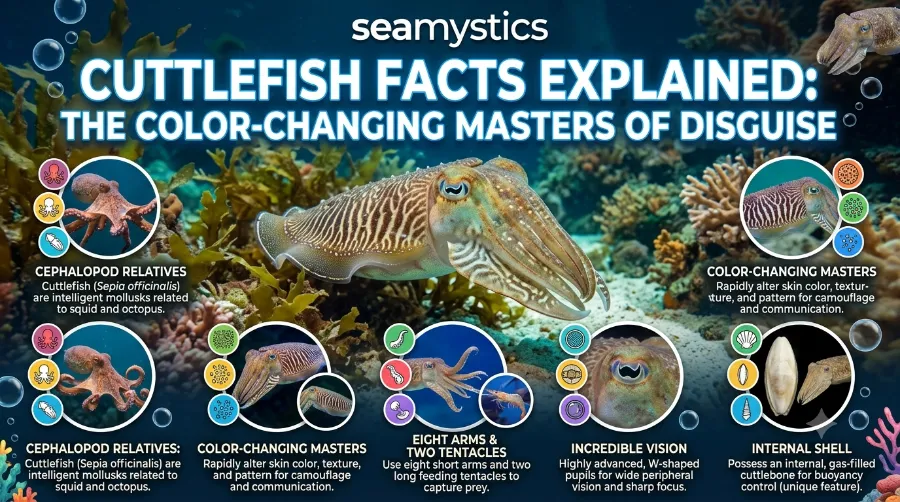
Most people know cuttlefish from aquarium tanks or nature documentaries, yet very few understand how their bodies actually work. Of course, a cuttlefish is neither a fish nor a squid, although it is closely related to both octopus and squid. It has eight arms, two longer feeding tentacles, and an internal shell called a cuttlebone that helps it control buoyancy.
Leafy Sea Dragon Facts Nature’s Best Camouflage Artits
What sets cuttlefish apart, however, is not their shape. It is their skin. Underneath that skin sits one of the most advanced color changing systems in the animal kingdom, and scientists are still uncovering new details about how it works. Because of this, cuttlefish sit at the center of ongoing research into camouflage, vision, and even soft robotics.
If you want to understand ocean camouflage as a whole, our pillar guide on ocean animal camouflage covers other masters of disguise as well, from octopus to flatfish. Cuttlefish, though, remain the benchmark species for this kind of research.
Cuttlefish Color Change: How the Skin Actually Works
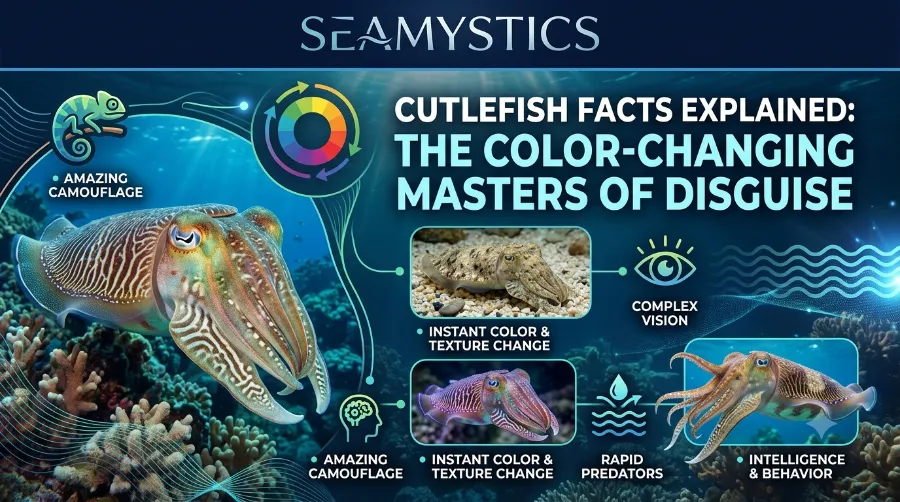
Cuttlefish color change happens through three layers of specialized skin cells working together. Naturally, this is not paint or pigment applied on top of the skin. Rather, it is a living, muscle-controlled system that reacts to what the cuttlefish sees around it.
Sea Cucumber Facts The Ocean’s Strangest Defense Mechanism
Here is a simple breakdown of the three layers, based on research from the Okinawa Institute of Science and Technology and the Max Planck Institute for Brain Research:
- Chromatophores: First, these are pigment sacs sitting closest to the surface. Tiny muscles pull them open or let them shrink, changing how much yellow, red, or brown shows through. Each chromatophore is surrounded by a set of muscles that contract and relax under direct control of neurons. ScienceDaily
- Iridophores: Next, sitting below the chromatophores, these reflect light and create shimmering blues and greens.
- Leucophores: Finally, the deepest layer, these scatter white light and help the animal match brighter backgrounds like sand.
Meanwhile, a 2023 study published in Nature, led by researchers at OIST, analyzed over 200,000 observations of cuttlefish reacting to different backgrounds. The team found that the process is highly dynamic and depends on the instinctive coordination of thousands of neurons that interpret surrounding visual scenes almost instantaneously. In simple terms, the cuttlefish brain is running a constant visual calculation, and the skin is the output screen. Courthouse News Service
Why Color Vision Is Not Required
What makes this even stranger is that cuttlefish cannot actually see in color. Even so, their eyes only detect light and dark, yet they still manage to match colors almost perfectly. Interestingly, some researchers believe cuttlefish may sense color through light-sensitive cells in their skin itself, a theory that is still being tested in labs today. Ultimately, this single fact alone is why so many people search for cuttlefish facts explained in the first place, because it defies normal biology.
Flounder Camouflage Facts How This Fish Changes Its Own Skin Pattern
For a great visual walkthrough of this process, PADI’s dive education team put together a helpful overview of cuttlefish fun facts that pairs well with underwater footage.
Cuttlefish Camouflage Science: Beyond Simple Blending
Cuttlefish camouflage science used to be explained with one simple idea, blend into the background and hope predators pass by. However, recent field research shows this picture is incomplete. Rather than just hiding, cuttlefish actively use motion, pattern, and timing as hunting tools.
A landmark study published in Science Advances in March 2025 by researchers from the University of Bristol tracked wild broadclub cuttlefish while they hunted small crabs and fish. The team uncovered a novel form of motion camouflage, in which the cuttlefish passed dark stripes downward across their head and arms to disguise their hunting movements. According to lead researcher Dr Matteo Santon, this pattern seems to overwhelm the visual system of the prey, so it fails to notice the predator closing in until it is too late. ScienceDaily
As a result, this is a big shift in how biologists think about camouflage. Traditionally, camouflage research focused on prey animals hiding from hunters. This new evidence, though, flips that idea, showing that a predator can use a moving visual trick to mask its own approach. Overall, it is one of the clearest examples of how ocean animals evolve tools that blur the line between hiding and hunting.
A Field Encounter in Lembeh Strait
During my own fieldwork off the coast of Lembeh Strait in 2019, I watched a broadclub cuttlefish stalk a small goby for almost four minutes, its skin flashing rolling bands of dark and light the entire time. At the time, I assumed it was simple excitement or stress coloring. Years later, though, reading the Bristol team’s findings gave that memory a whole new meaning, and it is a good reminder that ocean behavior often looks random until science catches up to explain it.
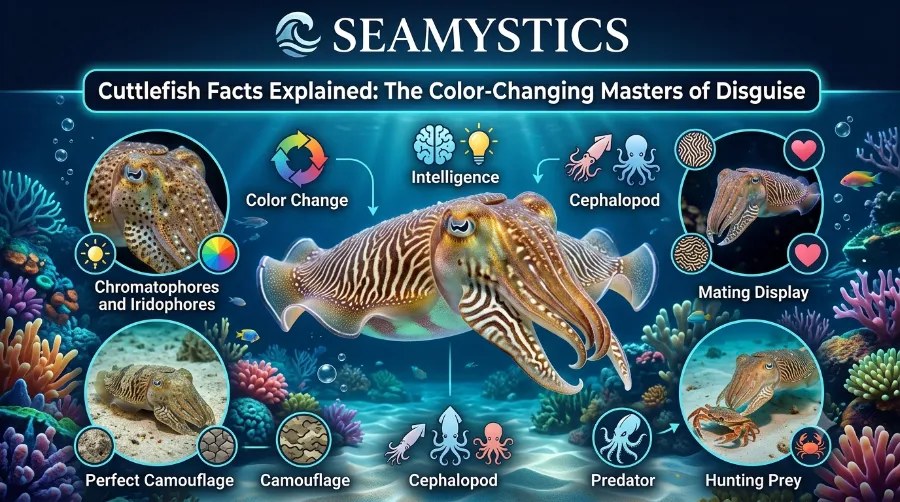
In addition, cuttlefish camouflage depends heavily on eyesight and texture control, not just color. Their skin contains small bumps called papillae that can rise or flatten in less than a second, mimicking coral, rock, or seaweed texture. Similarly, divers who want to see this trick in action can read more from Emperor Divers, who documented several encounters in their piece on cuttlefish, the masters of disguise.
Quick Steps: How a Cuttlefish Camouflages in Real Time
- First, eyes scan the surrounding seafloor, reef, or seagrass for color and pattern cues.
- Then, the brain sends signals through nerve cells directly to skin muscles.
- Meanwhile, chromatophores expand or shrink to adjust surface color within milliseconds.
- Next, iridophores and leucophores shift underneath to fine tune brightness and shimmer.
- Finally, papillae muscles raise or flatten to match rough or smooth textures nearby.
Cuttlefish Intelligence Facts: Smarter Than Most People Assume
Cuttlefish intelligence facts have surprised even experienced marine biologists in the last few years. Indeed, these animals live short lives, usually only one to two years, yet they show learning and memory skills that researchers once thought belonged only to primates, crows, and a handful of other animals.
Stonefish Venom Facts Why It Is the Ocean’s Deadliest Fish
The clearest example comes from a study published on March 3, 2021, in Proceedings of the Royal Society B, led by Dr Alexandra Schnell at the University of Cambridge. For this experiment, researchers adapted the famous “marshmallow test,” originally designed for children, to work with common cuttlefish. Remarkably, the cuttlefish could wait for over two minutes for a better snack rather than eating a lower quality meal right away. Dr Schnell noted that this was surprising for a fast-growing animal with an average lifespan of less than two years. University of CambridgeUniversity of Cambridge
The same study also tested learning speed. Notably, cuttlefish that waited the longest for the better food also performed best in a separate learning task, marking the first documented link between delayed gratification and intelligence in a species outside primates. That connection between patience and problem solving is rare in the animal world, and it places cuttlefish in some unusual company. uchicago
What Later Research Confirmed
Follow up research has continued to build on these findings. Specifically, recent work summarized by ocean science outlets in early 2025 described how cuttlefish that showed strong self-control also adapted faster when researchers switched the reward rules midway through testing, suggesting flexible memory rather than fixed habit. This kind of mental flexibility, though, is normally associated with animals that live in groups and raise their young, yet cuttlefish do neither. Most, in fact, hatch alone and never meet a parent.
A few more cuttlefish intelligence facts are worth knowing:
- First, they can recognize and remember individual humans in some lab settings.
- Also, they show evidence of episodic-like memory, recalling what, where, and when food was found.
- Notably, their brain to body size ratio is among the highest of any invertebrate.
- Finally, they appear to plan foraging decisions based on expected hunger later in the day, not just current hunger.
Cuttlefish Species Facts: Meet the Family
Cuttlefish species facts often surprise beginners because people assume there is only one type. In reality, there are around 120 recognized species, ranging from tiny reef dwellers to giants nearly a meter long. Below, then, is a comparison table covering some of the most notable species divers and researchers encounter.
| Species | Common Name | Typical Size | Notable Trait |
|---|---|---|---|
| Sepia officinalis | Common cuttlefish | 30 to 45 cm | Most studied species in labs worldwide |
| Sepia apama | Giant Australian cuttlefish | Up to 100 cm | Forms massive mating gatherings off South Australia |
| Sepia bandensis | Dwarf cuttlefish | 5 to 7 cm | Popular in home aquariums |
| Sepia latimanus | Broadclub cuttlefish | Up to 50 cm | Subject of the 2025 motion camouflage study |
| Metasepia pfefferi | Flamboyant cuttlefish | 6 to 8 cm | Walks on the seafloor instead of swimming |
The Giant Gathering at Whyalla
The giant Australian cuttlefish deserves special mention here. Every winter, tens of thousands gather along a narrow stretch of rocky reef near Whyalla, South Australia, to mate. Consequently, this event has become one of the most studied cephalopod gatherings on the planet, and local conservation groups have tracked population swings closely since the early 2000s, after numbers dropped sharply and then slowly recovered.
Seagrass meadows are another important habitat for several cuttlefish species, offering shelter for both adults and eggs. In particular, Project Seagrass has documented how these ecosystems support cuttlefish through their early life stages in their feature on creatures that call seagrass home, which is worth a read for anyone interested in habitat conservation.
Real World Examples and Field Observations
Textbook facts only tell part of the story, so let me share a few grounded examples from actual research and dive logs.
Pattern Switching in the Wild
In 2020, a team studying cuttlefish camouflage recorded that a single cuttlefish can produce more than 30 distinct body patterns depending on the background and threat level. In practice, this means the same individual might look completely different within the same afternoon, simply by moving between a rocky patch and a sandy clearing. Personally, I have logged this behavior dozens of times during survey dives in Indonesia and the Philippines, and it remains one of the most reliable ways to identify a resting cuttlefish, since the shift often happens the moment a diver gets too close.
Why Aquaculture Researchers Care Too
Aquaculture researchers have also studied cuttlefish for practical reasons. For instance, a 2020 paper in Aquaculture examined how controlled backgrounds affect stress and pigmentation in farmed cuttlefish, since color patterns can signal health status to caretakers. Ultimately, this kind of applied research shows that cuttlefish study is not limited to pure biology labs, it also feeds into aquaculture management and even materials science, where engineers study chromatophores for ideas on adaptive camouflage fabric.
Common Myths About Cuttlefish
A few misunderstandings keep showing up in articles and forums, so it helps to correct them clearly.
- Cuttlefish are a type of fish, or so people assume. In fact, they are mollusks, closely related to octopus and squid, not fish at all.
- Some believe they change color mainly to hide from predators. However, research shows they also use color and pattern to hunt, communicate, and even startle rivals during mating disputes.
- It is often thought that cuttlefish live for many years. On the contrary, most species live only one to two years, making their learning abilities even more remarkable given such a short lifespan.
- Many assume all cuttlefish look similar. Yet with around 120 species, sizes range from a few centimeters to nearly a meter, and coloring varies dramatically.
If you want to compare cuttlefish behavior against their closest relatives, our related guide on octopus versus cuttlefish intelligence breaks down the differences in more depth.
Chromatophore Density Chart
Based on published cephalopod skin studies, chromatophore density varies significantly across the body, which explains why certain areas change color faster than others.
| Body Region | Approximate Chromatophore Density | Color Change Speed |
|---|---|---|
| Head and mantle | High | Very fast, under 1 second |
| Arms | Medium to high | Fast, 1 to 2 seconds |
| Fin margins | Medium | Moderate |
| Underside | Low | Slower, often stays pale |
This pattern makes sense biologically. Since the head and upper mantle face the most visual exposure to predators and prey, evolution has packed that area with the densest network of pigment cells.
Frequently Asked Cuttlefish Facts Explained
How fast can a cuttlefish change color?
Generally, a cuttlefish can shift its entire skin pattern in less than one second, thanks to direct nerve control over its chromatophores.
Are cuttlefish dangerous to humans?
No, cuttlefish are not dangerous to humans. Instead, they are shy animals that prefer to camouflage or swim away rather than confront a diver.
Can cuttlefish actually see color?
Currently, evidence suggests cuttlefish are color blind, yet they still match background colors accurately, possibly through light sensitivity in their skin.
How long do cuttlefish live?
Typically, most cuttlefish species live between one and two years, which makes their advanced learning and memory abilities especially unusual among animals.
What is the smartest cuttlefish species?
Generally speaking, the common cuttlefish, Sepia officinalis, is the most studied in cognitive research and has shown strong results in memory and self-control testing.
Conclusion
Cuttlefish remain one of the clearest examples of how much mystery still exists beneath the surface of the ocean. Their skin works like a living screen, their hunting tricks fool prey that never see it coming, and their memory skills challenge old assumptions about which animals count as intelligent. Every new study, from the 2021 Cambridge self-control experiments to the 2025 Bristol motion camouflage findings, adds another piece to a puzzle that researchers are still solving. For divers, students, and curious readers alike, few ocean animals reward close attention quite like the cuttlefish does. To keep exploring marine adaptations like this, visit Sea Mystics for more research-backed ocean guides.
References
- Santon, M., Troscianko, J., Heatubun, C. D., & How, M. J. (2025). Stealth and deception: Adaptive motion camouflage in hunting broadclub cuttlefish. Science Advances, 11(13). University of Bristol.
- Schnell, A. K., et al. (2021). Cuttlefish exert self-control in a delay of gratification task. Proceedings of the Royal Society B. University of Cambridge.
- Okinawa Institute of Science and Technology & Max Planck Institute for Brain Research (2023). Cuttlefish camouflage: More than meets the eye. Published in Nature.
- How, M. J., van den Berg, C., Karcz, M., Heatubun, C. D., & Santon, M. (2025). Multiple hunting displays in wild broadclub cuttlefish. Ecology.
- Emperor Divers. Cuttlefish, the Masters of Disguise.
- PADI Blog. Cuttlefish Fun Facts.
- Project Seagrass. Creatures That Call Seagrass Home: The Cuttlefish.