
Picture a soft, slow-moving creature with no claws, no teeth, and no shell, sitting quietly on the seafloor. Now picture that same creature fighting off a predator by shooting its own guts out through its body wall. That is not science fiction. It is one of the strangest sea cucumber facts in the animal kingdom, and it happens more often than most people think.
Nudibranch Facts Why These Sea Slugs Steal Their Colors
Sea cucumbers look boring at first glance. They barely move, they barely react, and they spend most of their life doing very little. But under that plain, tube-shaped body is one of the weirdest survival systems in the ocean. This guide walks through what sea cucumbers actually are, where they live, and why their defense strategy, called evisceration, has fascinated marine biologists for decades.
Key Takeaways
| Fact | Detail |
|---|---|
| What it is | A soft-bodied marine animal related to starfish and sea urchins |
| Main defense | Evisceration, expelling internal organs to confuse or repel predators |
| Recovery time | Most species regrow lost organs within weeks to a few months |
| Habitat | Found on ocean floors worldwide, from shallow reefs to deep trenches |
| Extra weapon | Sticky Cuvierian tubules that can trap or tangle a predator |
| Human use | Harvested for food and traditional medicine across Asia |
| Conservation status | Several species are overharvested and now protected in parts of their range |
TL;DR: Sea cucumbers are slow, soft-bodied ocean animals that defend themselves through evisceration, a process where they expel sticky internal organs to confuse or entangle predators, then regrow those organs later. Some species also release toxins or sticky Cuvierian tubules as backup weapons. It is one of the odder survival tricks found anywhere in the ocean.
What Is a Sea Cucumber, Exactly
Sea cucumbers are not vegetables and they are not related to cucumbers at all. They belong to the class Holothuroidea, which puts them in the same broader group as starfish and sea urchins, known as echinoderms. There are over 1,700 known species, ranging from a few centimeters long to giants over a meter in length.
Clownfish Facts Explained The Real Science Behind Nemo’s Species
Their body is soft, leathery, and tube-shaped, which is exactly how they got their common name. Most species move using tiny tube feet along the underside of their body, and many feed by sweeping sediment into their mouth to filter out algae and organic particles. According to the Florida Museum of Natural History, sea cucumbers play a major role in recycling nutrients on the seafloor, functioning almost like earthworms of the ocean.
Because they lack a shell, spines, or speed, sea cucumbers had to evolve a different kind of protection. That protection turned out to be one of the most unusual in the animal kingdom.
Mantis Shrimp Facts The Animal With the Strongest Punch in the Ocean
Sea Cucumber Habitat: Where They Actually Live
Sea cucumber habitat spans nearly every ocean on Earth. They live on coral reefs, sandy lagoons, rocky shorelines, and even the deepest parts of the ocean floor. Some species have been documented at depths beyond 5,000 meters, where almost nothing else can survive.
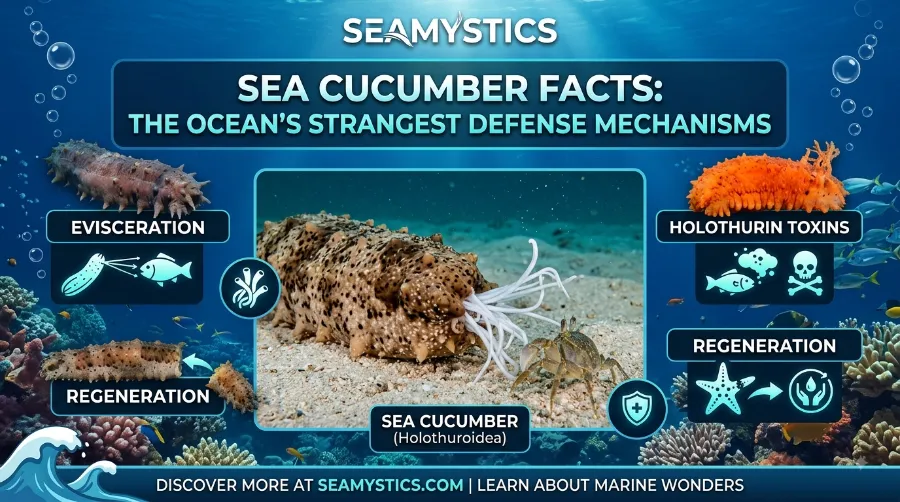
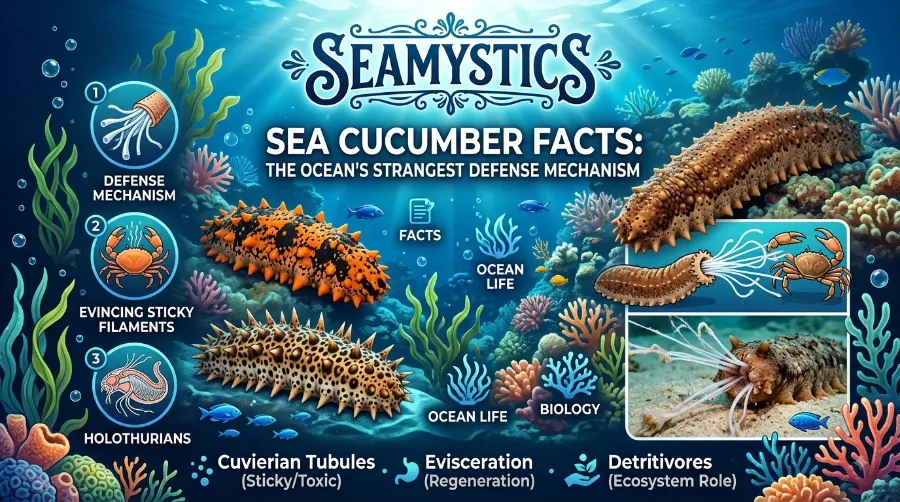
Sea Cucumber Facts The Ocean’s Strangest Defense Mechanism
A few common habitat patterns worth knowing:
- Shallow tropical waters, especially around coral reefs in the Indo-Pacific region
- Sandy or muddy sediment zones, where they burrow partially or fully
- Deep-sea trenches, where certain species make up a large share of the total seafloor biomass
- Temperate coastal zones, including parts of the Mediterranean and the Atlantic
This wide range is part of why sea cucumbers are considered so ecologically important. If you’re curious how other ocean animals use their surroundings to survive, our guide to ocean animal camouflage covers a very different strategy from the one sea cucumbers rely on.
Sea Cucumber Defense: Why Evisceration Exists
Here is where sea cucumber facts get genuinely strange. When a sea cucumber is grabbed, squeezed, or threatened, many species respond by violently contracting their body and expelling parts of their internal organs, usually through the anus, though a few species push them out through a tear in the body wall.
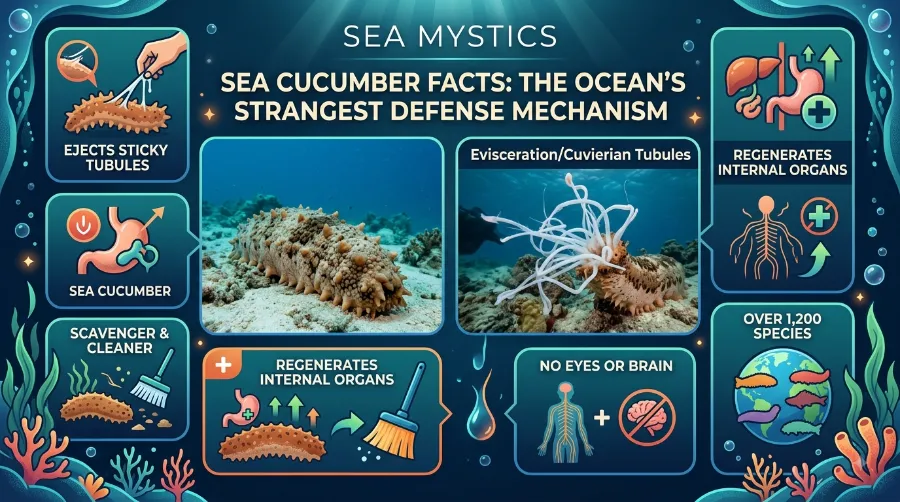
This is called evisceration, and it is not an accident or an injury response. It is a deliberate, evolved defense.
How Evisceration Actually Works
The expelled organs, often sticky respiratory tubules or intestinal material, do two things at once. First, they can physically entangle or gum up a predator’s mouth. Second, in some species those expelled tissues contain toxins that irritate or deter the attacker. While the predator is distracted dealing with a mouthful of sticky, sometimes toxic material, the sea cucumber uses the moment to move away.
It sounds costly, and it is. But sea cucumbers have a remarkable ability to regenerate. Research summarized by the Sanibel Sea School notes that many species can regrow their expelled organs within a matter of weeks, though full recovery can take a few months depending on the species and water temperature.
Cuvierian Tubules: The Backup Weapon
Some sea cucumber species, particularly in the family Holothuriidae, have an even more specialized version of this defense called Cuvierian tubules. These are thin, sticky, thread-like structures stored near the animal’s respiratory system. When threatened, the sea cucumber contracts and shoots these tubules out of its body at the attacker.
On contact with water, the tubules rapidly expand and become extremely sticky and elastic, sometimes stretching to many times their original length. A crab, fish, or small predator can end up completely entangled in a sticky web, giving the sea cucumber time to retreat. Some species also load these tubules with a toxin called holothurin, which adds a chemical deterrent on top of the physical one.
This layered defense, sticky entanglement plus toxin, is similar in spirit to how other slow-moving ocean animals rely on chemistry rather than speed. The stonefish’s venom-based defense is a good comparison, since both animals trade mobility for a potent chemical backup plan.
Weird Ocean Defense: How Sea Cucumbers Compare to Other Species
Evisceration is bizarre, but it is not the only strange survival trick in the ocean. Marine animals have evolved wildly different solutions to the same basic problem: staying alive without teeth, claws, or speed.
- Cuttlefish change skin color and texture in under a second to disappear against a background, a strategy explained in our cuttlefish facts guide.
- Mimic octopuses physically imitate the shape and movement of venomous animals like lionfish and sea snakes, a trick covered in our mimic octopus facts page.
- Leafy sea dragons rely on elaborate body appendages that look exactly like drifting seaweed, detailed in our leafy sea dragon guide.
- Flounders flatten their bodies and shift skin pattern to blend into sandy or rocky seafloor, as shown in our flounder camouflage breakdown.
- Sea cucumbers, by contrast, do not hide or blend in at all. They defend by sacrifice and chemistry instead.
That contrast is part of what makes sea cucumber defense so interesting to researchers. Instead of avoiding a confrontation, they let it happen and then make themselves an unpleasant, sticky, sometimes toxic mouthful.
Common Sea Cucumber Species and Their Defense Style
| Species | Common Name | Defense Highlight |
|---|---|---|
| Holothuria edulis | Pink sea cucumber | Mild evisceration, sediment feeding |
| Bohadschia argus | Leopard sea cucumber | Strong Cuvierian tubule ejection |
| Actinopyga mauritiana | Surf redfish | Toxic holothurin in tubules |
| Apostichopus japonicus | Japanese sea cucumber | Regenerates organs quickly, widely harvested |
| Cucumaria frondosa | Orange-footed sea cucumber | Cold-water species, less frequent evisceration |
Sea Cucumbers and Humans
Sea cucumbers are not just a biological curiosity. They have been harvested for food across parts of Asia for centuries, often dried and sold as “trepang” or “beche-de-mer.” Demand has grown sharply in recent decades, and that demand has put real pressure on wild populations.
According to conservation groups tracking the trade, several high-value species have seen population declines steep enough to trigger fishing restrictions in countries including Mexico, the Philippines, and parts of the Pacific Islands. Because sea cucumbers grow slowly and take years to reach reproductive maturity, overharvesting can hit local populations hard and recovery is often slow.
Beyond food, sea cucumber extracts show up in traditional medicine and increasingly in skincare products, driven partly by interest in their collagen content. Marine researcher Maddie Cranston has written about the broader ecological and cultural role of these animals in more depth in her piece on sea cucumbers, which is worth a read for anyone wanting a wider view of the topic.
Why Sea Cucumbers Matter to the Ocean
It would be easy to dismiss sea cucumbers as unimportant because they barely move and rarely get attention. That would be a mistake. As they crawl along the seafloor, they process huge volumes of sediment, breaking down organic waste and recycling nutrients back into the ecosystem.
In some reef systems, sea cucumbers process a meaningful share of the surrounding sediment every year, which helps keep the sand cleaner and supports healthier coral growth nearby. Removing large numbers of them from an ecosystem does not just affect the species itself. It can quietly change water chemistry and sediment quality for everything living around them.
Frequently Asked Questions
Does evisceration hurt the sea cucumber permanently? No. It is a temporary, energy-costly response, but most species regenerate the expelled organs within weeks to a few months.
Can a sea cucumber die from evisceration? It is rare, but it can happen if the animal is already weak, stressed, or repeatedly triggered without enough recovery time.
Are sea cucumbers dangerous to humans? Generally no. A few species contain toxins that can irritate skin or eyes on contact, so direct handling is best avoided, but they pose little real threat.
Why don’t sea cucumbers have shells or spines like other echinoderms? Their evolutionary path favored a soft, flexible body suited to squeezing into crevices and burrowing, with chemical and organ-based defense replacing physical armor.
Where can I see sea cucumbers in the wild? Shallow reef flats and lagoons in tropical regions are the easiest places to spot them, often during low tide.
Conclusion
Sea cucumbers prove that survival in the ocean does not always depend on speed, size, or sharp teeth. Their defense strategy, expelling sticky, sometimes toxic organs and then quietly regrowing them, is one of the more unusual solutions evolution has produced. Learning these sea cucumber facts changes how you look at a creature that seems, on the surface, almost too simple to be interesting. Next time you spot one resting on a reef, you’re looking at an animal with a defense system stranger than almost anything else in the sea.
References
- Florida Museum of Natural History, Sea Cucumbers overview, https://www.floridamuseum.ufl.edu/100-years/object/sea-cucumbers/
- Sanibel Sea School, Cucumbers of the Sea, https://sanibelseaschool.org/2021-4-12-cucumbers-of-the-sea/
- Maddie Cranston, Sea Cucumber blog post, https://www.maddiecranston.com/blog/sea-cucumber