
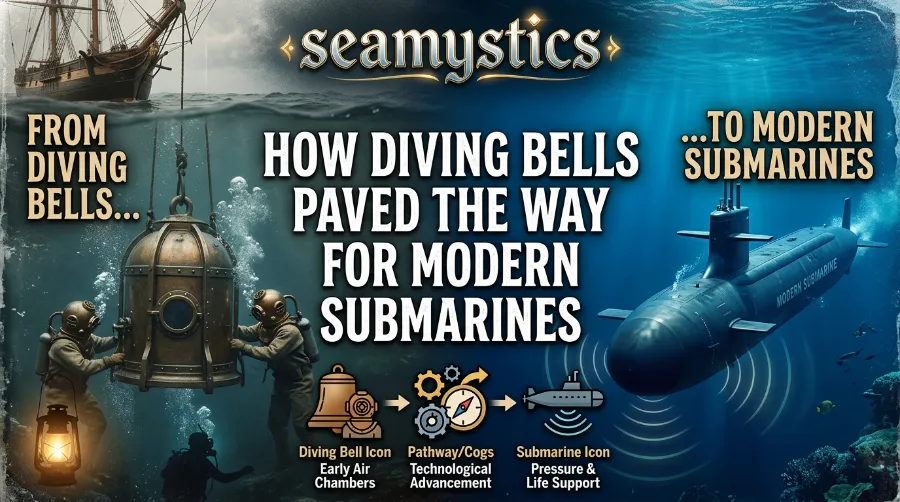

Long before a submarine could silently cross an ocean, a wooden barrel was already sinking to the bottom of a harbor. A man crouched inside, trying not to run out of air. That barrel is where diving bell history really begins. It is a stranger, more human story than most people expect. It involves a comet hunter, a Connecticut farmer’s son, a doomed Englishman named Day, and a Navy commander who built a rescue device only after watching two crews die without one.
The Beagle Voyage Darwin Took How Five Years at Sea Rewrote Ocean Science
This is not a dusty footnote in engineering textbooks. It is the direct ancestor of the pressurized hulls, escape hatches, and rescue chambers that keep modern submariners alive today. Once you see the thread connecting a 1690 wooden bell to a 1939 submarine rescue 243 feet down, you start noticing it everywhere in modern naval design.
Lighthouse Navigation History: How Beacons Guided Sailors for 2,300 Years
TL;DR: Diving bells began as simple air-trapping containers used by ancient divers. They evolved through Edmund Halley’s 1690 design and Smeaton’s 1788 pump-fed bell into a technology that directly shaped the first submarines. That same lineage led to the McCann Rescue Chamber, which saved 33 sailors from the sunken USS Squalus in 1939. Diving bell engineering never really stopped. It just moved underwater with the vessels it inspired.
Key Takeaways
| Era | Milestone | Why It Mattered |
|---|---|---|
| 4th century BCE | Aristotle describes divers using inverted containers | Earliest written reference to trapped-air diving |
| 1620 | Cornelius Drebbel builds a rowed submersible on the Thames | First workable submarine, built by a diving bell engineer |
| 1690 | Edmund Halley’s diving bell invention | Fresh air resupply let divers stay down for hours, not minutes |
| 1776 | David Bushnell’s Turtle | First submarine used in actual combat |
| 1788 | John Smeaton’s pump-fed iron bell | Turned diving bells into practical industrial tools |
| 1930 | McCann Rescue Chamber developed | Applied bell principles to submarine crew rescue |
| 1939 | USS Squalus rescue | 33 sailors saved from 243 feet, proving the technology worked under pressure |
From Church Bells to Combat Vessels: Why Diving Bell History Matters Today
People have been trying to breathe underwater for far longer than most of us realize. Aristotle wrote about divers using upturned kettles or vessels to trap a pocket of air. He did this around the 4th century BCE. Legend even places Alexander the Great inside a glass diving bell during a reconnaissance dive. Neither claim can be verified with modern rigor. Together, though, they show that carrying air down with you is an ancient idea, not a modern one.
By 1531, the concept had become a genuine engineering project. Italian inventors Guglielmo de Lorena and Francesco de Marchi used an early bell-shaped device to explore Roman shipwrecks in Lake Nemi. By the early 1600s, diving bells were common enough that a Dutch inventor decided to seal one shut entirely. He wanted to see what happened next.
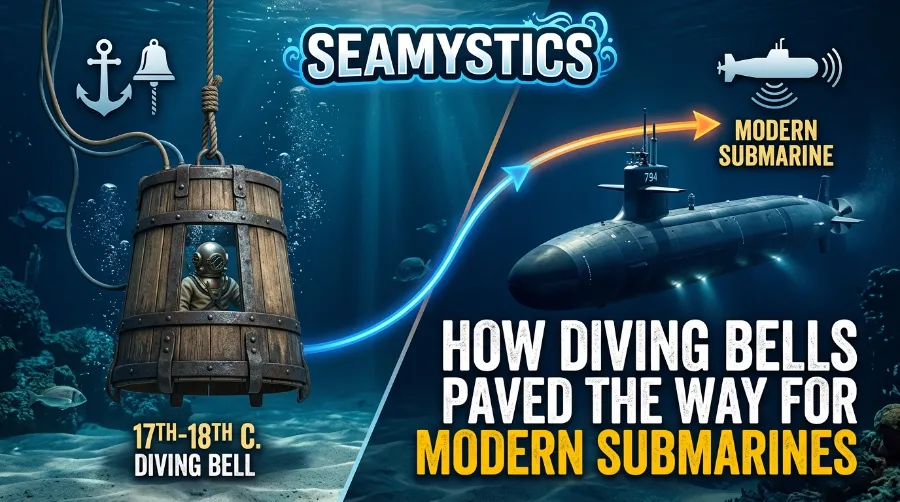
How Diving Bells Paved the Way for Modern Submarines
Drebbel’s Sealed Bell and the First Working Submarine
That inventor was Cornelius Drebbel, and his decision matters more than it sounds. Around 1620, he worked as court inventor for King James I of England. Drebbel built a copper, glass-windowed bell that sealed the diver off from the surrounding water completely. Soon after, he adapted the same thinking into a rowed, wood-roofed vessel. It traveled roughly 15 feet under the Thames River, carrying twelve oarsmen. In other words, the man who advanced diving bell technology also built what historians generally credit as the first functional submarine.
The Diving Bell Invention That Changed Everything: Edmund Halley’s 1690 Breakthrough
If you only remember one name from diving bell invention history, make it Edmund Halley. Yes, the same astronomer the comet is named after. In 1690, Halley built a wooden, open-ended bell weighted with a half-ton of lead sheeting and fitted with a glass viewport. It solved the one problem that had limited every bell before it: a fixed air supply.
Earlier bells could only hold the air trapped inside them at launch. Divers had to surface the moment that air grew stale. Halley’s design changed that by using weighted, air-filled barrels lowered separately from the surface. As his divers pulled a barrel level with the bell’s open bottom, water pressure forced fresh air up into the chamber. Stale air simply bubbled out below. Using this method, Halley and his crew reportedly stayed at a depth of around 60 feet, or 18.3 meters, for as long as an hour and a half. That was a genuinely radical endurance record for 1690.
A few decades later, a very different approach appeared. English diver John Lethbridge built what is often called the first true bell-shaped diving apparatus in 1715. It was a barrel-like suit, filled with compressed air using bellows before it sank. Two men, working in shifts, could stay submerged in it for roughly thirty minutes at a time, mostly to salvage cargo from wrecked ships.
Smeaton’s Iron Bell and the Birth of Industrial Diving
The next real leap didn’t come from an astronomer or a treasure hunter. It came from a civil engineer trying to fix a harbor wall. In 1788, Scottish engineer John Smeaton designed a square, cast-iron diving bell fitted with a hand pump on its roof. The pump allowed a continuous stream of fresh air to be forced down, rather than swapped out barrel by barrel. He used it on the Ramsgate Harbour works in 1790, and by his own written account, the trial succeeded almost immediately.
Around the same period, fellow Scot Charles Spalding refined Halley’s older barrel-based design by adding his own air pump. This made bells noticeably safer and more reliable for construction crews. These improvements mattered a great deal. Throughout the 18th century, engineers increasingly relied on diving bells to lay underwater bridge and harbor foundations, work that previously depended on guesswork and enormous risk. As a result, this period marks the point where diving bells stopped being scientific curiosities. They became standard industrial equipment across Britain and Europe.
Early Submarine History: When Bells Grew Propellers
Once engineers had solved the air-supply problem for a stationary bell, an obvious question followed. Could the same idea move? English mathematician William Bourne sketched a design for a self-propelled underwater vessel as early as 1578, though he never actually built it. Nearly two centuries of trial and error followed before anyone made real progress, and much of that experimentation traces directly back to diving bell principles.
Bushnell’s Turtle and Fulton’s Nautilus
David Bushnell, a farmer’s son from Saybrook, Connecticut, took the idea furthest. In the summer of 1776, he launched the Turtle. It was an oak-hulled, one-man submersible shaped like two tortoise shells joined together, powered by a hand-cranked propeller and a foot-operated ballast pump. On September 7, 1776, Continental soldier Ezra Lee piloted the Turtle beneath the British warship HMS Eagle in New York Harbor. He tried to attach a gunpowder mine to its copper-sheathed hull. The drill couldn’t bite into the copper, so the attack failed and Lee escaped. Even so, the mission still stands as history’s first submarine attack on record.
A generation later, American inventor Robert Fulton pushed things further while working in Paris. Between 1797 and 1800, he built the Nautilus, an all-metal submarine. It reportedly stayed submerged for up to six hours using an onboard air tube and reached depths of around 25 feet during practice dives. It never saw real combat either, mostly because its sail made it easy for enemy lookouts to spot on the surface. Its design still influenced submarine engineering for decades afterward.
Not every attempt ended even that well. In 1774, an Englishman known only by the surname Day tested a sealed, ballasted diving vessel in Plymouth Sound. He deliberately loaded it with thirty tons of stone to force it underwater. He had no way to release the extra ballast once submerged, and he was never recovered. It is a grim reminder: early submarine history was written by people taking real, often fatal, risks to solve problems we now take for granted.
A quick timeline makes the pattern easier to follow:
- 1578: William Bourne designs the first theoretical submarine, never built.
- 1620: Cornelius Drebbel rows a working submersible under the Thames.
- 1690: Edmund Halley’s diving bell introduces continuous air resupply.
- 1774: Day’s sealed diving vessel fails fatally in Plymouth Sound.
- 1776: Bushnell’s Turtle carries out the first submarine attack in combat.
- 1788: Smeaton’s pump-fed iron bell modernizes industrial diving.
- 1800: Fulton’s Nautilus achieves six-hour submerged endurance in testing.
Diving Bell Facts That Still Shape Submarine Safety
Some of the most useful diving bell facts have nothing to do with exploration. They have everything to do with survival. In 1837, German-born engineer Augustus Siebe invented a diving suit and helmet connected to a surface air hose. This gave individual divers freedom of movement that a fixed bell could never offer. That freedom came at a cost, though, because nobody yet understood how pressure affected the human body.
For decades, workers who spent long hours in bells and caissons suffered from a mysterious illness. It left them in pain, paralyzed, or dead, a condition then called caisson sickness. It wasn’t until 1908 that Scottish physiologist John Scott Haldane developed the first reliable decompression tables. His work finally gave divers a scientific method for limiting nitrogen absorption and surfacing safely. That single breakthrough is still the foundation of the dive tables used by commercial and recreational divers today, a connection our guide to aqua-lung invention history explores in more depth.
The Night a Diving Bell Saved 33 Submariners
The clearest proof that diving bell engineering never stopped mattering came on May 23, 1939. The submarine USS Squalus suffered a catastrophic valve failure during a test dive off Portsmouth, New Hampshire. It sank to 243 feet with 33 men trapped inside. Commander Charles “Swede” Momsen had already spent over a decade pushing for a proper rescue device. He had watched two earlier submarines, the S-51 in 1925 and the S-4 in 1927, sink with the loss of nearly every man aboard, simply because no rescue equipment existed.
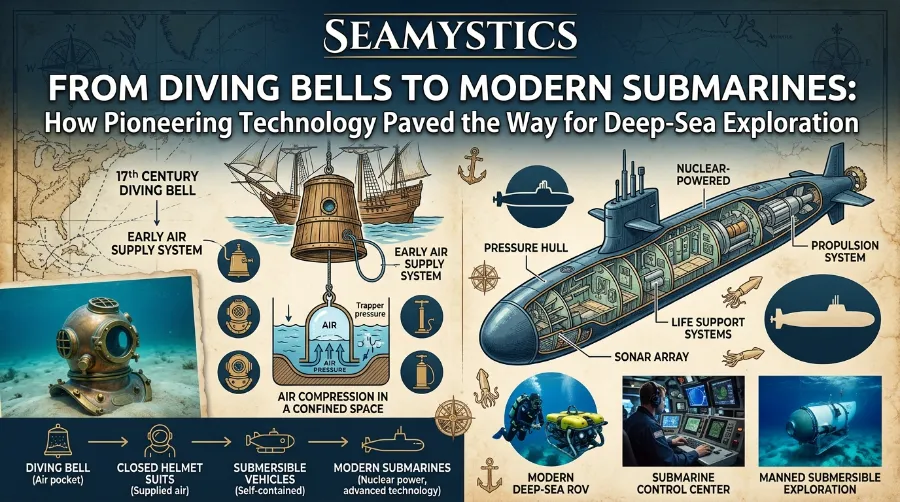
By 1930, that effort had produced the McCann Rescue Chamber. It was a ten-foot, pear-shaped descendant of Halley’s original bell, engineered to mate directly with a submarine’s escape hatch. Here is what happened when it finally faced a real emergency:
- Divers attached a down-haul cable to the Squalus’s forward hatch so the chamber could be guided down accurately.
- The rescue ship USS Falcon lowered the chamber to the seafloor, where it sealed against the hatch to create a dry, pressurized connection.
- Over four separate trips across 13 grueling hours, the chamber ferried groups of survivors up to the surface.
- A frayed, jammed cable nearly stranded the final trip, but the crew hauled the chamber up by hand and recovered everyone alive.
All 33 survivors made it out. Four Navy divers later received the Medal of Honor for their role in the operation. It remains the first time in naval history that a submarine crew had been rescued from beyond 20 feet, let alone from nearly a quarter mile down. It is a case study still taught in naval engineering circles today. For a broader look at how naval powers used underwater technology in the decades that followed, our piece on Cold War oceanography picks up almost exactly where this story leaves off.
From Rescue Chambers to Modern Steel Bells
Diving bells kept advancing even after that. In 1962, Swiss diver Hannes Keller used a specially pressurized bell to reach 984 feet, or 300 meters. That was an extraordinary depth for the era, and it pushed commercial diving firms to take mixed-gas research seriously. Today’s diving bells are built from steel rather than wood or cast iron. They are still standard equipment for submarine rescue operations and for commercial work like marine salvage, as our guide to shipwreck salvage history covers in detail, and offshore construction.
From Bells to Submersibles: The Modern Thread
Modern deep-sea vehicles owe more to this lineage than most museum visitors ever realize. The pressurized, hatch-sealing logic behind the McCann chamber shows up again in today’s rescue submersibles. The same problem Halley was solving in 1690, keeping people alive in a hostile pressure environment, still drives the engineering behind deep-sea submersibles built for scientific research. If you’re curious how underwater detection technology developed alongside these vessels, our article on sonar invention history is a natural next stop.
It’s also worth remembering how much of this progress survives only because someone bothered to document it. Early bells and submarines were frequently recorded through sketches, salvage logs, and, later, photography. Our underwater photography history guide traces that tradition from its earliest roots. Archaeologists studying sunken bells and early submersibles today rely on the same careful, evidence-based methods described in our underwater archaeology methods piece. Coastal engineers who built the harbors these bells worked in often depended on the guidance systems covered in our lighthouse navigation history article.
If any of this has you wanting to see the machines themselves, rather than just read about them, the Diving Museum has published a striking collection of vintage diving bell photographs. It brings the 18th and 19th century equipment to life. There’s also a genuinely strange regional story worth a detour: the Chestatee River diving bell, used during Georgia’s gold rush. It shows how far this technology traveled beyond Europe’s shipyards. For the official naval account of the Squalus rescue described above, the Naval History and Heritage Command’s archive is the authoritative source. The Naval Undersea Museum also has a detailed writeup of how Momsen’s rescue chamber was actually designed.
Frequently Asked Questions
What is the origin of diving bell history? The earliest written reference comes from Aristotle around the 4th century BCE. He described divers using inverted containers to trap air. The first documented physical bells appeared in Europe in the 1500s.
Who really invented the diving bell? No single person invented it. Edmund Halley’s 1690 design is widely credited as the breakthrough that made extended, practical diving possible, thanks to its continuous air resupply system.
How are diving bells connected to submarines? Early submarine builders, including Cornelius Drebbel and David Bushnell, worked directly with the same air-supply and buoyancy problems. Diving bell engineers had already been solving those problems for over a century.
Are diving bells still used today? Yes. Modern steel diving bells remain standard equipment in commercial diving, offshore construction, and naval submarine rescue operations, including systems descended directly from the 1930s McCann Rescue Chamber.
What was the deepest historical diving bell descent? Swiss diver Hannes Keller reached roughly 984 feet, or 300 meters, in a pressurized diving bell in 1962. That record pushed the commercial diving industry toward serious mixed-gas research.
Conclusion
Diving bell history is not a straight line from primitive barrel to modern submarine. It is a messy, occasionally tragic chain of trial and error, stretched across more than three centuries and several countries. Halley’s air-resupply trick, Smeaton’s pump, Bushnell’s Turtle, and Momsen’s rescue chamber were each solving a version of the same problem in their own era. Each success made the next leap possible. The next time you see a submarine slide beneath the waves, remember this: its safest features exist because a handful of stubborn inventors, and thirty-three very lucky sailors off the coast of New Hampshire, proved the idea could work under real pressure.
If you want to keep exploring this thread of underwater engineering history, start with our full archive at Sea Mystics for more deep dives into the tools and inventions that opened up the ocean.
References
- Naval History and Heritage Command, “USS Squalus (SS-192),” history.navy.mil
- Naval Undersea Museum, “The Submarine Rescue Chamber,” navalunderseamuseum.org
- Encyclopedia.com, “Diving Bell”
- PADI Blog, “The History of the Diving Bell”
- The Diving Museum, “Vintage Photos of the Diving Bell,” divingmuseum.org
- Dahlonega Nugget/Dahlonega.org, “The Strange Story of the Chestatee River Diving Bell”
- History.com, “9 Groundbreaking Early Submarines”
- Connecticut History.org, “David Bushnell and His Revolutionary Submarine”