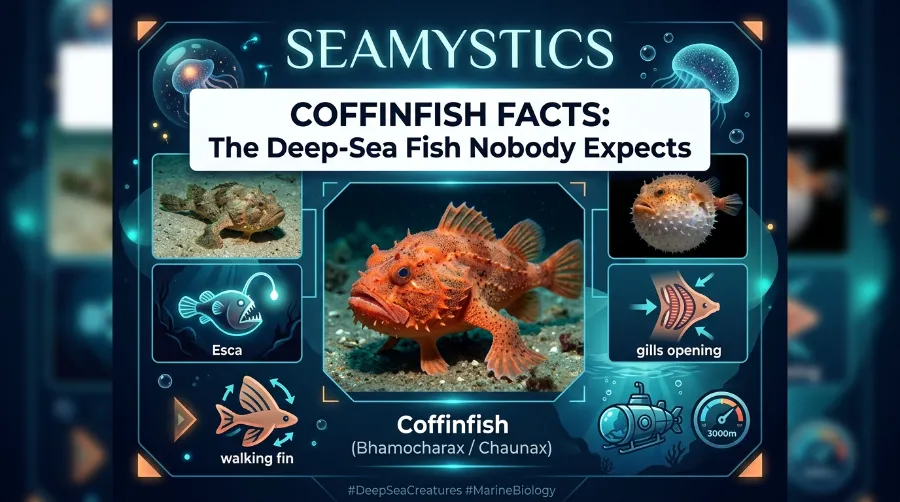

Ask a hundred people to name a strange ocean animal and almost nobody says coffinfish. Yet this pink, balloon-shaped bottom dweller might be one of the oddest finds of any coffinfish deep sea expedition, and once you see one, you will not forget it. It looks part toad, part deflated football, and part horror movie prop, and it survives in total darkness using tricks that still surprise marine scientists today.
Key takeaways
| Fact | Detail |
|---|---|
| Family | Chaunacidae, also called sea toads, part of the anglerfish order Lophiiformes |
| Number of species | Roughly 29 recognized species across two genera, Chaunax and Chaunacops |
| Typical depth | 90 to over 2,500 meters, most common below 200 meters |
| Size | Usually 20 to 40 centimeters, about 8 to 16 inches |
| Signature trick | Can hold its breath for up to four minutes by inflating its gill chambers with seawater |
| Diet | Small crustaceans and fish, caught by ambush using a small head mounted lure |
TL;DR: The coffinfish is a slow, boxy anglerfish relative that lives on muddy ocean floors around the world, mostly between 200 and 2,500 meters down. It walks on modified fins instead of swimming, and in 2019 researchers confirmed it can hold its breath for up to four minutes by filling its gill chambers with seawater, a behavior never recorded in any other fish. It is not dangerous, not commercially fished on purpose, and largely unnoticed, which is exactly what makes it so fascinating.
I have spent two decades studying benthic fish behavior, and coffinfish still catch me off guard every time footage comes in from a remotely operated vehicle. This guide breaks down what the coffinfish actually is, why its body works the way it does, where you would need to look to ever see one, and how it fits into the wider, often overlooked world of bizarre sea creatures living far below sunlight.
What Exactly Is a Coffinfish?
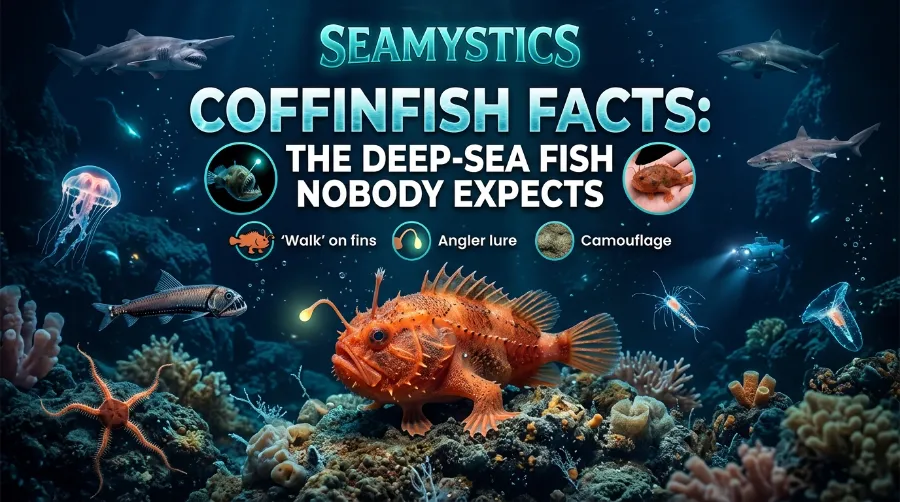
A coffinfish is a small, bottom-living member of the family Chaunacidae, a group of deep sea anglerfish also nicknamed sea toads. The name comes from its boxy, tapering body shape, which does resemble a small coffin once the fish is out of water and its loose skin sags. Scientists currently recognize close to 29 species in the genus Chaunax, plus a handful more in the related genus Chaunacops.
Barreleye Fish Facts: The Fish With a Transparent Head
Coffinfish belong to Lophiiformes, the same order as the more famous deep sea anglerfish with the glowing lure. That makes the coffinfish a genuinely rare anglerfish relative, though its lure is short, mop-like, and tucked into a groove on its head rather than dangling on a long rod like its cousins.
Giant Isopod Facts: The Deep-Sea Relative of the Pill Bug
Where the Name Comes From
Early naturalists were not being poetic when they picked the name. The body is wide, flat-topped, and narrows sharply toward the tail, so from certain angles it genuinely looks like a tiny casket drifting along the mud. Some regional names lean gentler, calling the same fish a sea toad because of its squat posture and wide mouth.
The Deep-Sea Slug That Baffled Scientists: Pink See-Through Fantasia
Coffinfish Appearance Facts That Surprise Most People
Most people picture deep sea fish as thin, spiky, and menacing. Coffinfish break that image completely, and that mismatch is exactly why coffinfish appearance facts tend to go viral whenever a new photo surfaces.
- Body color ranges from bright pink and orange to deep red, with some species showing olive or brown patches.
- Skin is loose, soft, and almost spongy, quite different from the scaled fish most divers expect.
- Pectoral fins have rotated into limb-like paddles, letting the fish push itself along the seafloor in a slow hop rather than a swim.
- A short, retractable lure sits in a small pit near the mouth, used to twitch and attract curious prey.
- The mouth is large, upturned, and lined with fine teeth suited to grabbing rather than chewing.
Divers who have watched footage from frilled sharks or the drifting dumbo octopus often assume every deep sea animal is designed to look frightening. The coffinfish is a useful reminder that plenty of deep ocean life instead looks soft, round, and almost comically unbothered by the pressure crushing down on it.
Zombie Worm Facts: The Creature That Eats Whale Bones
Coffinfish Facts Habitat: Where This Fish Actually Lives
Coffinfish are found in tropical and temperate oceans nearly worldwide, including the Atlantic, Indian, and Pacific basins, plus parts of the Mediterranean. Solid coffinfish facts habitat data show most species settle on soft mud or sandy continental slopes rather than rocky reefs, since digging in and staying still burns almost no energy.
Depth is the real defining feature of this species group. Records span from around 90 meters down to more than 2,500 meters, though the majority of sightings cluster below 200 meters, a zone with almost no natural light. That places coffinfish well within what oceanographers call the bathyal zone, alongside the barreleye fish and other true deep sea specialists.
| Region | Typical depth range | Common species examples |
|---|---|---|
| East coast of Australia | 50 to 300 meters | Chaunax endeavouri, the furry coffinfish |
| Gulf of Mexico and North Atlantic | 200 to 1,000 meters | Chaunax pictus and relatives, studied via NOAA ROV dives |
| Indian Ocean, southern Africa | 200 to 2,500 meters | Chaunax africanus, Chaunax apus, Chaunax flammeus |
A Simple Depth Comparison
To put that habitat in context, here is how the coffinfish’s typical range stacks up against a few other well-known deep sea residents.
Approximate maximum recorded depths, based on published marine biology surveys. Bar length is scaled for comparison only.
The Breath-Holding Trick That Made Coffinfish Famous
For decades, coffinfish sat quietly in the weird deep sea fish category without much attention. That changed in 2019, when Nicholas Long, then an undergraduate at Dickinson College, and Stacy Farina, a biologist at Howard University, reviewed hours of ROV footage collected by the National Oceanic and Atmospheric Administration in the Gulf of Mexico and North Atlantic.
Sea Pig Facts: The Deep-Sea Cucumber That Looks Like a Toy
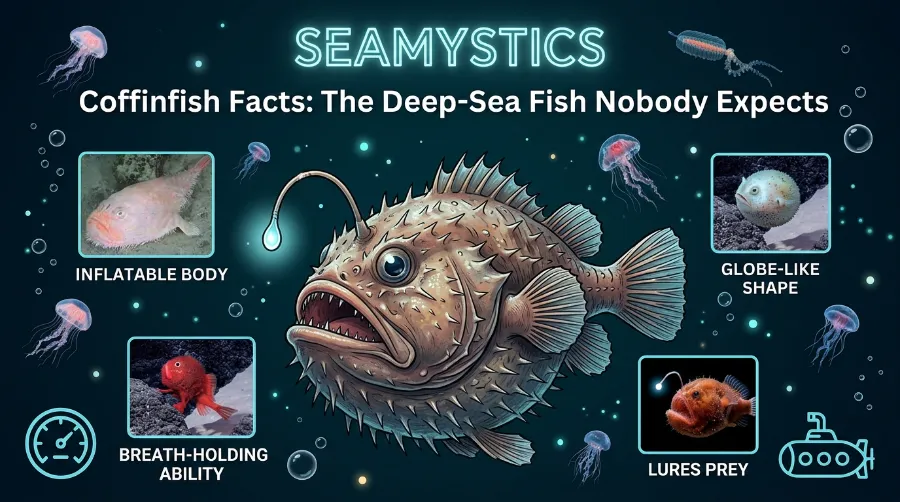
They noticed something no one had documented in any fish before. Coffinfish were pumping seawater into their unusually large gill chambers, swelling their bodies by up to 30 percent, and then simply stopping. No gill movement, no breathing motion, for stretches of up to four minutes at a time. Their findings were published in the Journal of Fish Biology in 2019, and later covered by National Geographic, which described how the extra water lets the fish pull in more oxygen at once and avoid the constant work of pumping water through its gills.
Fangtooth Fish Facts: The Small Fish With the Biggest Teeth
Smithsonian Magazine picked up the story too, noting how unusual it is for any water breathing animal to pause respiration on purpose. Most fish that stop moving their gills are in serious trouble. Coffinfish appear to do it deliberately, likely to save energy in an environment where food can be scarce for weeks at a time.
Why Holding a Breath Underwater Actually Saves Energy
Pumping water through gills takes muscle work, and muscle work costs calories that a slow moving, ambush hunting fish cannot easily replace. Coffinfish appear to trade a burst of extra water weight for a long pause in that muscular effort, a strategy Hakai Magazine compared to a diver taking one deep breath before going still rather than paddling constantly to stay near the surface.
- The coffinfish opens its mouth and gill covers wide to draw in a large volume of seawater.
- Enlarged gill chambers expand to hold that water against the gill filaments.
- Oxygen transfers into the bloodstream slowly, over the course of several minutes, rather than in one quick pass.
- Once oxygen runs low, the fish exhales and repeats the cycle.
It is a genuinely first-hand experience to watch this on a monitor during a live ROV dive review. The fish looks almost frozen, and then, without warning, it releases a visible pulse of water and looks like it has deflated slightly, which is honestly one of the stranger sights I have logged in years of reviewing benthic survey footage.
Diet, Predators, and Daily Behavior
Coffinfish are ambush predators rather than active hunters. They rest on the seafloor, twitch their small lure, and wait for shrimp, small crustaceans, or passing fish to investigate. Once prey gets close, the coffinfish’s large, upward angled mouth snaps shut in a fraction of a second.
Because they rarely swim and expend so little visible energy, some researchers have half jokingly called coffinfish the laziest fish on the seafloor. That reputation is not really fair. Staying still and letting food come to you is a legitimate survival strategy at depths where a single meal might need to last for days.
- Diet: small crustaceans, shrimp, and occasional small fish
- Main predators: larger deep sea sharks, including cow sharks that patrol the same slopes
- Movement style: a slow hop across the mud using paddle-like pectoral and pelvic fins
- Typical lifespan: not fully documented, though related deep sea anglerfish often live several years
How Coffinfish Fit Into the Bigger Deep Sea Picture
Coffinfish rarely headline a documentary the way an anglerfish with a glowing lure does, yet they represent a huge and mostly hidden slice of ocean biodiversity. Deep sea trawl surveys off Australia, southern Africa, and the Indian Ocean have described new coffinfish species in just the last fifteen years, which tells you how little of this habitat has actually been mapped.
That pattern repeats across the deep ocean. Species like the pink see-through fantasia sea cucumber and the paddle-nosed barreleye were both effectively invisible to science until submersibles and ROVs became affordable enough for regular use. Coffinfish belong to that same wave of animals we only understand because someone finally pointed a camera at the right patch of mud.
Trawl fisheries occasionally pull coffinfish up as unintentional bycatch, since the species has little to no commercial value on its own. Marine researchers have flagged this as worth monitoring, not because coffinfish populations look threatened today, but because so little baseline data exists for a group of fish this widespread. You cannot track a decline you never measured to begin with.
Coffinfish vs Other Weird Deep Sea Fish
People searching for a weird deep sea fish list almost always land on the same handful of names, an anglerfish with a glowing lure, a fangtooth, a gulper eel. Coffinfish deserve a spot on that list for a different reason. Instead of looking terrifying, they look almost cartoonish, and that contrast between appearance and the extreme environment they survive in is part of what keeps drawing researchers and photographers back to them.
| Species | Standout trait | Typical size |
|---|---|---|
| Coffinfish | Holds its breath up to four minutes by inflating gill chambers | 20 to 40 cm |
| Frilled shark | Snake-like body with 300 recurved teeth, a living fossil lineage | Up to 2 m |
| Dumbo octopus | Ear-shaped fins used for gentle hovering near the seafloor | 20 to 30 cm |
| Barreleye fish | Transparent, fluid-filled dome around tube-shaped eyes | Around 15 cm |
Frequently Asked Questions
Is a coffinfish dangerous to humans?
No. Coffinfish live far too deep to encounter divers and have no venom or aggressive behavior recorded toward people.
Is a coffinfish the same thing as an anglerfish?
It is a rare anglerfish relative rather than a true anglerfish in the classic sense. Both belong to the order Lophiiformes, but coffinfish have a short, hidden lure instead of the long glowing rod seen in deep sea anglerfish.
How deep do coffinfish actually live?
Most sightings occur between 200 and 2,500 meters, though a few shallower populations have been recorded around 50 to 90 meters in specific regions like eastern Australia.
Can a coffinfish be kept in an aquarium?
Practically no. The extreme pressure, cold, and darkness they are adapted to make captivity in a standard aquarium unrealistic, and no major public aquarium currently displays a living specimen long term.
Why did the coffinfish suddenly become famous online?
A 2019 study on its breath-holding gill chambers, later covered by outlets including National Geographic and Smithsonian Magazine, introduced the species to a wide audience that had never heard of it before.
Conclusion
The coffinfish is proof that the strangest animals on the planet are not always the ones built to look scary. A soft, pink, slow moving fish that can voluntarily stop breathing for four minutes is stranger than most horror movie designs, and it earned that trait through millions of years of quiet adaptation on the dark ocean floor. If a fish this unassuming can hide a trick nobody expected, it is worth wondering what else is still waiting to be filmed down there. For a wider tour of animals just as unusual, the bizarre sea creatures guide is a good next stop, and readers curious about first photos of newly documented species or how scientists confirm a brand new octopus can start with our field notes on first contact discoveries and our breakdown of how researchers verify a new deep sea species.
References
- Long, N. and Farina, S. (2019). Enormous gill chambers of deep-sea coffinfishes support unique ventilatory specialisations such as breath holding and extreme inflation. Journal of Fish Biology, 95, 502 to 509.
- National Geographic, This odd deep-sea fish can hold its breath for four minutes: nationalgeographic.com
- Smithsonian Magazine, Coffinfish Can Hold Their Breath for Four Minutes: smithsonianmag.com
- Hakai Magazine, This Fish Can Hold Its Breath: hakaimagazine.com
- Wikipedia, Chaunax genus overview: en.wikipedia.org