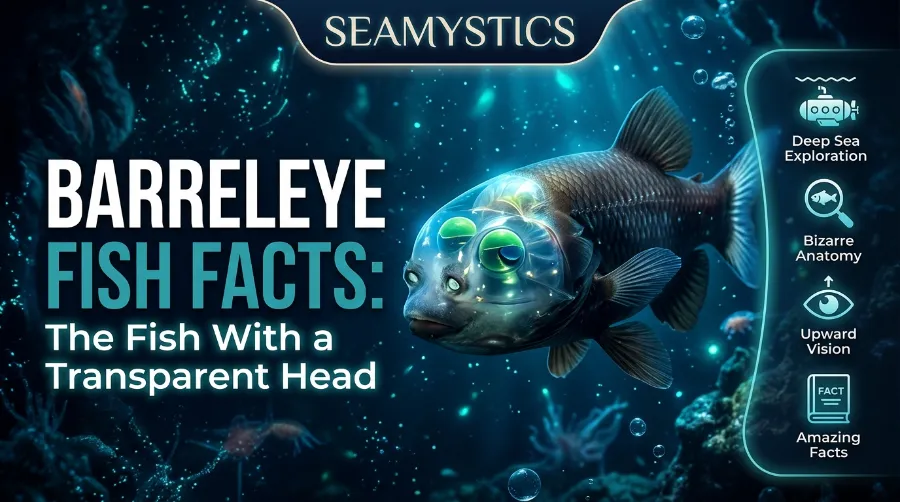

The first time I watched footage of a barreleye fish drifting through pitch-black water, I genuinely thought the video had been edited. A fish with a see-through skull? Two glowing green eyes rotating behind a dome of clear tissue? It looked like a prop from a science fiction film, not something swimming in the Pacific right now. Yet these barreleye fish facts are real, documented, and still surprising even to people who have studied the ocean for decades.
TL;DR: The barreleye fish (Macropinna microstoma) has a fluid-filled, transparent head that lets its tubular, green-lensed eyes rotate upward to spot prey silhouetted against faint sunlight. It lives 600 to 800 meters down in the deep sea’s twilight zone, and scientists did not photograph one alive with its dome intact until 2004, 65 years after it was first described.
| Quick Fact | Detail |
|---|---|
| Scientific name | Macropinna microstoma |
| Transparent head fish trait | Fluid-filled dome covering the skull |
| Barreleye fish habitat | Twilight zone, 600 to 800 meters deep |
| Eye color | Bright green, tubular lenses |
| Size | About 6 inches (15 cm) |
| First described | 1939, by W. M. Chapman |
| First live photo | 2004, by MBARI researchers |
| Main diet | Zooplankton, small crustaceans, siphonophore prey |
What Is a Barreleye Fish, Exactly?
The barreleye belongs to a small family of deep sea fish called Opisthoproctidae, which includes roughly 20 species spread across several genera. What sets Macropinna microstoma apart, though, is that see through fish head. Instead of a bony skull covered in skin, its forehead is a dome of soft, transparent, fluid-filled tissue.
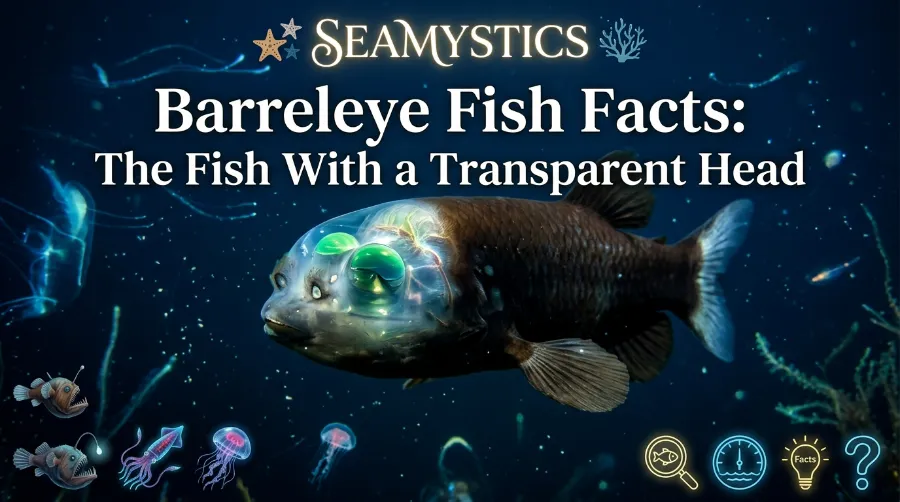
Inside that dome, you can actually watch the fish’s internal machinery at work. Its brain, its nerve tissue, and its barrel-shaped eyes all sit visible beneath the surface. According to a detailed writeup from The Fisheries Blog, the species remained a scientific curiosity for decades simply because that fragile dome tore apart almost every time a net brought one to the surface.
The Deep-Sea Slug That Baffled Scientists: Pink See-Through Fantasia
The Science Behind Its Transparent Head
Why the Dome Exists in the First Place
Marine biologists at the Monterey Bay Aquarium Research Institute (MBARI) solved much of this mystery after filming live barreleyes with remotely operated vehicles instead of hauling them up in nets. Their research showed the transparent shield protects the eyes while still letting light pass through, so the fish can watch for predators or prey without exposing soft tissue to the open water. You can read MBARI’s original findings directly on their research page, which remains one of the clearest public explanations of the discovery.
Coffinfish Facts: The Deep-Sea Fish Nobody Expects
What’s Actually Inside the Head
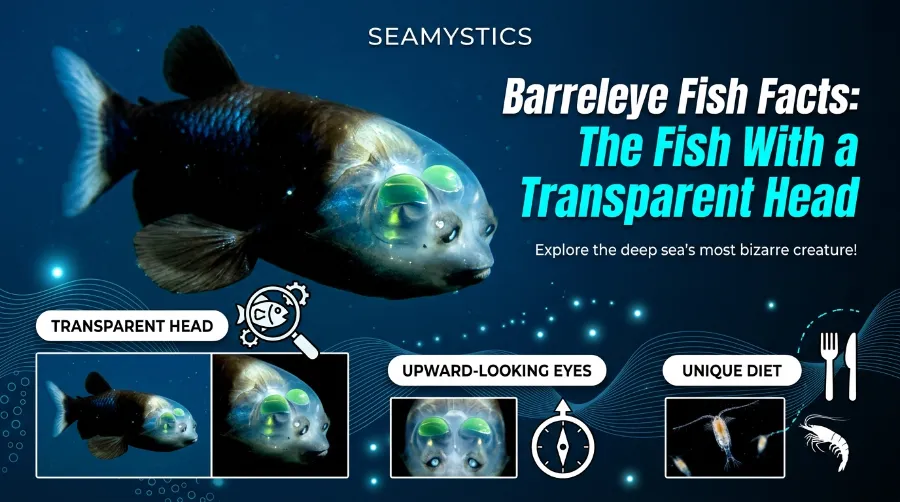
The dome is not empty. It is filled with a clear, gel-like fluid that cushions the eyes and gives the whole structure its glassy, aquarium-like appearance. Two small openings that look like eyes near the mouth are not eyes at all. They’re olfactory organs, similar in function to a human nose, and they sit separately from the actual eyes hidden higher up in the dome.
Barreleye Fish Habitat: Life in the Ocean’s Twilight Zone
The barreleye fish habitat sits in what oceanographers call the mesopelagic, or twilight, zone. This is the layer of ocean where sunlight is fading but has not disappeared entirely, generally between 200 and 1,000 meters down. Barreleyes are usually found around 600 to 800 meters, in the darker end of that range.
Giant Isopod Facts: The Deep-Sea Relative of the Pill Bug
This chart shows roughly where that zone sits compared to the rest of the water column.
At that depth, there is just enough light filtering down for the barreleye to make out faint silhouettes above it, but not nearly enough for ordinary eyesight to work well. That is exactly the problem its rotating, light-collecting eyes evolved to solve.
Barreleyes have turned up off the coast of California, in the Bering Sea, and near Japan, though sightings remain rare simply because of how deep and dark this habitat is. Researchers still describe every confirmed sighting as noteworthy, even in 2024 and 2025 survey reports from Pacific ROV expeditions.
Zombie Worm Facts: The Creature That Eats Whale Bones
How the Barreleye Hunts With Rotating Eyes
Here is where the deep sea barreleye gets genuinely clever. Its tubular eyes, capped with bright green lenses, normally point straight up through the transparent dome. That upward gaze lets the fish spot the dark outlines of small prey, often crustaceans, silhouetted against the dim light trickling down from the surface.
Sea Pig Facts: The Deep-Sea Cucumber That Looks Like a Toy
The barreleye often hovers almost motionless near siphonophores, jellyfish-like colonial animals that trail long stinging tentacles loaded with trapped prey. Then it does something unusual:
- It watches from below and slightly behind the siphonophore’s tentacles.
- It rotates its eyes forward as it rises, keeping the food in view.
- It steals the already-captured prey directly from the tentacles, all while its transparent shield protects its eyes from the stinging cells.
This shield-and-steal strategy, first confirmed on video by MBARI, is a big part of why the species draws so much attention from both scientists and ocean documentary crews.
Fangtooth Fish Facts: The Small Fish With the Biggest Teeth
A Timeline of Barreleye Discoveries
The story of how we came to understand this fish stretched across most of a century.
- 1939 – W. M. Chapman formally describes Macropinna microstoma from preserved specimens.
- 1939 to 2004 – Every barreleye pulled up in trawl nets arrives with its transparent dome damaged or destroyed, leaving scientists guessing at the head’s true shape.
- 2004 – MBARI researchers, using a remotely operated vehicle, film a live barreleye with its dome fully intact for the first time.
- 2009 – MBARI publishes formal findings confirming the eyes rotate inside the transparent shield, solving the decades-old mystery of how the fish sees while feeding.
- 2021 – MBARI releases new high-definition footage that goes viral, introducing the species to a much wider audience online.
This kind of patient, ROV-based observation is the same approach covered in our guide on bizarre sea creatures, where deep ocean robots keep turning up biology nobody expected.
Barreleye Fish vs Other Strange Deep-Sea Faces
The barreleye is famous, but it is far from the only deep sea animal built around unusual sensory tricks. The frilled shark relies on an eel-like body and rows of needle teeth rather than a transparent head. The dumbo octopus uses ear-shaped fins to hover just above the seafloor instead of rotating eyes. And the pink see-through fantasia sea cucumber shows that transparency itself is a recurring survival trick at these depths, even outside the fish world.
Comparing these species side by side helps explain why “transparent head fish” keeps showing up in searches. It is not one gimmick. It is a whole pattern of adaptations that deep sea life keeps arriving at independently.
| Species | Signature Trait | Depth Range |
|---|---|---|
| Barreleye fish | Transparent, fluid-filled head | 600 to 800 m |
| Frilled shark | Eel-like body, hinged jaw | 50 to 1,570 m |
| Dumbo octopus | Ear-like fins for hovering | 3,000 to 4,000 m |
| Pink see-through fantasia | Transparent body wall | 1,000 to 5,000 m |
Why the Barreleye Fish Matters Beyond Curiosity
It is easy to treat the barreleye as an internet novelty, a “weird fish” clip that gets shared and forgotten. But every confirmed sighting adds real data to how little we still know about the mesopelagic zone, a layer of ocean that covers more volume than every rainforest on Earth combined. According to the detailed species profile from Wildlife Nomads, researchers are still documenting basic behavior for this species, more than 85 years after it was first named.
That gap in knowledge matters because the twilight zone is also where a huge share of the ocean’s carbon cycling happens. Fish like the barreleye sit inside food webs we are only beginning to map, which is part of why marine biologists keep pushing for more ROV survey funding rather than relying on old trawl-net methods that destroy the very features they want to study.
FAQs About Barreleye Fish Facts
Is the barreleye fish dangerous to humans?
No. It lives far too deep to ever encounter swimmers or divers, and it has no defenses aimed at large animals.
Can you keep a barreleye fish in an aquarium?
No, not currently. The pressure and temperature of its deep sea habitat cannot be replicated safely, and its fragile transparent head does not survive standard capture methods.
How rare is it to see a live barreleye fish?
Extremely rare. Confirmed live sightings with an intact dome remained essentially nonexistent until MBARI’s 2004 footage, and sightings today still make headlines.
What does the barreleye fish eat?
Mostly zooplankton and small crustaceans, often stolen directly from the stinging tentacles of siphonophores.
Why is its head see-through?
The transparent, fluid-filled dome protects its rotating eyes while still letting enough light through for it to see faint prey silhouettes above.
Conclusion
The barreleye fish earns every bit of its reputation as one of the ocean’s strangest animals, and yet nothing about it is fake or exaggerated for clicks. A genuinely transparent head, eyes that rotate like tiny periscopes, and a feeding strategy built around outsmarting jellyfish relatives, all of it is documented, filmed, and still being studied today. The more ROVs we send into the twilight zone, the more these barreleye fish facts remind us how much of the ocean remains unmapped, sitting just a few hundred meters below the last reach of daylight.
References
- Monterey Bay Aquarium Research Institute (MBARI), research findings on Macropinna microstoma
- Ocean Conservancy, “All About Barreleye Fish”
- The Fisheries Blog, “Barreleye”
- Wildlife Nomads, “Barreleye Fish Facts”
- EarthSky, coverage of MBARI’s 2021 barreleye footage
- Fact Animal, species profile of Macropinna microstoma