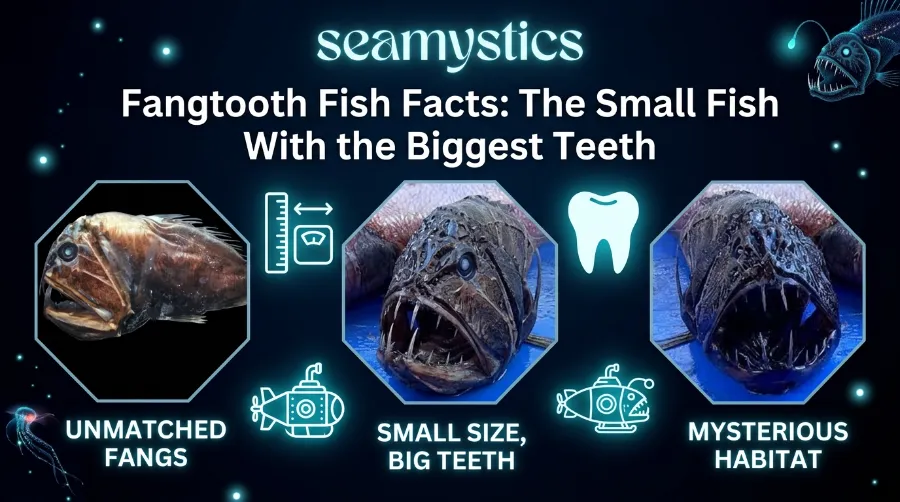

Picture a fish barely the length of your palm, living a mile beneath the waves, in water cold enough to numb your hand in seconds. Now give that fish teeth so long it can’t fully close its mouth. That’s the fangtooth, and it’s one of the strangest entries in any bizarre sea creatures guide you’ll ever read. Despite the horror-movie face, this animal is smaller than most goldfish, which is exactly what makes the fangtooth fish facts below so hard to believe at first glance.
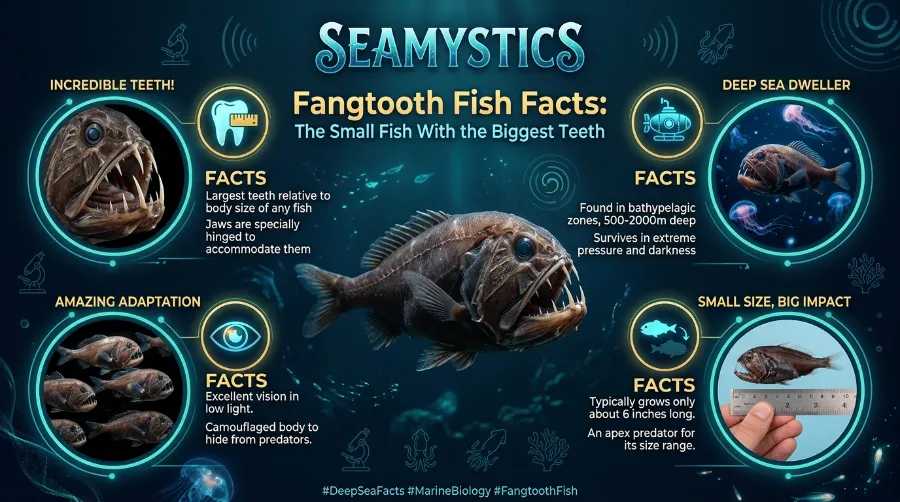
TL;DR: The fangtooth (Anoplogaster cornuta) grows to roughly six inches, yet it carries the largest teeth relative to body size of any fish in the ocean. It lives between 500 and 5,000 meters down in near-total darkness, hunts by smell and touch rather than sight, and survives conditions that would crush most other vertebrates. It’s intimidating on paper, but it poses zero threat to humans.
Key Takeaways
| Fact | Detail |
|---|---|
| Scientific name | Anoplogaster cornuta |
| Average length | 4 to 6 inches (10 to 16 cm) |
| Depth range | 500 to 5,000 meters (1,600 to 16,400 feet) |
| Diet | Small fish, squid, crustaceans |
| Notable trait | Largest teeth relative to body size of any fish |
| Vision | Poor; relies on smell and lateral line sensing |
| Conservation status | Not evaluated; population stable, no known threats |
What Is a Fangtooth Fish, Exactly?
The fangtooth’s common nickname, ogrefish, tells you almost everything before you even read a description. It belongs to the family Anoplogastridae and is found circling the globe in tropical and temperate waters, including the Atlantic, Pacific, Indian Ocean, and even the Mediterranean. So while it sounds like a rare deep-sea rumor, it’s actually one of the more widely distributed predators on the planet, just never in a place people happen to look.
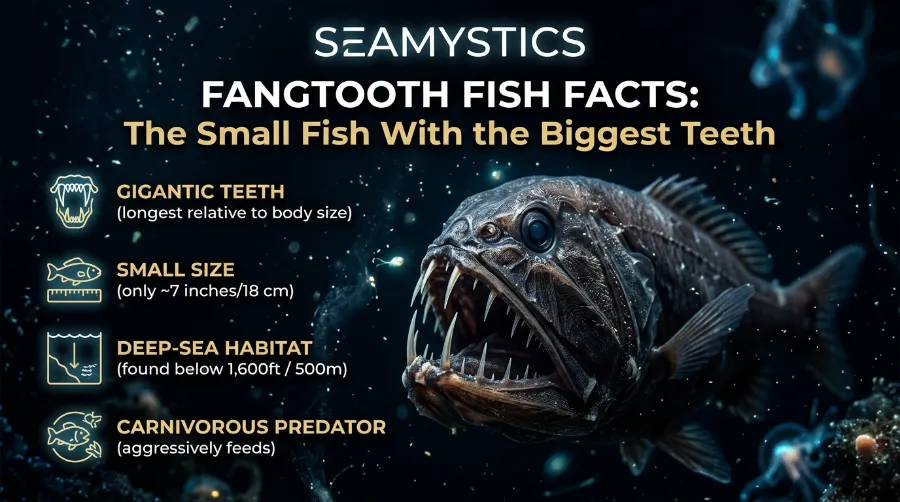
Two teeth in the lower jaw are so long that the fangtooth has evolved special sockets on either side of its brain to let its mouth close without stabbing itself. That single adaptation is, for many marine biologists, the fish’s most fascinating feature, and it says a lot about what a “biggest teeth fish ocean” title actually requires: not size in absolute terms, but proportion to the animal wearing them.
Giant Isopod Facts: The Deep-Sea Relative of the Pill Bug
Fangtooth Fish Habitat: Life Without Light
Fangtooth deep sea facts start and end with pressure and darkness. These fish live in the mesopelagic and bathypelagic zones, a stretch of ocean where sunlight simply never arrives. At those depths, water temperature hovers near freezing and pressure can exceed 500 times what we feel at sea level.
A few habitat notes worth knowing:
- Juveniles stay shallower, generally within the mesopelagic zone (200 to 1,000 meters), feeding mostly on zooplankton.
- As they mature, fangtooths migrate deeper into the bathypelagic zone, sometimes past 4,000 meters.
- Many individuals rise closer to the surface at night to feed, then retreat to the depths by dawn, a pattern called diel vertical migration that’s common across deep-sea species.
- Their skin is nearly black, which is not decoration but camouflage, since even the faint bioluminescent flashes of other creatures can give away a paler fish.
This is also why fangtooths are almost never seen alive by humans. Most of what scientists know comes from trawl nets or submersible footage, not observation in a lab tank.
Scariest Deep-Sea Fish? The Case For and Against
The fangtooth regularly tops “scariest deep-sea fish” lists, and it’s easy to see why the moment you see a photo. But here’s where the real story is more interesting than the myth: this is not an aggressive hunter chasing down prey through open water. It’s closer to an ambush opportunist.
Because vision is nearly useless in total darkness, the fangtooth relies on:
- A well-developed lateral line system that senses vibrations and pressure changes in the water.
- Chemoreception, essentially smell, to detect nearby prey.
- An enormous gape that lets it swallow fish and squid close to its own body size in one strike.
So while the face is genuinely unsettling, the behavior is closer to patient waiting than relentless pursuit. That mismatch between appearance and lifestyle is part of why the fangtooth has become something of a mascot for deep-sea biology; it looks like a monster and behaves like a fish that mostly wants to be left alone in the dark.
Zombie Worm Facts: The Creature That Eats Whale Bones
How the Fangtooth Compares to Other Deep-Sea Predators
It helps to put the fangtooth next to its neighbors. The frilled shark, for instance, hunts in some of the same depth zones but relies on an eel-like body and a mouth full of backward-curving teeth to trap slippery prey, rather than the fangtooth’s fixed, oversized fangs. Meanwhile, the barreleye fish takes almost the opposite survival strategy, using a transparent, fluid-filled head to look straight up for silhouettes of prey overhead instead of relying on smell.
Sea Pig Facts: The Deep-Sea Cucumber That Looks Like a Toy
Compare that again to something like the dumbo octopus, which survives the same crushing pressure zones through a soft, flexible body rather than armor or aggression, or the pink see-through fantasia, whose transparency does the camouflage work that the fangtooth achieves with pure black pigment. Seen together, these species show just how many different engineering solutions evolution has produced for the exact same problem: staying alive in a place with no light, brutal pressure, and very little food.
Why the Deep Ocean Still Matters to Everyone
It’s tempting to treat the fangtooth’s world as irrelevant to daily life, given that almost none of us will ever go there. But the deep ocean plays an active role in regulating global climate and weather patterns, absorbing heat and carbon dioxide on a scale that affects surface conditions worldwide, according to the World Meteorological Organization. Ocean warming, even in layers far above where fangtooths live, is already shifting the temperature bands these fish depend on, as tracked by long-term monitoring work summarized by the Shape of Life project.
Deep circulation patterns, which move nutrients, oxygen, and heat around the planet, are also what keep zones like the mesopelagic productive enough to support species like the fangtooth in the first place; a clear explanation of how these currents function is available from Royal Ocean. In other words, a fish most people will never see is still connected to systems that shape weather on the surface.
Frequently Asked Questions
Is the fangtooth fish dangerous to humans?
No. Fangtooths live thousands of feet below where any diver or swimmer would encounter them, and their size makes them harmless even in the unlikely event of contact.
How big does a fangtooth fish actually get?
Most adults reach about 4 to 6 inches long, occasionally approaching 7 inches, making it one of the smallest fish with an outsized reputation.
Do fangtooth fish have good eyesight?
Not really. Their eyes are small and underdeveloped for their size, since there’s essentially no light to see by at their typical depth. They compensate with smell and vibration sensing instead.
How long do fangtooth fish live?
Their lifespan isn’t well documented, since specimens are rarely observed alive in their natural habitat; most data comes from trawled or deceased individuals.
Where can you find fangtooth fish?
They’re distributed globally in tropical and temperate deep waters, including the Atlantic, Pacific, Indian Ocean, and Mediterranean Sea.
Conclusion
The fangtooth fish is proof that scale and threat level aren’t the same thing. A creature this small, living this deep, has still managed to become one of the most talked-about faces in ocean biology, not because it’s actually dangerous, but because it looks like something out of a nightmare while quietly going about a fairly ordinary predator’s life in total darkness. The next time someone brings up the scariest deep-sea fish, the fangtooth is worth mentioning, along with the reminder that most of what makes it famous is armor, not aggression.
References
- Wikipedia contributors, “Fangtooth,” Wikipedia
- A-Z Animals, “Fangtooth Animal Facts,” a-z-animals.com
- SeaSky.org, “Fangtooth (Anoplogaster cornuta)”
- World Meteorological Organization, “How the Ocean Shapes Weather and Climate,” wmo.int
- Shape of Life, “Ocean Warming,” shapeoflife.org
- Royal Ocean, “How Ocean Currents Work,” royalocean.es