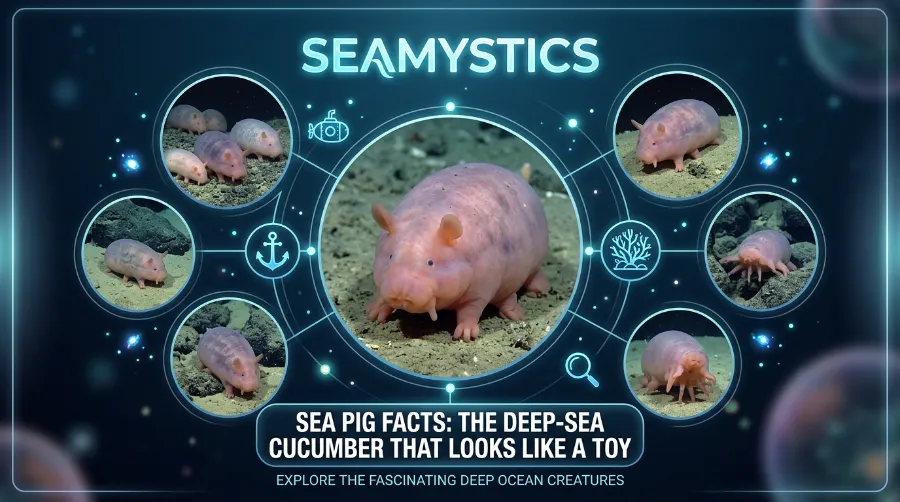

The first time footage of a sea pig crossed my desk years ago, I genuinely thought someone had dropped a rubber toy overboard during an ROV dive. Pink, round, and wobbling across the seafloor on stilt-like legs, it looked exactly like something a child would squeeze in the bathtub. However, this was no toy. In fact, it was a living animal, thriving nearly four kilometers down, in total darkness, under crushing pressure. Because of quirks like this, sea pig facts keep resurfacing in ocean documentaries: the animal looks impossible, yet millions of them walk the abyssal plain right now.
Key Takeaways
| Fact | Detail |
|---|---|
| Scientific name | Scotoplanes (three known species) |
| Classification | Sea cucumber, phylum Echinodermata |
| Depth range | Roughly 1,000 to 6,000 meters |
| Size | About 10 to 17 centimeters long |
| Diet | Marine detritus and organic sediment |
| Locomotion | Inflatable, stilt-like tube feet |
| Notable trait | One of the few echinoderms with bilateral symmetry |
| Defense | Produces a mild toxin called holothurin |
TL;DR: A sea pig is not a pig at all. Instead, it is a deep-sea cucumber cousin of the starfish that walks the abyssal seafloor on inflatable tube feet and eats mud for a living. Often, it travels in herds of hundreds, sometimes thousands, and survives depths and pressures that would be lethal to most animals, which is exactly why sea pig facts keep surprising people who assume the deep ocean is empty.
What Exactly Is a Sea Pig?
Despite the nickname, a sea pig has nothing to do with pigs. Rather, it belongs to the genus Scotoplanes, a group of deep-sea cucumbers, which puts them in the same broad phylum as starfish, sea urchins, and sand dollars. According to MBARI, sea pigs rank among the most commonly sighted animals on the deep seafloor off the California coast, even though most people have never heard of them.
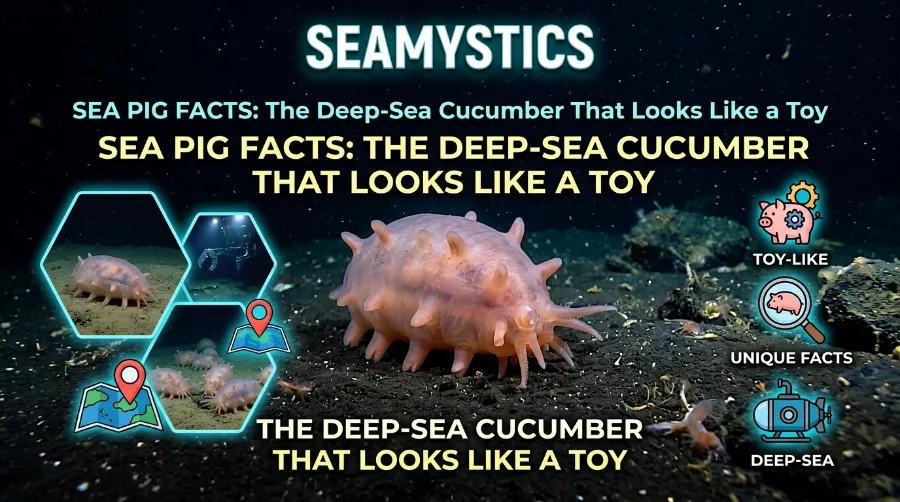
There are three recognized species: S. globosa, S. angelicus, and S. mutabilis. All three, meanwhile, share the same basic body plan: a soft, oval, semi-transparent body with a cluster of tube feet that look uncannily like stubby legs. For a wider tour of animals this strange, our bizarre sea creatures guide covers several others that seem to have wandered in from a different planet.
Fangtooth Fish Facts: The Small Fish With the Biggest Teeth
Sea Pig Species Facts Worth Knowing
Understanding sea pig species facts helps explain why scientists still argue about exactly how many species exist. Since they live so deep and disintegrate quickly once surfaced, intact specimens are rare, which limits how thoroughly researchers can compare them.
- Scotoplanes globosa was first collected during the HMS Challenger expedition of 1873 to 1876, and formally described in 1882.
- Consequently, some researchers suspect S. globosa, as currently classified, may actually be a complex of closely related species.
- Overall, all known species share the same abyssal habitat preference, mud-based diet, and stilt-walking behavior, which is why they get grouped under one common name.
Sea Pig Habitat: Life at Crushing Depths
Sea pig habitat is about as extreme as animal real estate gets. Specifically, these animals live on abyssal plains and hadal trenches, generally between 1,000 and 6,000 meters deep, though some individuals have been recorded far deeper still. The Monterey Bay Aquarium notes they favor soft, muddy seafloor sediment, exactly the terrain their inflatable tube feet are built for.
Giant Isopod Facts: The Deep-Sea Relative of the Pill Bug
At those depths, water pressure is immense and sunlight is completely absent, so food is scarce unless something dies and sinks. To solve this, sea pigs act as patient scavengers, processing marine snow, the slow drizzle of dead plankton, waste, and organic debris falling from sunlit waters far above.
A few habitat facts stand out:
- Sea pigs have been documented in the Pacific, Atlantic, and Indian Oceans.
- However, they have not yet been confirmed specifically in the North Atlantic, per species profiles from Ocean Info.
- Additionally, large aggregations have been photographed gathering around whale carcasses, known as whale falls.
- Notably, populations appear to boom after climate events like El Niño, when more surface nutrients reach the seafloor.
Whale falls, for example, are worth comparing with how other scavengers behave in the deep. Our fangtooth fish facts piece covers a species that patrols some of the same depth zones.
Zombie Worm Facts: The Creature That Eats Whale Bones
How the Deep Sea Cucumber Pink Color and Body Actually Work
The deep sea cucumber pink coloring people notice in photos is not a fixed trait. Instead, sea pigs range from off-white and translucent to soft pink or orange, and their skin is thin enough that you can sometimes see the outline of their gut through it. This is not a design flaw, though; at depth, where no light reaches for predators to spot pigment with anyway, color camouflage is largely pointless.
What makes sea pigs genuinely unusual among echinoderms is their body symmetry. Most echinoderms, think starfish and urchins, have radial symmetry, arranged around a central point, whereas sea pigs kept a bilateral body plan instead, with a front, a back, and mirrored left and right sides. As a result, they look almost like tiny land animals rather than typical spiny-skinned sea creatures.
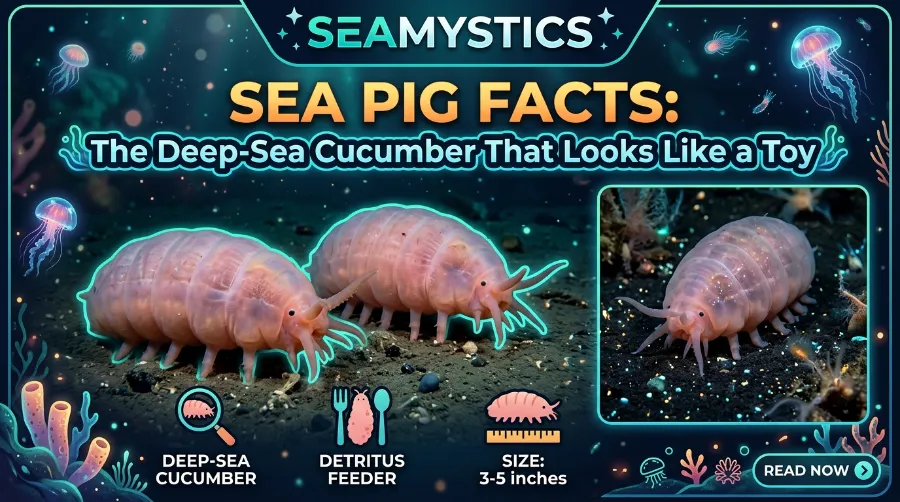
Sea Pig Facts: The Deep-Sea Cucumber That Looks Like a Toy
Their movement mechanism, meanwhile, is arguably the most toy-like feature of all. Rather than solid legs, their tube feet are hydraulic structures filled with water, which the animal inflates and deflates to walk, a system run entirely by its water vascular system rather than muscle contractions. This is likely why so many people compare sea pigs to wind-up toys.
A few more anatomical quirks:
- Sea pigs breathe through a structure near their rear, since they lack lungs or gills in the conventional sense.
- Also, their tissue includes mutable collagenous tissue, letting them stiffen or relax their skin on demand.
- Furthermore, around ten feeding tentacles ring the mouth, helping shovel sediment in and likely doubling as sensory organs.
Sea Pig Species Facts: Diet, Defense, and Deep-Sea Roommates
Sea pigs are detritivores, meaning they process dead organic material rather than hunting live prey. As they crawl across the mud, they essentially eat their way forward, extracting nutrients and leaving cleaned sediment behind. Multiply that by the sheer number of sea pigs on a stretch of seafloor, and they effectively function as one of the deep sea’s primary recycling crews.
For defense, sea pigs rely on chemistry rather than speed. Like other sea cucumbers, they produce a toxin called holothurin, which discourages most predators. This is likely one reason juvenile king crabs have been documented hitching rides on sea pig bodies: MBARI research described young king crabs using sea pigs as mobile shelter, gaining protection from the toxin while the sea pig seems largely unbothered. In some observed populations, in fact, this hitchhiking behavior showed up in nearly all individuals studied.
These odd partnerships show up elsewhere too. Our dumbo octopus facts article covers another abyssal species from the same neighborhood, while our piece on the pink see-through fantasia sea cucumber is a close cousin worth comparing directly.
Abyssal Sea Cucumber Behavior: Herding and Whale Falls
One striking abyssal sea cucumber behavior is herding. Often, sea pigs are photographed in dense groups, sometimes numbering in the hundreds, occasionally in the thousands, and footage of these gatherings can look like a shifting pink carpet stretching toward the edge of the camera light.
This herding ties directly to food distribution. Because organic material tends to concentrate in patches rather than spread evenly, sea pigs congregate wherever the mud is richest. A whale fall, for instance, is the extreme version of this: when a large marine mammal dies and sinks, it can support a temporary boom in sea pig density, as the nutrient pulse ripples outward for months or even years.
This boom-and-bust feeding strategy is common among deep-sea scavengers generally. Ultimately, it’s part of why abyssal ecosystems, despite looking barren, actually support dense and specialized animal communities once you know where to look. For another deep-sea oddity sharing this environment, see our barreleye fish facts.
Frequently Asked Questions
Is a sea pig actually a pig?
No. A sea pig is a deep-sea cucumber in the genus Scotoplanes, related to starfish and sea urchins, not to any mammal.
How deep do sea pigs live?
Most sea pigs live between roughly 1,000 and 6,000 meters, with some records from even deeper trench environments.
What do sea pigs eat?
They mainly consume organic sediment and marine snow, the slow fall of dead organic material from upper ocean layers.
Are sea pigs dangerous to humans?
Not really. Although they produce a mild toxin that deters predators, they pose no real threat to people, mostly because almost no one encounters one outside a research submersible.
Why do sea pigs look pink or transparent?
Their thin, semi-transparent skin lets some internal organs show through, and pigmentation ranges from off-white to pink depending on species and individual.
A Note From the Field
Years spent reviewing ROV transects taught me one thing about the abyssal plain: it rewards patience. A camera can drift over what looks like empty gray mud for minutes, and then the light catches a herd of sea pigs shuffling along, tentacles waving, turning the frame into a slow-motion parade. It’s easy to forget, staring at a screen in a lab, that these are wild animals going about ordinary business under more pressure than a small car sitting on your chest.
Conclusion
Sea pig facts consistently surprise people because the animal looks like something a toy designer invented rather than something evolution produced. Indeed, every strange feature, from the inflatable tube feet to the pink translucent skin to the crab hitchhikers, serves a clear survival purpose at depths where sunlight and food behave completely differently than near the surface. So, next time deep-sea footage shows a pink, wobbling creature crawling across the mud, you’ll know exactly what you’re looking at. For one of its equally strange relatives, our frilled shark facts page is worth a look next.
References
- MBARI, “Sea pig,” https://www.mbari.org/animal/sea-pig/
- Fact Animal, “Sea Pig Facts,” https://factanimal.com/sea-pig/
- Monterey Bay Aquarium, “Sea pig,” https://www.montereybayaquarium.org/animals-the-ocean/animals-a-to-z/sea-pig
- Museums Victoria, “Scotoplanes globosa (Théel, 1879), sea pig”
- Animalia.bio, “Scotoplanes globosa”