
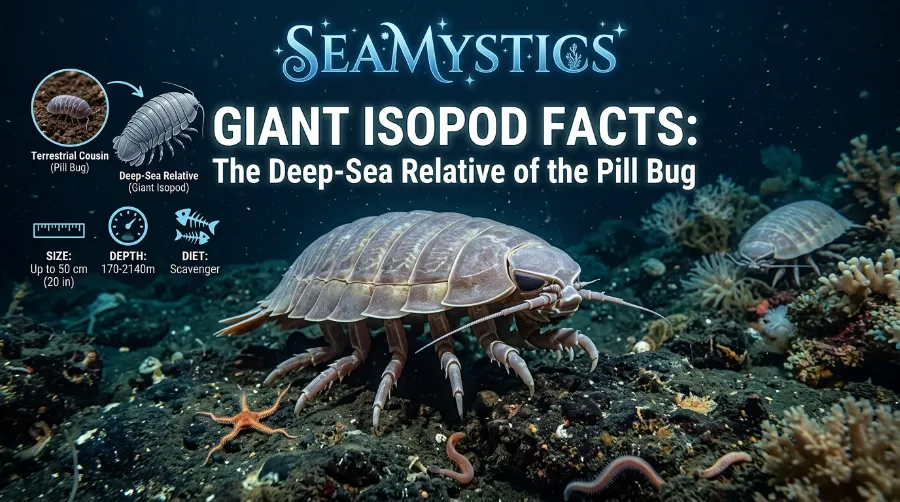

Picture the pill bug from your garden. Now imagine it after fourteen years at the gym, wrapped in armor, and shipped to the bottom of the ocean. That is roughly what you get with the giant isopod, and once you start collecting giant isopod facts, it is hard to stop. In fact, these creatures have haunted deep-sea documentaries, gone viral online, and even ended up on dinner plates in Vietnam. Even so, marine biologists still argue over why they got so big, and new species keep turning up even now.
Zombie Worm Facts: The Creature That Eats Whale Bones
This guide pulls together the science, the strange behavior, and the latest 2025 and 2026 discoveries about this armored scavenger. Overall, I have written it the way I would explain it to a curious diver on a boat deck, not a textbook.
Key Takeaways
| Fact | Detail |
|---|---|
| Scientific name | Bathynomus giganteus (plus roughly 20 other Bathynomus species) |
| Typical size | 7.5 to 20 inches, some supergiants reach 32.5 cm or more |
| Habitat depth | 170 to 2,500 meters (550 to 8,200 feet) |
| Range | Atlantic, Pacific, and Indian Oceans, most common in the Gulf of Mexico and off eastern Australia |
| Diet | Scavenger, eats whale falls, dead fish, and marine snow |
| Newest discovery | Bathynomus vaderi, described in January 2025 |
| Lifespan | Not fully known, likely several decades in the wild |
| Conservation status | Not endangered, but fishing pressure is rising in Southeast Asia |
TL;DR: Giant isopods are deep-sea crustaceans related to the backyard pill bug. Thanks to deep-sea gigantism, they can grow up to 20 inches long, and they live 550 to 8,200 feet down scavenging dead animals off the seafloor. Meanwhile, scientists are still finding new species, including one named after Darth Vader in 2025.
What Is a Giant Isopod? Meet the Ocean’s Armored Scavenger
A giant isopod is not an insect, even though it looks like a horror movie prop. Rather, it belongs to the crustacean group, so it shares a family tree with crabs, lobsters, and shrimp instead of beetles or roaches. For a quick shortcut to giant sea bug facts, just remember this: same body plan as a woodlouse, dialed up to deep-sea proportions.
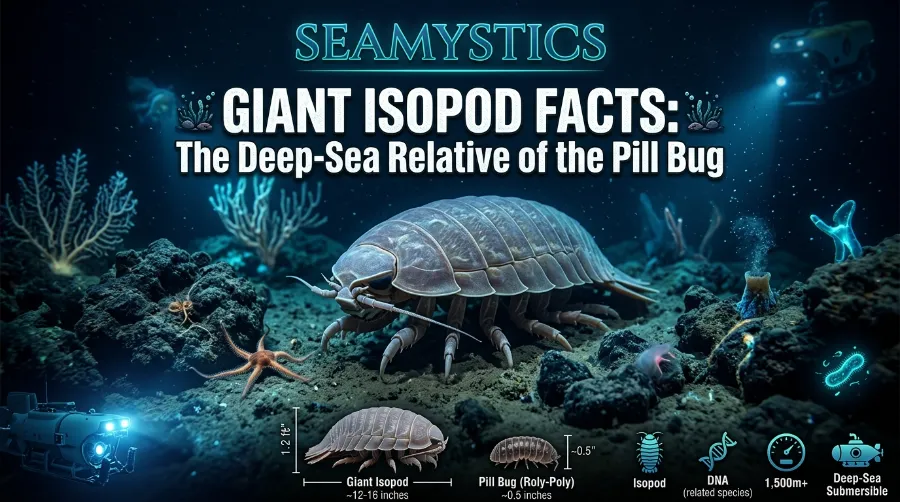
The genus is called Bathynomus. French zoologist Alphonse Milne-Edwards first described it in 1879, after a colleague hauled up a juvenile specimen from the Gulf of Mexico. At the time, scientists had only recently disproven the idea that the deep ocean was lifeless, so this find mattered a great deal. As a result, that original discovery still shapes how researchers study these animals today. If accidental deep-sea discoveries fascinate you, for instance, the frilled shark has a similarly strange backstory.
Here is what sets a giant isopod apart from the bug you would step on in your kitchen:
- A hard, segmented exoskeleton made of overlapping plates, usually pale pink, lilac, or beige
- Two pairs of antennae and large compound eyes built for near total darkness
- Fourteen legs total, seven pairs, adapted for slow crawling across mud and clay
- The ability to curl into a tight ball, exactly like a pill bug, when threatened
Giant Isopod Size: How Big Do These Deep-Sea Giants Get
This is usually the first question anyone asks, and the giant isopod size numbers rarely disappoint. Typically, adults measure between 7.5 and 20 inches, or 19 to 50 cm, and the largest confirmed specimens reach a full 50 centimeters. On top of that, weight can climb as high as 1.7 kilograms, about 3.7 pounds, which is roughly a small housecat carried around on fourteen legs.
Sea Pig Facts: The Deep-Sea Cucumber That Looks Like a Toy
Now compare that to the common pill bug back home, which barely tops an inch, and the gap feels almost unfair. Scientists call this jump in size deep-sea gigantism, and the pattern shows up again and again in cold, high-pressure environments. Similarly, oddities like this appear throughout our bizarre sea creatures guide, including neighbors of the barreleye fish that live in the same depth range.
Fangtooth Fish Facts: The Small Fish With the Biggest Teeth
Deep-Sea Gigantism Explained
Nobody has one confirmed answer for why this happens. Instead, researchers keep circling back to a few theories:
- Cold water slows metabolism, which can let animals grow larger and live longer.
- Lower oxygen levels may favor bodies built with bigger, more efficient tissue.
- Fewer predators at extreme depth remove the pressure to stay small and hidden.
- Scarce, unpredictable food rewards animals that eat massive amounts at once and then wait. For example, giant isopods can go long stretches without eating, then gorge until they bulge between their plates once food finally appears.
Giant Isopod vs Pill Bug: A Quick Comparison
| Feature | Giant Isopod | Common Pill Bug |
|---|---|---|
| Average length | 7.5 to 20 inches | Under 1 inch |
| Habitat | Deep ocean floor | Garden soil, leaf litter |
| Lifespan | Likely decades | About 2 to 3 years |
| Diet | Scavenger, occasional predator | Decaying plant matter |
| Legs | 14 | 14 |
Giant Isopod Habitat: Where These Bugs of the Abyss Live
Giant isopod habitat sits in the bathyal and abyssal zones, where sunlight never reaches and pressure would crush an unprotected human body. Generally, most populations settle between 170 and 2,140 meters, roughly 550 to 7,020 feet, favoring soft mud or clay where they can burrow. That said, some individuals turn up far deeper than that, and a few species even tolerate shallower water around 980 feet.
Geographically, though, they are anything but rare. Across the Indo West Pacific and Western Atlantic, dense populations cluster off eastern Australia and throughout the Gulf of Mexico. Additionally, smaller pockets sit near Japan, the Caribbean, and the coastline running from Georgia down through Brazil.
Plenty of neighbors, in fact, share that dark, muddy address. The dumbo octopus lives nearby, along with the ghostly pink see-through fantasia sea cucumber and the razor-toothed fangtooth fish.
Deep-Sea Isopod Species: Inside the Bathynomus Family
A single giant isopod species does not exist. Instead, roughly twenty of them make up the family, and it keeps growing. Some, called giants, mature around 150 mm long, while a separate lineage of supergiants can stretch to 500 mm. Understanding this diversity of deep sea isopod species matters, since each one adapts slightly differently to local depth, temperature, and food supply.
Bathynomus vaderi: The 2025 Darth Vader Discovery
In January 2025, researchers from Singapore, Indonesia, and Vietnam formally described a new supergiant species. They named it Bathynomus vaderi because its head closely resembles Darth Vader’s helmet, and it measures roughly 12.8 inches, or 32.5 centimeters, in length. Notably, the team first collected specimens back in 2022, but it took until early 2023 to realize they were looking at something science had never classified. Peter Ng of the National University of Singapore led the description, published in the journal ZooKeys, and by his own admission is a lifelong Star Wars fan.
That story, in short, shows how much of the ocean still hides in plain sight. For another creature that stayed hidden until researchers looked closely, check out the zombie worm.
The 2026 Ocean Census Discoveries
The pace of discovery has only sped up since then. During 2026, for instance, researchers working with the Ocean Census project identified more than 100 potential new isopod species in a single two week workshop. That number alone shows just how incomplete our picture of deep sea isopod species still is, even now.
What Do Giant Isopods Eat? Diet and Scavenging Behavior
Scavenging comes first for a giant isopod, and hunting is a distant second. Typically, their menu includes dead fish, crab remains, and marine snow, the slow drift of organic debris falling from the surface above. However, when something larger sinks, they take full advantage of it.
- Whale falls, where dozens can descend on a single carcass for weeks
- Sunken debris and shipwrecks, since organic material on old wrecks and submarines attracts them
- Slow-moving benthic animals, when carrion runs scarce
- Fish caught in bottom trawls or baited traps, which is exactly how many specimens end up studied
Overall, that gorge-then-fast lifestyle explains why giant isopods survive so well in captivity on minimal feeding, and it has also made them minor celebrities in public aquariums.
Giant Isopod Behavior and Defense Mechanisms
Watching one move is oddly hypnotic. It crawls slowly across the seafloor on all fourteen legs, rarely rushing anywhere, since little reason exists to hurry in near total darkness. Understandably, when threatened, it rolls into a tight, armored ball, the exact defense trick its pill bug cousins use in your backyard.
Their eyesight deserves a mention too. Specifically, compound eyes carry roughly 4,000 individual facets, an unusually high number for a deep-sea scavenger, and this helps them detect faint movement near the seafloor. Females, meanwhile, raise young differently than most crustaceans, brooding offspring in a pouch and releasing them as fully formed miniature juveniles, skipping the free-swimming larval stage entirely.
Threats Facing Giant Isopods
Giant isopods are not currently endangered, and their remote habitat has shielded them from most human contact for millions of years. Recently, though, that has started to shift in two specific ways worth watching.
First, plastic pollution has reached even this depth. Researchers have documented plastic fragments in gut content analyses of wild giant isopods, confirming that animals living hundreds of meters down are not immune to human waste.
Second, demand for giant isopods as food has also grown fast across parts of Southeast Asia. Over the past decade, Bathynomus species have become a popular seafood delicacy in Vietnam and China. Consequently, researchers now worry that rising fishing pressure could threaten populations, since these animals lay few eggs and grow slowly. For more on this shift, Animals Discovered covers the culinary trend in detail.
Giant Isopods in Captivity and Culture
Public aquariums love giant isopods for being dramatic, low maintenance, and endlessly photogenic. In fact, one long-running internet legend involves a Japanese aquarium isopod that reportedly stopped eating for years, and that story turned the species into an accidental meme about patience and stubbornness.
Pop culture has embraced them in other ways too. For example, the nickname “giant sea bug,” used widely across Vietnam and China, captures the creature’s unsettling resemblance to a supersized cockroach. That same nickname, incidentally, is exactly why so many people search for giant sea bug facts before ever learning the scientific name Bathynomus. Meanwhile, anglers curious about a chance encounter while bottom fishing in the Gulf can find a solid regional rundown at Texas Saltwater Fishing Magazine.
Farther south, Antarctic waters host their own dramatic version of this story. Expedition teams sailing there regularly encounter the closely related giant Antarctic isopod, and Oceanwide Expeditions documents ten facts gathered from actual polar dives that pair nicely with everything covered here.
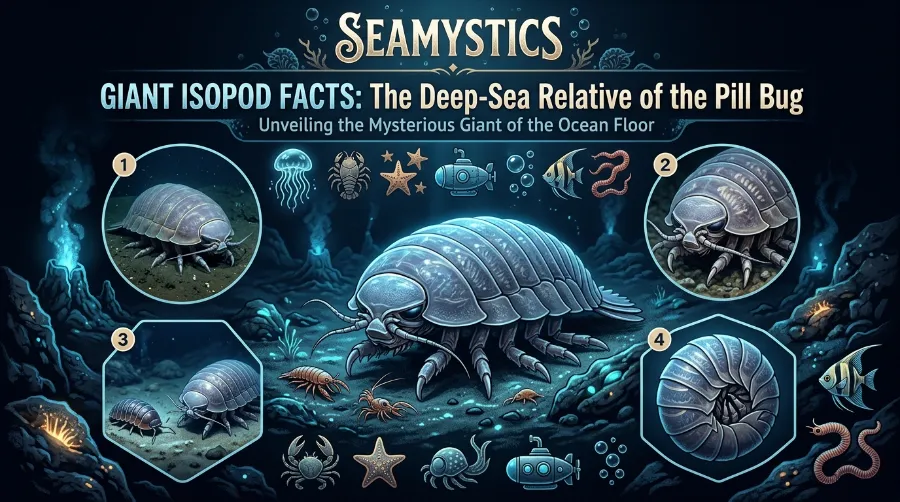
If deep-sea oddities have you hooked by now, our full bizarre sea creatures guide rounds up more animals, including the deep-sea pink cucumber that shares the same neighborhood as the giant isopod.
Frequently Asked Questions
Can a giant isopod hurt a human?
No. Despite the intimidating look, these are scavengers rather than active predators of large animals, and none have ever been documented attacking a person.
How long do giant isopods live?
Exact lifespan data is limited, but most researchers estimate several decades, based on their slow metabolism and infrequent feeding pattern.
Are giant isopods edible?
Yes. Demand has grown quickly across Vietnam and China, where they are prepared much like lobster and sold in seafood markets and restaurants.
What is the biggest giant isopod ever recorded?
Confirmed measurements reach up to 50 centimeters, roughly 20 inches, while supergiant species like Bathynomus vaderi regularly reach around 32.5 centimeters.
Why are giant isopods so much bigger than pill bugs?
Scientists point to deep-sea gigantism, where cold water, low oxygen, scarce food, and reduced predation pressure at extreme depth all play a role.
Final Thoughts
Giant isopods sit at a rare intersection: genuinely strange and genuinely important. On one hand, they recycle nutrients on the seafloor that would otherwise go to waste. On the other, they reveal how life adapts to crushing pressure and total darkness. Ultimately, though, what stands out most is how the deep ocean still holds surprises, sometimes literally named after movie villains. So next time someone dismisses a pill bug as boring, mention that its deep-sea cousin can weigh nearly four pounds and outlive most house pets.
References
- Milne-Edwards, A. (1879), original description of Bathynomus, as documented on Wikipedia’s Giant Isopod entry
- Ng, P., Sidabalok, C., and Nguyen, T.S. (2025), ZooKeys, description of Bathynomus vaderi
- ScienceDaily (January 2025), “The Dark Side of the Ocean: New Giant Sea Bug Species Named After Darth Vader”
- Ocean Census (2026), species discovery workshop findings on Isopoda
- Monterey Bay Aquarium, Giant Isopod species profile
- A-Z Animals, Bathynomus giganteus physical measurements and behavior data